Questions

2 Marks Questions

Take a timed test

6 questions · self-marked practice — reveal the answer and mark yourself.

Question 12 Marks
What will be the path of a charged particle moving in a region of crossed (or transverse) uniform electrostatic and magnetic fields with initial velocity zero?
Answer
Cycloid (e.g., the path of a point on the rim of moving wheel) with its forward motion normal to both $\overrightarrow{ E }$ and $\overrightarrow{ B }$.
View full question & answer
Question 22 Marks
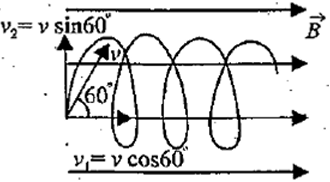
A beam of protons with a velocity $4 \times 10^5 m / s$ enters a uniform magnetic field of $0.3 T$ at an angle $60^{\circ}$ to the magnetic field. Find the radius of the helical path taken by the proton beam. Also find the pitch of the helix mp $=1.67 \times 10^{-27} k$
Answer
Image

$v _1$ is responsible for horizontal motion of proton
$v _2$ is responsible for circular motion of proton
$\text { Now, } \frac{m v_2^2}{r}=q v_2 B$
$\therefore r =\frac{m v_2}{q B}$
$r=\frac{1.67 \times 10^{-27} \times 4 \times 10^5 \sin 60}{1.6 \times 10^{-19} \times 0.3}$
$=1.2 \times 10^{-2}=1.2 \ cm$
$T=\frac{2 \pi r}{v \sin \theta}=2.175 \times 10^{-7} S$
$\therefore P=v \cos \theta T$
$=4 \times 10^5 \times \frac{1}{2} \times 2.175 \times 10^{-7}=4.35 \ cm$
View full question & answer
Question 32 Marks
The ground state energy of hydrogen atom is $-13.6 eV.$ If an electron makes a transition from an energy level $-1.51 eV$ to $- 3.4 eV, $ then calculate the wavelength of the spectral line emitted and name the series of hydrogen spectrum to which it belongs.
Answer
Energy difference $=$ Energy of emitted photon
$=E_2-E_1$
$=-1.51-(-3.4)=1.89 eV $
$=1.89 \times 1.6 \times 10^{-19} J$
$\lambda=\frac{h c}{E_2-E_1}$
$=\frac{6.6 \times 10^{-34} \times 3 \times 10^8}{1.89 \times 1.6 \times 10^{-19}}$
$=\frac{19.8}{3.024} \times 10^{-7}$
$=6.548 \times 10^{-7} m=6548 \stackrel{o}{A}$
This wavelength belongs to Balmer series of hydrogen spectrum.
View full question & answer
Question 42 Marks
Two crystals $C _1$ and $C _2$, made of pure silicon, are doped with arsenic and aluminium respectively.
a. Identify the extrinsic semiconductors so formed.
b. Why is doping of intrinsic semiconductors necessary?
Answer
a. $C_1$ is n-type semiconductor and $C_2$ is the p-type semiconductor.
b. Doping of intrinsic semiconductors is required to increase the majority of charge carriers based on which n-type and p-type semiconductors can be made and thus can be used.
View full question & answer
Question 52 Marks
Two magnetic poles, one of which is $10$ times as strong as the other, exert on each other a force equal to $9.604\ mN$ , when placed $10 \ cm$ apart in air. Find the strength of the two poles.
Answer
Here, $F =9.604\ mN =9.604 \times 10^{-3} N$
If $m _1= m , m _2=10 m, r =10 \ cm=0.1 m$
As $F =\frac{\mu_0}{4 \pi} \frac{m_1 m_2}{r^2}$
$\therefore 9.604 \times 10^{-3}=\frac{10^{-7} m(10 m)}{(0.1)^2}$
$m_2=96.04, m=9.8\ Am$
$\therefore m _1=9.8 Am , m _2=10 m=98\ Am $
View full question & answer
Question 62 Marks
Use the formula $\lambda_{ m } T =0.29 cm K$ to obtain the characteristic temperature ranges for different parts of the electromagnetic spectrum. What do the numbers that you obtain tell you?
Answer
A body at a particular temperature produces a continuous spectrum of wavelengths. In the case of a black body, the wavelength corresponding to the maximum intensity of radiation is given according to Planck's law. It can be given by the relation,
$\lambda_m=\frac{0.29}{T} cmK$
Where,
$\lambda_{ m }=$ maximum wavelength
T = temperature
Thus, the temperature for different wavelengths can be obtained as:
For $\lambda_{ m }=10^{-4} cm ; T=\frac{0.29}{10^{-4}}=2900^{\circ} k$
For $\lambda_{ m }=5 \times 10^{-5} cm ; T=\frac{0.29}{5 \times 10^{-5}}=5800^{\circ} k$
For $\lambda_{ m }=10^{-6} cm ; T=\frac{0.29}{10^{-6}}=290000^{\circ} k$ and so on.
The numbers obtained tell us that temperature ranges are required for obtaining radiations in different parts of an electromagnetic spectrum. As the wavelength decreases, the corresponding temperature increases.
View full question & answer