Questions

M.C.Q (1 Marks)

Take a timed test

12 questions · self-marked practice — reveal the answer and mark yourself.

Question 11 Mark
Consider a ray of light incident from air onto a slab of glass (refractive index $n$ ) of width d , at an angle $\theta$. The phase difference between the ray reflected by the top surface of the glass and the bottom surface is
Answer
(d) $\frac{4 \pi d}{\lambda}\left(1-\frac{1}{n^2} \sin ^2 \theta\right)^{1 / 2}+\pi$
Explanation: The ray reflected by the top surface of the glass and the bottom surface is:-
$\frac{4 \pi d}{\lambda}\left(1-\frac{1}{n^2} \sin ^2 \theta\right)^{1 / 2}+\pi$
View full question & answer
Question 21 Mark
A conducting circular loop is placed in a uniform magnetic field, $B =0.025 T$ with its plane perpendicular to the loop. The radius of the loop is made to shrink at a constant rate of $1\ mm\ s ^{-1}$. The induced emf when the radius is $2 \ cm ,$ is
Answer
$(b)\ \pi \mu V$
Explanation:
$\phi=B \pi r^2 \cos 0^{\circ}=B \pi r^2$
$|\varepsilon|=\frac{d \phi}{d t}=\frac{d}{d t}\left(\pi r^2 B\right)=2 \pi r B \frac{d r}{d t}$
When $r =2 \ cm=2 \times 10^{-2} m$
$\frac{d r}{d t}=1\ mm\ s^{-1}=10^{-3}\ ms^{-1}$
$|\varepsilon|=0.025 \times \pi \times 2 \times 2 \times 10^{-2} \times 10^{-3}$
$=0.100 \times \pi \times 10^{-5}=\pi \mu V$
View full question & answer
Question 31 Mark
Submarine cables act as
Answer
(d) cylindrical capacitor with outer cylinder earthed
Explanation: A submarine cable consists of an inner conductor which carries power. This conductor is covered by an insulator, which acts as a dielectric. The dielectric material is covered by a metal coating called shield, which is connected to ground. The cable acts as a cylindrical capacitor, with the conductor acting as the inner cylinder, and the metal shield as the outer cylinder which is connected to earth.  
View full question & answer
Question 41 Mark
The formation of depletion region in a p-n junction diode is due to
Answer
(c) diffusion of both electrons and holes
Explanation: diffusion of both electrons and holes  
View full question & answer
Question 51 Mark
The radius of curvature of the curved surface of a plano$-$convex lens is $20 \ cm$. If the refractive index of the material of the lens be $1.5$, it will
Answer
$(d)$ act as a convex lens irrespective of the side on which the object lies
Explanation:
The relation between focal length $f ,$ the refractive index of the given material $\mu, R _1$ and $R _2$ is known as lens maker's formula and it is $\frac{1}{f}=(\mu-1)\left(\frac{1}{R_1}-\frac{1}{R_2}\right)$
$R_1=\infty, R_2=-R$
$f=\frac{R}{(\mu-1)}$
Image

Here$, R = 20 \ cm, \mu= 1.5$.
​​​​​​​On substituting the values, we get
$ f=\frac{R}{\mu-1}=\frac{20}{1.5-1}=40 \ cm $
As $f >0$ means converging nature.
Therefore, the lens act as a convex lens irrespective of the side on which the object lies.
View full question & answer
Question 61 Mark
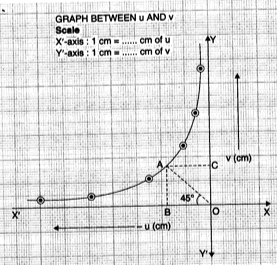
The graph drawn with object distance along abscissa & image as ordinate for a convex lens is
Answer
(c) rectangular hyperbola 
Explanation: 
Image
View full question & answer
Question 71 Mark
Inversion temperature of a thermocouple is the temperature of the hot junction at which the emf is:
Answer
(d) zero
Explanation: At the temperature of inversion, thermo emf is zero.  
View full question & answer
Question 81 Mark
The magnetic moment of a current (l) carrying circular coil of radius (r) and number of turns (n) varies as
Answer
(d) $r ^2$
Explanation: $M = IA = I \times \pi r ^2$ i.e., $M \propto r^2$
View full question & answer
Question 91 Mark
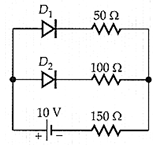
Assume that each diode shown in the figure has a forward bias resistance of $50 \Omega$ and an infinite reverse bia resistance. The current through the $150 \Omega$ resistance is
Image
Answer
$(a)\ 0.04 A$ 
Explanation: 
Diode $D_1$ is forward biased and offers $50 \Omega$ resistance.
Diode $D_2$ is reverse biased and offers infinite resistance.
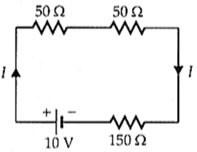
The equivalent circuit is
Image

Current through the $150 \Omega$ resistance,
$I=\frac{10}{50+50+150}$
$=\frac{10}{250}=0.04 A$
View full question & answer
Question 101 Mark
Select the correct statements. Coulomb’s law correctly describes the electric force that:
i. binds the electrons of an atom to its nucleus.
ii. binds the protons and neutrons in the nucleus of an atom.
iii. binds atoms together to form molecules.
Answer
(b) (i) and (iii)
Explanation: According to Coulomb’s law, electric force binds the electrons of an atom to its nucleus and atoms together to form molecules.  
View full question & answer
Question 111 Mark
A paramagnetic sample shows a net magnetisation of $8\ Am ^{-1}$ when placed in an external magnetic field of $0.6 T$ at a temperature of $4 K$ . When the same sample is placed in an external magnetic field of $0.2 T$ at a temperature of $16 K ,$ the magnetisation will be
Answer
$(b)\ \frac{2}{3} Am ^{-1}$
Explanation:
On increasing the temperature magnetic susceptibility of paramagnetic material decreases or vice versa .
According to Curie law, we can deduce a formula for the relation between magnetic field induction, temperature and magnetisation.
$i.e., I ($magnetization$) \propto \frac{B(\text { magnetic field induction })}{t(\text { temperature in kelvin })} $
$\Rightarrow \frac{I_2}{I_1}=\frac{B_2}{B_1} \times \frac{t_1}{t_2}$
Let us suppose, here $I _1=8 Am ^{-1}$
$ B _1=0.6 T, t _1=4 K$
$B _2=0.2 T, t _2=16 K$
$\Rightarrow \frac{0.2}{0.6} \times \frac{4}{16}=\frac{I_2}{8}$
$\Rightarrow I_2=8 \times \frac{1}{12}=\frac{2}{3} Am ^{-1}$
View full question & answer