Questions

3 Marks Question

Take a timed test

12 questions · self-marked practice — reveal the answer and mark yourself.

Question 13 Marks
"Write ampere's circuital law. In a long straight wire of cross-sectional cut (radius a), a direct current is flowing in the wire. Current is uniformly distributed in the wire. Calculate the magnetic field in inner surface of the wire ( $r
Answer
According to Ampere's law, the line integral of the magnetic field around a closed path is equal to the product of magnetic permeability of that space and the algebraic sum of the current passing through that closed path in vacuum or air.
In mathematical form,
$ \oint \overrightarrow{B} \cdot \overrightarrow{d l}=\mu_0 \Sigma I $
where, $\mu_0=$ magnetic permeability of vacuum and $\oint \overrightarrow{ B } \cdot \overrightarrow{d l}=$ is known as line integral of magnetic field $(\overrightarrow{ B })$.
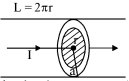
We need to calculate the magnetic field at $r<a$ and for this ampere loop is that circle on which I is marked. On taking radius of the circle to be r for this loop,
Image
Now here, the electric current associated is not I but less than this. Since electric current is distributed uniformly, therefore, magnitude of element of associated electric current,
$ I_e=\left(\frac{\pi r^2}{\pi a^2}\right)=\frac{l r^2}{a^2} $
On applying Ampere's law
$B \times(2 \pi r)=\frac{\mu_0 I r^2}{a^2}$
$\Rightarrow \quad B =\left(\frac{\mu_0 I r^2}{a^2}\right) \times \frac{1}{2 \pi r}$
$B =\left(\frac{\mu_0 I }{2 \pi a^2}\right) r$
View full question & answer
Question 23 Marks
An alpha particle enters a magnetic field of 0.2 weber $/ m ^2$ with a speed of $6.0 \times 10^5 m / s$ perpendicular to the field. Find out the acceleration of the particle and radius of the path.
Answer
Given : For Alpha particle
$\therefore \quad q=2 e=2 \times 1.6 \times 10^{-19} C$
$=3.2 \times 10^{-19} C$
$m =4 \times 1.67 \times 10^{-27} kg$
$=6.68 \times 10^{-27} kg$
$B =0.2$ weber $/ m ^2$
$v=6.0 \times 10^5 m / s$
$\theta=90^{\circ}$
Force on alpha particle due to magnetic field $F=q v B \sin \theta $
On putting the values
$=3.2 \times 10^{-19} \times 6.0 \times 10^5 \times 0.2 \times \sin 90^{\circ}$
$=3.2 \times 1.2 \times 10^{-14} \times 1$
$=3.84 \times 10^{-14} N$
Acceleration of the particle,
$a=\frac{ F }{m}=\frac{3.84 \times 10^{-14}}{6.68 \times 10^{-27}}$
$=5.75 \times 10^{12} m / s ^2$
Radius of the path of alpha particle,
$r=\frac{m \nu}{q B}$
$r=\frac{6.68 \times 10^{-27} \times 6.0 \times 10^5}{3.2 \times 10^{-19} \times 0.2}$
$=\frac{6.68 \times 6 \times 10^{-22}}{0.64 \times 10^{-19}}$
$=6.3 \times 10^{-2}$ meter Ans.
View full question & answer
Question 33 Marks
Write Biot-Savart law. Write the path of the motion of an electron when it enters magnetic field (a) perpendicularly (b) at $\theta$ angle.
Answer
Biot-Savart's law : When current flows through a conductor then a magnetic field is produced around it. To find out the intensity of magnetic field at any point, Biot and Savart propounded a law based on their experiments which is known as Biot-Savart law. According to this rule, due to a small part $\delta /$ of any current carrying conductor, magnitude of magnetic induction or intensity of magnetic field $\delta /$ at a point $P$ is
(i) proportional to the magnitude of current I.
(ii) proportional to the current fraction length $\delta l$.
(iii) The angle between the position vector $\vec{r}$ of the observation point relative to the current fraction $\overrightarrow{\delta l}$ is directly proportional to the $\sin \theta$ of the $\theta$ i.e. $\sin \theta$.
(iv) inversely proportional to the square of distance $r$ from the observation point to the element length.
$ \text { i.e. } \quad \delta B \propto \frac{I \delta / \sin \theta}{r^2} $
In vacuum or magnetic medium
$ \delta B=\left(\frac{\mu_0}{4 \pi}\right) \frac{I \delta / \sin \theta}{r^2} $
Where $\mu_0=4 \pi \times 10^{-7}$ weber/ampere or henry/meter and is known as magnetic permeability of vacuum $\mu_0$.
(a) Circular,
(b) In the shape of coil.
View full question & answer
Question 43 Marks
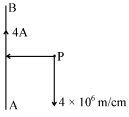
Current of 4 A is flowing in a straight wire AB. A proton $P$ is travelling parallel to the wire in the opposite direction of current with a speed of $4 \times 10^6$ $m / s$ at a distance of 0.2 m from the wire as shown in the diagram. Calculate the magnitude of force applied on the proton and also tells its direction.
Answer
Magnetic field produced in long wire located in plane of paper at a distance of 0.2 m
$ \begin{aligned} B & =\frac{\mu_0}{4 \pi}\left(\frac{2 I}{r}\right)=10^{-7}\left(\frac{2 \times 4}{0.2}\right) \\ & =4 \times 10^{-6} \text { weber } / m^2 \end{aligned} $
Image
Due to second rule of righthand palm rule, the direction of $\vec{B}$ will be perpendicular to the plane of paper inwards. Proton is moving perpendicular to it.
Magnitude of force acting on it $ F=q v B \sin 90^{\circ}=q v B $
On substituting the values,
$F=1.6 \times 10^{-19} \times\left(4 \times 10^6\right) \times 4 \times 10^{-6}$
$=1.6 \times 16 \times 10^{-19}$
$=25.6 \times 10^{-19}=2.56 \times 10^{-18} N$
According to Fleming's left-hand rule, direction of force on paper will be in plane of paper, perpendicular to the wire, away from it which means towards the right.
View full question & answer
Question 53 Marks
Two long parallel wires are 8 cm apart. Currents of magnitudes $i$ and $3 i$ are flowing in them respectively in the same direction. Where the resultant magnetic field due to two will be zero?
Answer
Sol. Let magnetic field at distance $x$ from wire carrying $i$ current, due to two wires is zero, then distance from the wire carrying $3 i$ current is $(8-x) cm$. Therefore, magnetic field at distance $x$ due to wire carrying $i$ current
$B _1=\frac{\mu_0 i}{2 \pi x}$
Magnetic field due to wire carrying $3 i$ current at a distance $(8-x)$
$B _2=\frac{\mu_0(3 i)}{2 \pi(8-x)}$
According to the question,
$B _1- B _2=0$ or $B _1= B _2$
From equations (1) and (2)
$\frac{\mu_0 i}{2 \pi x}=\frac{\mu_0(3 i)}{2 \pi(8-x)}$
or $\frac{1}{x}=\frac{3}{8-x}$
or $8-x=3 x$
or $8=4 x$
or $x=\frac{8}{4}=2 cm$
Hence, at a distance of 2 cm from the wire carrying current $i$, the resultant magnetic field due to two wires will be zero.


View full question & answer
Question 63 Marks
A square coil of side 10 cm consists of 20 turns and carries a current of 12 A. The coil is suspended vertically and normal to the plane of the coil makes an angle of $30^{\circ}$with the direction of a uniform horizontal magnetic field of magnitude 0.80 T. What is the magnitude of the torque experienced by the coil?
Answer
Given: Length of each arm, l = 10cm
$\therefore \quad$ Area $=l \times l$
$=10 \times 10=100 cm^2$
$=100 \times 10^{-4} m^2$
$A =10^{-2} m^2$
Total turn in coil $N =20$
Current flowing through the coil,
$I =12 A$
Magnitude of uniform magnetic field,
$\begin{aligned}B & =0.80 T
\\\theta & =30^{\circ}\end{aligned}$
Torque experienced by coil, $\tau=$ ?
We know that, using formula
$\tau=$ NBIA $\sin \theta$
$\tau=20 \times 0.80 \times 12 \times 10^{-2} \times \sin 30^{\circ}$
$=20 \times 80 \times 12 \times 10^{-4} \times \frac{1}{2}$
$=96 \times 10^{-2} Nm$
$=0.96 Nm$
View full question & answer
Question 73 Marks
A closely wound solenoid 80 cm long has 5 layers of windings of 400 turns each. The diameter of the solenoid is 1.8 cm. If the current carried is 8.0 A, estimate the magnitude of B inside the solenoid near its centre.
Answer
Given: Length of the solenoid, l = 80cm
$=80 \times 10^{-2} m$
Number of layers in the solenoid,
$n=5$
Number of turns in each layer $=400$
Total number of turns in the solenoid
$=5 \times 400=2000$
Current flowing in the solenoid,
$I=8.0 A$
Let the magnitude of magnetic field inside the solenoid near its centre, $B =$ ?
$B =\frac{\mu_0 NI }{l}$
On putting the values,
$\begin{aligned}B & =\frac{4 \pi \times 10^{-7} \times 2000 \times 8}{80 \times 10^{-2}} \\&
=8 \pi \times 10^{-3} T=2.5 \times 10^{-2} T\end{aligned}$
View full question & answer
Question 83 Marks
Two long and parallel straight wires A and B carrying currents of 8.0 and 5.0 A in the same direction are separated by a distance of 4.0 cm. Estimate the force on a 10 cm section of wire A.
Answer
Given:
$d=4.0 cm=4 \times 10^{-2} m$
$I _1=8.0 A$
$\begin{aligned} I _2 & =5.0 A
\\ l &=10 cm=10 \times 10^{-2} m\end{aligned}$
Magnitude of force on unit length
$F=\frac{\mu_0 I_1 I_2}{2 \pi d}$
Magnitude of force for length $l$
$F=\frac{\mu_0 I_1 I_2 l}{2 \pi d}$
On putting the values,
$F =\frac{\left(4 \pi \times 10^{-7}\right) \times 8.0 \times 5.0 \times 10 \times 10^{-2}}{2 \pi \times 4 \times 10^{-2}}$
$=200 \times 10^{-7}=2 \times 10^{-5} N$
Direction of F: Since current is flowing in the same direction in both the wires, hence perpendicular of A are attracted towards B.
View full question & answer
Question 93 Marks
A 3.0 cm wire carrying of 10 A is placed inside a solenoid perpendicular to its axis. The magnetic field inside the solenoid is given to be 0.27 T. What is the magnetic force on the wire?
Answer
Given Length of the wire,
$l=3.0 cm=3 \times 10^{-2} m$
Current in the wire,$\begin{aligned}I & =10 A
\\\theta & =90^{\circ}\end{aligned}$
Magnetic field inside the solenoid,
$B=0.27 T$
Let magnitude of magnetic field on wire $= F =$ ?
Using$F=BI / \sin \theta$
Putting the values,
$F=0.27 \times 10 \times 3 \times 10^{-2} \times \sin 90^{\circ}$
$=8.1 \times 10^{-2} \times 1 \quad \because \sin 90^{\circ}=1$
$=8.1 \times 10^{-2} N$
Direction of F : Direction of force (F) can be determined by Fleming's left hand rule.
View full question & answer
Question 103 Marks
What is the magnitude of magnetic force per unit length on a wire carrying of 8 A and making an angle of 30° with the direction of a uniform magnetic field of 0.15 Т?
Answer
Given: Magnitude of current flowing in the wire,
$I =8 A$
Angle made by the wire with uniform magnetic field,
$\begin{array}{l}\theta=30^{\circ} \\
andB=0.15 T\end{array}$
Let magnetic force per unit length of the wire,
$F^{\prime}=\frac{F}{l}$$\therefore$
Use $F ^{\prime}= BI \sin \theta$
On putting the values,
$\begin{aligned}F^{\prime} & =\frac{F}{l} 0.15 \times 8 \times \sin 30^{\circ} \\&
=0.15 \times 8 \times \frac{1}{2}=4 \times 0.15 \\&
=0.6 N / m\end{aligned}$
The direction of the force will be perpedicular to the length of the wire and the plane of the magnetic field, which can be determined from Fleming's left hand rule.
View full question & answer
Question 113 Marks
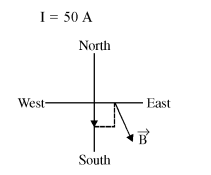
A long straight wire in the horizontal plane carries a current of 50 A in north to south direction. Give the magnitude and direction B at a point 2.5 m east of the wire.
Answer
Given Current flowing in the wire from north to south,
Image
Perpendicular distance from the wire,
$\begin{aligned}r & =2.5 m \\B &
=\frac{\mu_0 I}{2 \pi r}\end{aligned}$
Putting the values,
$B=\frac{4 \pi \times 10^{-7} \times 50}{25}=4 \times 10^{-6} T$
Direction of B : Vertically upwards (By right hand thumb rule).
View full question & answer
Question 123 Marks
obtain the frequency of revolution of the electron in its circular orbit. Does the answer depend on the speed of the electron? Explain.
Answer
Frequency of rotation of electron in circular orbit = v =?
According to the formula,
$B e v=\frac{m v^2}{r}$
$\Rightarrow \quad B e=\frac{m v}{r}=\frac{m \times r \omega}{r}$
$\Rightarrow \quad B e=m \omega=m \times 2 \pi v$
$\therefore \quad \text { Frequency } v=\frac{B e}{2 m \pi}$ ....(1)
On putting the values, $v=\frac{6.5 \times 10^{-4} \times 1.6 \times 10^{-19}}{2 \times 9.1 \times 10^{-31} \times 3.14}$
$\begin{array}{l}=18.18 \times 10^6 Hz \\
=18.18 MHz \end{array}$
It is clear from equation (1) that frequency (v) of electron is independent of velocity of the electron.
View full question & answer