Question 14 Marks
A person is standing on a weighing machine placed on the floor of an elevator. The elevator starts going up with some acceleration, moves with uniform velocity for a while and finally decelerates to stop. The maximum and the minimum weights recorded are $72\ kg$ and $60\ kg.$ Assuming that the magnitudes of the acceleration and the deceleration are the same, find:
- The true weight of the person.
- The magnitude of the acceleration. Take $g = 9.9m/s^2.$
Answer
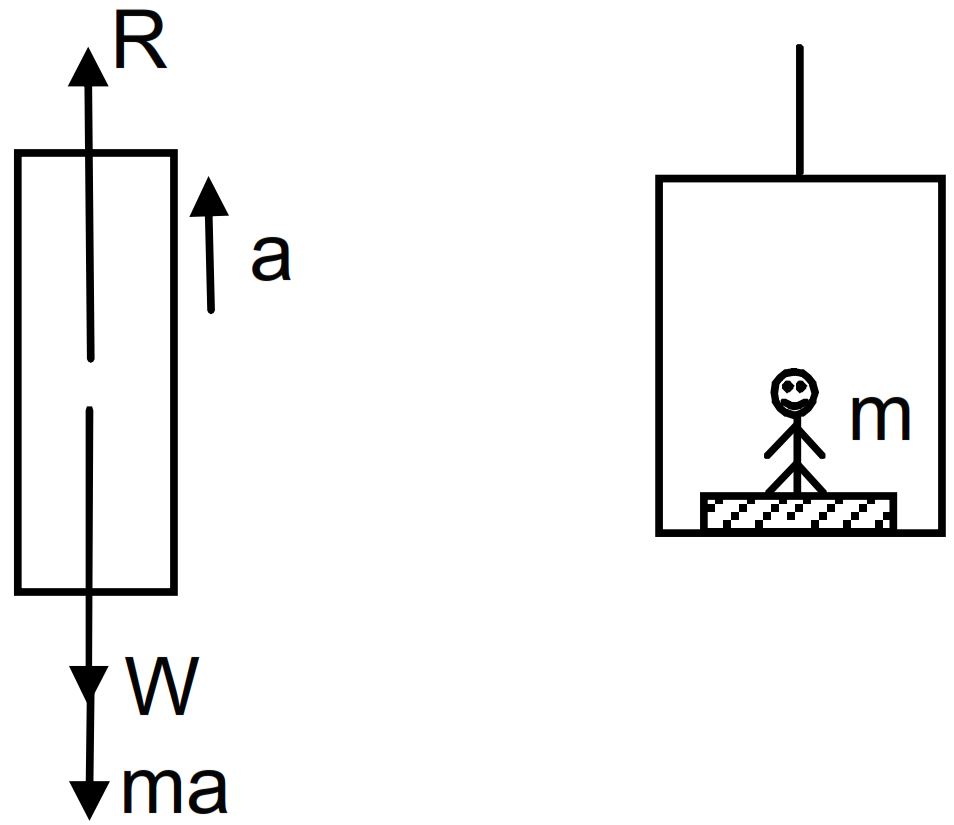
View full question & answer→When the elevator is accelerating upwards,
maximum weight will be recorded. $R - (W + ma ) = 0 \Rightarrow R = W + ma = m(g + a)$ max.wt.
When decelerating upwards,
maximum weight will be recorded. $R + ma - W = 0 \Rightarrow R = W - ma = m(g - a)$
So, $m(g + a) = 72 \times 9.9 …(1) m(g - a) = 60 \times 9.9 …(2)$
Now, $mg + ma = 72 \times 9.9$
$\Rightarrow mg - ma = 60 \times 9.9$
$\Rightarrow 2mg = 1306.8$
$\Rightarrow\text{m}=\frac{1306.8}{2\times9.9}=66\text{kg}$
So, the true weight of the man is $66\ kg.$
Again, to find the acceleration, $mg + ma = 72 \times 9.9$
$\Rightarrow\text{a}=\frac{72\times9.9-66\times9.9}{66}=\frac{9.9}{11}=0.9\text{m/s}^2.$
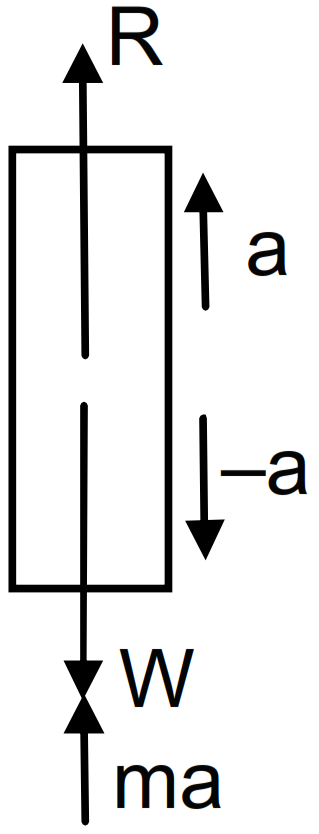
maximum weight will be recorded. $R - (W + ma ) = 0 \Rightarrow R = W + ma = m(g + a)$ max.wt.
When decelerating upwards,
maximum weight will be recorded. $R + ma - W = 0 \Rightarrow R = W - ma = m(g - a)$
So, $m(g + a) = 72 \times 9.9 …(1) m(g - a) = 60 \times 9.9 …(2)$
Now, $mg + ma = 72 \times 9.9$
$\Rightarrow mg - ma = 60 \times 9.9$
$\Rightarrow 2mg = 1306.8$
$\Rightarrow\text{m}=\frac{1306.8}{2\times9.9}=66\text{kg}$
So, the true weight of the man is $66\ kg.$
Again, to find the acceleration, $mg + ma = 72 \times 9.9$
$\Rightarrow\text{a}=\frac{72\times9.9-66\times9.9}{66}=\frac{9.9}{11}=0.9\text{m/s}^2.$