Questions

3 Marks Question

Take a timed test

15 questions · self-marked practice — reveal the answer and mark yourself.

Question 13 Marks
Is $\text{p}=\frac{\text{E}}{\text{c}}$ valid for electrons?
Answer
From Einstein's mass- energy equation,$\text{E}=\text{mc}^2$
$\Rightarrow\text{E}=\frac{\text{m}_0\text{c}^2}{\sqrt{1\frac{\text{v}^2}{\text{c}^2}}}$
Relativistic momentum,
$\text{p}=\text{mv}$
$\Rightarrow\text{p}=\frac{\text{m}_0\text{c}^2}{\sqrt{1\frac{\text{v}^2}{\text{c}^2}}}$
Combining the above equations, we get:
$\text{E}^2=\text{m}_0^2\text{c}^ 4+\text{p}^2\text{c}^2$
From the above equation, it is clear that for $\text{p}=\frac{\text{E}}{\text{c}}$ to be valid, the rest mass of the body should be zero. As electrons do not have zero rest mass, this equation is not valid for electrons.
View full question & answer
Question 23 Marks
Show that it is not possible for a photon to be completely absorbed by a free electron.
Answer
If the i undergoes an elastic collision with a photon. Then applying energy conservation to this collision.We get, $\frac{\text{hc}}{\lambda}+\text{m}_0\text{c}^2=\text{mc}^2$
and applying conservation of momentum $\frac{\text{h}}{\lambda}=\text{mv}$
Mass of e $=\text{m}=\frac{\text{m}_0}{\sqrt{1-\frac{\text{v}^2}{\text{c}^2}}}$
from above equation it can be easily shown that
V = C
V = 0
both of these results have no physical meaning hence it is not possible for a photon to be completely absorbed by a free electron.
View full question & answer
Question 33 Marks
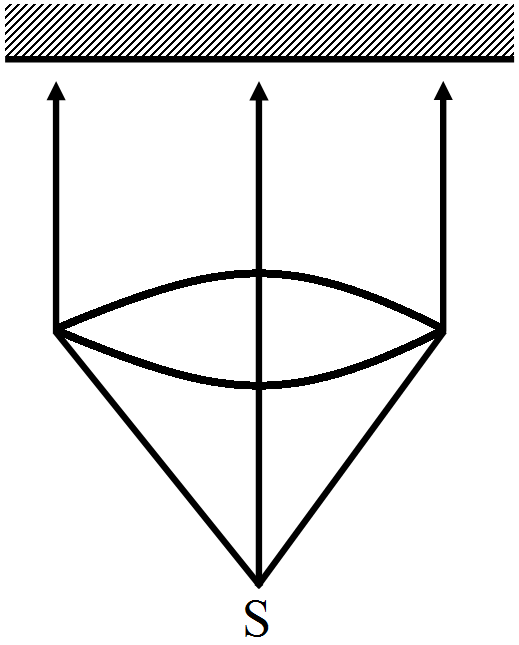
A totally reflecting, small plane mirror placed horizontally faces a parallel beam of light, as shown in the figure. The mass of the mirror is 20g. Assume that there is no absorption in the lens and that 30% of the light emitted by the source goes through the lens. Find the power of the source needed to support the weight of the mirror. Take $g = 10m/s^2.$​​​​​​​
Answer
m = 20g The weight of the mirror is balanced. Thus force exerted by the photons is equal to weight$\text{p}=\frac{\text{h}}{\lambda}$
$\text{E}=\frac{\text{hc}}{\lambda}=\text{pc}$
$\Rightarrow\frac{\text{E}}{\text{t}}=\frac{\text{p}}{\text{t}}\text{c}$
⇒ Rate of change of momentum $=\frac{\text{power}}{\text{C}}$ 30% of light passes through the lens.
Thus it exerts force. 70% is reflected.$\therefore$ Force exerted = 2(rate of change of momentum)
$=2\times\frac{\text{power}}{\text{C}}$
$30\%\Big(\frac{2\times\text{power}}{\text{C}}\Big)=\text{mg}$
$\Rightarrow\text{power}=\frac{20\times10^{-3}\times10\times3\times10^{8}\times10}{2\times3}$
$=10\text{W}=100\text{MW.}$
View full question & answer
Question 43 Marks
Can we find the mass of a photon by the definition p = mv?
Answer
No, we cannot find the mass of a photon by the definition p = mv. The equation p = mv is valid only for objects that move with a velocity that is much slower than the speed of light. The momentum of a relativistic particle like photon is given by.$\text{pc}=\sqrt{\text{E}^2-\text{m}^2\text{c}^4.}$
A photon has zero rest mass. Therefore, on putting m = 0 in the equation, we get $\text{p}=\frac{\text{E}}{\text{c}},$ which is the valid equation for a photon.
View full question & answer
Question 53 Marks
Visible light has wavelengths in the range of 400nm to 780nm. Calculate the range of energy of the photons of visible light.
Answer
$\lambda_1=400\text{mm}\text{ to}\lambda_ 2=780\text{mm}$$\text{E}=\text{hv}=\frac{\text{hv}}{\lambda}$
$\text{h}=6.63\times10^{-34}\text{j}-\text{s}$
$\text{c}=3\times10^8\text{m/s},\lambda_1=400\text{nm},\lambda_2=780\text{nm}$
$\text{E}_1=\frac{6.6.3\times10^{-34}\times3\times10^8}{400\times10^{-9}}$
$=\frac{6.63\times3}{4}\times10^{-19}=5\times10^{-19}\text{J}$
$\text{E}_2=\frac{6.63\times3}{7.8}\times10^{-19}=2.55\times10^{-19}\text{J}.$
So, the range is $5\times10^{-19}\text{J}\text{ to }2.55\times10^{-19}\text{J}.$
View full question & answer
Question 63 Marks
A monochromatic light source of intensity 6mW emits $8 \times 10^{16}$ photons per second. This light ejects photoelectrons from a metal surface. The stopping potential for this setup is 2.0V. Calculate the work function of the metal.
Answer
$\text{w}_0=\text{hv}-\text{ev}_0$$=\frac{5\times10^{-3}}{8\times10^{15}}-1.6\times10^{-19}\times2$
$($Given $V_0 = 2V,$ No. of photons $= 8 \times 10^{15}$, Power $= 5mW)$
$=6.25\times10^{-19}-3.2\times10^{-19}=3.05\times10^{-19}\text{J}$
$=\frac{3.05\times10^{-19}}{1.6\times10^{-19}}$
$=1.906\text{ev.}$
View full question & answer
Question 73 Marks
Two neutral particles are kept 1m apart. Suppose by some mechanism some charge is transferred from one particle to the other and the electric potential energy lost is completely converted into a photon. Calculate the longest and the next smaller wavelength of the photon possible.
Answer
r = 1m$\text{Energy}=\frac{\text{kq}^2}{\text{R}}=\frac{\text{kq}^2}{1}$
Now, $\frac{\text{kq}^2}{1}=\frac{\text{hc}}{\lambda}$
$\lambda=\frac{\text{hc}}{\text{kq}^2}$
For max $'\lambda',$ ‘q’ should be min,
For minimum $‘e’ = 1.6 \times 10^{-19}C$
$\text{Max}\lambda=\frac{\text{hc}}{\text{kq}^2}=0.863\times10^3=863\text{m.}$
For next smaller wavelength
$=\frac{6.63\times3\times10^{-34}\times10^{8}}{9\times10^9\times(1.6\times2)^2\times10^{-38}}$
$\frac{863}{4}=215.74\text{m}$
View full question & answer
Question 83 Marks
It is found that photosynthesis starts in certain plants when exposed to the sunlight but it does not start if the plant is exposed only to infrared light. Explain.
Answer
Photosynthesis starts when a plant is exposed to visible light. The visible light's photons possess just enough energy to excite the electrons of molecules of the plant without causing damage to its cells. Infrared rays have less frequency than visible light. Due to this, the energy of the photons of infrared rays are not sufficient to initiate photosynthesis. Therefore, photosynthesis does not start if plants are exposed only to infrared light.
View full question & answer
Question 93 Marks
ls it always true that for two sources of equal intensity, the number of photons emitted in a given time are equal?
Answer
Let the source's area be A, and intensity of the source be I. The energy of each emitted photonis E. Then, the number of photons emitted in a given time will be $\text{n}=\frac{\text{I}}{\text{AE}}.$
If the areas of the sources and the wavelengths of light emitted by the two sources are different, then the number of photons emitted will be different.
View full question & answer
Question 103 Marks
The electric field associated with a monochromatic beam becomes zero $1.2 \times 10^{15}$ times per second. Find the maximum kinetic energy of the photoelectrons when this light falls on a metal surface whose work function is 2.0eV.
Answer
The electric field becomes $01.2 \times 10^{45}$ times per second.
$\therefore$ Frequency $=\frac{1.2\times10^{15}}{2}=0.6\times10^{15}$
$\text{hv}=\phi_0+\text{kE}$
$\Rightarrow\text{hv}-\phi_0=\text{KE}$
$\Rightarrow\text{KE}=\frac{6.63\times10^{-34}\times0.6\times10^{15}}{1.6\times10^{-19}}-2$
$=0.482\text{ev}=0.48\text{ev.}$
View full question & answer
Question 113 Marks
A 100W light bulb is placed at the centre of a spherical chamber of radius 20cm. Assume that 60% of the energy supplied to the bulb is converted into light and that the surface of the chamber is perfectly absorbing. Find the pressure exerted by the light on the surface of the chamber.
Answer
Power = 100W Radius = 20cm 60% is converted to light = 60wNow, $\text{Force}=\frac{\text{power}}{\text{velocity}}=\frac{60}{3\times10^8}=2\times10^{-7}\text{N}.$
$\text{pressure}=\frac{\text{force}}{\text{area}}=\frac{2\times10^{-7}}{4\times3.14\times(0.2)^2}$
$\frac{1}{8\times3.14}\times10^{-5}$
$=0.039\times10^{-5}=3.9\times10^{-7}=4\times10^{-7}\text{N/m}^2.$
View full question & answer
Question 123 Marks
In a photoelectric experiment, the collector plate is at 2.0V with respect to the emitter plate made of copper ($\phi$ - 4.5eV). The emitter is illuminated by a source of monochromatic light of wavelength 200 run. Find the minimum and maximum kinetic energy of the photoelectrons reaching the collector.
Answer
$\phi=4.5\text{ev},\lambda=200\text{nm}$Stopping potential or energy
$=\text{E}-\phi=\frac{\text{wc}}{\lambda}-\phi$
Minimum 1.7V is necessary to stop the electron
The minimum K.E. = 2eV
[Since the electric potential of 2V is reqd. to accelerate the electron to reach the plates]
The maximum K.E. = (2 + 1, 7)ev = 3.7ev.
View full question & answer
Question 133 Marks
The work function of a metal is $2.5 \times 10^{-19}\ J.$​​​​​​​
  1. Find the threshold frequency for photoelectric emission.
  2. If the metal is exposed to a light beam of frequency $6.0 \times 10^{-14}\  Hz$, what will be the stopping potential?
Answer
$W0 = 2.5 \times 10 - 19J$​​​​​​​
  1. We know $W_0 = hv_0​​​​​​​$​​​​​​​
$\text{v}_0=\frac{\text{W}_0}{\text{h}}=\frac{2.5\times10^{-19}}{6.63\times10^{-34}}$
$=3.77\times10^{14}\text{Hz}=3.8\times10^{14}\text{Hz}$
  1. $eV_0 = hv - W_0​​​​​​​$​​​​​​​
or, $\text{v}_0=\frac{\text{hv}-\text{W}_0}{\text{e}}$
$=\frac{6.63\times10^{-34}\times6\times10^{14}-2.5\times10^{-19}}{1.6\times10^{-19}}=0.91\text{v}$
View full question & answer
Question 143 Marks
Calculate the number of photons emitted per second by a 10W sodium vapour lamp. Assume that 60% of the consumed energy is converted into light. Wavelength of sodium light = 590nm.
Answer
$\text{p}=10\text{w}$$\therefore$ E in 1sec = 10J
% used to convert into photon = 60%
$\therefore$ Energy used = 6J
Energy used to take out 1 photon
$=\frac{\text{hc}}{\lambda}=\frac{6.63\times10^{-34}\times3\times10^{8}}{590\times10^{-9}}=\frac{6.633}{590}\times10^{-17}$
No. of photons used
$=\frac{6}{\frac{6.63\times3}{590}\times10^{-17}}=\frac{6\times590}{6.63\times3}\times10^{17}$
$=176.9\times10^{17}=1.77\times10^{19}$
View full question & answer
Question 153 Marks
Should the energy of a photon be called its kinetic energy or its internal energy?
Answer
Relativistic equation of energy:
$E^2 = p^2c^2 + m^2c^4...(1)$
Here, $p^2c^2 =$ kinetic energy of photon
$m_0^2c^4 =$ internal energy of photon
We know photons have zero rest mass. Therefore, $m_0 = 0.$
Substituting the value of $m_0 = 0$ in equation (1), we get:
$E = pc$
Thus, the energy of a photon should be called its kinetic energy.
View full question & answer