Questions

1 Marks Question

Take a timed test

44 questions · self-marked practice — reveal the answer and mark yourself.

Question 11 Mark
What is the height of the final image of the tower if it is formed at 25cm?
Answer
Focal length of the objective lens, $f_0= 140\ cm$
Focal length of the eyepiece, $f_e= 5\ cm$
Height of the tower, $h_1= 100\ m$
Image is formed at a distance, $d = 25\ cm$
The magnification of the eyepiece is given by the relation:
$\text{m}=1+\frac{\text{d}}{\text{f}_\text{e}}$
$=1+\frac{25}{5}=1+5=6$
Height of the final image $= mh_2= 6 × 4.7 = 28.2 cm$
Hence, the height of the final image of the tower is $28.2 cm.$
View full question & answer
Question 21 Mark
What is the magnification in this case?
Answer
We have,
Least distance of distinct vision, v = 25 cm
Object distance, $|\text{u}|=7.14 \ \text{cm}$
Therefore,
Magnitude of magnification, $\text{m}=\frac{\text{v}}{\text{u}}$
$=\frac{25}{7.14}$
= 3.5
View full question & answer
Question 31 Mark
For the telescope described in, what is the separation between the objective lens and the eyepiece?
Answer
Focal length of the objective lens, $\mathrm{f}_0=140 \mathrm{~cm}$
Focal length of the eyepiece, $\mathrm{f}_{\mathrm{e}}=5 \mathrm{~cm}$
In normal adjustment, the separation between the objective lens and the eyepiece
$=f_o+f_e=140+5=145 \mathrm{~cm}$
View full question & answer
Question 41 Mark
How does the angle of minimum deviation of a glass prism vary, if the incident violet light is replaced by red light? Give reason.
Answer
  1. Decreases.
  2. $\mathrm{n}_{\text {Violet }}>\mathrm{n}_{\text {Red }}$
View full question & answer
Question 51 Mark
A biconcave lens made of a transparent material of refractive index 1.25 is immersed in water of refractive index 1.33. Will the lens behave as a converging or a diverging lens? Give reason.
Answer
As a diverging lens.
Light rays diverge on going from a rarer to a denser medium.
View full question & answer
Question 61 Mark
A biconvex lens made of a transparent material of refractive index 1.5 is immersed in water of refractive index 1.33. Will the lens behave as a converging or a diverging lens? Give reason.
Answer
Converging lens.
Light rays converge, on moving from denser to rarer medium.
View full question & answer
Question 71 Mark
When light travels from an optically denser medium to a rarer medium, why does the critical angle of incidence depend on the colour of light?
Answer
Critical angle depends upon the refractive index (n) of the medium and refractive index is different for different colours of light.
View full question & answer
Question 81 Mark
A biconvex lens made of a transparent material of refractive index 1.25 is immersed in water of refractive index 1.33. Will the lens behave as a converging or a diverging lens? Give reason.
Answer
As a diverging lens. Light rays diverge on going from a rarer to a denser medium.
View full question & answer
Question 91 Mark
For the same value of angle of incidence, the angles of refraction in three media A, B and C are 15°, 25° and 35° respectively. In which medium would the velocity of light be minimum?
Answer
Velocity of light is minimum in medium ‘A’.
View full question & answer
Question 101 Mark
A converging lens is kept coaxially in contact with a diverging lens – both the lenses being of equal focal lengths. What is the focal length of the combination?
Answer
$\frac{1}{\text{f}} = \frac{1}{\text{f}_{1}} + \frac{1}{\text{f}_{2}}$
as $\text{f}_{1} = - \text{f}_{2}$
$\therefore\text{f} = \Rightarrow\infty.$
View full question & answer
Question 111 Mark
When light travels from a rarer to a denser medium, the speed decreases. Does this decrease in speed imply a decrease in the energy carried by the light wave? Justify your answer.
Answer
No, because energy depends on amplitude and frequency only./(or Energy does not depend on speed.)
View full question & answer
Question 121 Mark
Two thin lenses of power + 6 D and – 2 D are in contact. What is the focal length of the combination?
Answer
Power = + 6D – 2D = + 4D
$\text{focal length} = \frac{1}{\text{power}} =25\text{cm}.$
View full question & answer
Question 131 Mark
How does the angle of minimum deviation of a glass prism vary, if the incident violet light is replaced with red light?
Answer
$\mu = \frac{\sin\bigg(\frac{\text{A} + \text{D}_{m}}{2}\bigg)}{\sin\bigg(\text{A}\big/2\bigg)}$
Angle of Minimum Deviation, $D_m$, decreases.
View full question & answer
Question 141 Mark
Why does the bluish colour predominate in a clear sky?
Answer
Scattering of light/blue has shorter wavelength and is scattered more.
View full question & answer
Question 151 Mark
Does the magnifying power of a microscope depend on the colour of the light used? Justify your answer.
Answer
Yes
Justification: $m\text{ }\alpha\text{ }\frac{1}{f_0f_e}$
And focal length depends on colour$/\mu$.
View full question & answer
Question 161 Mark
A concave lens of refractive index 1.5 is immersed in a medium of refractive index 1.65. What is the nature of the lens?
Answer
Converging (convex lens).
View full question & answer
Question 171 Mark
A convex lens is placed in contact with a plane mirror. A point object at a distance of 20 cm on the axis of this combination has its image coinciding with itself. What is the focal length of the lens?
Answer
20 cm.
View full question & answer
Question 181 Mark
Write the relationship between angle of incidence ‘i’, angle of prism ‘A’ and angle of minimum deviation for a triangular prism.
Answer
$\text{A} + \delta_{m} = 2i.$
View full question & answer
Question 191 Mark
Under what condition does a biconvex lens of glass having a certain refractive index act as a plane glass sheet when immersed in a liquid?
Answer
When the refractive index of glass is equal to the refractive index of the liquid.
 
View full question & answer
Question 201 Mark
When monochromatic light travels from one medium to another its wavelength changes but frequency remains the same, Explain.
Answer
Atoms (of the second medium) oscillate with the same (incident light) frequency and in turn, emit light of the same frequency.
Alternate Answer
Frequency of light may be viewed as a property of the source and not of the medium.

Alternate Answer
From Huygen's principle, we find that $\frac{\text{v}_{1}}{\lambda_{1}} = \frac{\text{v}_{2}}{\lambda_{2}} = \text{n}$
Hence frequency remains the same.
View full question & answer
Question 211 Mark
State the conditions for the phenomenon of total internal reflection to occur.
Answer
  1. Refraction should take place from denser to rarer medium.
  2. Angle of incidence should be greater than the critical angle.
View full question & answer
Question 221 Mark
A glass lens of refractive index 1.45 disappears when immersed in a liquid. What is the value of refractive index of the liquid?
Answer
1.45
View full question & answer
Question 231 Mark
You are given following three lenses. Which two lenses will you use as an eyepiece and as an objective to construct an astronomical telescope?
Lenses Power (P) Aperture (A)
$L_1$ 3 D 8 cm
$L_2$ 6 D 1 cm
$L_3$ 10 D 1 cm
Answer
$\mathrm{L}_3-$ Eyepiece $\mathrm{L}_1$ - objective
Alternate Answer
$L_2$ - Eyepiece
$\mathrm{L}_1$ - objective
View full question & answer
Question 241 Mark
A glass lens of refractive index 1.5 is placed in a trough of liquid. What must be the refractive index of the liquid in order to make the lens disappear?
Answer
1.5 (or same as that of glass).
View full question & answer
Question 251 Mark
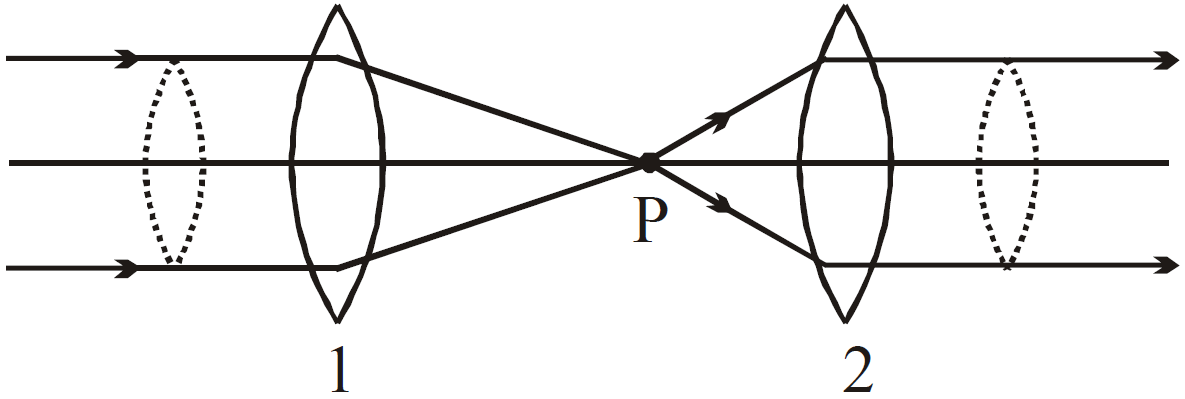
Two converging lenses of unequal focal lengths can be used to reduce the aperture of a parallel beam of light without losing the energy of the light. This increases the intensity. Describe how the converging lenses should be placed to do this.
Answer

Point p is focal length of lens 1 as well as lens 2.
View full question & answer
Question 261 Mark
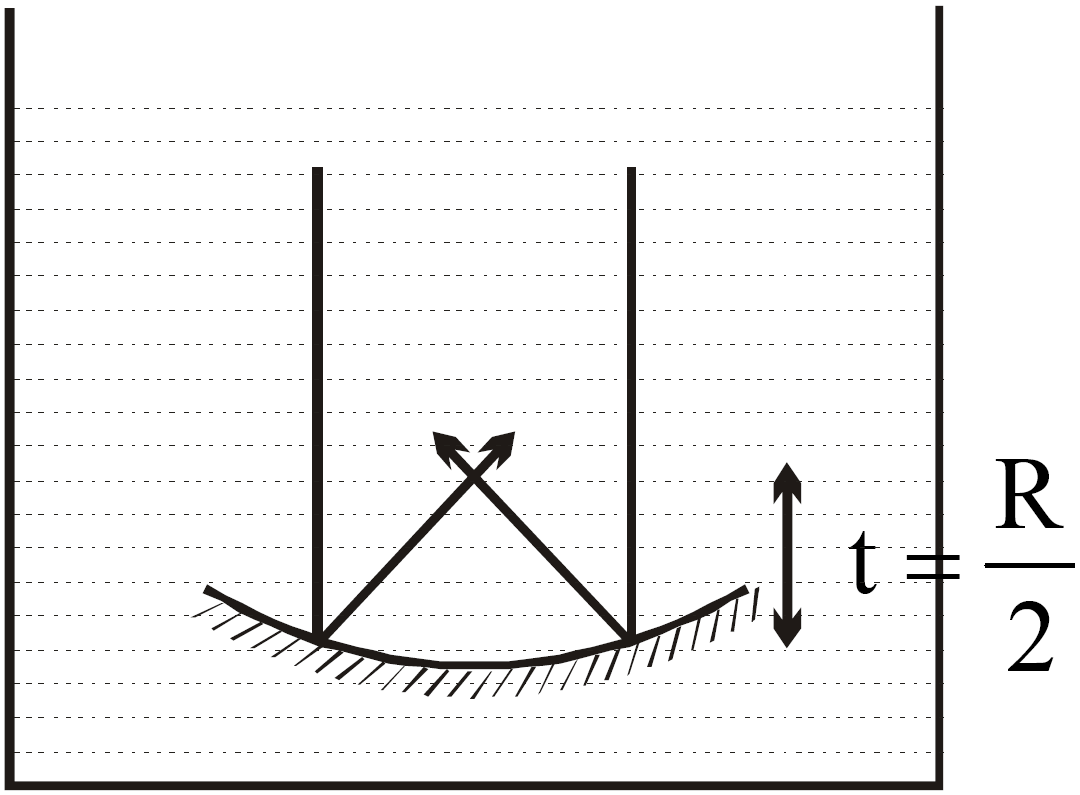
If a spherical mirror is dipped in water, does its focal length change?
Answer
No (offcourse we always take the thickness of mirror to be 3 to 4mm only)

If thickness of mirror is there then refraction through glass and water is to be considered.
View full question & answer
Question 271 Mark
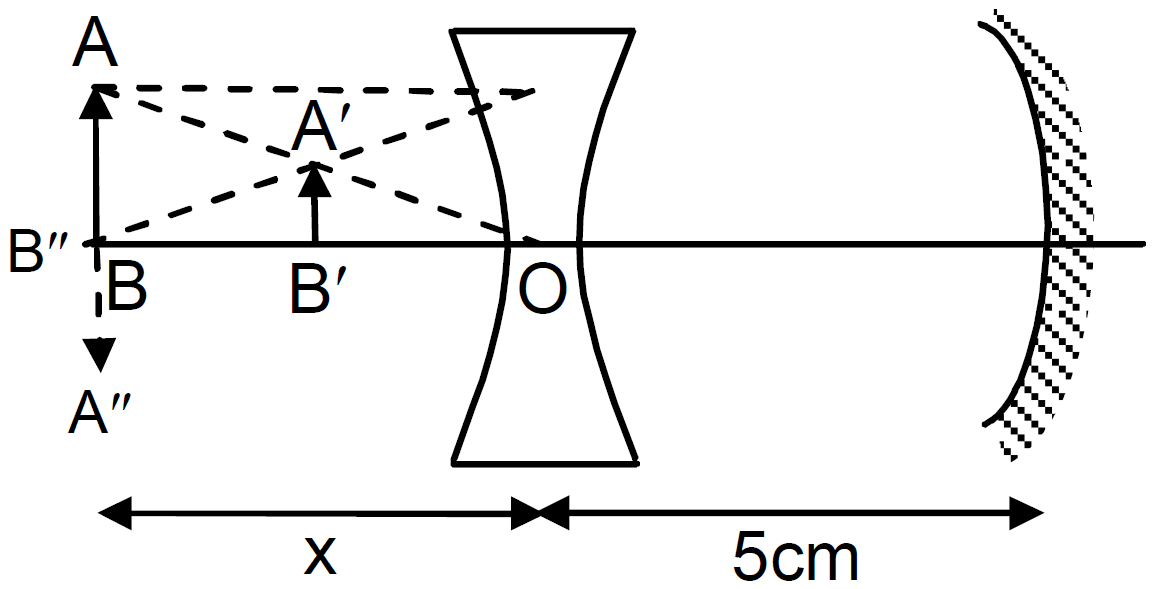
A diverging lens of focal length 20cm and a converging mirror of focal length 10cm are placed coaxially at a separation of 5cm. Where should an object be placed so that a real image is formed at the object itself?
Answer

Let the object to placed at a distance x from the lens further away from the mirror.
For the concave lens ($1^{st}$ refraction)
u = -x, f = -20cm
From lens formula,
$\frac{1}{\text{v}}-\frac{1}{\text{u}}=\frac{1}{\text{f}}\Rightarrow\frac{1}{\text{v}}=\frac{1}{-20}+\frac{1}{-\text{x}}$
$\Rightarrow\text{v}=-\Big(\frac{20\text{x}}{\text{x}+20}\Big)$
So, the virtual image due to fist refraction lies on the same side as that of object. (A'B')
This image becomes the object for the concave mirror.
For the mirror,
$\Rightarrow\text{u}=-\Big(5+\frac{20\text{x}}{\text{x}+20}\Big)=-\Big(\frac{25\text{x}+100}{\text{x}+20}\Big)$
$\text{f}=-10\text{cm}$
From mirror equation,
$\frac{1}{\text{v}}-\frac{1}{\text{u}}=\frac{1}{\text{f}}\Rightarrow\frac{1}{\text{v}}=\frac{1}{-10}+\frac{\text{x}+20}{25\text{x}+100}$
$\Rightarrow\text{v}=\frac{50(\text{x}+4)}{3\text{x}-20}$
So, this image is formed towards left of the mirror.
Again for second refraction in concave lens,
$\text{u}=-\Big[5-\frac{50(\text{x}+4)}{3\text{x}-20}\Big]$ (assuming that image of mirror is formed between the lens and mirro 3x -20)
$\text{v}=+\text{x}$ (Since, the final image is produced on the object A"B")
Using lens formula,
$\frac{1}{\text{v}}-\frac{1}{\text{u}}=\frac{1}{\text{f}}$
$\Rightarrow\frac{1}{\text{x}}+\frac{1}{\frac{5-50(\text{x}+4)}{3\text{x}-20}}=\frac{1}{-20}$
$\Rightarrow 25\text{x}^2-1400\text{x}-6000=0$
$\Rightarrow\text{x}^2-56\text{x} -240=0$
$\Rightarrow (\text{x}-60)(\text{x}+4)=0$
So, $\Rightarrow\text{x}=60\text{cm}$
The object should be placed at a distance 60cm from the lens further away from the mirror. So that the final image is formed on itself.
View full question & answer
Question 281 Mark
A thin converging lens is formed with one surface convex and the other plane. Does the position of image depend on whether the convex surface or the plane surface faces the object?
Answer
No, If it is a thin lens then focal length is not effected by from which side ray falls.
View full question & answer
Question 291 Mark
A laser light is focused by a converging lens. Will there be a significant chromatic aberration?
Answer
No, since it is monochromatic or of single wave length so $\mu$ is single so single wave length.
View full question & answer
Question 301 Mark
An air bubble is formed inside water. Does it act as a converging lens or a diverging lens?
Answer
Diverging.
View full question & answer
Question 311 Mark
For same value of angle of incidence, the angles of refraction in three media are 15°, 20° and 25° respectively. In which medium, the velocity of light will be minimum?
Answer
$\mu=\frac{\text{c}}{\text{V}}=\frac{\sin\text{i}}{\sin\text{r}}\text{V},\propto\sin\text{r,}$ Hence velocity will be minuimum for r = 15°.
View full question & answer
Question 321 Mark
Can mirrors give rise to chromatic aberration?
Answer
No,
For all colour Ray focal length is $\frac{\text{R}}{2}$ so for all rays image is formed at same point hence no chromatic aberration.
View full question & answer
Question 331 Mark
An equi-convex lens has refractive index 1.5. Write its focal length in terms of radius of curvature R.
Answer
$\frac{1}{\text{f}}=(1.5+1)\Big(\frac{1}{\text{R}}-\frac{1}{\text{R}}\Big)$
$\Rightarrow\frac{1}{\text{f}}=\frac{1}{\text{R}}$
$\Rightarrow\text{f}=\text{R}.$
View full question & answer
Question 341 Mark
Why does a diamond shine more than a glass piece cut to the same shape?
Answer
M is concept: The ray get trapped inside the diamond and undergo multiple reflection and shine.
Concept: When while light falls on diamond as critical angle is very small it undergo multiple TIR before coming out more is TIR more separation is between the different colours when this light comes out and fall on eye. It due to different colours it shines.
View full question & answer
Question 351 Mark
If a thin lens is dipped in water, does its focal length change?
Answer
Yes,
$\frac{1}{\text{f}_2}=\Big(\frac{\mu_2}{\mu_\text{m}}-1\Big)\Big[\frac{1}{\text{R}_1}-\frac{1}{\text{R}_2}\Big]$
Is $\mu_{\text{medium}}$ is changed focal length gets changed.
View full question & answer
Question 361 Mark
For which colour the magnifying power of a simple microscope is highest? For which colour it is lowest?
Answer
It is highest for violet and lowest for red colour since M $=1+\frac{\text{D}}{\text{f}}\text{ and }\text{fv}<\text{f}_{\text{R}}.$
View full question & answer
Question 371 Mark
A converging lens of focal length 12cm and a diverging mirror of focal length 7.5cm are placed 5.0cm apart with their principal axes coinciding. Where should an object be placed so that its image falls on itself?
Answer
Let the object be placed at a distance x cm from the lens (away from the mirror).
For the convex lens ($1^{st}$ refraction) u = -x, f = -12cm
From the lens formula:
$\frac{1}{\text{v}}-\frac{1}{\text{u}}=\frac{1}{\text{f}}$
$\Rightarrow \frac{1}{\text{v}}=\frac{1}{(-12)}+\frac{1}{-\text{x}}$
$\Rightarrow \text{v}=-\Big(\frac{12\text{x}}{\text{x}+12}\Big)$
Thus, the virtual image due to the first refraction lies on the same side as that of object A'B'.
This image becomes the object for the convex mirror,
For the mirror,
$\text{u}=-\Big(5+\frac{12\text{x}}{\text{x}+12}\Big)$
$=-\Big(\frac{17\text{x}+60}{\text{x}+12}\Big)$
$\text{f}=-7.5\text{cm}$
From mirror equation,
$\frac{1}{\text{v}}+\frac{1}{\text{u}}=\frac{1}{\text{f}}$
$\Rightarrow \frac{1}{\text{v}}=\frac{1}{-7.5}+\frac{\text{x}+12}{17\text{x}+60}$
$\Rightarrow \frac{1}{\text{v}}=\frac{17\text{x}+60-7.5}{7.5(17\text{x}+60)}$
$\Rightarrow \text{v}=\frac{7.5(17\text{x}+60)}{52.5-127.5\text{x}}$
$\Rightarrow \text{v}=\frac{250(\text{x}+4)}{15\text{x}-100}$
$\Rightarrow \text{v}=\frac{50(\text{x}+4)}{(3\text{x}-20)}$
Thus, this image is formed towards the left of the mirror.
Again for second refraction in concave lens,
$\text{u}=-\Big[\frac{5-50(\text{x}+4)}{3\text{x}-20}\Big]$
(assuming that the image of mirror formed between the lens and mirror is 3x - 20),
$\text{v}=\pm\text{x}$ (since, the final image is produced on the object A"B")
Using lens formula:
$\frac{1}{\text{v}}-\frac{1}{\text{u}}=\frac{1}{\text{f}}$
$\Rightarrow \frac{1}{\text{x}}+\frac{1}{\frac{5-50(\text{x}\times4)}{3\text{x}-20}}=\frac{1}{-20}$
$\Rightarrow 25\text{x}^2-1400\text{x}-6000=0$
$\Rightarrow \text{x}^2-56\text{x}-240=0$
$\Rightarrow (\text{x}-60)(\text{x}+4)=0$
Thus, $\text{x}=60\text{m}$
View full question & answer
Question 381 Mark
Can the image formed by a simple microscope be projected on a screen without using any additional lens or mirror?
Answer
The image formed by a simple microscope is virtual and erect. So, it cannot be projected on a screen without using any additional lens or mirror.
View full question & answer
Question 391 Mark
A person is viewing an extended object. If a converging lens is placed in front of his eyes, will he feel that the size has increased?
Answer
If a person views an extended object through a converging lens, then it will appear larger and wider to him.
View full question & answer
Question 401 Mark
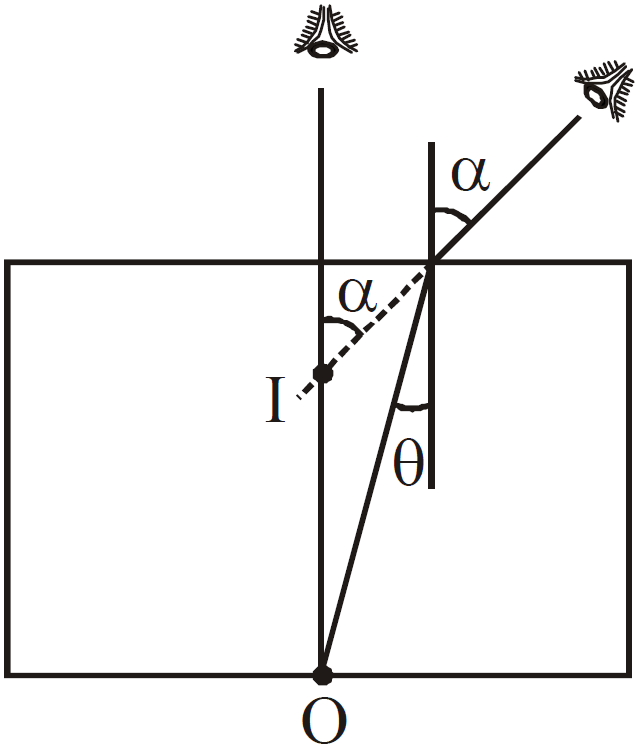
Is the formula "Real depth/ Apparent depth $=\mu$" valid if viewed from a position quite away from the normal?
Answer
No, In the derivation of above formulae $\sin\theta\approx\tan\theta$ this can be done only when angle is small. For eye 1 this approximation can be done but not for eye 2.
View full question & answer
Question 411 Mark
A magician during a show makes a glass lens with $n=1.47$ disappear in a trough of liquid. What is the refractive index of the liquid? Could the liquid be water?
Answer
The refractive index of the liquid must be equal to 1.47 in order to make the lens disappear. This means $n_1=n_2$. This gives $1 / f=0$ or $f \rightarrow \infty$. The lens in the liquid will act like a plane sheet of glass. No, the liquid is not water. It could be glycerine.
View full question & answer
Question 421 Mark
Light from a point source in air falls on a spherical glass surface ( $n=1.5$ and radius of curvature $=20 cm )$. The distance of the light source from the glass surface is $100 cm$. At what position the image is formed?
Answer
We use the relation given by Eq. (9.16). Here $u=-100 cm , v=$ ?, $R=+20 cm , n_1=1$, and $n_2=1.5$.
We then have
$
\frac{1.5}{v}+\frac{1}{100}=\frac{0.5}{20}
$
or $v=+100 cm$
The image is formed at a distance of $100 cm$ from the glass surface, in the direction of incident light.
View full question & answer
Question 431 Mark
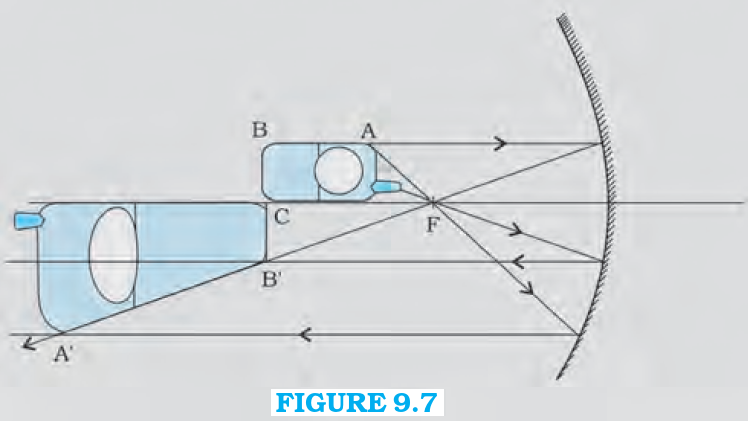
A mobile phone lies along the principal axis of a concave mirror, as shown in Fig. 9.7. Show by suitable diagram, the formation of its image. Explain why the magnification is not uniform. Will the distortion of image depend on the location of the phone with respect to the mirror?
Image
Answer
The ray diagram for the formation of the image of the phone is shown in Fig. 9.7. The image of the part which is on the plane perpendicular to principal axis will be on the same plane. It will be of the same size, i.e., $B ^{\prime} C = BC$. You can yourself realise why the image is distorted.
View full question & answer
Question 441 Mark
Suppose that the lower half of the concave mirror's reflecting surface in Fig. 9.6 is covered with an opaque (non-reflective) material. What effect will this have on the image of an object placed in front of the mirror?
Answer
You may think that the image will now show only half of the object, but taking the laws of reflection to be true for all points of the remaining part of the mirror, the image will be that of the whole object. However, as the area of the reflecting surface has been reduced, the intensity of the image will be low (in this case, half).
View full question & answer