Questions

2 Marks Questions

Take a timed test

8 questions · self-marked practice — reveal the answer and mark yourself.

Question 12 Marks
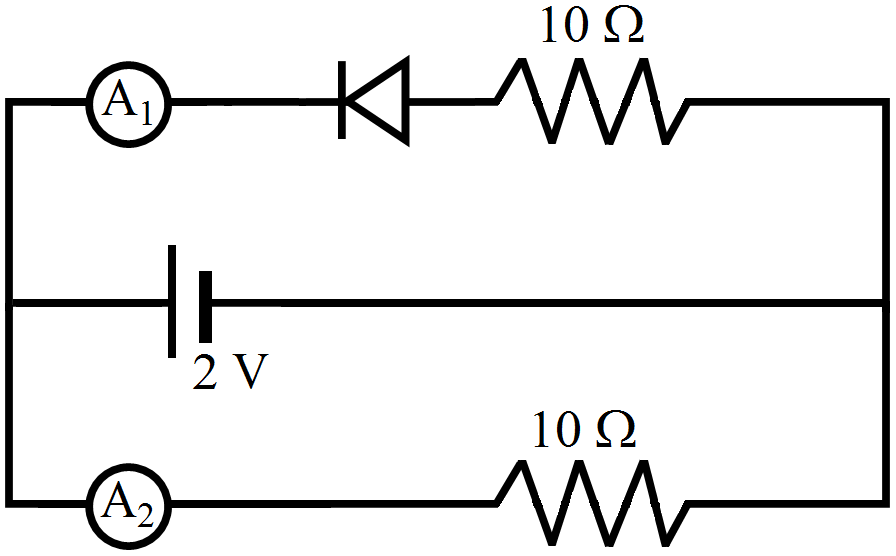
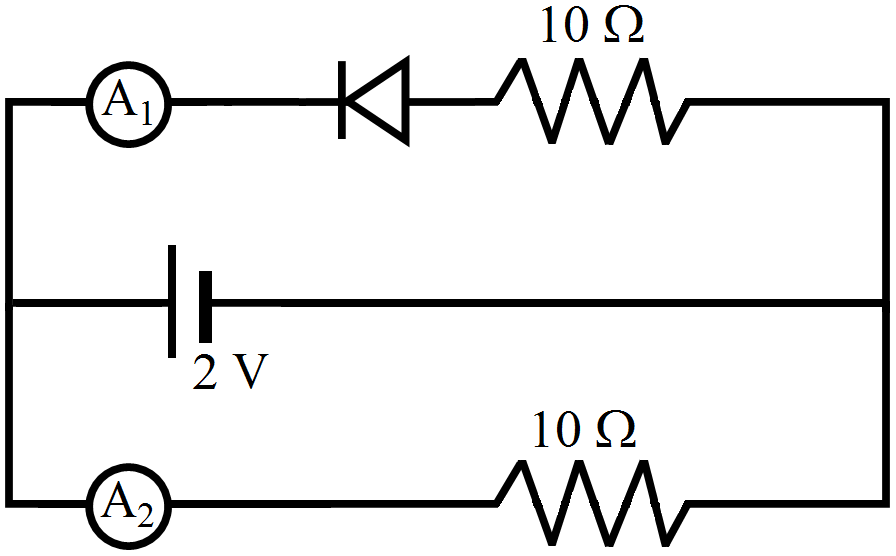
What are the readings of the ammeters $A_1$ and $A_2$ shown in figure. Neglect the resistance of the meters.
Answer
The diode is reverse biased.
Hence the resistance is infinite.
So, current through $A_1$ is zero.
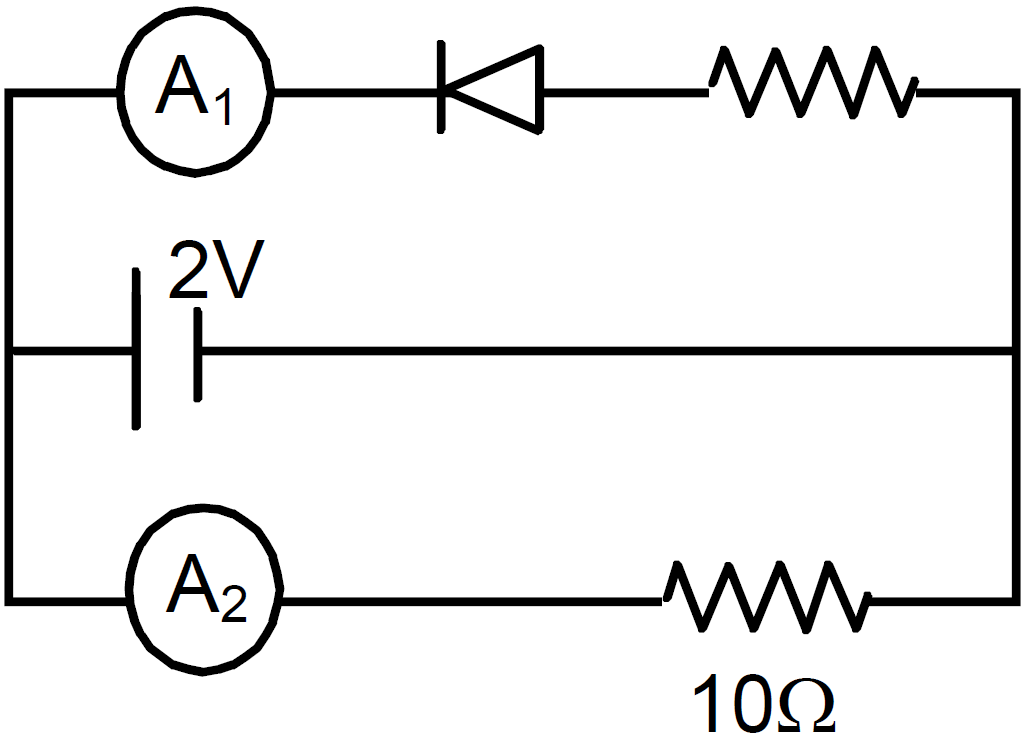
For $A_2,$ current $=\frac{2}{10}=0.2\ \text{Amp}.$
View full question & answer
Question 22 Marks
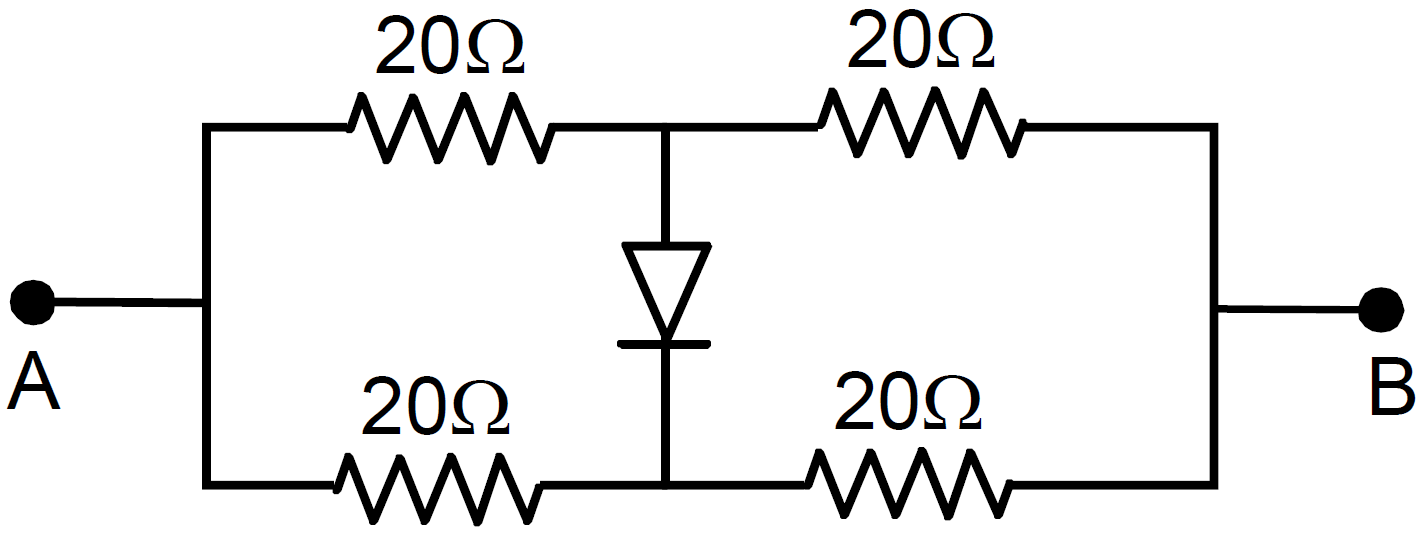
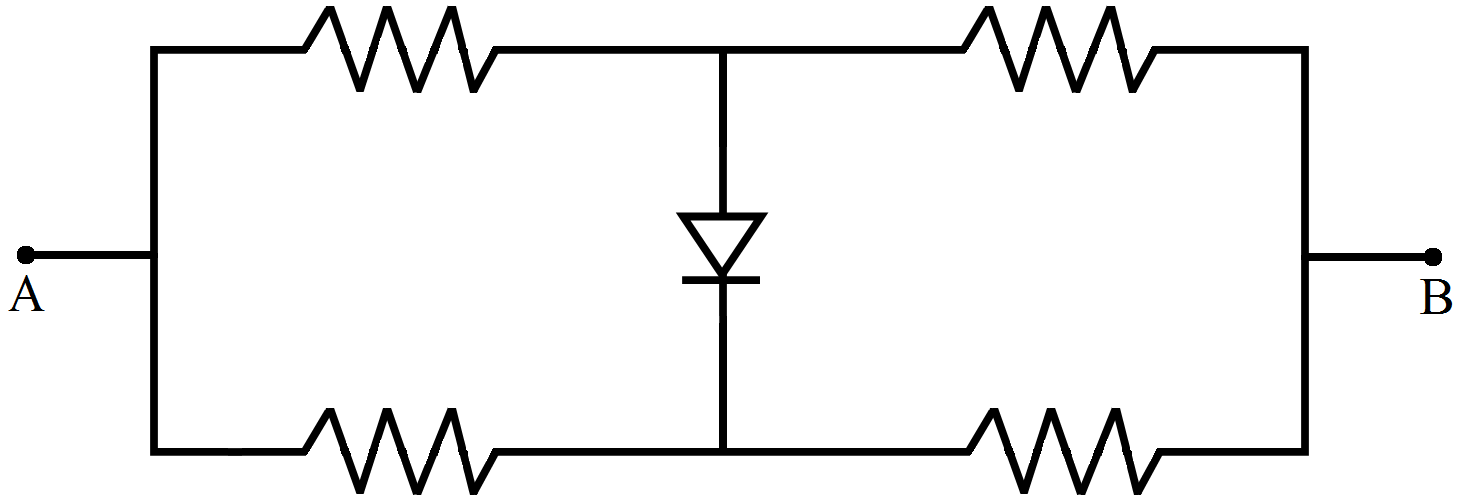
Each of the resistances shown in figure. has a value of $20\Omega.$ Find the equivalent resistance between A and B. Does it depend on whether the point A or B is at higher potential?
Answer
From the figure.

According to wheat stone bridge principle, there is no current through the diode.
Hence net resistance of the circuit is $\frac{40}{2}=20\Omega.$
View full question & answer
Question 32 Marks
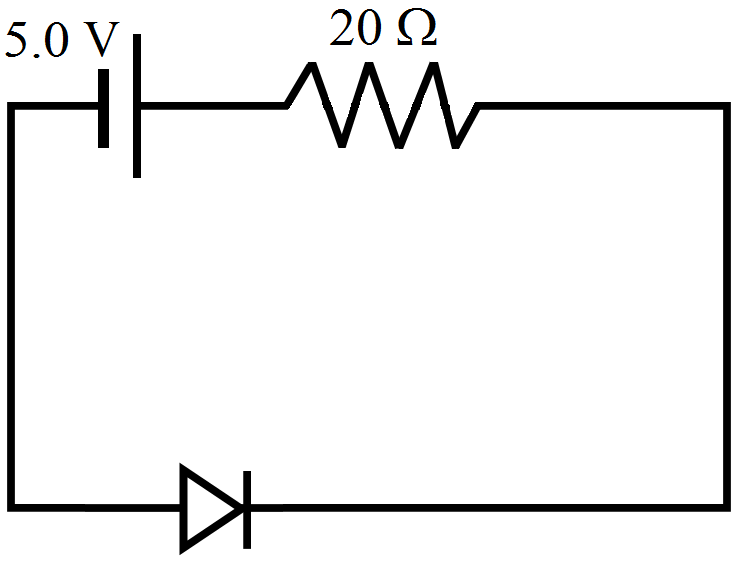
Calculate the current through the circuit and the potential difference across the diode shown in figure. The drift current for the diode is $20\mu\text{A}.$
Answer

Current in the circuit = Drift current
(Since, the diode is reverse biased $=20\mu\text{A})$
Voltage across the diode $=5-\big(20\times20\times10^{-6}\big)$
$=5-\big(4\times10^{-4}\big)=5\text{V}.$
View full question & answer
Question 42 Marks
The drift current in a p-n junction is $20.0\mu\text{A}.$ Estimate the number of electrons crossing a cross-section per second in the depletion region.
Answer
Drift current $=20\mu\text{A}=20\times10^{-6}\text{A}$
Both holes and electrons are moving
So, no.of electrons $=\frac{20\times10^{-6}}{2\times1.6\times10^{-19}}=6.25\times10^{13}.$
View full question & answer
Question 52 Marks
Consider an amplifier circuit using a transistdf. The output power is several times greater than the input power. Where does the extra power come from?
Answer
The amplifier takes this energy from the power supply. Amplifiers take the energy from the power supply and control the output to match with the input signal but with greater amplitude.
View full question & answer
Question 62 Marks
Find the maximum wavelength of electromagnetic radiation which can create a hole-electron pair in germanium. The band gap in germanium is 0.65eV.
Answer
Given,
Band gap of germanium, E = 0.65eV
Wavelength of the incident radiation, $\lambda=?$
For the electron‒hole pair creation, the energy of the incident radiation should be at least equal to the band gap of the material.
So,
$\text{E}=\frac{\text{hc}}{\lambda}$
$\Rightarrow\lambda=\frac{\text{hc}}{\text{E}}=\frac{1242\text{eV}-\text{nm}}{0.65\text{eV}}$
$\Rightarrow\lambda=1910.7\times10^{-9}\text{m}$
$\Rightarrow\lambda=1.9\times10^{-5}\text{m}$
View full question & answer
Question 72 Marks
Suppose the energy liberated in the recombination of a hole-electron pair is converted into electromagnetic radiation. If the maximum wavelength emitted is 820nm, what is the band gap?
Answer
Given,
Wavelength, $\lambda = 820\text{nm}$
The minimum energy released in the recombination of a conduction band electron with a valence band hole is equal to the band gap of the material.
Band gap, $\text{E}=\frac{\text{hc}}{\lambda}$
$\Rightarrow\text{E}=\frac{1240}{820}\frac{\text{eV}-\text{nm}}{\text{nm}}$
$\Rightarrow\text{E}=1.5\text{eV}$
View full question & answer
Question 82 Marks
What is the resistance of an intrinsic semiconductor at 0K?
Answer
At 0K, the valence band is full and the conduction band is empty. As no electron is available for conduction in an intrinsic semiconductor, the intrinsic semiconductor at 0K acts as an insulator and hence offers infinite resistance.
View full question & answer