Questions

1 Marks Question

Take a timed test

25 questions · self-marked practice — reveal the answer and mark yourself.

Question 11 Mark
Answer the following question:
In what way is diffraction from each slit related to the interference pattern in a double-slit experiment?
Answer
If, width of each slit is of the order $\lambda$ then the intensity of interference fringes in Young's double-slit experiment is modified by the diffraction pattern of each slit.
View full question & answer
Question 21 Mark
Answer the following question:
When a tiny circular obstacle is placed in the path of light from a distant source, a bright spot is seen at the centre of the shadow of the obstacle. Explain why?
Answer
A bright spot is seen at the center of the shadow of objective because, wave diffracted from the edge of the circular obstacle interface constructively at the centre of the shadow producing a bright spot.
View full question & answer
Question 31 Mark
Answer the following question:
When a low flying aircraft passes overhead, we sometimes notice a slight shaking of the picture on our TV screen. Suggest a possible explanation.
Answer
A low flying aircraft reflects the TV signal. The slight shaking on the TV screen is due to interference between the direct signal and the reflected signal.
View full question & answer
Question 41 Mark
To which part of the electromagnetic spectrum does a wave of frequency $5 \times 10^{11} Hz$ belong?
Answer
A wave of frequency $5 \times 10^{11} Hz$ will belong to the Microwaves of electromagnetic spectrum.
View full question & answer
Question 51 Mark
To which part of the electromagnetic spectrum does a wave of frequency $3 \times 10^{13} Hz$ belong?
Answer
The frequency $3 \times 10^{13 }Hz$ belongs to infrared region of electromagnetic spectrum.
View full question & answer
Question 61 Mark
Why does sun appear red at sunrise and sunset?
Answer
It is due to least scattering of red light as it has the longest wavelength/ As per Rayleigh’s scattering, the amount of light scattered $\propto\frac{1}{\lambda^{4}}$.
View full question & answer
Question 71 Mark
To which part of the electromagnetic spectrum does a wave of frequency $5 \times 10^{19} Hz$ belong?
Answer
$\text{X} - \text{rays} /\gamma - \text{rays}.$
View full question & answer
Question 81 Mark
How does the angular separation between fringes in single-slit diffraction experiment change when the distance of separation between the slit and screen is doubled?
Answer
No change.
View full question & answer
Question 91 Mark
How would the angular separation of interference fringes in Young’s double slit experiment change when the distance between the slits and screen is doubled?
Answer
Angular separation will not change.
View full question & answer
Question 101 Mark
Which of the following waves can be polarized (i) Heat waves (ii) Sound waves? Give reason to support your answer.
Answer
Heat waves, as they are transverse/electromagnetic in nature.
View full question & answer
Question 111 Mark
What type of wavefront will emerge from an (i) point source, and (ii) distant light source?
Answer
Wavefront from point source - Spherical.Wavefront from distant light source - Plane.
View full question & answer
Question 121 Mark
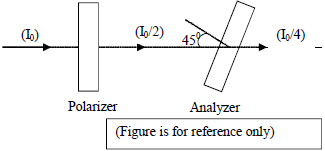
If the angle between the pass axis of polarizer and the analyser is 45°, write the ratio of the intensities of original light and the transmitted light after passing through the analyser.
Answer
 
$\text{I} = \text{I}_{\circ} = \text{cos}^{2}\theta$
$\frac{\text{I}_{before polarizer}}{\text{I}_{before analyzer}} = \frac{4}{1}$
View full question & answer
Question 131 Mark
How does the fringe width of interference fringes change, when the whole apparatus of Young’s experiment is kept in a liquid of refractive index 1.3?
Answer
DecreasesAlternate Answer
Become 1/1.3 times of its initial value.
View full question & answer
Question 141 Mark
What is the speed of light in a denser medium of polarising angle 30°?
Answer
$\mu=\tan\text{i}_\text{p}$
$\mu=\tan30^\circ=\frac{1}{\sqrt3}$
$\mu=\frac{\text{c}}{\text{V}}=\frac{1}{\sqrt3}$
$\text{V}=\text{c}\times\sqrt3$
$\text{V}=3\sqrt3\times10^8\text{m}/\text{s}$
View full question & answer
Question 151 Mark
What are coherent sources of light?
Answer
Two sources of light having same frequency and zero or constant initial phase difference are called coherent sources.
View full question & answer
Question 161 Mark
Answer the following question:
When a tiny circular obstacle is placed in the path of light from a distant source, a bright spot is seen at the centre of the shadow of the obstacle. Explain why?
Answer
A bright spot is seen at the center of the shadow of objective because, wave diffracted from the edge of the circular obstacle interface constructively at the centre of the shadow producing a bright spot.
View full question & answer
Question 171 Mark
Two Polaroids are placed with their optic axis perpendicular to each other. One of them is rotated through $45^\circ ,$ what is the intensity of light emerging from the second Polaroid if $I_0$ is the intensity of unpolarised light?
Answer
$\text{I}=\frac{1_0}{2}\ \cos^2(45)^\circ=\frac{I_0}{4}.$
View full question & answer
Question 181 Mark
Find the thickness of a plate which will produce a change in optical path equal to half the wavelength $\lambda$ of the light passing through it normally. The refractive index of the plate is $\mu$.
Answer
Let, t = thickness of the plate
Given, optical path difference $=(\mu-1)\text{t}=\frac{\lambda}{2}$
$\Rightarrow\text{t}=\frac{\lambda}{2(\mu-1)}$
View full question & answer
Question 191 Mark
The polarising angle of a medium is 60°. What is the refractive index of the medium?
Answer
Brewster's law $\text{n}=\tan\text{ i}_\text{p}=\tan60^\circ=\sqrt{3}=1.732.$
View full question & answer
Question 201 Mark
In Young’s double slit experiment, if the distance between the slits be less than $\lambda(\text{i.e.,d<}\lambda)$ what will be the effect on interference fringes?
Answer
Fringe with $\beta=\frac{\text{D}\lambda}{\text{d}},\text{if d}<\lambda,$ so no fringe will be observed in region of visibility.
View full question & answer
Question 211 Mark
Consider the situation of the previous problem. If the mirror reflects only 64% of the light energy falling on it, what will be the ratio of the maximum to the minimum intensity in the interference pattern observed on the screen?
Answer
Given that, the mirror reflects 64% of energy (intensity) of the light.
So, $\frac{\text{I}_1}{\text{I}_2}=0.64=\frac{16}{25}\Rightarrow\frac{\text{r}_1}{\text{r}_2}=\frac{4}{5}$
So, $\frac{\text{I}_\text{max}}{\text{I}_\text{min}}=\frac{(\text{r}_1+\text{r}_2)^2}{(\text{r}_1-\text{r}_2)^2}=81:1.$
View full question & answer
Question 221 Mark
State the essential condition for diffraction of light to take place.
Answer
The condition is “The width or sharpness of obstacle or aperture must be of the order of the wavelength of light used.”
View full question & answer
Question 231 Mark
Plane microwaves are incident on a long slit having a width of 5.0cm. Calculate the wavelength of the microwaves if the first diffraction minimum is formed at $\theta=30^\circ.$
Answer
For first minimum diffraction, $\text{b}\sin\theta=\lambda$Here, $\theta=30^\circ,\text{b}=5\text{cm}$
$\therefore\lambda=5\times\sin30^\circ=\frac{5}{2}=2.5\text{cm}.$
View full question & answer
Question 241 Mark
When a tiny circular obstacle is placed in the path of light from a distant source, a bright spot is seen at the center of the shadow of the obstacle. Explain why.
Answer
Waves diffracted from the edges of the circular obstacle interfere constructively at the centre of the shadow producing a bright spot.
View full question & answer
Question 251 Mark
Draw the intensity distribution of the fringe for diffraction by single slit.
Answer
The pattern consists of a bright central maximum of maximum intensity, flanked by secondary maxima of rapidly decreasing intensity.
View full question & answer
1 Marks Question - Physics STD 12 Science Questions - Vidyadip