Questions

1 Marks Question

Take a timed test

29 questions · self-marked practice — reveal the answer and mark yourself.

Question 11 Mark
Define the following :
Interference of light
Answer
When two waves of same frequency superimpose on each other the intensity of light gets disturbed. This nature of light is called interference of light.
View full question & answer
Question 21 Mark
Which property of light is confirmed by the pattern of polarization?
Answer
The phenomenon of polarization confirms the transverse wave nature of light.
View full question & answer
Question 31 Mark
Explain the difference between wave front and ray.
Answer
The point of particles vibrating in uniform phase is called wavefront. The perpendicular line drawn on the wave front expresses the direction of wave propagation. This is called ray.
View full question & answer
Question 41 Mark
If coherent waves of light produce destructive interference, then what will be the phase difference between them?
Answer
Value of phase difference $\phi=\pi, 3 \pi, 5 \pi \ldots \ldots \ldots$ $(2 n+1) \pi$.
View full question & answer
Question 51 Mark
Write the upper and lower limits of interference in terms of path difference.
Answer
We know that :
Phase difference $=\frac{2 \pi}{\lambda} \times$ path difference
or $\phi=\frac{2 \pi}{\lambda} y \ldots(i) $
We also know that for constructive interference to $\phi=2 n \pi \ldots(ii) $
From equation (i) and (ii)
$
\frac{2 \pi}{\lambda} y=2 n \pi
$
or
$
y=2 n \cdot \frac{\lambda}{2}
$
For $n$th maxima, $y=y_n$
$\underline {y_n=2 n \cdot \frac{\lambda}{2}}$
Thus, to occur the constructive interference, path difference must be even multiple of $\frac{\lambda}{2}$
For minimum intensity $\quad \phi=(2 n+1) \pi$
or $\quad\frac{2 \pi}{\lambda} y=(2 n+1) \pi$
$\therefore$$\quad y=(2 n+1) \frac{\lambda}{2}$
For $n$th minima : $y=y_n$
$\therefore$ $y_n=(2 n+1) \frac{\lambda}{2}$
Thus, for destructive interference, path difference must be odd multiple of $\frac{\lambda}{2}$.
View full question & answer
Question 61 Mark
Two exactly identical 15 watt bulbs are placed very close to each other. Will they produce interference effects?
Answer
Two bulbs are separate sources, which can never be phase related, hence the interference effect will not be visible.
View full question & answer
Question 71 Mark
Write the importance of Huygens principle. What are the two assumptions of this theory?
Answer
The importance of Huygens principle is to determine the geometric structure and position of the wavefront from a given position at a later time.
Assumptions : (i) On a given wavefront, which is called the initial wavefront, every point is a source of secondary waves and propagates the disturbance of the original light source in the same way with the same speed in all possible directions.
(ii) The new position of the wave front at any time is obtained by drawing tangents to the secondary wavefronts at that time.
View full question & answer
Question 81 Mark
Write an expression that describes the relationship between the path difference $(x)$ and the phase difference $(\phi)$ between two waves.
Answer
Path difference $(x)=\lambda / 2 \pi \times$ (phase difference)
Or $x=\lambda / 2 \pi . \phi$
View full question & answer
Question 91 Mark
If the ratio of the amplitudes of two waves is $a_1: a$, , then what will be the ratio of their intensities?
Answer
We know that
Intensity $\quad I \propto[\text { Amplitude }(a)]^2$
That is $\quad I \propto a^2$
Therefore $\quad I _1: I _2=a_1{ }^2: a_2{ }^2$
View full question & answer
Question 101 Mark
What are circular and elliptically polarized light?
Answer
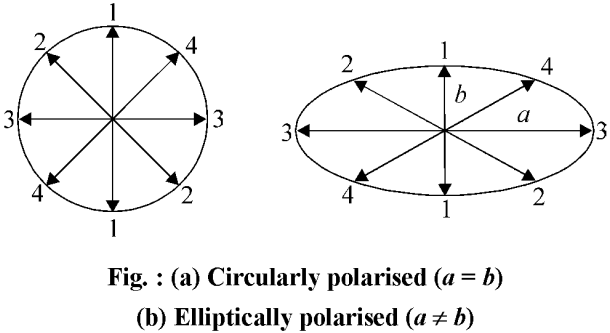
Circularly polarized light : When two plane polarized light rays are superimposed on each other under special circumstances in such a way that the resulting light vector starts rotating by a certain magnitude in a plane perpendicular to the direction of wave propagation, then the displacement of vibration in the light vector occurs in the form of a circle. Such light is called circularly polarized light. In this, the magnitude of the electric vector remains constant but its direction keeps changing regularly.

Image
Elliptically polarized light : When two plane polarized light rays are superimposed on each other under special circumstances in such a way that the resulting light vector starts rotating with a changed magnitude in a plane perpendicular to the direction of wave propagation, then the vibrational displacement of the light vector occurs in an ellipse. Such light is called elliptically polarized light.
View full question & answer
Question 111 Mark
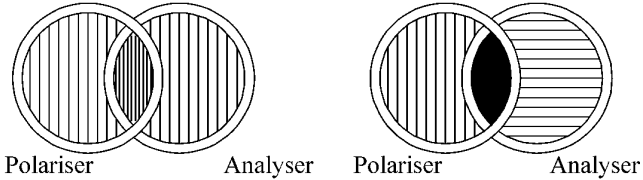
What is the parallel and crossed arrangement of polaroid?
View full question & answer
Question 121 Mark
Explain the uses of Polaroid.
Answer
Uses of Polaroid :
1. To remove glare : Polaroid is used to reduce the glare caused by reflection of light from extremely white or bright surfaces or wet roads or the scorching sun. Glare consists of partially polarized light. If polaroid glasses are worn on the eyes, it will cut off the horizontal vibrations of partially polarized light. Hence the glare will be eliminated.
2. To prevent accidents : When the light emitted from the headlights of motor cars and trucks falls on the hood of a motor car or truck coming from the other side, the reflected light reaches the eyes and causes glare. This not only causes pain to the eyes, but there is also a possibility of an accident. To overcome this, headlight cover glass and windscreen are made of polaroid.
3. In polaroid camera or photography : A polaroid is placed in front of the lens of the polaroid camera so that the polarized light coming in its background is blocked by the polaroid.
4. To determine the concentration of sugar: The concentration of sugar is determined by polari meter. Polaroids are used to produce and analyze plane polarized light in a polari meter.
5. In the study of optical properties of metals.
6. To study the effect of stresses.
View full question & answer
Question 131 Mark
On what components does diffraction depend?
Answer
It depends on the following two components:
(i) Size of aperture (point) and (ii) Wavelength.
View full question & answer
Question 141 Mark
Write the definition of resolution limit of an optical instrument.
Answer
It is the minimum distance by which two point objects are separated so that their images can be seen with an optical instrument only by separating them.
View full question & answer
Question 151 Mark
What type of wave front will emerge?
(i) From a point light source, (ii) From a remote light source.
Answer
(i) A spherical wave front will emerge from a point light source.
(ii) A flat wavefront will be obtained from a distant light source.
View full question & answer
Question 161 Mark
Using Huygens principle, write Snell's law related to refraction of plane waves.
Answer
$n_1 \sin i=n_2 \sin r$
$n_1$ and $n_2$ are the refractive indices of medium 1 and medium 2 respectively.
View full question & answer
Question 171 Mark
If in a single slit diffraction experiment the width of the slit is doubled, what will be the effect on the central maximum?
Answer
If the slit width (a) is doubled then the width ( $\lambda / a$ ) of central maxima will decrease because the area will be halved, but the intensity will remain $\frac{1}{4}$ th times.
View full question & answer
Question 181 Mark
When unpolarised light from air, passes through transparent medium, in which direction will the reflected light be polarized?
Answer
When light is incident on the air-transparent medium interface the angle will be equal to the polarization angle.
View full question & answer
Question 191 Mark
What is the necessary condition for diffraction of light?
Answer
The size of the obstacle or line hole (aperture) should be of the order of the wavelength of light.
View full question & answer
Question 201 Mark
In the phenomenon of interference, write the value of path difference of superimposed waves at the places where constructive and destructive interference occurs.
Answer
The path difference for constructive interference is $n \lambda$ and for destructive interference is and $(2 n-1) \lambda / d$. Here $n=0,1,2,3 \ldots \ldots$.
View full question & answer
Question 211 Mark
What is the specialty of sunglasses made from polaroid instead of ordinary glass?
Answer
Ordinary colored glass absorbs light. This makes objects appear distorted. In contrast, polaroid absorbs only polarized light which causes glare in the eyes.
View full question & answer
Question 221 Mark
Which waves are possible to be polarized in X-rays, sound waves and radio waves?
Answer
X-rays and radio waves.
The polarization of X-rays is possible, because these rays are longitudinal whereas the sound waves are transverse, so cannot be polarized.
View full question & answer
Question 231 Mark
What direction does the line perpendicular to the wave front express?
Answer
The direction of wave propagation.
View full question & answer
Question 251 Mark
What will be the shape of the wave front emitted by a light source in the form of a narrow slit?
Answer
Cylindrical.
View full question & answer
Question 271 Mark
What is find by using the Huygens' principle?
Answer
Huygens' principle can be used to find the shape of the wave front of a plane wave propagating in a medium.
View full question & answer
Question 281 Mark
How many types of wavefronts are there? Write.
Answer
There are three types of wave fronts :(a) Spherical wave front (b) Cylindrical wave front (c) Plane wave front.
View full question & answer
Question 291 Mark
In a Young's doulbe-slit experiment, the slits are separated by 0.28 mm and the screen is placed 1.4 m away. The distance between the central bright fringe and the fourth bright fringe is measured to be 1.2 cm. Determine the wavelength of light used in the experiment.
Answer
Here, d = 0.28mm = 0.28 × 10⁻³ m D = 1.4m
$x=1.2 cm=1.2 \times 10^{-2} m, n=4, \lambda=?$
For constructive interference $x=n \lambda \frac{ D }{d}$
or $\lambda=\frac{x d}{n D }=\frac{1.2 \times 10^{-2} \times 0.28 \times 10^{-3}}{4 \times 1.4}=6 \times 10^{-7} m$
View full question & answer