A beam of light consisting of two wavelengths, 650 nm and 520 nm, is used to obtain interference fringes in a Young's double-slit experiment (a) Find the distance of the third bright fringe on the screen from the central maximum for wavelength 650 nm. (b) What is the least distance from the central maximum where the bright fringes due to both the wavelength coincide?
Answer
Here, $\lambda_1=650 nm=650 \times 10^{-9} m$, $\lambda_2=520 nm=520 \times 10^{-9} m$ Suppose $\quad d=$ distance between two slits, $D =$ distance of screen from the slits. (a) For third bright fringe, n=3 $\therefore \quad x=n \lambda_1 \frac{ D }{d}=3 \times 650 \frac{ D }{d} nm=1950 \frac{ D }{d} mm$ (b) Let $n$th fringe due to $\lambda_2=520 nm$ coincide with $(n-1)$ th bright fringe due to $\lambda_1=650 nm$. $n \lambda_2=(n-1) \lambda_1$ $n \times 520=(n-1) 650$ $4 n=5 n-5$ or $n=5$. $\therefore$ The least distance required, $x=n \lambda_2 \frac{ D }{d}$ $=5 \times 520 \frac{ D }{d}=2600 \frac{ D }{d} nm$.
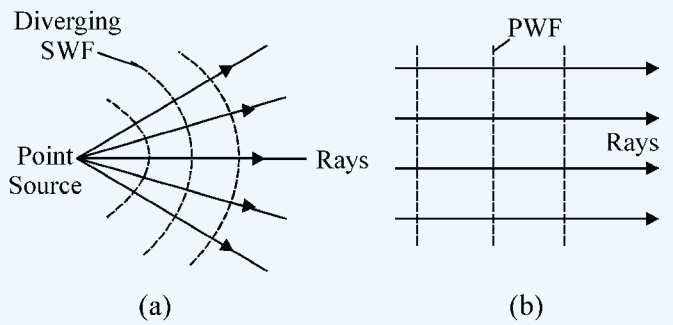
What is the shape of the wavefront in each of the following cases: (a) Light diverging from point source. (b) Light emerging out of a convex lens when a point source is placed at its focus. (b) (c) The portion of the wavelength of light from a distant star intercepted by the Earth.
Answer
(a) The geometrical shape of the wave front would be diverging spherical wave front, as shown in Fig. (a). (b) When a point source is placed at the focus of a convex lens, the rays emerging from the lens are parallel. Therefore, the wave front must be plane, as shown in Fig. (b). (c) As the star (i.e. source of light is very far off i.e. at inifnity, the wave front intercepted by earth must be a plane wave front as shown in Fig. (b).
Monochromatic light of wavelength 589 nm is incident from air on a water surface. What are the wavelength, frequency and speed of (a) reflected, and (b) refracted light? Refractive index of water is 1.33.
Answer
Here $, \quad \lambda=589 nm, \quad c=3 \times 10^8 m / s , \mu=1.33$ (a) For reflected light wavelength, $\lambda=589 nm=589 \times 10^{-9} m, v=\frac{c}{\lambda}$ $=\frac{3 \times 10^8}{589 \times 10^{-9}}=5.09 \times 10^{14}$ hertz speed, $v=c=3 \times 10^8 m / s$ (b) For refracted light $\lambda^{\prime}=\frac{\lambda}{\mu}=\frac{589 \times 10^{-9}}{1.33}=4.42 \times 10^{-7} m$ As frequency remains unaffected on entering another medium, therefore, v' = v = 5.09 1014 hz speed, $v^{\prime}=\frac{c}{\mu}=\frac{3 \times 10^8}{1.33}$ $=2.25 \times 10^8 m / s$