Questions

5 Marks Questions

Take a timed test

15 questions · self-marked practice — reveal the answer and mark yourself.

Question 15 Marks
Neelam’s father needs $1\frac34$ m of cloth for the skirt of Neelam’s new dress and $\frac12$ m for the scarf. How much cloth must he buy in all?
Answer
Given, cloth for skirt $=1\frac34\text{m.}$And cloth required for scarf $=\frac12\text{m}.$
In order to find the total cloth, Neelam's father must buy, we will add $1\frac34$ and $\frac12$
$\therefore$ Total cloth $=1\frac{3}{4}+\frac12$
$=\frac{1\times4+3}{4}+\frac12$
$\because$ Mixed fraction = Improper fraction $=\frac{\text{Whole number}\times\text{Denominator}+\text{Numerator}}{\text{Denominator}}$
$=\frac74+\frac12$
$=\frac74+\frac{1\times2}{2\times2} [ \because LCM$ of $2$ and $4$ is $4,$ so convert each of the given faction to an equivalent fraction with denominator $4.]$
$=\frac{7}{4}+\frac24=\frac{7+2}{4}=\frac94=2\frac14\text{m}$
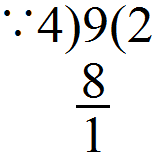
So, he must buy $2\frac14\text{m}$ cloth.
View full question & answer
Question 25 Marks
Sunil purchased $12\frac12$ litres of juice on Monday and $14\frac34$ litres of juice on Tuesday. How many litres of juice did he purchase together in two days?
Answer
Given, juice purchased by Sunil on Monday $=12\frac12\text{L}.$And juice purchased by Sunil on Tuesday $=14\frac34\text{L}.$
$\therefore$ Total juice purchased $=12\frac12+14\frac34$
$=\frac{12\times2+1}{2}+\frac{14\times4+3}{4}$
$\because$ Mixed fraction = Improper fraction $=\frac{\text{Whole number×Denominator+Numerator}}{\text{Denominator}}$
$\frac{25}{2}+\frac{59}{4}$
$=\frac{25\times2}{2\times2}+\frac{59\times1}{4\times1}  [ \therefore LCM$ of $2$ and $4$ is $4$ so convert each fraction to an equivalent fraction with denominator $4]$

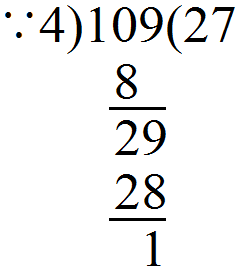
$=\frac{50}{4}+\frac{59}{4}=\frac{50+59}{4}=\frac{109}{4}=27\frac14\text{L}$
So, he purchased $27\frac14\text{L}$ of juice in two days.
View full question & answer
Question 35 Marks
The fish caught by Neetu was of weight $3\frac34 \ kg$ and the fish caught by Narendra was of weight $2\frac12 \ kg. $ How much more did Neetu’s fish weigh than that of Narendra?
Answer
Given weight of fish caught by Neetu $=3\frac34\text{kg.}$ And
weight of fish caught by Narendra $=2\frac12\text{kg.}$ In order to find how much Neetu fish weight more,
we will find the difference between the weight of fishes.
$\therefore$ Defference between their weights $=3\frac34\text{kg}-2\frac12\text{kg}.$
$=\frac{3\times4+3}{4}-\frac{2\times2+1}{2}$
$\because$ Mixed fraction = Improper fraction $=\frac{\text{Whole number}\times\text{Denominator}+\text{Numerator}}{\text{Denominator}}$
$=\frac{15}{4}-\frac52$
$=\frac{15\times1}{4\times1}-\frac{5\times2}{2\times2} [ \because LCM$ of $4$ and $2$ is $4,$ so convert each of the given fraction to an equivalent fraction with denominator 4] $=\frac{15}{4}-\frac{10}{4}=\frac{15-10}{4}=\frac54=1\frac14\text{kg}$

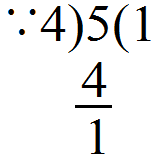
 So, Neetu's fish weight $1\frac14\text{kg}$ more than that of Narendra.
View full question & answer
Question 45 Marks
Katrina rode her bicycle $6\frac12 \ km$ in the morning and $8\frac34 \ km$ in the evening. Find the distance travelled by her altogether on that day.
Answer
Given, bicycle rode by Katrina in the morning $=6\frac12\text{km}$ And bicycle rode by Katrina in the evening $=8\frac34\text{km}$
In order to know, the total destance convered by her on that day, we will add $=6\frac12\text{km}$ and $=8\frac34\text{km}$
We have, $6\frac12+8\frac34=\frac{6\times+1}{2}+\frac{8\times4+3}{4}$
$\because$ Mixed fraction = Improper fraction $=\frac{\text{Whole number×Denominator+Numerator}}{\text{Denominator}}$
$=\frac{13}{2}+\frac{32+3}{4}  [ \because LCM$ of $2$ and $4$ is $4$ so convert each fraction to an equivalent fraction with denominator $4]$
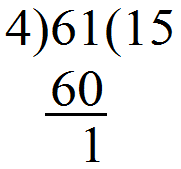
$=\frac{13\times2}{2\times2}+\frac{35\times1}{4\times1}=\frac{26}{4}+\frac{35}{4}=\frac{26+35}{4}=\frac{61}{4}=15\frac14\text{km}$

Hence, the destance travalled by Katrina together on that day is $15\frac14\text{km}.$
View full question & answer
Question 55 Marks
Arrange the fractions $\frac67,\frac78,\frac45$ and $\frac34$ in descending order.
Answer
In order to arrange the given fractions in descending order, we have to convert them into like fractions.So, $LCM$ of the denominators, i.e. $7, 8, 5$ and $4$
$= 2 \times 2 \times 2 \times 5 \times 7 = 280.$
Now, we converting the given fractions to equaivalent fractions with denominator $280.$
$\begin{array}{c|c}2&7,8,5,4\\\hline2&7,4,5,2 \\\hline2&7,2,5,1\\\hline5&7,1,5,1\\\hline7&7,1,1,1 \\\hline&1,1,1,1\end{array}$
$\frac{6\times40}{7\times40}=\frac{240}{280},$
$\frac{7\times35}{8\times35}=\frac{245}{280}{},$
$\frac{4\times56}{5\times56}=\frac{224}{280},$
$\frac{3\times70}{4\times70}=\frac{210}{280}$
Clearly, $\frac{245}{280}>\frac{240}{280}>\frac{224}{280}>\frac{210}{280}$ [In the fractions, fraction whose numerator is largest will be the largest fraction]
$\therefore\frac78>\frac67>\frac45>\frac34$
View full question & answer
Question 65 Marks
Nazima gave $2\frac34$ litres out of the $5\frac12$ litres of juice she purchased to her friends. How many litres of juice is left with her$?$
Answer
Given, quantity of juice Nazima has $=5\frac12\text{L}.$And she gave $2\frac34\text{L}$ out of this to her friends.
In order to find the juice left with her, we will subtract $2\frac34\text{L}$ from $5\frac12\text{L}$
$\therefore$ Juice left with her $=5\frac12-2\frac34$
$=\frac{5\times2+1}{2}-\frac{2\times4+3}{4}$
$\because$ Mixed fration = Improper fraction $=\frac{\text{Whole number×Denominator+Numerator}}{\text{Denominator}}$
$=\frac{11}2-\frac{11}4=\frac{11\times2}{2\times2}-\frac{11}{4} [ \because LCM$ of $2$ and $4$ is $4$ so convert each fraction to an equivalent fraction with denominator $4]$

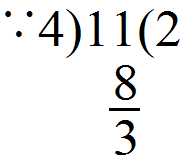
$=\frac{22}{4}-\frac{11}{4}=\frac{22-11}{4}=\frac{11}{4}=2\frac34\text{L}$
So, $2\frac34\text{L}$ of juice is left with her.
View full question & answer
Question 75 Marks
Nasir travelled $3\frac12 \ km$ in a bus and then walked $1\frac18 \ km$ to reach a town. How much did he travel to reach the town?
Answer
Given, distance travelled by bus $=3\frac12\text{km}$ And distance walked by Nasir to reach town $=1\frac18\text{km.}$ In order to find the total distance travelled by Nasir to reach the town we will add $3\frac12$ and $1\frac18.$
$\therefore$ Total distance $=3\frac12+1\frac18$
$=\frac{3\times2+1}{2}+\frac{1\times8+1}{8}$
$\because$ Mixed fraction $=$ Improper fraction $=\frac{\text{Whole number}\times\text{Denominator}+\text{Numerator}}{\text{Denominator}}$
$=\frac72+\frac98=\frac{7\times4}{2\times4}+\frac{9\times1}{8\times1}  [ \because LCM$ of $2$ and $8$ is $8,$
so convert each of the given fraction to an equivalent fractoin with denominator $8.]$
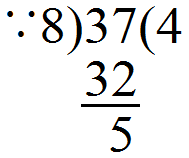
$=\frac{28}{8}+\frac98=\frac{28+9}{8}=\frac{37}{8}=4\frac58\text{km}$
 
So, total distance travelled by Nasir to reach the town is $4\frac58\text{km}.$
View full question & answer
Question 85 Marks
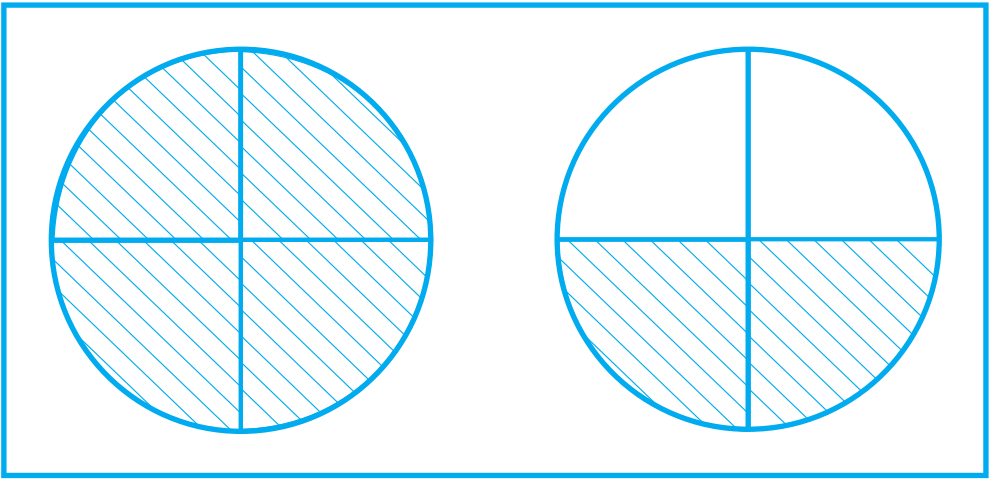
Match the fractions of Column $I$ with the shaded or marked portion of figures of Column $II:$
S.No. Column $I$ S.No. Column $II$
$i.$ $\frac64$ $A.$
$ii.$ $\frac{6}{10}$ $B.$
$iii.$ $\frac66$ $C.$
$iv.$ $\frac{6}{16}$ $D.$
    $E.$
Answer
On observing the figures given in Column $II, $ we get
$a.\ $Line is divided into $10$ equal parts out of which $6$ parts are shaded.
The fraction of shaded portion to the total parts $= \frac{6}{10}.$
$b.\ $Square is divided into $16$ equal parts out of which $6$ parts are shaded.
The fraction of shaded portion to the total parts $= \frac{6}{10}. $
$c.\ $Rectangle is divided into $7$ equal parts out of which $6$ parts are shaded.
The fraction of shaded portion to the total parts $=\frac67.$
$d.\ $Each of the two circle is divided in $4$ equal parts out of which $4$ parts of one circle and $2$ parts of second circle are shaded.
The fraction of shaded portion to the total parts $= \frac{4+2}{4+4} = \frac68.$
$e.\ $Rectangle is divided into $6$ equal parts out of which $6$ are shaded.
The fraction of shaded portion to the total parts.
Hence, the $(i) \rightarrow d, (ii) \rightarrow a, (iii) \rightarrow e, (iv) \rightarrow b, (v) \rightarrow c.$
 
View full question & answer
Question 95 Marks
It was estimated that because of people switching to Metro trains, about $33000$ tonnes of $\text{CNG}, 3300$ tonnes of diesel and $21000$ tonnes of petrol was saved by the end of year $2007.$ Find the fraction of:
$i.\ $The quantity of diesel saved to the quantity of petrol saved.
$ii.\ $The quantity of diesel saved to the quantity of $\text{CNG}$ saved.
Answer
Given, quantity of $\text{CNG}$ saved $= 33000$
tonne Quantity of diesel saved $= 3300$
tonne Quantity of petrol saved $= 21000$
tonne Fraction of the quantity of diesel saved to the quantity fo petrol saved $=\frac{3300}{21000}$ $=\frac{33}{210}=\frac{33\div3}{210\div3}[\because \text{HCF}$ of $33$ and $210$ is $3]$
$=\frac{11}{70}$ Fraction of the quantity of diesel to the quantity of $\text{CNG}$ saved $=\frac{3300}{33000}=\frac{33}{330}$
$=\frac{33\div33}{330\div33}=\frac{1}{10}$
View full question & answer
Question 105 Marks
Arrange in ascending order: $0.011, 1.001, 0.101, 0.110.$
Answer
Given numbers are $0.011, 1.001, 0.101$ and $0.110.$
$\therefore0.011=0+\frac{0}{10}+\frac{1}{100}+\frac{1}{1000}$
$1.001=1+\frac{0}{10}+\frac{0}{100}+\frac{1}{1000}$
$0.101=0+\frac{1}{10}+\frac{0}{100}+\frac{1}{1000}$
$0.110=0+\frac{1}{10}+\frac{1}{100}+\frac{0}{1000}$
Here, the whole number part of $1.001$ is greater than $0.011, 0.101$ and $0.110.$
Now, tenths part of $0.101=\frac{1}{10}$
And tenths part of $0.110=\frac{1}{10}$
$\therefore 0.011<0.101$ and $0.011<0.110$
Again, hundredths parts of $0.101=\frac{1}{100}$
And hundredths parts of $0.110=\frac{1}{100}$
$\therefore 0.101<0.110$
Hence, the ascending order of given numbers are $0.011<0.101<0.110<1.001$
View full question & answer
Question 115 Marks
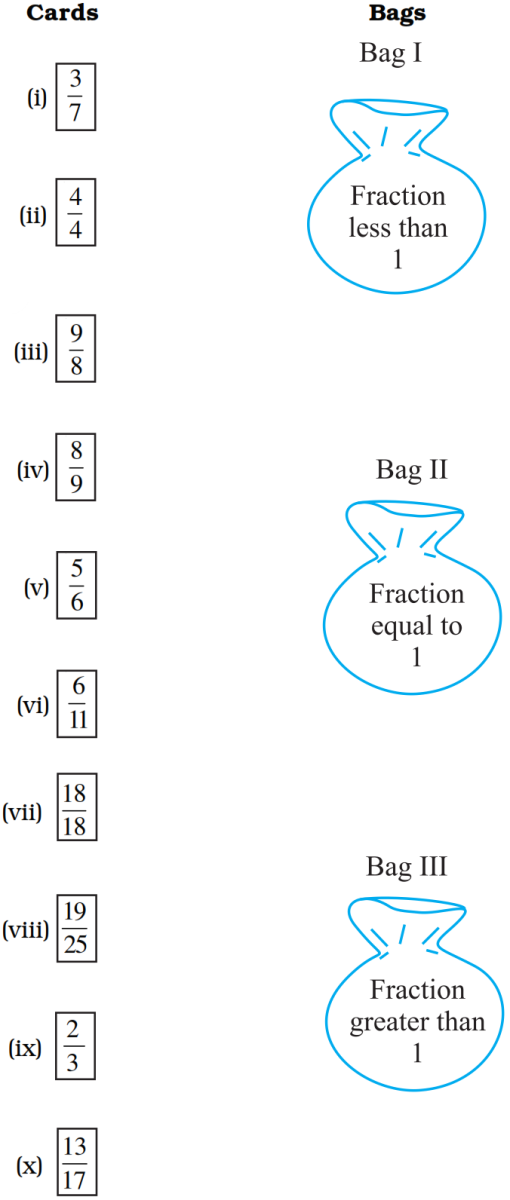
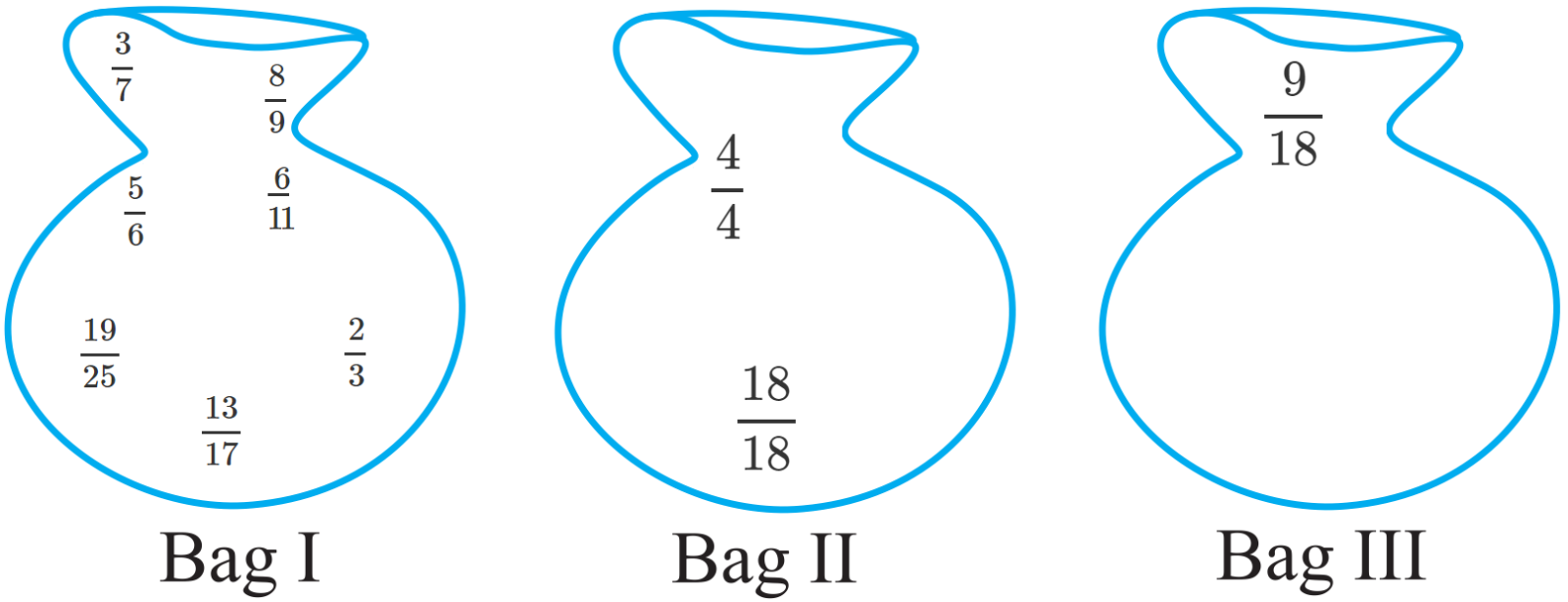
Put the right card in the right bag.
Answer
We know that, a fraction is of the from $\frac{\text{p}}{\text{q}},$ where $p$ is called the numerator $(N)$ and $q$ is called the Denominator $(D)$ than,
$a.$ If $\frac{\text{p}}{\text{q}}$ is a proper fractionk, i.e. $p < q,$ then the value of fraction is always less than $1.$
$b.$ If $\frac{\text{p}}{\text{q}}$ is an Improper fraction , i.e. $p > q,$ then the value of fraction is always greater than $1.$
$c.$ If $\frac{\text{p}}{\text{q}}$ is a fraction in which $p = q,$ then value of fraction is always aqual to $1.$
$i.\ \frac37 $
Here, $3 < 7,$ i.e. $N < D$. So, the value of fraction is less than $1.$
$ii.\  \frac44 $
Here, $4 = 4 ,$ i.e. $N = D.$ So, the value of fraction is equal to $1.$
$iii.\ \frac98$
Here, $9 > 8,$ i.e. $N > D.$ So, the value of fraction is greater than $1.$
$iv.\ \frac89$
Here, $8 < 9,$ i.e. $N < D.$ So, the value of fraction is less than $1.$​​​​​​​
$v.\ \frac56$
Here, $5 < 6,$ i.e. $N < D.$ So, the value of fraction is less than $1.$​​​​​​​
$vi.\ \frac{6}{11}$
$\frac{18}{18}$
$\frac{19}{25}$
Here, $19 < 25,$ i.e. $N < D.$ So, the value of fraction is less than $1.$​​​​​​​
$ix.\ \frac23$
$\frac{13}{17}$
Here, $13 < 17,$ i.e. $N < D.$ So, the value of fraction is less than $1.$​​​​​​​
View full question & answer
Question 125 Marks
Write a pair of fractions whose sum is $\frac{7}{11}$ and difference is $\frac2{11}.$
Answer
Let $a$ and $b$ be the pair of fraction whose sum is $\frac{7}{11}$ and difference is $\frac{2}{11},$
then $\text{a}+\text{b}=\frac{7}{11}\ ...\text{(i)}$
and $\text{a}-\text{b}=\frac{2}{11}\ ...\text{(ii)}$
On adding $Eqs. (i)$ and $(ii),$ we get
$(\text{a}+\text{b})+(\text{a}-\text{b})=\frac{7}{11}+\frac{2}{11}$
$\Rightarrow\text{a}+\text{b}+\text{a}-\text{b}=\frac{7+2}{11}$
$\Rightarrow\text{2a}=\frac{9}{11}$
$\Rightarrow\text{a}=\frac{9}{11\times2}=\frac9{22}$
On substituting value of a in $Eq. (i),$ we get
$\frac{9}{22}+\text{b}=\frac{7}{11}$
$\Rightarrow\text{b}=\frac{7}{11}-\frac{9}{22}$
$\Rightarrow\text{b}=\frac{7\times2}{11\times2}-\frac{9}{22}  [ \because LCM$ of $11$ and $22$ is $22$ so convert each fraction to an equivalent fraction with denominator $22.]$
$\Rightarrow\text{b}=\frac{14}{22}-\frac{9}{22}$
$\Rightarrow\text{b}\frac{14-9}{22}=\frac{5}{22}$
So, $\frac{9}{22}$ and $\frac{5}{22}$ is a pair of fraction,
whose sum is $\frac{7}{11}$ and defferences is $\frac{2}{11}.$
View full question & answer
Question 135 Marks
Roma gave a wooden board of length $150\frac14 \ cm$ to a carpenter for making a shelf. The Carpenter sawed off a piece of $40\frac15 \ cm$ from it. What is the length of the remaining piece?
Answer
Given, total length of wooden board given by Roma $=150\frac14\text{cm}$ And
the length of piece sawed off by carpenter $=40\frac15\text{cm}.$
In order to find the length of the remaining piece, we will sutract $40\frac15$ from $150\frac14.$
$\therefore$ Length of the remaining piece
$=150\frac14-40\frac15{}{}$
$=\frac{150\times4+1}{4}-\frac{40\times5+1}{5}$
$\because$ Mixed fraction $=$ Improper fraction $=\frac{\text{Whole number\times Denominator+Numerator}}{\text{Denominator}}$
$=\frac{601}{4}-\frac{201}{5}$
$=\frac{601\times5}{4\times5}-\frac{201\times4}{5\times4}[\because LCM$ of $4$ and $5$ is $20,$ so convert each fraction to an equivalent fraction with denominator $20.]$
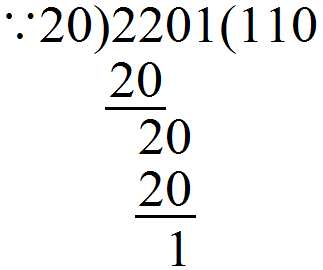
$=\frac{3005}{20}-\frac{804}{20}=\frac{2201}{20}=110\frac{1}{20}\text{cm}$

So, the length of the remaining piece is $110\frac{1}{20}\text{cm.}$
View full question & answer
Question 145 Marks
Arrange in ascending order: $0.011, 1.001, 0.101, 0.110.$
Answer
Given numbers are $0.011, 1.001, 0.101$ and $0.110.$
$\therefore0.011=0+\frac{0}{10}+\frac{1}{100}+\frac{1}{1000}$
$1.001=1+\frac{0}{10}+\frac{0}{100}+\frac{1}{1000}$
$0.101=0+\frac{1}{10}+\frac{0}{100}+\frac{1}{1000}$
$0.110=0+\frac{1}{10}+\frac{1}{100}+\frac{0}{1000}$
Here, the whole number part of $1.001$ is greater than $0.011, 0.101$ and $0.110.$
Now, tenths part of $0.101=\frac{1}{10}$
And tenths part of $0.110=\frac{1}{10}$
$\therefore 0.011<0.101$ and $0.011<0.110$
Again, hundredths parts of $0.101=\frac{1}{100}$
And hundredths parts of $0.110=\frac{1}{100}$
$\therefore 0.101<0.110$
Hence, the ascending order of given numbers are $0.011<0.101<0.110<1.001$
View full question & answer
Question 155 Marks
Alok purchased $1\ kg\ 200\ g$ potatoes, $250\ g$ dhania, $5\ kg\ 300\ g$ onion, $500\ g$ palak and $2\ kg\ 600\ g$ tomatoes. Find the total weight of his purchases in kilograms.
Answer
Firstly, we convert all the weight in the same unit,i.e. gram into kilogram and then find the total weight.
Given, weight of potatoes $= 1\ kg + 200\ g$
$= 1\ kg + 200\ g$
$=1\text{kg}+\frac{200}{1000}\text{kg}$
$=1\text{kg}+0.200\text{kg}\Big[\because1\text{g}\frac{1}{1000}\text{kg}\Big]$
$=1.200\text{kg}$
Weifht of dhania $=250\text{g}=\frac{250}{1000}\text{kg}=0.250\text{kg}$
Weight of onion $=5\text{kg}300\text{g}=5\text{kg}+\text{300g}$
$=5\text{kg}=\frac{300}{1000}\text{kg}=5\text{kg}+0.300\text{kg}$
$=5.300\text{kg}$
Weight of palak $=500\text{g}=\frac{500}{1000}\text{kg}=0.500\text{kg}$
Weight of tomatoes $2\text{kg}600\text{g}=2\text{kg}+600\text{g}$
$=2\text{kg}+\frac{600}{1000}\text{kg}\Big[\because\text{1g}=\frac{1}{1000}\text{kg}\Big]$
$=2\text{kg}+0.600\text{kg}=2.600\text{kg}$
$\therefore$ Total weight of his purchases in kg
$=$ Weight of potatoes $+$ Weight oa dhania $+$ Weight of onion $+$ Weight of palak $+$ Weight of tomatoes
$= 1.200\ kg + 0.250\ kg + 5.300\ kg + 0.500\ kg + 2.600\ kg$
$= [1.200 + 0.250 + 5.300 + 0.500 + 2.600]\ kg = 9.850\ kg$
Hence, the total weight is $9.850\ kg.$
View full question & answer