Questions

2 Marks Questions

Take a timed test

8 questions · self-marked practice — reveal the answer and mark yourself.

Question 12 Marks
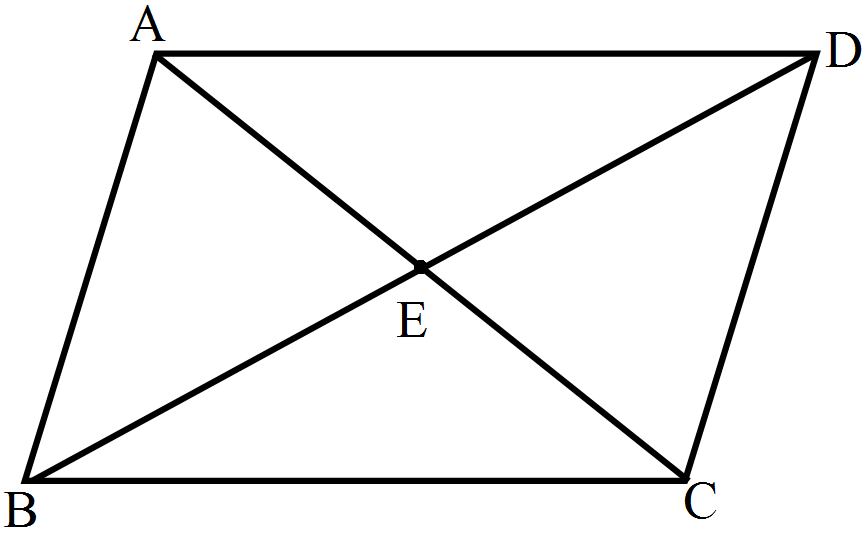
In Fig.,
$a.\ $What is $AE + EC?$
$b.\ $What is $AC - EC?$
$c.\ $What is $BD - BE?$
$d.\ $What is $BD - DE?$
Answer
From the figure, we observe that:
$a.\ \text{AE + EC = AC}$
$b.\ \text{AC - EC = AE}$
$c.\ \text{BD - BE = ED}$
$d.\ \text{BD - DE = BE}$
View full question & answer
Question 22 Marks
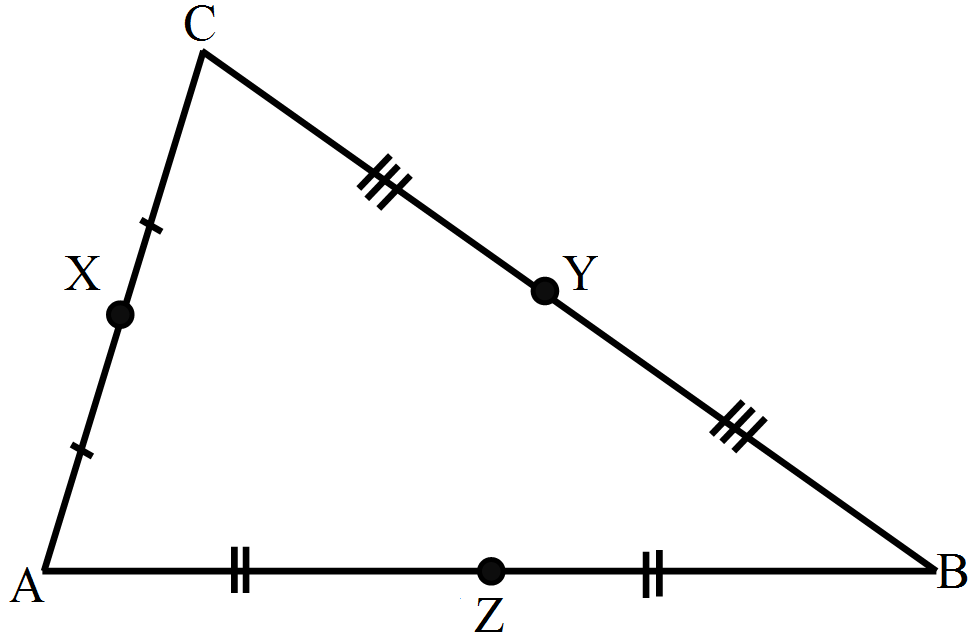
State the mid points of all the sides of Fig.
Answer
Mid-point of a line segment divides it into two equal parts.
Clearly, from the figure, $AZ = ZB, AX = XC$ and $CY = YB.$
 So $Z, X$ and $Y$ are the mid-points of $AS, AC$ and $CB,$ respectively.
 Hence, there are $3$ mid-points, i.e. $X, Z$ and $Y.$
View full question & answer
Question 32 Marks
In Fig.,
$a.\ $Is $AC + CB = AB?$
$b.\ $Is $AB + AC = CB?$
$c.\ $Is $AB + BC = CA?$
Answer
$a.\ $Yes.
$b.\ $No, it is not possible.
$c.\ $No, it is not possible.
View full question & answer
Question 42 Marks
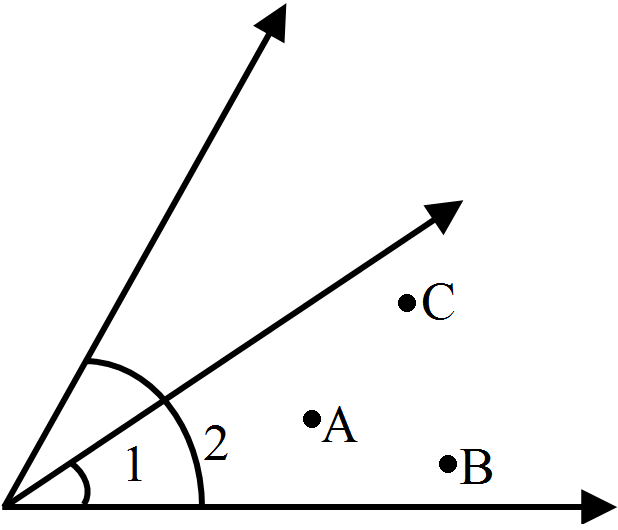
Look at Fig. Mark a point:
$1.\ A$ which is in the interior of both $\angle1$ and $\angle2$
$2.\ B$ which is in the interior of only $\angle1$
$3.$ Point $C$ in the interior of $\angle1.$

Now, state whether points $B$ and $C$ lie in the interior of $\angle2$ also.
Answer
Yes, points $B$ and $C$ lie in the interior of $\angle2$ also. Since, $\angle1$ is in interior of $\angle2, $ then all the points lying inside the $\angle1$, will also lie inside the $\angle2$
View full question & answer
Question 52 Marks
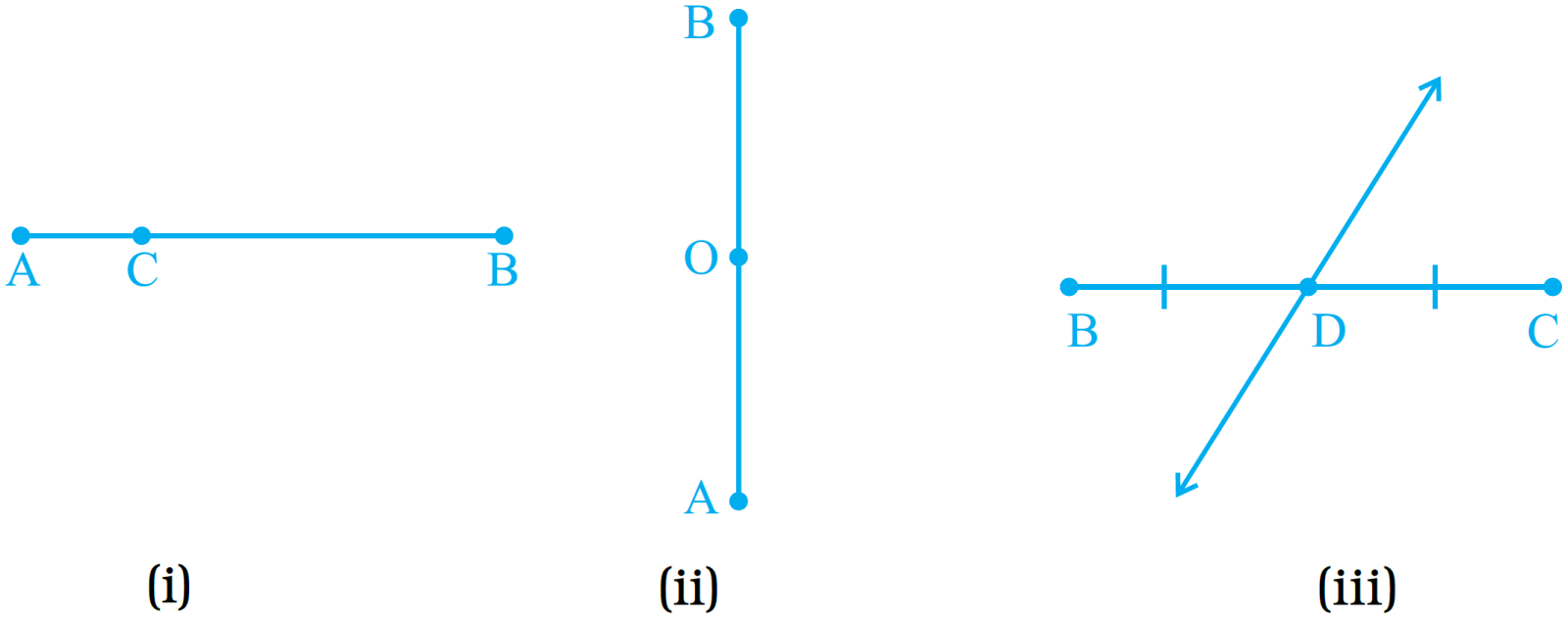
Which points in Fig., appear to be mid-points of the line segments? When you locate a mid-point, name the two equal line segments formed by it.
Answer
In figure $(ii),$ point $O$ appears to be the mid-point and equal line segments formed are $OA$ and $OB. $ Also, in figure $(iii),$ point $D$ appears to be the mid-point and equal line segments formed are $BD$ and $DC.$
View full question & answer
Question 62 Marks
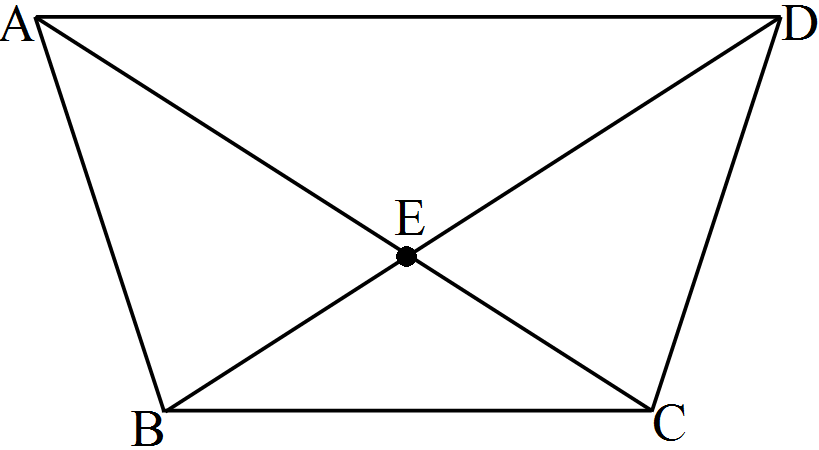
In Fig.,
$a.\ $Name any four angles that appear to be acute angles.
$b.\ $Name any two angles that appear to be obtuse angles.
Answer
$1.$ The four angles that appear to be acute angles are $\angle\text{AEB}, \angle\text{ADE}, \angle\text{BAE}$ and $\angle\text{BCE}$
$2.\ \angle\text{BCD}$ and $\angle\text{BAD}$ are angles that appear to be obtuse angles $($answer may vary$).$
View full question & answer
Question 72 Marks
Is it possible for the same:
$a.\ $Line segment to have two different lengths?
$b.\ $Angle to have two different measures?
Answer
$a.\ $No, it is not possible that the same line segments have two different lengths,
$b.\ $No, it is not possible that the same angles have two different measures.
View full question & answer
Question 82 Marks
Can we have two obtuse angles whose sum is:
$a.\ $A reflex angle? Why or why not?
$b.\ $A complete angle? Why or why not?
Answer
$a.\ $Yes, the sum of two obtuse angles is always greater than $180^\circ .$ Hence, the sum of two obtuse angles may be a reflex angle.
$b.\ $No, the sum of two obtuse angles cannot be $360^\circ .$ Because each obtuse angle lies between $90^\circ $ to $180^\circ .$ So, the sum of the two obtuse angles lies between $180^\circ $ to $360^\circ .$
View full question & answer