Questions

3 Marks Question

Take a timed test

7 questions · self-marked practice — reveal the answer and mark yourself.

Question 13 Marks
Write the name of:
$a.\ $Vertices.
$b.\ $Edges, and
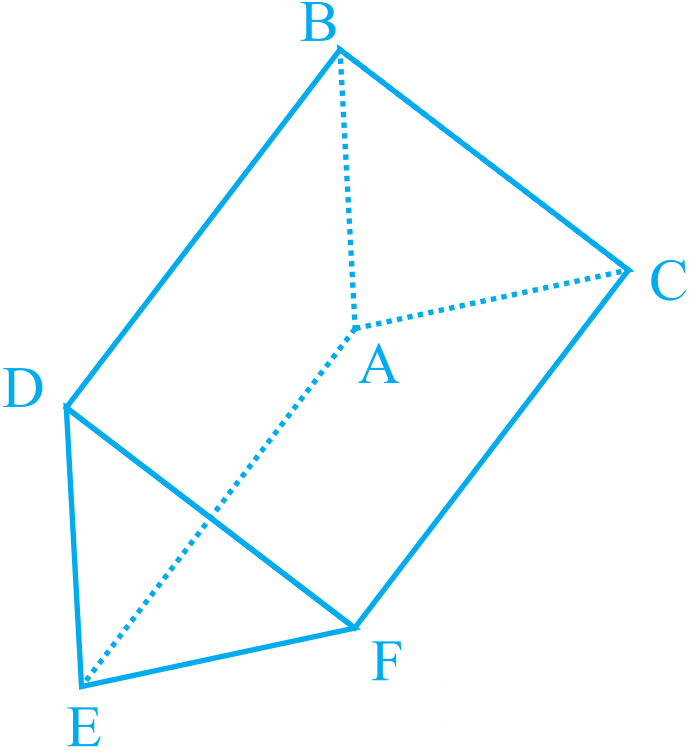
$c.\ $Faces of the prism shown in Fig.
Answer
$a.\ $Vertices shown in the figure are $\text{A, B, C, D, E}$ and $F$.
$b.\ $Edges shown in the figure are $\text{AB, AC, BC, BD, DF, FC, EF, ED}$ and $\text{AE.}$
$c.\ $Faces of prism shown in the figure are $\text{ABC, DEF, AEFC, AEDB}$ and $\text{BDFC.}$
View full question & answer
Question 23 Marks
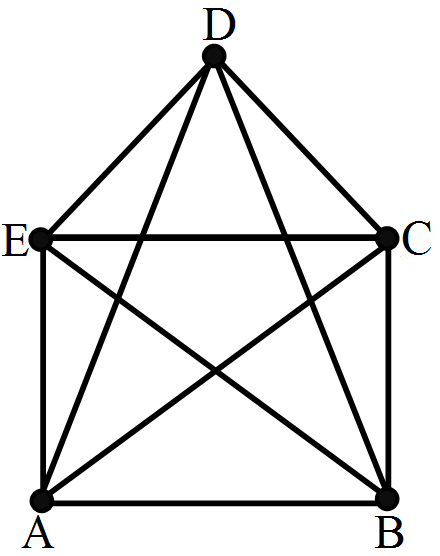
Draw all the diagonals of a pentagon $ABCDE$ and name them.
Answer
Since, a pentagon has five sides, i.e. $n = 5$.
Hence, the number of diagonals $=\frac{5(5-3)}{2}=5$

The diagonals of paentagon are $AC, AD, BE, BD$ and $CE.$
View full question & answer
Question 33 Marks
Name the following angles of Fig, using three letters:
$a.\ \angle1$
$b.\ \angle2$
$c.\ \angle3$
$d.\ \angle1 + \angle2$
$e.\ \angle2 + \angle3$
$f.\ \angle1 + \angle2 + \angle3$
$g.\ \angle\text{CBA} - \angle1$
Answer
 
From the figure:
$a.\ \angle1=\angle\text{CBD}$
$b.\ \angle2=\angle\text{DBE}$
$c.\ \angle3=\angle\text{EBA}$
$d.\ \angle1+\angle2=\angle\text{CBD}+\angle\text{DBE}$
$=\angle\text{CBE}$
$e.\ \angle2+\angle3=\angle\text{DBE}+\angle\text{EBA}$
$=\angle\text{DBA}$
$f.\ \angle1+\angle2+\angle+3=\angle\text{CDB}+\angle\text{DBE}+\angle\text{EBA}$
$=\angle\text{CBA}\text{ or}\angle\text{ABC}$
$g.\ \angle\text{CBA}-\angle1=\angle\text{CBA}-\angle\text{CBD}$
$=\angle\text{DBA or }\angle\text{ABD}$
 
View full question & answer
Question 43 Marks
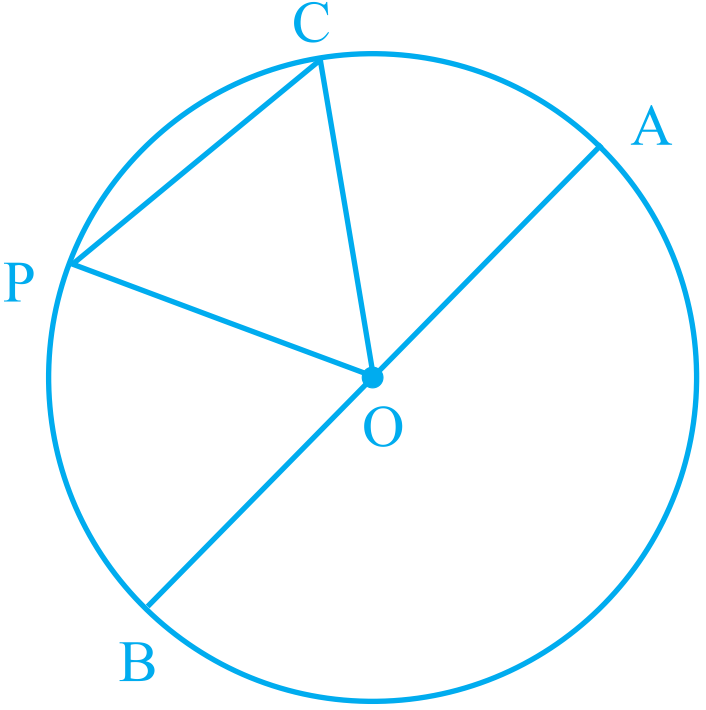
In Fig. $O$ is the centre of the circle.

$a.\ $ Name all chords of the circle.
$b.\ $ Name all radii of the circle.
$c.\ $ Name a chord, which is not the diameter of the circle.
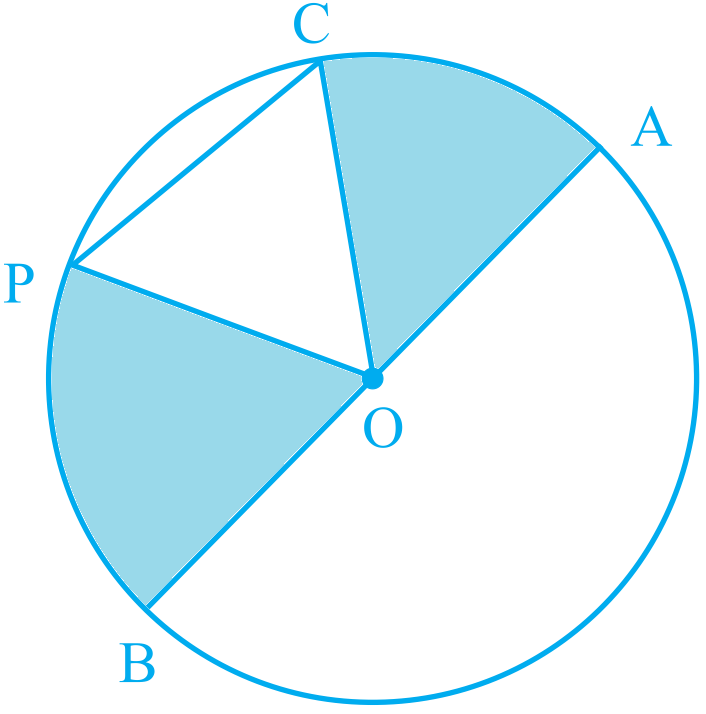
$d.\ $ Shade sectors $OAC$ and $OPB$.
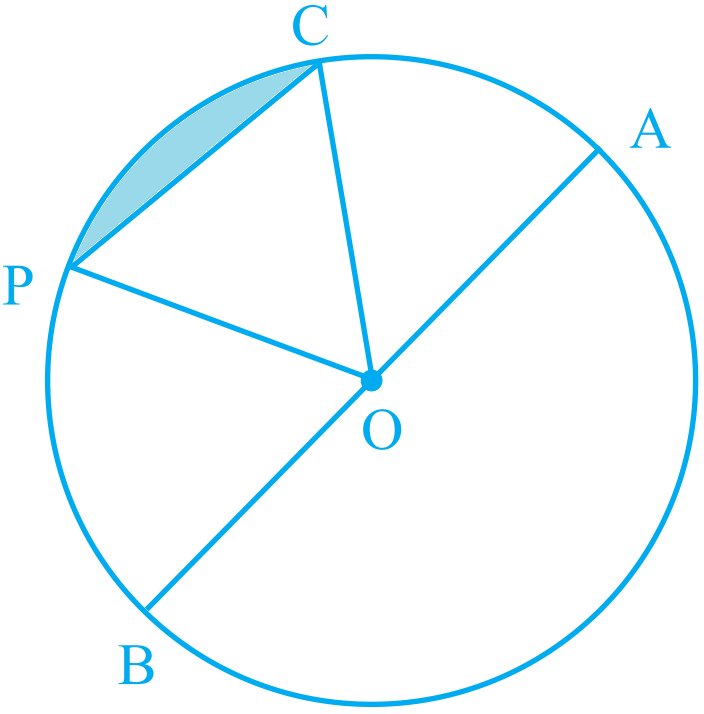
$e.\ $Shade the smaller segment of the circle formed by $CP$.
Answer
A chord of a circle is a straight line segment whose both end points lie on the circle. The longest chord which passes through the centre of the circle is known as diameter. Line segment joining the centre to the point which lie on the circle is known as radius. The portion of a circle enclosed by two radii is known as sector. The segment of a circle is the region bounded by a chord and the arc subtended by the chord.
$a.\ CP$ and $AB$ are the two chords.
$b.\ \text{OA, OB, OC}$ and $OP$ are the radii of the circle.
$c.\ CP$ is a chord which is not the diameter of the circle because it does not pass through the centre.
$d.\ $Shaded sectors $\text{OAC}$ and $\text{OPB}$ are as:

$e.\ $Shaded smaller segment of the circle fromed by $CP$ is as:
 
View full question & answer
Question 53 Marks
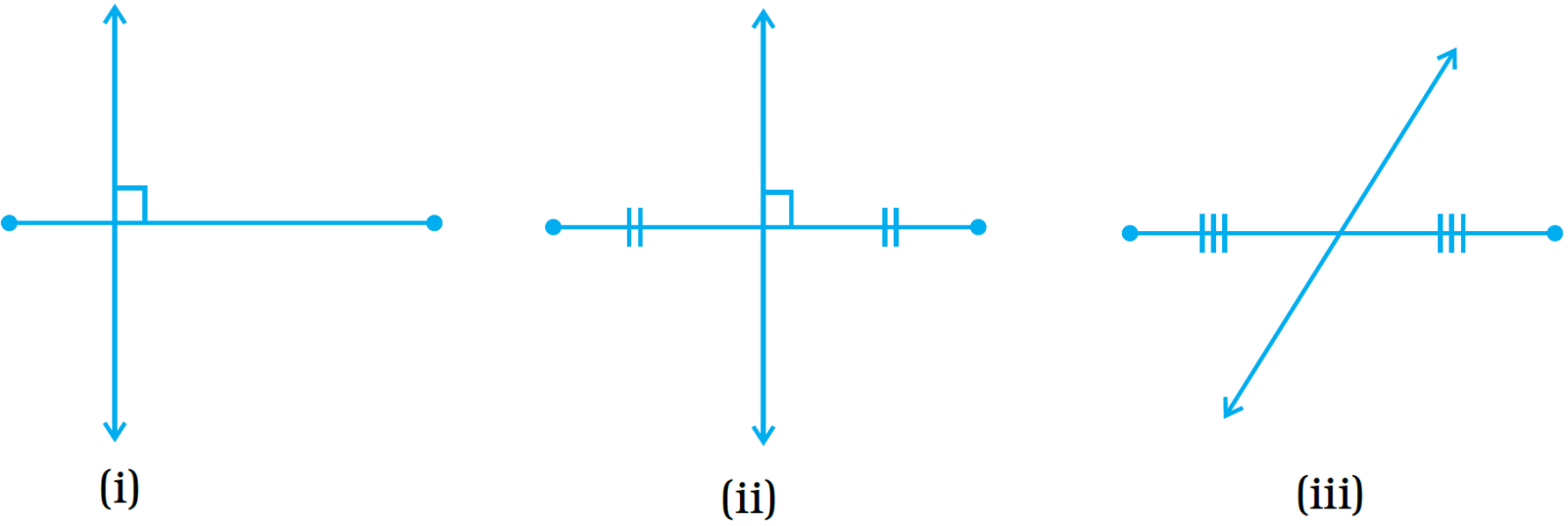
In which of the following figures:
$a.\ $Perpendicular bisector is shown?
$b.\ $Bisector is shown?
$c.\ $Only bisector is shown?
$d.\ $Only perpendicular is shown?

Answer
A bisector is a line which bisects a given line segment into two equal parts. If this bisector is perpendicular to the given line segment, then it is known as perpendicular bisector.
$a.\ $Figure $(ii)$ represents a perpendicular bisector.
$b.\ $Figures $(ii)$ and $(iii)$ represent bisectors.
$c.\ $Figure $(iii)$ represents only bisector.
$d.\ $Figure $(i)$ represents only perpendicular.
View full question & answer
Question 63 Marks
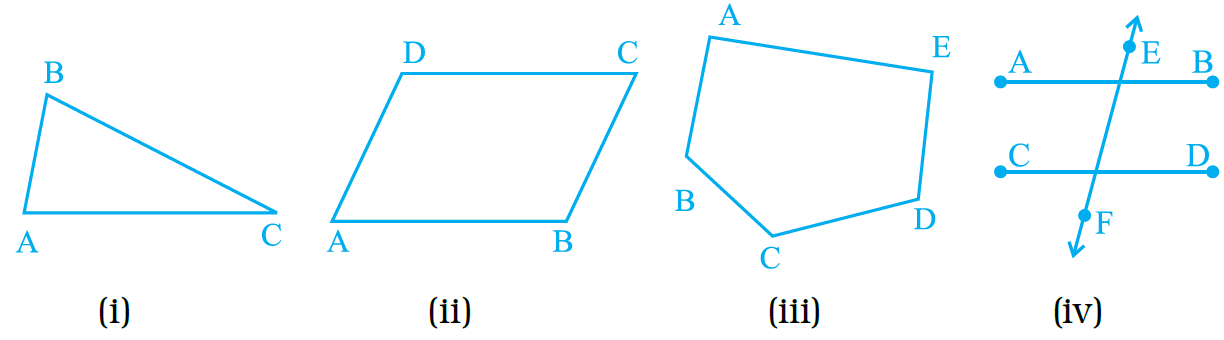
Name the points and then the line segments in each of the following figures:
Answer
$i.\ $Points: $\text{A, B}$ and $C$
Line segments: $\text{AB, BC}$ and $CA$
$ii.\ $Points: $\text{A, B, C}$ and $D$
Line segments: $\text{AB, BC, CD}$ and $DA$
$iii.\ $Points: $\text{A, B, C, D}$ and $E$
Line segments: $\text{AB, BC, CD, DE}$ and $EA$
$iv.\ $Points: $\text{A, B, C, D, E}$ and $F$ Line segments: $\text{AB, CD}$ and $EF$
View full question & answer
Question 73 Marks
Can we have two acute angles whose sum is:
$a.\ $An acute angle? Why or why not?
$b.\ $A right angle? Why or why not?
$c.\ $An obtuse angle? Why or why not?
$d.\ $A straight angle? Why or why not?
$e.\ $A reflex angle? Why or why not?
Answer
$a.\ $Yes, the sum of the two acute angles may be less than a right angle, e.g. $30^\circ $ and $45^\circ $ are acute angles and their sum (i.e. $30^\circ + 45^\circ = 75^\circ $) is also an acute angle.
$b.\ $Yes, the sum of two acute angles may be equal to a right angle, e.g. $30^\circ + 60^\circ = 90^\circ .$
$c.\ $Yes, the sum of two acute angles may be more than a right angle, i.e. obtuse angle, e.g. $60^\circ + 70^\circ = 130^\circ .$
$d.\ $No, the sum of two acute angles is always less than a straight angle, i.e. $180^\circ .$
$e.\ $No, the sum of two acute angles is always less than $180^\circ $. So, their sum cannot be a reflex angle.
View full question & answer