Questions

1 Marks Question

Take a timed test

17 questions · self-marked practice — reveal the answer and mark yourself.

Question 11 Mark
A table-top measures $2\ m$ by $1\ m\ 50\ cm.$ What is its area in square metres$?$
Answer
Length of the table-top $= 2\ m$
Breadth of the table-top $= 1\ m\ 50\ cm = 1.50\ m$
$\therefore$ Area of the table-top $=$ Length $\times$ Breadth $= 2\ m \times 1.50\ m$
$= 3.0\ sq\ m$
View full question & answer
Question 21 Mark
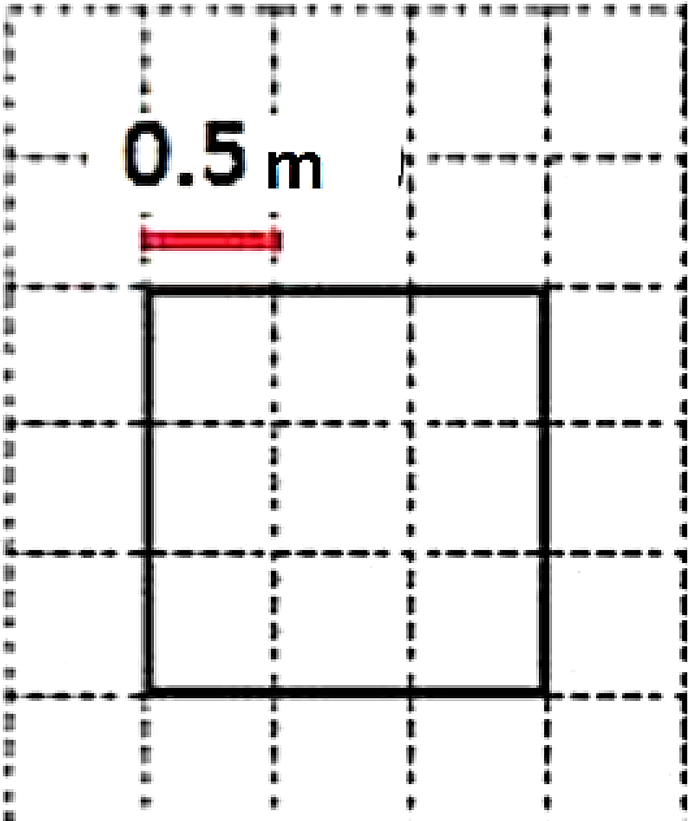
What is the perimeter of the figure? What do you infer from the answer?
Answer
Area of the square $=$ side $\times$ side
$= 5\ m \times 5\ m = 25\ sq\ m$
View full question & answer
Question 31 Mark
Find the area of the square whose side are $14 \ cm.$
Answer
Area of the square $=$ side $\times$ side
$= 14 \ cm \times 14 \ cm = 196\ sq \ cm$
View full question & answer
Question 41 Mark
Find the area of the square whose side are $10 \ cm.$
Answer
Area of the square $=$ side $\times$ side
$= 10 \ cm \times 10 \ cm = 100\ sq \ cm$
View full question & answer
Question 51 Mark
Find the area of the rectangle whose side are $2 \ km$ and $3 \ km.$
Answer
Area of the rectangle $=$ Length $\times$ Breadth $ = 2 \ km \times 3 \ km = 6\ sq \ km$
View full question & answer
Question 61 Mark
Find the area of the rectangle whose side are $12\ m$ and $21\ m.$
Answer
Area of the rectangle $=$ Length $\times$ Breadth $= 12\ m \times 21\ m = 252 \ sq\ m$
View full question & answer
Question 71 Mark
Find the area of the rectangle whose side are $3 \ cm$ and $4 \ cm.$
Answer
Area of the rectangle $=$ Length $\times$ Breadth $= 3 \times 4 \ cm = 12\ sq \ cm$
View full question & answer
Question 81 Mark
Find the area of the figure by counting squares:
Answer
From the figure, we see that it contains $9$ fully filled squares.
If the area of one such square is taken to be as $1$ square unit.
Then,
The area of the figure $= 9$ square units.
View full question & answer
Question 91 Mark
Find the area of the figure by counting squares:
Answer
From the figure, we see that it contains $5$ fully filled squares.
If the area of one such square is taken to be as $1$ square unit.
Then,
The area of the figure $= 5$ square units.
View full question & answer
Question 101 Mark
Find the area of the figure by counting squares:
Answer
Full-filled squares $= 10$
$\therefore$ Total Area $=$ Area covered by full squares $= 10 \times 1$ sq unit $= 10$ sq units
View full question & answer
Question 111 Mark
Find the area of the figure by counting squares:
Answer
Full-filled squares $= 8$
$\therefore$ Total Area $=$ Area covered by $8$ full squares $= 8  \times 1$ sq unit $= 8$ sq units
View full question & answer
Question 121 Mark
Find the area of the figure by counting squares:
Answer
From the figure, we see that it contains $5$ fully filled squares.
If the area of one such square is taken to be as $1$ square unit.
Then,
The area of the figure $= 5$ square units.
View full question & answer
Question 131 Mark
Find the area of the figure by counting squares:
Answer
From the figure, we see that it contains $4$ fully filled squares and $2$ half-filled squares.
If the area of one such square is taken to be as $1$ square unit.
Therefore, The area of the figure $ = 4 + (2 \times 0.5) = 4 + 1 = 5$ square units.
View full question & answer
Question 141 Mark
Find the area of the figure by counting squares:
Answer
From the figure, we see that it contains $2$ fully filled squares and $4$ half-filled squares.
If the area of one such square is taken to be as $1$ square unit.
Then,
Area of the figure $= 2 + (4 \times 0.5) = 2 + 2 = 4$ square units.
View full question & answer
Question 151 Mark
Find the area of the figure by counting squares:
Answer
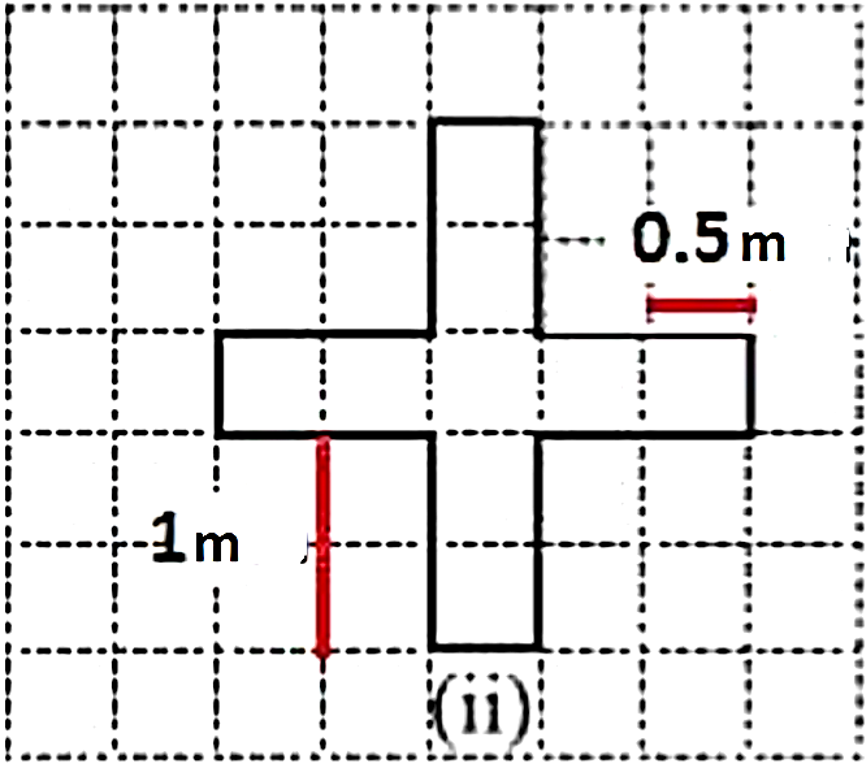
$i.$ From the given figure, the side of one slab is $\frac{1}{2} m$

Therefore, the side of the square formed by Avneet $=\left(3 \times \frac{1}{2}\right) m=\frac{3}{2} m$
Now,
We know that the perimeter of a square $= 4 \times$ Side $=4 \times \frac{3}{2}=6 \mathrm{m}$
$ii.$ We know that,
Perimeter $=$ Sum of all sides

Therefore Perimeter of the Shari's arrangement $= 0.5 + 1 + 1 + 0.5 + 1 + 1 + 0.5 + 1 + 1 + 0.5 + 1 + 1 = 10 m$
$iii.$ The arrangement which is in the shape of the cross has a greater perimeter $($i.e. $10 m)$
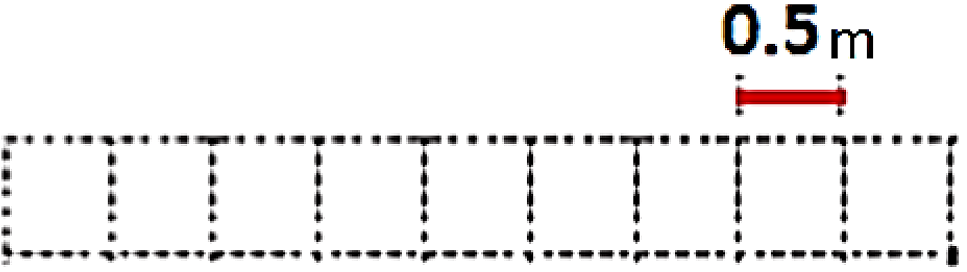
$iv.$ If we put all $9$ slabs in a line then, the perimeter will be $10 m,$ as shown below.

Thus, from the given arrangements, arrangements with perimeters greater than $10 m$ cannot be determined.
Hence $10$ is the largest possible value if the perimeter.
View full question & answer
Question 161 Mark
Find the perimeter of a regular pentagon with each side measuring $3 \ cm.$
Answer
This regular closed pentagon has 5 sides, each with a length of $3 \ cm.$
Therefore, Perimeter of the regular pentagon $= 5 \times 3 \ cm = 15 \ cm$
View full question & answer
Question 171 Mark
Find the area of a square plot of side $8\ m.$
Answer
Given that side of the square $= 8\ m$
Therefore, Area of the square $=$ side $\times$ side
$= 8\ m \times 8\ m = 64\ sq\ m.$
View full question & answer