Questions

5 Marks Questions

Take a timed test

10 questions · self-marked practice — reveal the answer and mark yourself.

Question 15 Marks
Divide the park shown in Fig. of question $40$ into two rectangles. Find the total area of this park. If one packet of fertilizer is used for $300\ sq-m,$ how many packets of fertilizer are required for the whole park$?$
Answer
$\because$ Area of rectangle $ABCG =$ Length $\times $ Breadth
$= 150 \times 100$
$= 15000\ sq-m$
and area of rectangle $DEFG =$ Length $ \times $ Breadth
$= 270 \times 180$
$= 48600\ sq-m$
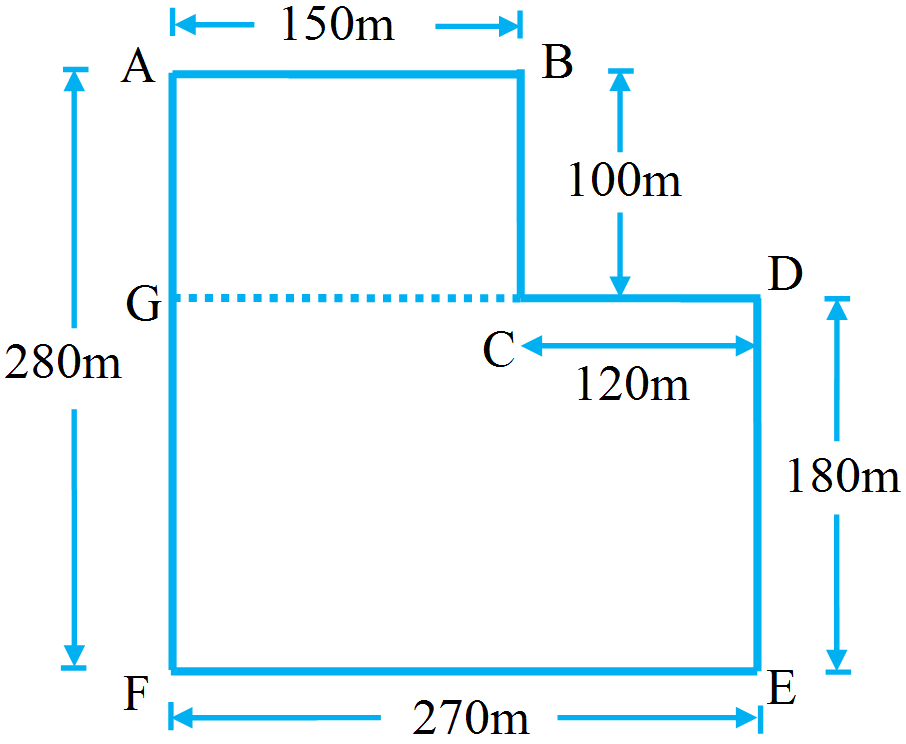
Now, total area of park $=$ Area of $ABCG\ +$ Area of $DEFG$
$= 15000 + 48600$
$= 63600\ sq-m$
Area uses by one packet of fertiliser $= 300\ sq-m [$given$]$
$\because$ In $300\ sq-m$ used paket $= 1$
$\therefore$ In $63600\ sq-m,$ used packet $=\frac{63600}{300}$
$= 121$
 
View full question & answer
Question 25 Marks
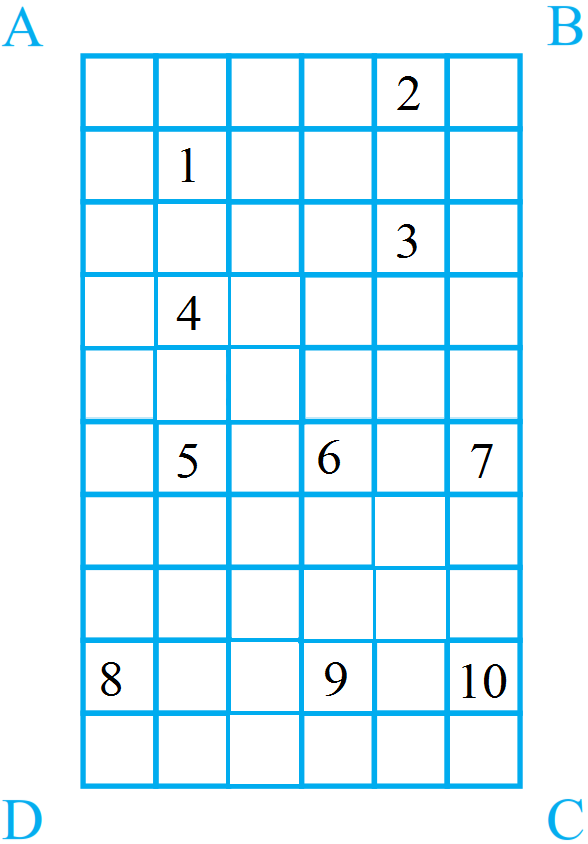
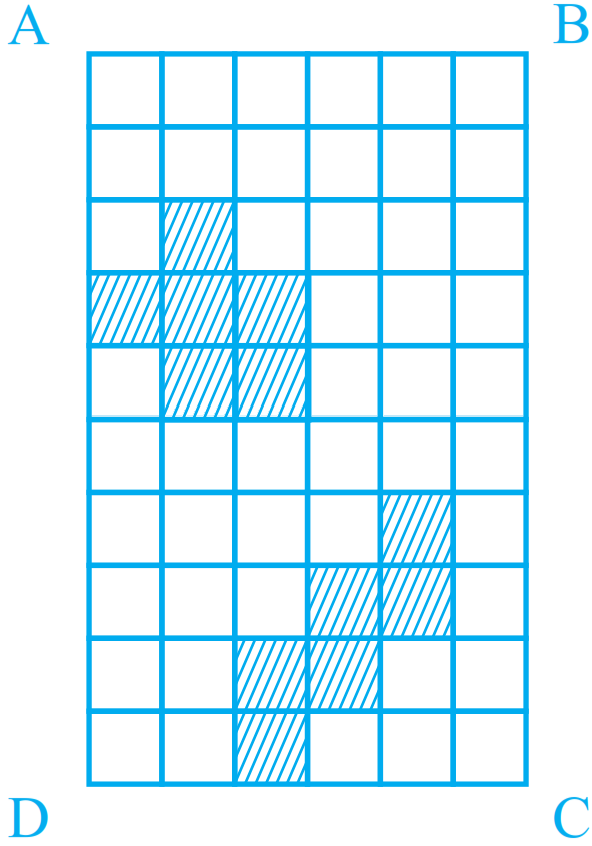
In Fig. each square is of unit length

$a.\ $What is the perimeter of the rectangle $ABCD?$
$b.\ $What is the area of the rectangle $ABCD?$
$c.\ $Divide this rectangle into ten parts of equal area by shading squares. $($Two parts of equal area are shown here$)$
$d.\ $Find the perimeter of each part which you have divided. Are they all equal?
Answer


Given, each side of square is of unit length. Figure contains length of $10$ squares and width of $6$ squares. Now, length of rectangle, $AD = BC =$ Sum of length of a side of $10$ squares $= 1 + 1 + 1 + 1 + 1 + 1 + 1 + 1 + 1 + 1 = 10 \times 1 = 10$ units and breadth of rectangle, $AB = DC =$ Width of $6$ squares $= 6 \times 1 = 6$ units
$a.\ $The perimeter of the rectangle $ABCD = AB + BC + CD + DA$
$= 6 + 10 + 6 + 10 = 32$ units
$b.\ $The area of the rectangle $ABCD =$ Length $\times $ Breadth
$= AD \times AB$
$=\frac{600}{10}=60\text{ sq units}$
$c.\ $The total area of rectangle $= 60$ sq. units.

Now, we have to divide the rectangle into $10$ equal parts i.e. $6 \times 1 = 6$ square units, i.e, we have to take a group of $6-6$ square blocks, which is shown in the figure
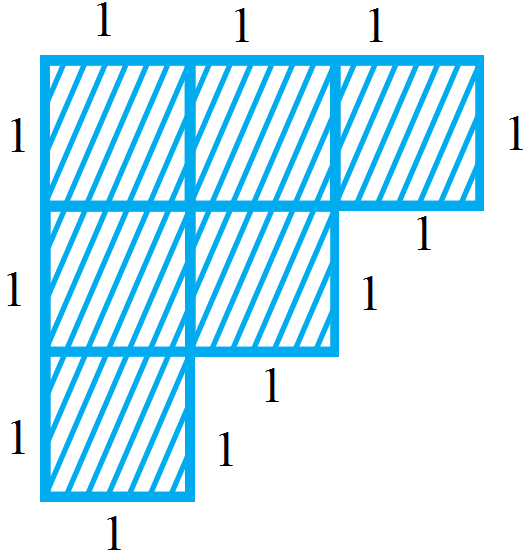
.$d.\ $Now, we find the perimeter of part $I. $ We know that perimeter of a figure is the total length of its boundary.

Perimeter of part $1 = 1 + 1 + 1 + 1 + 1 + 1 + 1 + 1 + 1 + 1 + 1 + 1 = 12$ units Similarly, we can find the perimeters of remaining $9$ parts, all the parts have same perimeter, i.e. $12$ units. Yes, all the parts have same perimeter.
 
View full question & answer
Question 35 Marks
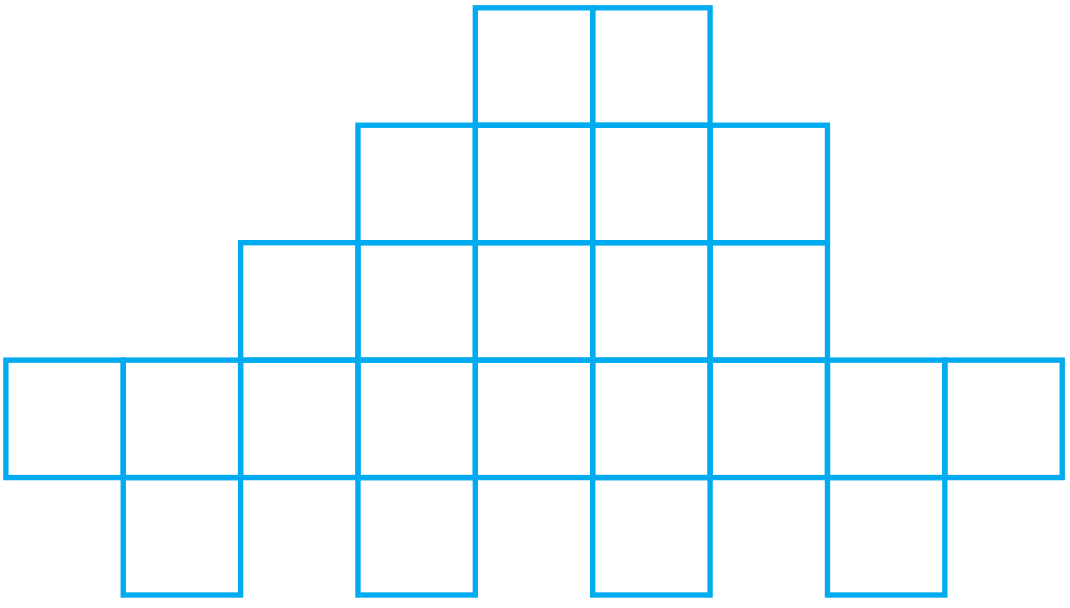
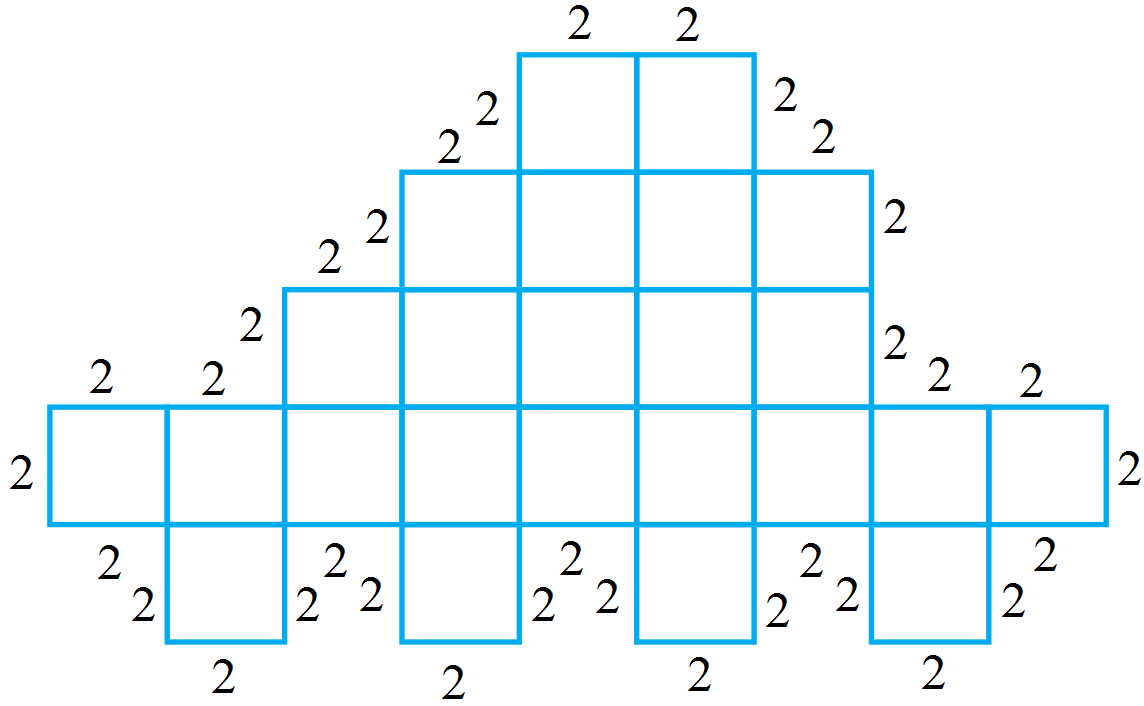
What is the area of each small square in the Fig. if the area of entire figure is $96\ sq-cm$. Find the perimeter of the figure.
Answer
Given, area of entire figure $= 96\ sq-cm$
In order to find out the area of each small square we will divide the area of entire figure by the number of small square in the figure.
Area of a small square $=\frac{\text{Area of entire figure}}{\text{Total number of small squares in the figure}}$
$=\frac{96}{24} [ \because$ total number of small squares $= 24]$
$= 4\ sq-cm$
We know that,
Area of a small square $=$ Side $\times $ Side
$\Rightarrow 4 = $ Side $\times $ Side
Taking square root on both the sides, we get
$\sqrt{4}=\sqrt{\text{Side}\times\text{Side}}$
$\Rightarrow $ Side $= 2\ cm$

Perimeter of the given figure $=$ Sum of all sides
$= (2 + 2 + 2 + 2 + 2 + 2 + 2 + 2 + 2 + 2 + 2 + 2 + 2 + 2 + 2 + 2 + 2 + 2 + 2 + 2 + 2 + 2 + 2 + 2 + 2 + 2 + 2 + 2 + 2 + 2 + 2 + 2 + 2 + 2)cm$
$= 68\ cm$
 
View full question & answer
Question 45 Marks
In the above question, how many square metres of cloth is required to cover all the display boards? What will be the length in m of the cloth used, if its breadth is $120\ cm?$
Answer
Given, total display boards $= 24$
Length of display board $= 1m + 50\ cm$
$=1\text{m}+\frac{50}{100}\text{m}=1\text{m}+\frac{1}{2}\text{m}  [ \because 1m = 100\ cm]$
$=\Big(\frac{2+1}{2}\Big)\text{m}$
$=\frac{3}{2}\text{m}$
Breadth of display board $= 1m$
Now, area of one display board $=$ Length $\times $ Breadth
$=1\times\frac{3}{2}=\frac{3}{2}\text{sq-m}$
$\therefore$ Area of $24$ display boards $= 24\ \times $ Area of one board $=24\times\frac{3}{2}$
$= 36\ sq-m$
Hence, $36\ sq-m$ cloth is required to cover all the display boards.
Now, breadth $= 120\ cm$ [given]
$\because 1m= 100\ cm$
$\therefore1\text{cm}=\frac{1}{100}\text{m}$
$\Rightarrow120\text{cm}=\frac{120}{100}=\frac{6}{5}\text{m}$
Let length $= lm$
$\because$ Area of display board $=$ Length $\times $ Breadth
$36=\text{l}\times\frac{6}{5}$
$\Rightarrow\frac{36\times5}{6}=\text{l}\times\frac{6}{5}\times\frac{5}{6}$
$\Big[$multiply both sides by $\frac{6}{5}\Big]$
$\Rightarrow\text{l}=30\text{m}$
 
View full question & answer
Question 55 Marks
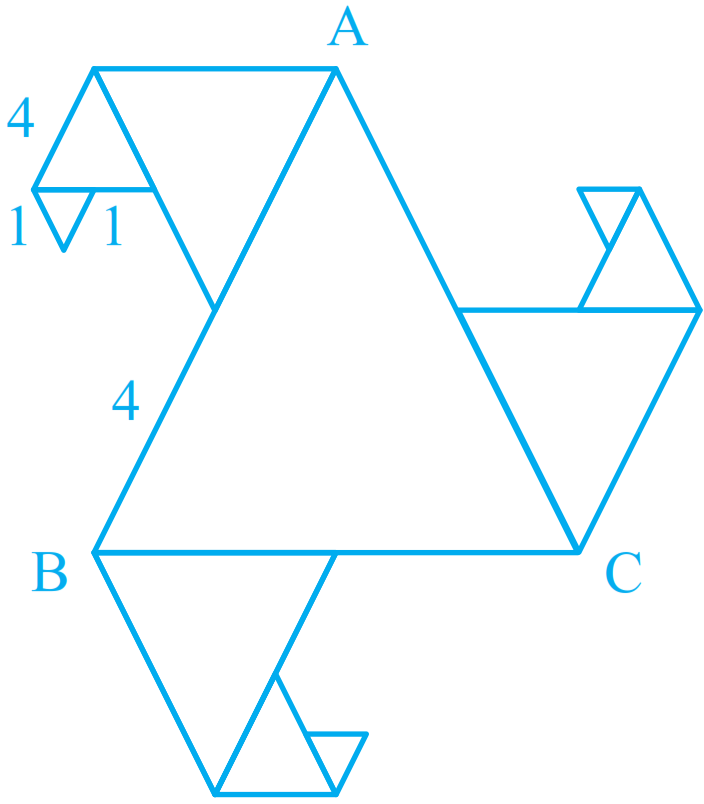
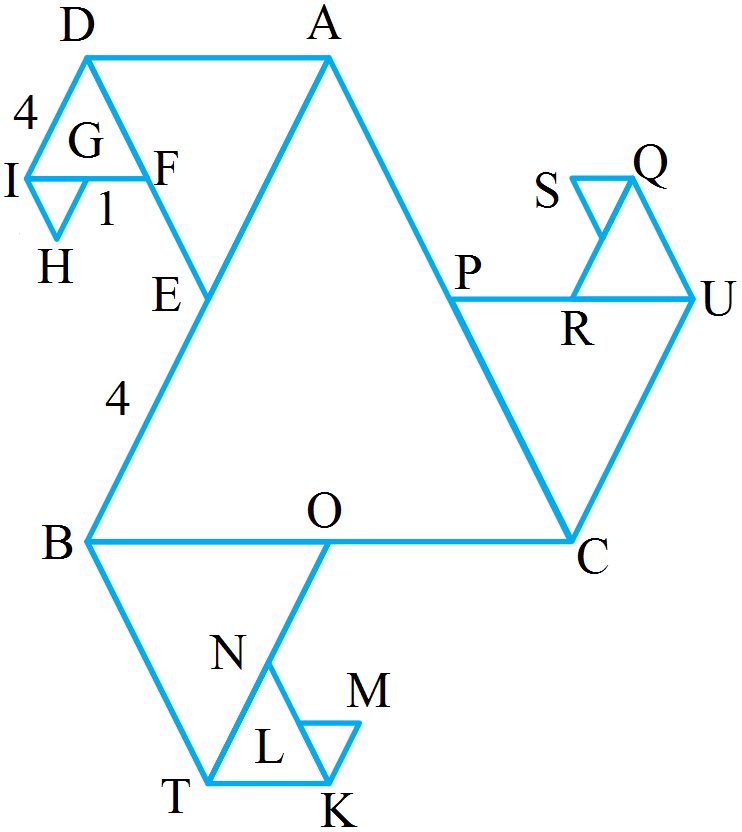
In Fig. all triangles are equilateral and $AB = 8$ units. Other triangles have been formed by taking the mid points of the sides. What is the perimeter of the figure$?$
Answer
Firstly, find the all outer sides of the given triangles and then find the perimeter by using sum of all sides of the triangles.
Given, $\triangle\text{ABC}$ is an equilateral triangle. Here, $AB = 8$ units
$\therefore AB = BC = CA = 8$ units Thus,
$\triangle\text{ADE}$ is an equilateral triangle.
Here, $E$ is the mid-point of $AB.$
$\therefore$ AE = BE $=\frac{\text{AB}}2{}=\frac{8}{2}=4\text{ units}$
Now, in $\triangle\text{ADE},$
$AD = DE = EA = 4$ units
Similarly, equilateral triangles are $ABOT$ and A $UPC,$ having each sides equal,
i.e. $BO = OT = BT = UC = PC = PU = 4$ units It is also clear that,
$OC = PA = 4$ units Also, $ADIF$ is an equilateral triangle.
Here, $F$ is the mid-point of $DE.$

$\therefore\text{DF = FE}=\frac{\text{DE}}{2}=\frac{4}{2}=2\text{ units}$
In $\triangle\text{DIF, DI = IF = DF}=2\text{ units}$
Similarly, in $\triangle\text{TKN}$ and $\triangle\text{RQU},$
$TK = KN = TN = RQ = UQ = UR = 2$ units
It is also clear that, $NC = RP = 2$ units
Also, $\triangle\text{HIG}$ is an equilateral triangle.
Here, $G$ is the mid-point of $IF.$
$\therefore\text{IG = GF}=\frac{\text{IF}}{2}=\frac{2}{2}=1\text{unit}$
Now, in $\triangle\text{HIG, HG = HI = GI}=1\text{ unit}$
Similarly, in $\triangle\text{MLK}$ and $\triangle\text{XQS},$
$ML = MK = LK = SQ = XS = QX = 1$ unit
It is also clear that, $LN = XR = 1$ unit
Now, perimeter of the given figure
$=$ Sum of all outer sides of the given figure
$= AD + DI + IH + HG + GF + FE + EB + BT + TK + KM + LM + LN + NO +$ $OC + CU + UQ + QS + XS + XR + PR + PA$
$= [4 + 2 + 1 + 1 + 1 + 2 + 4 + 4 + 2 + 1 + 1 + 1 + 2 + 4 + 4 + 2 + 1 + 1 + 1 + 2 + 4]cm$
$= 45\ cm$
Hence, the perimeter of the given figure is $45\ cm.$
View full question & answer
Question 65 Marks
Perimeter of a square and a rectangle is same. If a side of the square is $15\ cm$ and one side of the rectangle is $18\ cm,$ find the area of the rectangle.
Answer
Let breadth of rectangle $= b \ cm$
Given, length of rectangle $= 18\ cm$
and side of a square $= 15\ cm$
$\therefore$ Perimeter of a square $= 4\ \times $ Side
$= 4 \times 15$
$= 60\ cm$
But according to question,
Perimeter of Rectangle $=$ Perimeter of Square
$= 2 \times ($Length $+$ Breadth$) = 60$
$= 2(18 + b) = 60$
$\Rightarrow\frac{2\times(18+\text{b})}{2}=\frac{60}{2} [$dividing both sides by $2]$
$\Rightarrow 18 + b = 30$
$\Rightarrow b = 30 - 18 [$transposing $18$ to $RHS]$
$\Rightarrow b = 12$
Now, area of rectangle $=$ Length $\times $ Breadth
$= 18 \times 12$
$= 216\ sq-cm$
View full question & answer
Question 75 Marks
A magazine charges $Rs.300$ per $10\ sq-cm$ area for advertising. A company decided to order a half page advertisment. If each page of the magazine is $15\ cm \times 24\ cm,$ what amount will the company has to pay for it$?$
Answer
Given, charges for $10\ sq \ cm$ advertisement $= 300$
$\therefore$ Charges for $1\ sq-cm$ advertisement $=\frac{₹ \ 300}{10\text{sq-cm}}\times1\text{sq-cm}=₹ \ 30$
In order to find out the amount the company has to pay for a half page advertisment, we will find the area of half page of magazine and then multiply it with the charges for $1sq-cm$ advertisement.
Now, area of $1$ page of magazine $= 15\ cm \times 24\ cm = 360\ cm^2$
$\therefore$ Area of a half page of magazine $=\frac{\text{Area of 1 page of magazing}}{2}$
$=\frac{360}{2}=180\text{cm}^2$
So, charges for half page advertisement
$=$ Area of half page of magazine $\times $ Charges for $1\ sq-cm$ advertisement
$= 180 \times 30$
$= ₹ 5400$
Hence, the company has to pay $₹ 5400$ for it.
View full question & answer
Question 85 Marks
A wire is cut into several small pieces. Each of the small pieces is bent into a square of side $2\ cm.$ If the total area of the small squares is $28$ square cm, what was the original length of the wire?
Answer
Given, side of square made by bending a small piece of wire $= 2\ cm$ and total area of the small squares made by benting small pieces of wire $= 28\ sq-cm$
Now, number of small squares $=\frac{\text{Total area of small squares}}{\text{Area of one small squares}}$
$=\frac{28}{2\times2} [ \because$ area of square $=$ side $\times $ side$]$
$=\frac{28}{4}=7$
Now, perimeter of a small square $= 4\ \times $ Side
$= 4 \times 2$
$= 8\ cm$
Perimeter of $7$ such small squares $=$ Perimeter of one small square $\times \ 7$
$= 8 \times 7$
$= 56\ cm$
$\therefore$ Original length of wire $=$ Perimeter of $7$ small squares $= 56\ cm$
Hence, the original length of wire is $56\ cm.$
View full question & answer
Question 95 Marks
In an exhibition hall, there are $24$ display boards each of length $1\ m\ 50\ cm$ and breadth $1m.$ There is a $100m$ long aluminium strip, which is used to frame these boards. How many boards will be framed using this strip? Find also the length of the aluminium strip required for the remaining boards.
Answer
Given, total display boards $= 24$
Length of one display boards $=1\text{m}+50\text{cm}=1\text{m}+\frac{50}{100}\text{m} [ \because 1m = 100\ cm]$
$= (1 + 0.5)m$
$= 1.5m$
Breadth of one display board $= 1m$
$\therefore$ Perimeter of one display board $= 2 \times ($Length $+$ Breadth$)$
$= 2 \times (1.5 + 1)m = 2 \times 2.5m$
$= 5m$
Length of strip $= 100m [$given$]$
Now, number of boards will be framed $=\frac{\text{Length of strip}}{\text{Perimeter of one board}}$
$=\frac{100}{5}=20$
This means that out of $24$ only $20 $ boards will be framed.
Number of boards left unframed $= 24 - 20 = 4$
$\therefore$ Length of the strip required for remaining boards $= 4\ \times $ Perimeter of one board
$= 4 \times 2(1.5 + 1) = 4 \times 2 \times 2.5$
$= 20m$
 
View full question & answer
Question 105 Marks
The perimeter of a square garden is $48m.$ A small flower bed covers $18\ sq-m$ area inside this garden. What is the area of the garden that is not covered by the flower bed? What fractional part of the garden is covered by flower bed? Find the ratio of the area covered by the flower bed and the remaining area.
Answer
Let side of square garden be $x \ cm.$
Given that, perimeter of a squared garden $= 48m$
$\Rightarrow 4\ \times $ Side of a square $= 48$
$\Rightarrow 4x = 48$
$\Rightarrow\text{x}=\frac{48}{4}=12\text{m}$
Now, area of the square garden $= (x)^2= (12)^2= 144m^2$
Also given, area of small flower bed cover inside the garden $= 18m^2$
$\therefore$ Area of the garden not covered by flower bed
$=$ Area of square garden $-$ Area of flower bed
$= 144 - 18 = 126m^2$
The fractional part of the garden covered by flower bed $=\frac{\text{Area covered by flower bed}}{\text{Total area of garden}}$
$=\frac{18}{144}=\frac{1}{8}$
Ratio of the area covered by the flower bed and remaining area
$=\frac{\text{Area covered by the flower}}{\text{Area of remaining garden}}$
$=\frac{18}{126}=\frac{1}{7}$
Hence, the ratio of area covered by the flower bed and the remaining area is $1 : 7.$
View full question & answer