Questions

M.C.Q. [1 Marks Each]

Take a timed test

5 questions · auto-graded multiple-choice test.

MCQ 11 Mark
The side of a square is $10\ cm$. How many times will the new perimeter become if the side of the square is doubled?
  • $2$ times
  • B
    $4$ times
  • C
    $6$ times
  • D
    $8$ times
Answer
Correct option: A.
$2$ times
Given, side of a square $= 10\ cm$
We know that, perimeter of a square $= 4 \times $ Side $= 4 \times 10$
$= 40\ cm$
$\therefore$ Perimeter of old square $= 40\ cm$
Now, according to the question, side of the square is doubled.
New side$ = 2 \times 10 = 20\ cm$
Again, perimeter of new square = 4 \times Side
$= 4 \times 20 = 80\ cm$
$\therefore$ New perimeter
$= 2 \times $ (Old perimeter)
$= 2 \times 40 = 80\ cm$
Hence, the new perimeter is $2$ times of the old perimeter.
View full question & answer
MCQ 21 Mark
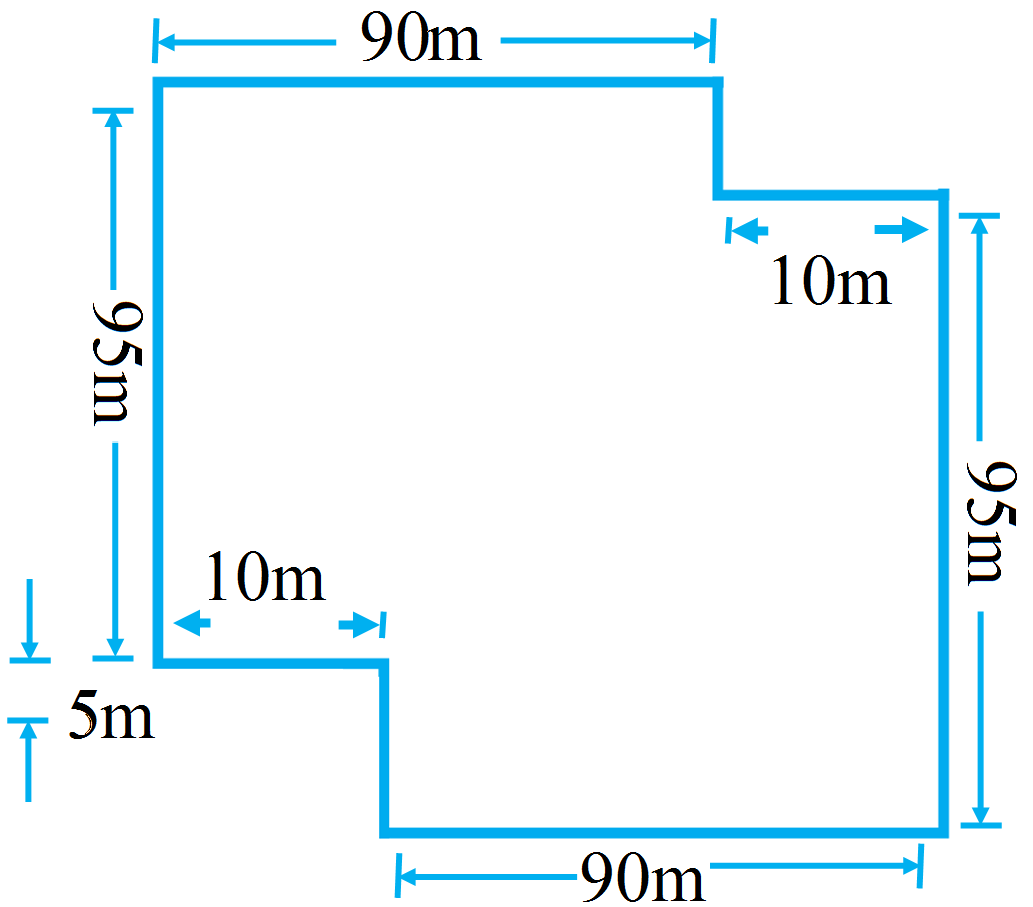
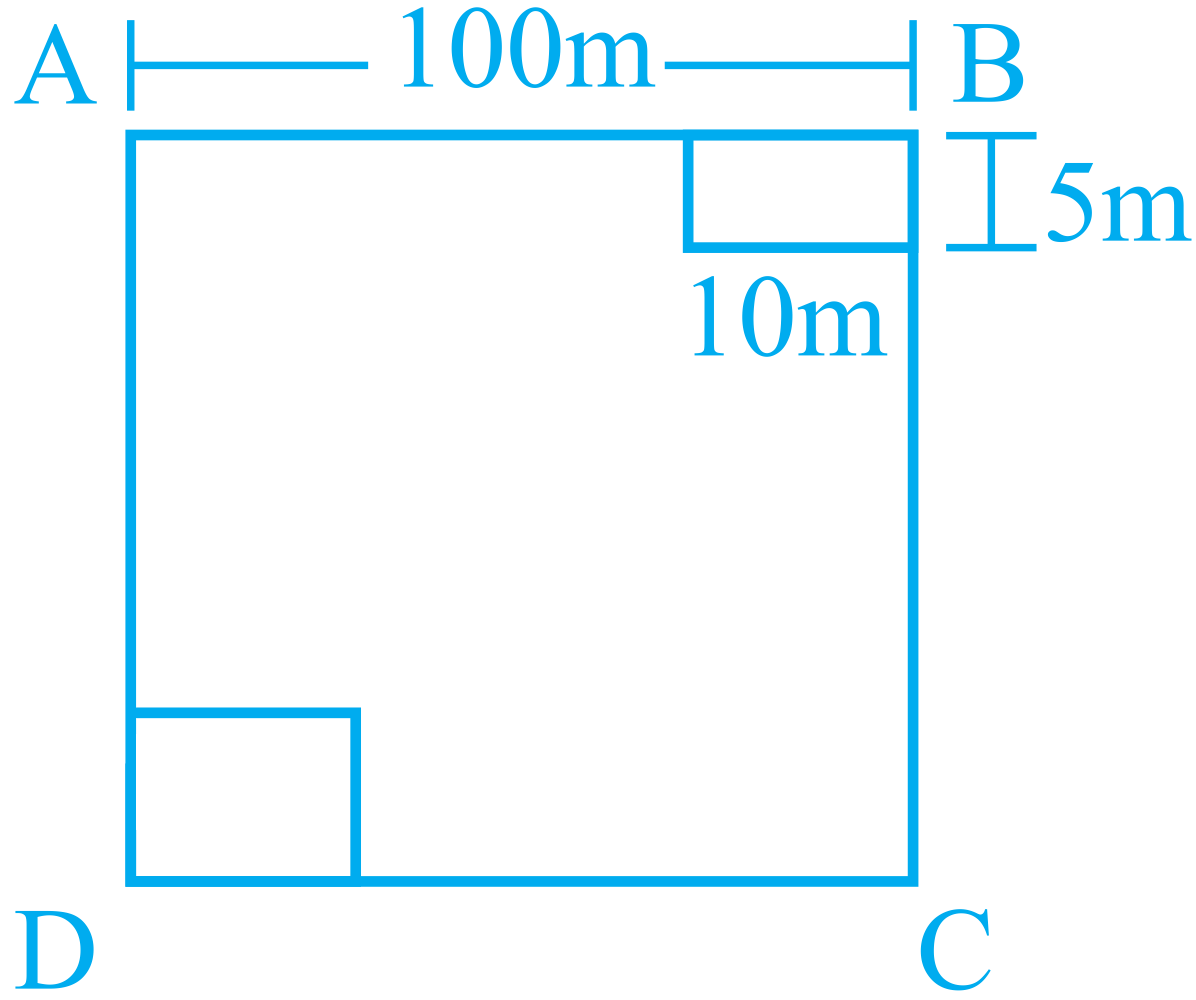
A square shaped park $ABCD$ of side 100m has two equal rectangular flower beds each of size $10m \times 5m$ Length of the boundary of the remaining park is:
  • A
    $360m$
  • $400m$
  • C
    $340m$
  • D
    $460m$
Answer
Correct option: B.
$400m$
In order to find the length of the boundary of the remaining park, we add two flower beds each of length $10m$ and breadth $5m$, then remaining park is shown below:

Now, length of the boundary of the remaining park = Perimeter of remaining park $= (90 + 5 + 10 + 95 + 90 + 5 + 10 + 95)m = 400m$
View full question & answer
MCQ 31 Mark
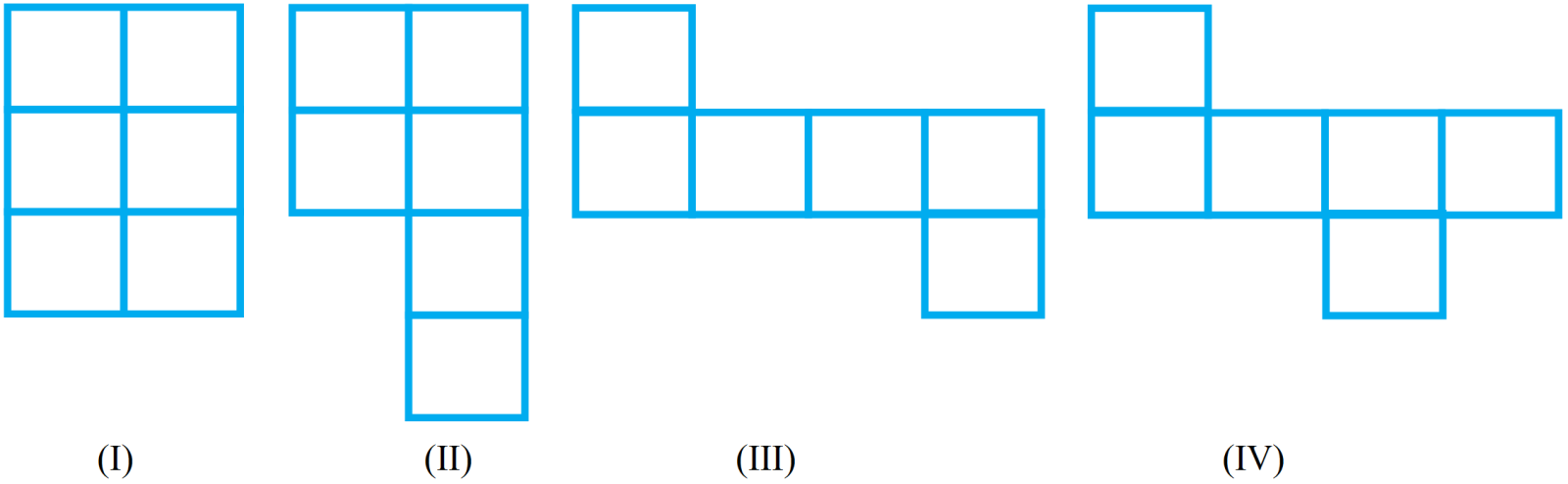
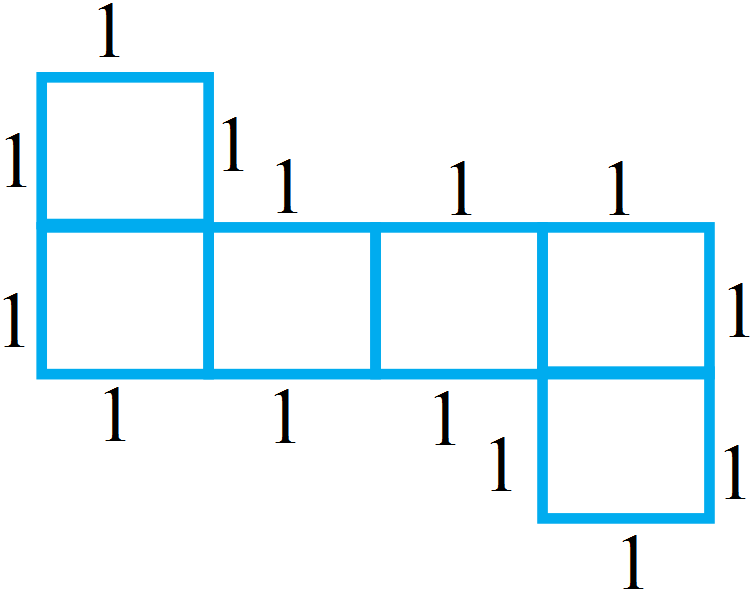
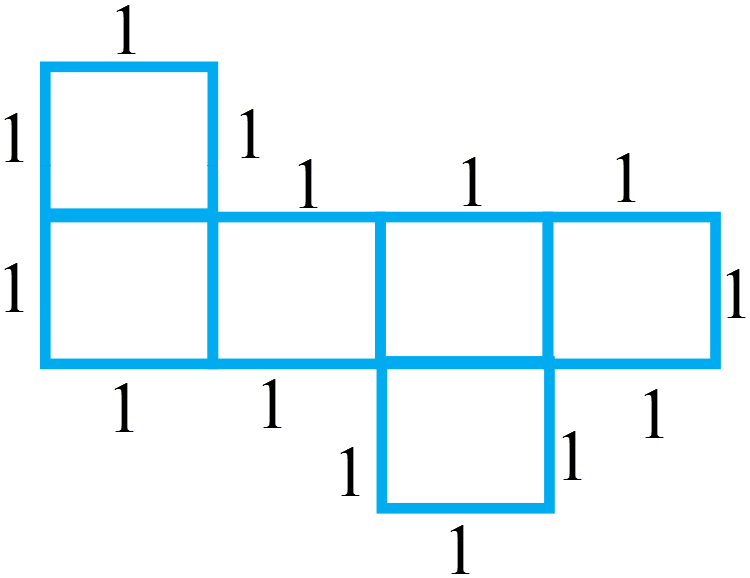
Following figures are formed by joining six unit squares. Which figure has the smallest perimeter in Fig.?
  • A
    $(ii)$
  • B
    $(iii)$
  • C
    $(iv)$
  • $(i)$
Answer
Correct option: D.
$(i)$
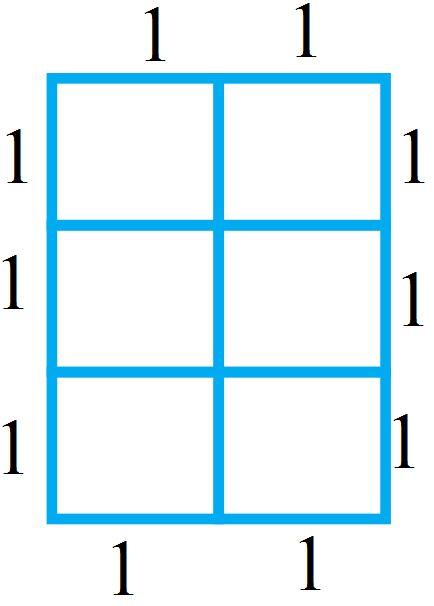
$i.$ Let the square $\Box = 1$ unit

Then, perimeter = Sum of all sides
$= 1 + 1 + 1 + 1 + 1 + 1 + 1 + 1 + 1 + 1$
$= 10$ units
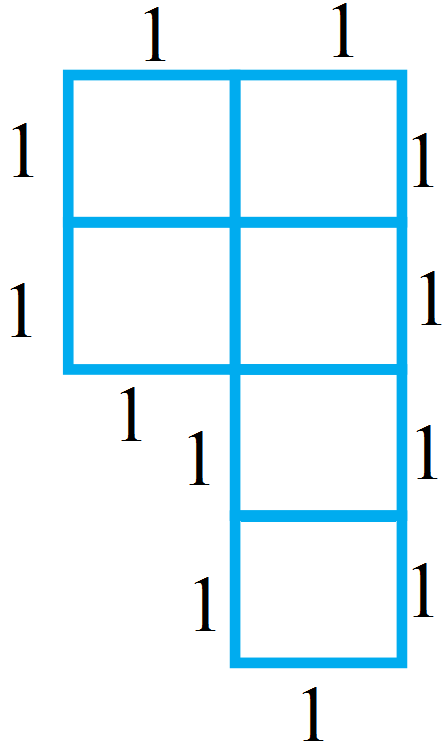
$ii.$ Perimeter $=$ Sum of all sides

$= 1 + 1 + 1 + 1 + 1 + 1 + 1 + 1 + 1 + 1 + 1 + 1$
$= 12$ units
$iii.$ Perimeter $=$ Sum of all sides

$= 1 + 1 + 1 + 1 + 1 + 1 + 1 + 1 + 1 + 1+ 1 + 1 + 1 + 1$
$= 14$ units
$iv.$ Perimeter $=$ Sum of all sides

$= 1 + 1 + 1 + 1 + 1 + 1 + 1 + 1 + 1 + 1+ 1 + 1 + 1 + 1$
$= 14$ units
Hence, smallest perimeter $= 10$ units
which is the perimeter of figure $(i).$
View full question & answer
MCQ 41 Mark
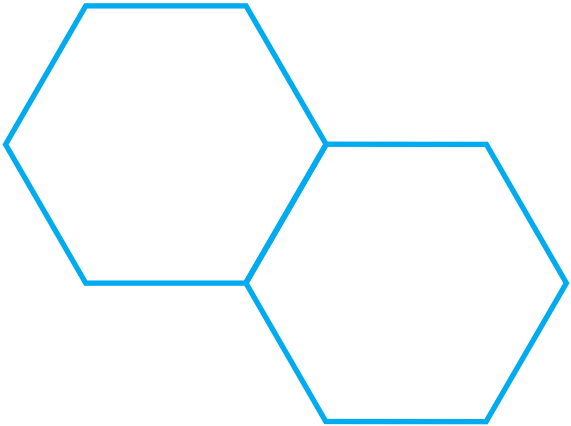
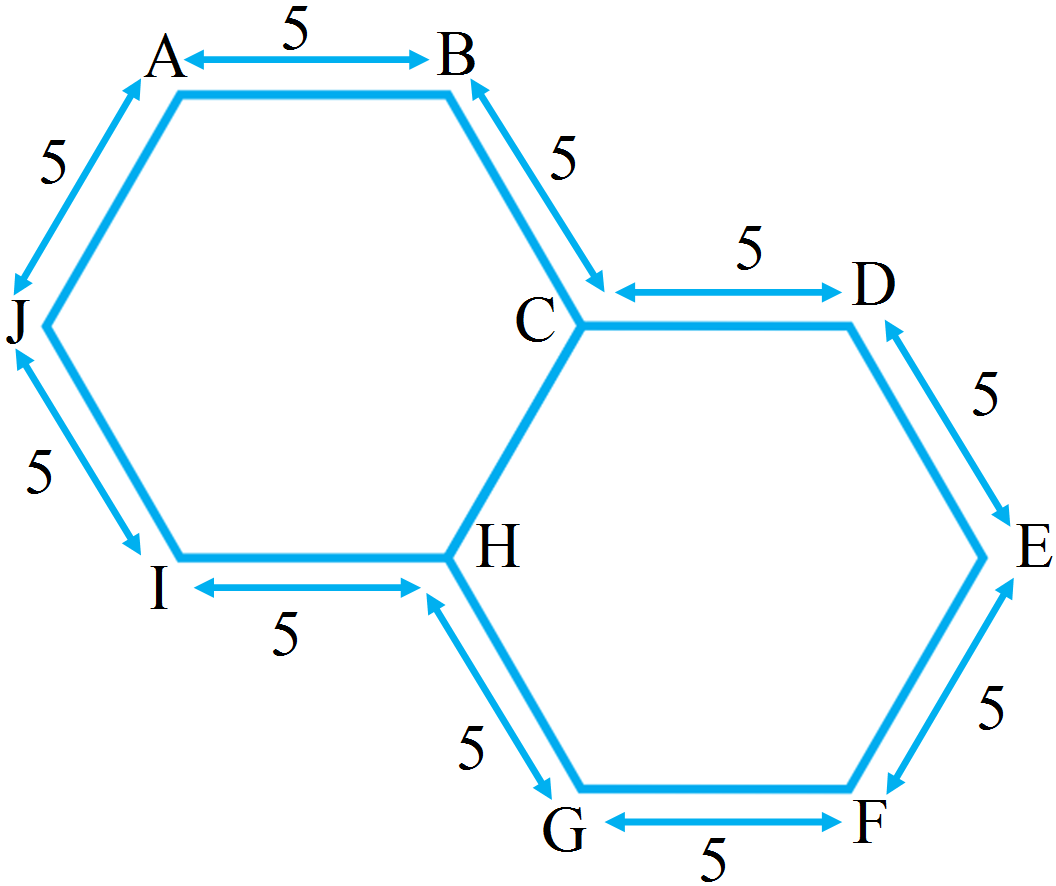
Two regular Hexagons of perimeter $30\ cm$ each are joined as shown in Fig. The perimeter of the new figure is:
  • A
    $65\ cm$
  • B
    $60\ cm$
  • C
    $55\ cm$
  • $50\ cm$
Answer
Correct option: D.
$50\ cm$
Given, perimeter of hexagon $= 30\ cm$
and number of sides in hexagon $= 6$
$\therefore$ Length of one side $=\frac{\text{Perimeter of hexagon}}{\text{Total number of sides}}$
$=\frac{30}{6}$
$=5\text{cm}$

Now, two hexagons are joined then perimeter = Sum of all sides
$= AB + BC + CD + DE + EF + FG + GH + HI + IJ + JA$
$= 5 + 5 + 5 + 5 + 5 + 5 + 5 + 5 + 5 + 5$
$= 50\ cm$
View full question & answer
MCQ 51 Mark
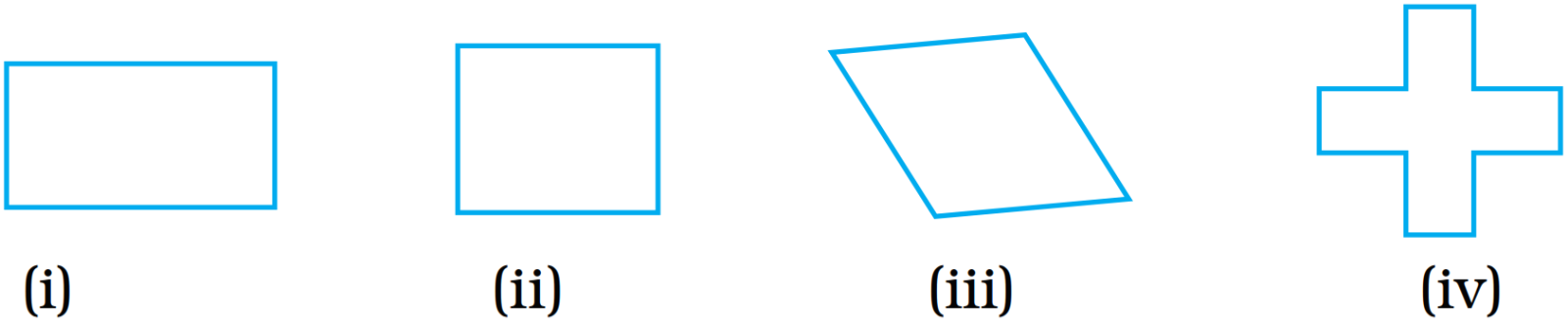
In Fig. which of the following is a regular polygon? All have equal side except $(i)$
  • A
    $(i)$
  • $(ii)$
  • C
    $(iii)$
  • D
    $(iv)$
Answer
Correct option: B.
$(ii)$
In regular polygon, all sides and angles are equal.
According to the question,
In figure $(i)$, all sides are not equal.
So, it is not a regular polygon.
In figure $(ii)$, it is a square and in square all sides are equal and all angles are of $90^\circ .$
So, it is a regular polygon.
In figure $(iii)$, it is a parallelogram and in parallelogram opposite sides are equal and
opposite angles are equal.
So, it is not a regular polygon.
In figure $(iv),$ all sides are not equal. So, it is not a regular polygon.
View full question & answer