Questions

3 Marks Question

Take a timed test

23 questions · self-marked practice — reveal the answer and mark yourself.

Question 13 Marks
The product of two numbers is $504347.$ If one of the numbers is $1591,$ find the other.
Answer
Product of two numbers $= 504347$ One of the two numbers $= 1591$ Let the number be $A$.
Therefore,$ A \times 1591 = 504347$
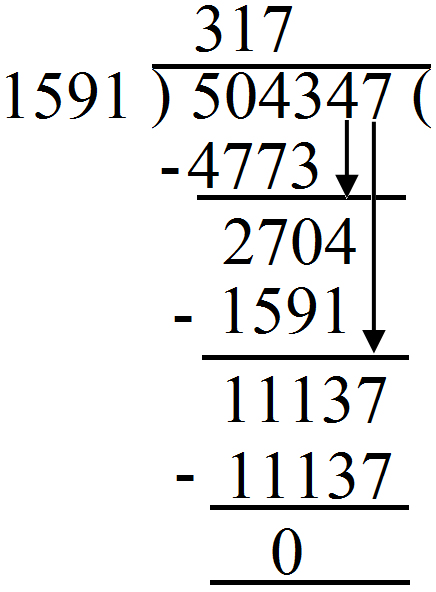
$​​​​​​​A = 5043471591 = 317$
View full question & answer
Question 23 Marks
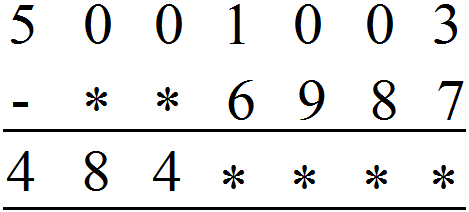
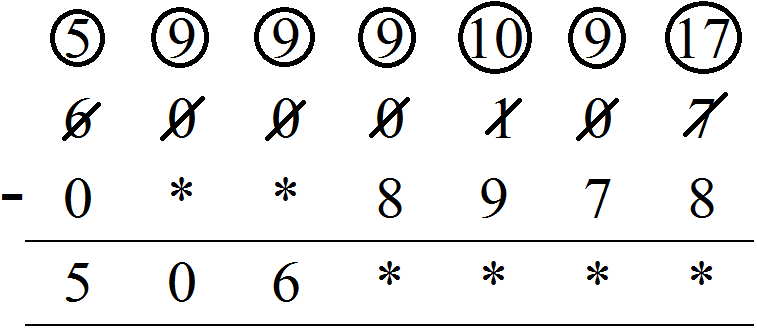
Replace each $*$ by the correct digit in the following:
Answer


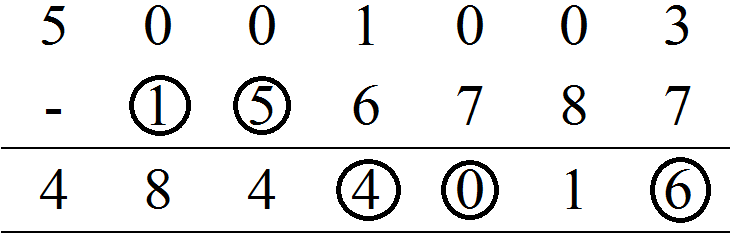
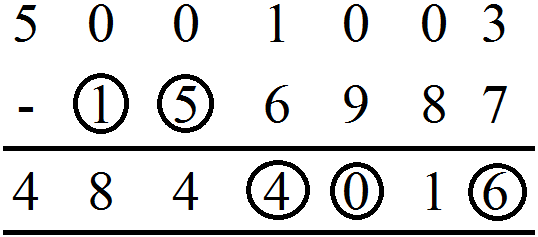
Here, in the units digit, $13 - 7 = 6$ In the tens digit, $9 - 8 = 1$
In the hundreds place, $9 - 9 = 0$
And in the thousands place, $10 - 6 = 4.$
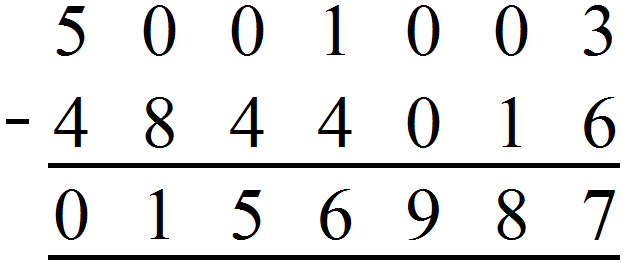
Addend difference $= 4844016.$
So, in order to get the addend, we will subtract $4844016$ from $5001003.$
View full question & answer
Question 33 Marks
Observe the pattern in the following and fill in the blanks:
$i.\ 9 \times 9 + 7 = 88$
$ii.\ 98 \times 9 + 6 = 888$
$iii.\ 987 \times 9 + 5 = 8888$
$iv.\ 9876 \times 9 + 4 =........$
$v.\ 98765 \times 9 + 3 =........$
$vi.\ 987654 \times 9 + 2 =........$
$vii.\ 9876543 \times 9 + 1 =........$
Answer
$i.\ 9 \times 9 + 7 =88$
$ii.\ 98 \times 9 + 6 = 888$
$iii.\ 987 \times 9 + 5 = 8888$
$iv.\ 9876 \times 9 + 4 = 88888$
$v.\ 98765 \times 9 + 3 = 888888$
$vi.\ 987654 \times 9 + 2 = 8888888$
$vii.\ 9876543 \times 9 + 1 = 88888888$
View full question & answer
Question 43 Marks
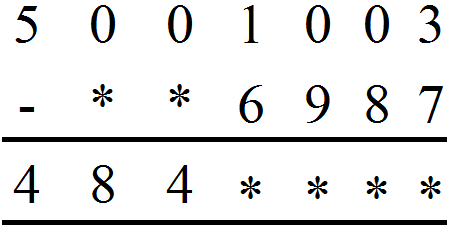
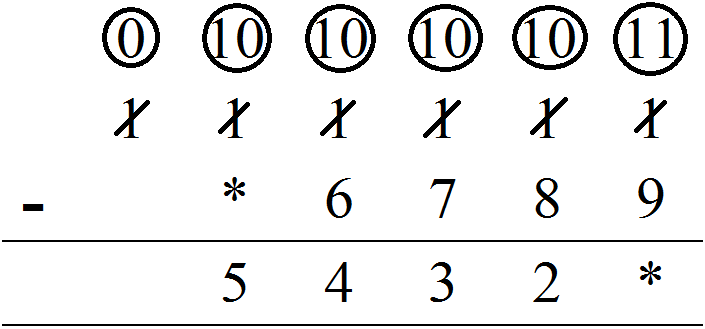
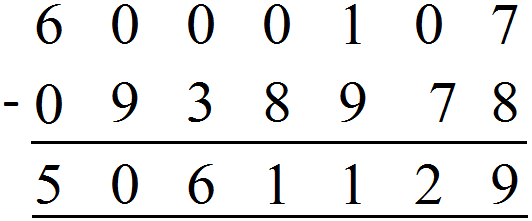
Replace * by correct digit in the following:
Answer
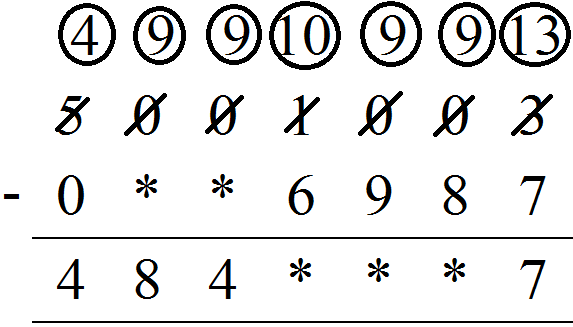
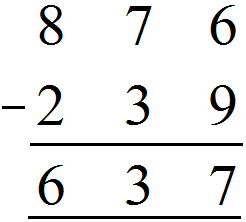
The complete subtraction is shown below:

Thus, the the digits replaced are circled as below:
View full question & answer
Question 53 Marks
Study the following pattern:
$1 + 3 = 2 \times 2$
$1 + 3 + 5 = 3 \times 3$
$1 + 3 + 5 + 7 = 4 \times 4$
$1 + 3 + 5 + 7 + 9 = 5 \times 5$
By observing the above pattern, find
$i.\ 1 + 3 + 5 + 7 + 9 + 11$
$ii.\ 1 + 3 + 5 + 7 + 9 + 11 + 13 + 15$
$iii.\ 21 + 23 + 25 + ......+ 51$
Answer
$1 + 3 = 2 \times 2$
$1 + 3 + 5 = 3 \times 3$
$1 + 3 + 5 + 7 = 4 \times 4$
$1 + 3 + 5 + 7 + 9 = 5 \times 5$
By observing the above pattern, find:
$i.\ 1 + 3 + 5 + 7 + 9 + 11$
$= 6 \times 6$
$= 36$
$ii.\ 1 + 3 + 5 + 7 + 9 + 11 + 13 + 15$
$= 8 \times 8$
$= 64$
$iii.\ 21 + 23 + 25 + … + 51$
$= (21 + 23 + 25 + $__ $+ 51)$ can also be written as
$(1 + 3 + 5 + 7 + $__ $+ 49 + 51) -(1 + 3 + 5 + $__$ + 17 + 19)$
$(1+ 3 + 5 + 7 +$ __ $+ 49 + 51)= 26 \times 26 = 676$
and, $(1 + 3 + 5 +$ __$ + 17 + 19 ) = 10 \times 10 = 100$
Now,
$( 21 + 23 + 25 + $__$ + 51 )= 676 - 100 = 576$
View full question & answer
Question 63 Marks
Determine the following sum by using suitable rearrangement: $2 + 3 + 4 + 5 + 45 + 46 + 47 + 48.$
Answer
Thus sum $2 + 3 + 4 + 5 + 45 + 46 + 47 + 48$ has to be evaluated using rearrangement.
We observe that,
$2 + 48 = 50 $
$3 + 47 = 50$
$ 4 + 46 = 50 $
$5 + 45 = 50$
Therefore $2 + 3 + 4 + 5 + 45 + 46 + 47 + 48 $
$= (5 + 45) (4 + 46) + (3 + 47) + (2 + 48) $
$= 50 + 50 + 50 + 50 $
$= 200$
Hence, $2 + 3 + 4 + 5 + 45 + 46 + 47 + 48 = 200.$
View full question & answer
Question 73 Marks
A dealer purchased $125$ colour television sets. If the cost of each set is $Rs. 19820$, determine the cost of all sets together.
Answer
Cost of $1$ color television set $= Rs. 19820$
Therefore, Cost of $125$ color television sets
$ = Rs. (19820 \times 125)$
$ = Rs. 19820 \times (100 + 25) $
$= Rs. (19820 \times 100) + (19820 \times 25) $
$= Rs. 1982000 + 495500 $
$= Rs. 2477500$
View full question & answer
Question 83 Marks
Replace each $*$ by the correct digit in the following:
Answer
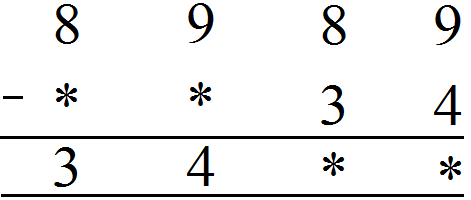
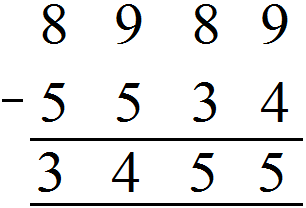
Here, it is clear that in the units place, $9 - 4 = 5$ And in the tens place, $8 - 3 = 5$.
We can now easily find out the other missing blanks by subtracting $3455$ from $8989$.
Addend (difference) $= 3455$ Thus, the correct answer is:
View full question & answer
Question 93 Marks
Replace each $*$ by the correct digit in the following:
Answer

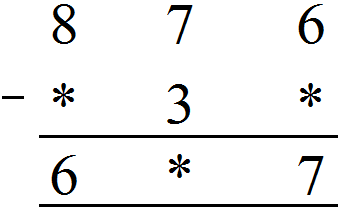
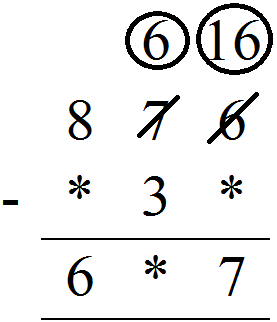
Here, we can we see that in the units digit, $6 - * = 7,$ which means that the value of $*$ is $9$, as $1$ gets carried from $7$ at tens place to $6$ at unit place and $6$ at unit digit becomes $16$ then $16 - 9 = 7$
Now, when $7$ gives $1$ to $6$, it becomes $6,$ so $6 - 3 = 3.$
Also, it can be easily deduced that in $(8 - * = 6),$ the value of $*$ is $2$
View full question & answer
Question 103 Marks
Shikha withdrew $Rs. 1,00,000$ from her bank account. She purchased a $TV$ set for $Rs. 38,750,$ a refrigerator for $₹23,890$ and jewellery worth $Rs. 35,560$. How much money was left with her.
Answer
Cost of $TV$ set $= Rs. 38,750$
Cost of referigerator $= Rs. 23,890$
Cost of jewellery $= Rs. 35,560$
Cost of all purchased items$ = Rs. 38,750 + Rs. 23,890 + Rs. 35,560 $
$= Rs. 98,200$
$\ \ \ \ 3\ 8\ 7\ 5\ 0\\ \ \ \ \ 2\ 3 \ 8\ 9\ 0\\\underline{+ \ 3\ 5\ 5\ 6\ 0}\\ \ \ \ \ 9\ 8\ 2\ 0\ 0$
Money left with Shikha $= Rs. 1,00,000 - Rs. 98,200 = Rs. 1,800$
Hence, money left with Shikha is $Rs. 1,800.$
View full question & answer
Question 113 Marks
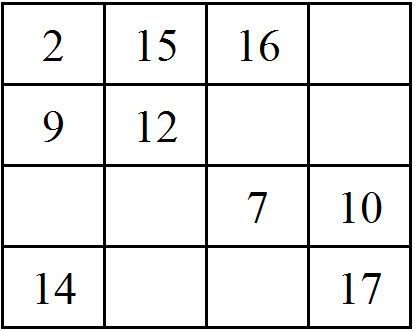
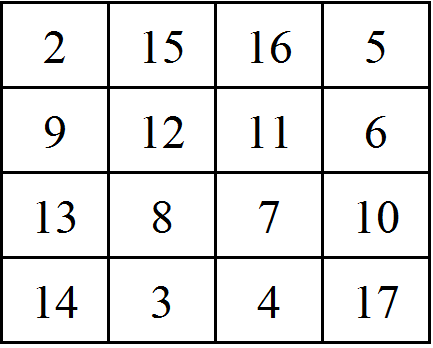
Complete the following magic square by supplying the missing numbers:
Answer
In magic square the numbers in each vertical, horizontal, and diagonal row add up to the same value.
Sum of diagonal elements $= 2 + 12 + 7 + 17 = 38$
Now, Missing element in the first column $= 38 - (2 + 9 + 14) = 38 - 25 = 13$
Missing element in the first row $= 38 - (2 + 15 + 16) = 38 - 33 = 5$
Missing element in the second row and fourth column $= 38 - (5 + 10 + 17) = 38 - 32 = 6$
Missing element in the second row and third column $= 38 - (9 + 12 + 6) = 38 - 27 = 11$
Missing element in the fourth row and third column $= 38 - (16 + 11 + 7) = 38 - 34 = 4$
Missing element in the third row and third column $= 38 - (13 + 7 + 10) = 38 - 30 = 8$
Missing element in the fourth row and second column $= 38 - (14 + 4 + 17) = 38 - 35 = 3$
Hence, the complete magic square is
View full question & answer
Question 123 Marks
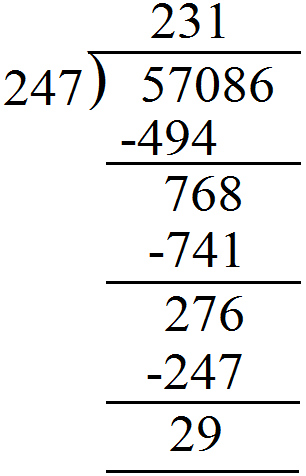
Divide $57086$ by $247$ and check the result by division algorithm.
Answer
Let us divide $57086$ by $247$ using long division method.

Here, divisor $= 247$, dividend $= 57086$, quotient $= 231$ and remainder $= 29.$
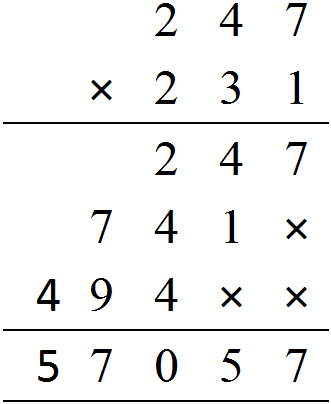
Now, Dividend = divisor $\times $ quotient + remainder $= 247 \times 231 + 29 = 57057 + 29 = 57086$
 
View full question & answer
Question 133 Marks
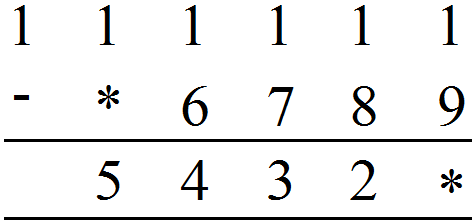
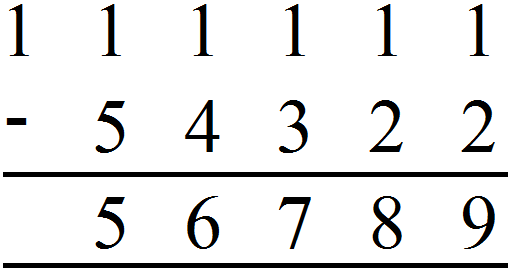
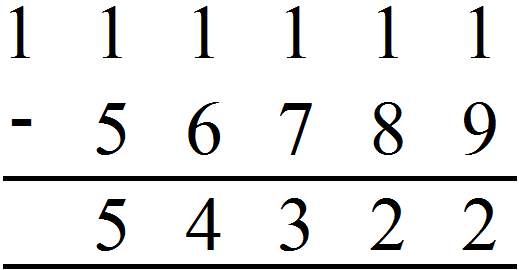
Replace each $*$ by the correct digit in the following:
Answer

It is clear from the units place that $11 - 9 = 2$ Addend difference $= 54322$ To get the other addend,
we will subtract $54322$ from $111111$

Thus, the other addend is $56789.$
The correct answer is:
 
View full question & answer
Question 143 Marks
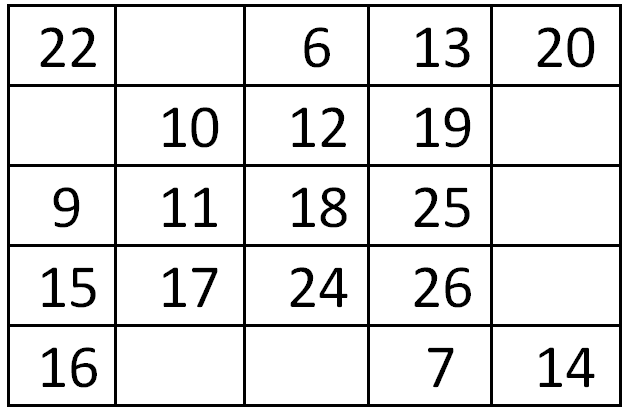
A magic square is an array of numbers having the same number of rows and columns and the sum of numbers in each row, column or diagonal being the same. Fill in the blank cells of the following magic square:
Answer
It can be seen that diagonally, $20 + 19 + 18 + 17 + 16 = 90.$
Thus,
Number in the second cell of the first row $= 90 - (22 + 6 + 13 + 20) = 29$
Number in the first cell of the second row $= 90 - (22 + 9 + 15 + 16) = 28$
Number in the fifth cell of the second row $= 90 - (28 + 10 + 12 + 19) = 21$
Number in the fifth cell of the third row $= 90 - (9 + 11 + 18 + 25) = 27$
Number in the fifth cell of the fourth row $= 90 - (15 + 17 + 24 + 26) = 8$
Number in the second cell of the fifth row $= 90 - (29 + 10 + 11 + 17) = 23$
Number in the third cell of the fifth row $= 90 - (6 + 12 + 18 + 24) = 30$
$22$
$29$
$6$
$13$
$20$
$28$
$10$
$12$
$19$
$21$
$9$
$11$
$18$
$25$
$27$
$15$
$17$
$24$
$26$
$8$
$16$
$23$
$30$
$7$
$14$
View full question & answer
Question 153 Marks
In a large housing complex, there are $15$ small buildings and $22$ large building. Each of the large buildings has $10$ floor with $2$ apartments on each floor. Each of the small buildings has $12$ floors with $3$ apartments on each floor. How many apartments are there in all.
Answer
Number of large buildings $= 22$
Number of small buildings $= 15$
Number of floors in $1$ large building $= 10$
Number of apartments on $1$ floor $= 2$
Therefore, Total apartments in $1$ large building $= 10 \times 2 = 20$
Similarly, Total apartments in $1$ small building $= 12 \times 3 = 36$
Therefore, Total apartments in the entire housing complex $= (22 \times 20) + (15 \times 36) = 440 + 540 = 980$
View full question & answer
Question 163 Marks
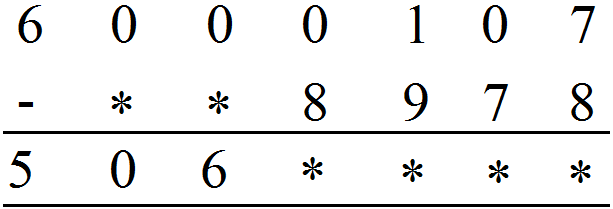
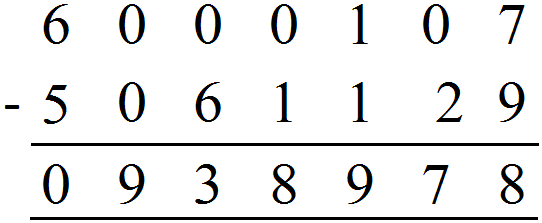
Replace each $*$ by the correct digit in the following:
Answer

Here, in the units digit, $17 - 8 = 9$
In the tens digit, $9 - 7 = 2$
In the hundreds place, $10 - 9 = 1$
And in the thousands place, $9 - 8 = 1.$
Addend difference $= 5061129.$
So, in order to get the addend, we will subtract $5061129$ from $6000107.$

Thus, the correct answer is:
View full question & answer
Question 173 Marks
Determine the sum by suitable rearrangements: $1 + 2 + 3 + 4 + 1996 + 1997 + 1998 + 1999$
Answer
$1 + 2 + 3 + 4 + 1996 + 1997 + 1998 + 1999$
Therefore, $99 + 1 = 100 98 + 2 = 100 97 + 3 = 100$ And, $96 + 4 = 100$
Therefore, $(1 + 1999) + (2 + 1998) + (3 + 1997) + (4 + 1996) $
$= 2000 + 2000 + 2000 + 2000 $
$= 8000$
View full question & answer
Question 183 Marks
Determine the product of:
The greatest number of five digits and the greatest number of three digits.
Answer
The largest five - digit number $= 9999$
The largest number of three digits $= 999$
Therefore,
Product of the largest three - digit number and the largest five - digit number
$= 9999 \times 999$
$= 9999 \times (1000 - 1)$
$= (9999 \times 1000) - (9999 \times 1)$
$= 9999000 - 9999$
$= 9989001$
View full question & answer
Question 193 Marks
On dividing $59761$ by a certain number, the quotient is $189$ and the remainder is $37$. Find the divisor.
Answer
Dividend $= 59761$ Quotient $= 189$ Remainder $= 37$ Divisor $= A$
Now, Dividend = Divisor $\times $ Quotient + Remainder $59761$
$= A \times 189 + 37 59761 - 37 $
$= A \times 189 59724$
$ = A \times 18$
Therefore, $A = 59724189 = 316$
View full question & answer
Question 203 Marks
$10 + 11 + 12 + 13 + 14 + 15 + 16 + 17 + 18 + 19 + 20$
Answer
$10 + 11 + 12 + 13 + 14 + 15 + 16 + 17 + 18 + 19 + 20$
$10 + 20 = 30$
$1 + 9 = 10$
$2 + 8 = 10$
$3 + 7 = 10$
And,
$4 + 6 = 10$
Therefore,
$(10 + 20) + (11 + 19) + (12 + 18) + (13 + 17) + (14 + 16)$
$= 30 + 30 + 30 + 30 + 30 + 15$
$= 150 + 15$
$= 165$
View full question & answer
Question 213 Marks
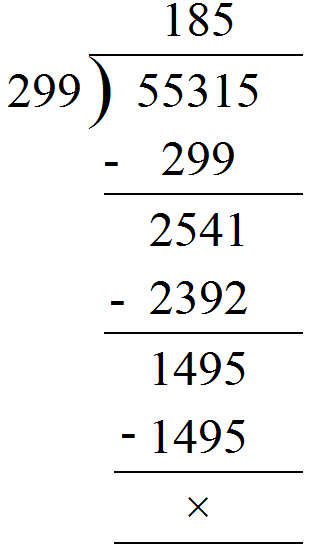
On dividing $55390$ by $299,$ the remainder is $75$. Find the quotient using division algorithm.
Answer
Here, divisor $= 299$, dividend $= 55390$ and remainder $= 75.$
dividend = divisor $\times $ quotient + remainder
$\Rightarrow 55390 = 299 \times $ quotient $+ 75$
$\Rightarrow 299 \times $ quotient $= 55390 − 75 = 55315$
$\Rightarrow $ quotient. $= 55315 ÷ 299 = 185$

Hence, the quotient is $185.$
View full question & answer
Question 223 Marks
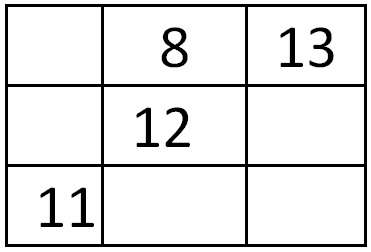
A magic square is an array of numbers having the same number of rows and columns and the sum of numbers in each row, column or diagonal being the same. Fill in the blank cells of the following magic square:
Answer
It can be seen that diagonally, $13 + 12 + 11 = 36.$
Thus, Number in the first cell of the first row $= 36 - (8 + 13) = 15$
Number in the first cell of the second row $= 36 - (15 + 11) = 10$
Number in the third cell of the second row $= 36 - (10 + 12) = 14$
Number in the second cell of the third row $= 36 - (8 + 12) = 16$
 Number in the third cell of the third row $= 36 - (11 + 16) = 9$
$15$
$8$
$13$
$10$
$12$
$141$
$11$
$16$
$9$
View full question & answer
Question 233 Marks
On dividing $55390$ by $299$, the remainder is $75$. Find the quotient.
Answer
Dividend $= 55390$ Divisor$ = 299$ Remainder $= 75$ Quotient $= A$
Dividend = Divisor $\times $ Quotient + Remainder 55390
$= 299 \times A + 75 55390 - 75 $
$= A \times 299 55315 $
$= A \times 299$
Therefore, $A = 55315299 = 185$
View full question & answer