Questions

1 Marks Question

Take a timed test

11 questions · self-marked practice — reveal the answer and mark yourself.

Question 11 Mark
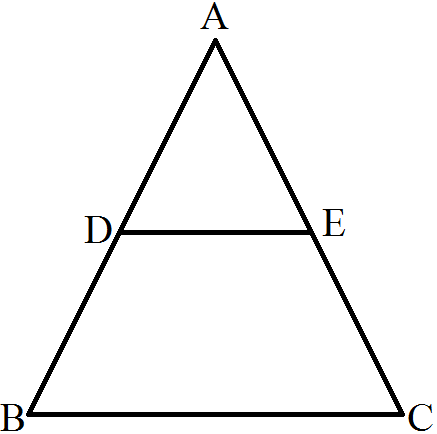
Indentify parallel line segments in the figures given below:
Answer
$DE\ ||\ BC$. This is because they do not intersect each other.
View full question & answer
Question 21 Mark
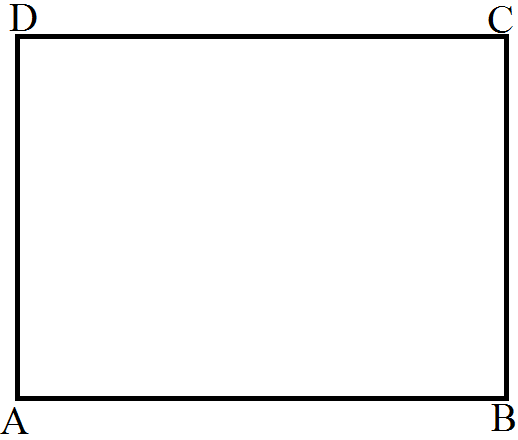
Indentify parallel line segments in the figures given below:
Answer
$AB\ ||\ DC$ and $AD\ ||\ BC.$
This is because these pairs of line segments do not intersect each other.
View full question & answer
Question 31 Mark
The following statement are true and false? Two parallel lines are everwhere the same distance distance apart.
Answer
True.
Perpendicular distance between two parallel lines is same at all points on the lines.
View full question & answer
Question 41 Mark
The following statement are true and false? Two lines are parallel if they do not meet, even when produced.
Answer
True.
The statement is true because such lines do not intersect even when produced.
View full question & answer
Question 51 Mark
The following statement are true and false?If two rays do not intersect, they are parallel.
Answer
True.
The corresponding lines determined by them will not intersect. Hence, they are parallel to each other.
View full question & answer
Question 61 Mark
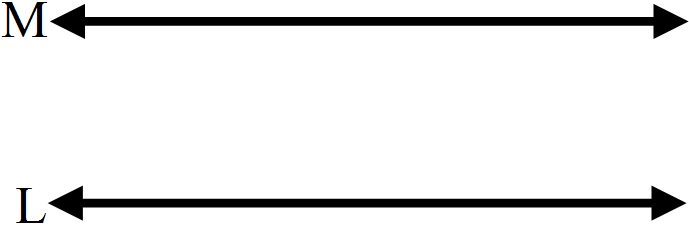
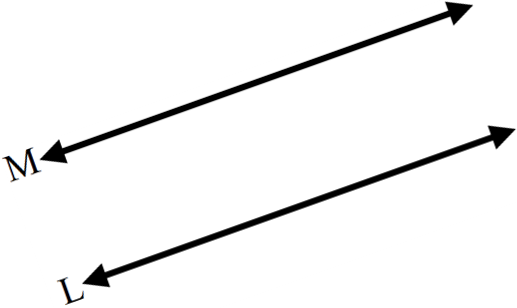
Find the distance between the parallel lines $l$ and $m$, using a set square.
Answer
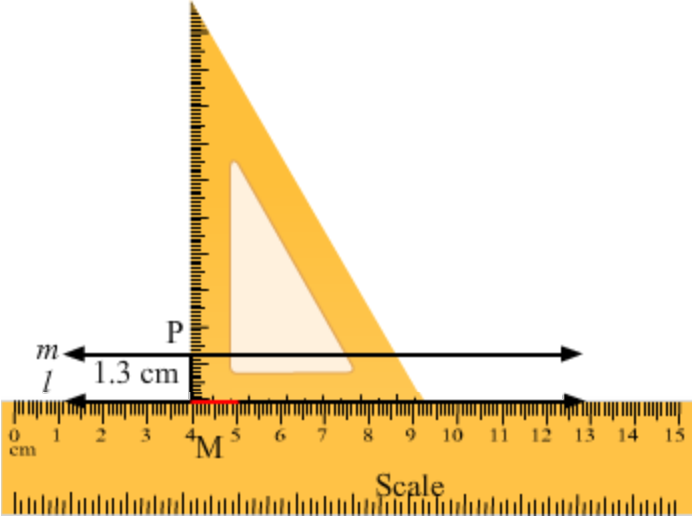
Distance between $l$ and $m$ is $1.3\ cm$. Place the ruler so that one of its measuring edges lies along the line $l$. Hold it with one hand. Now place a set square with one arm of the right angle coinciding with the edge of the ruler. Draw the line segment $PM$ along the edge of the set square, as shown in the figure. Then, measure the distance $(PM)$ between $l$ and $m$, which will be equal to $1.3\ cm.$
View full question & answer
Question 71 Mark
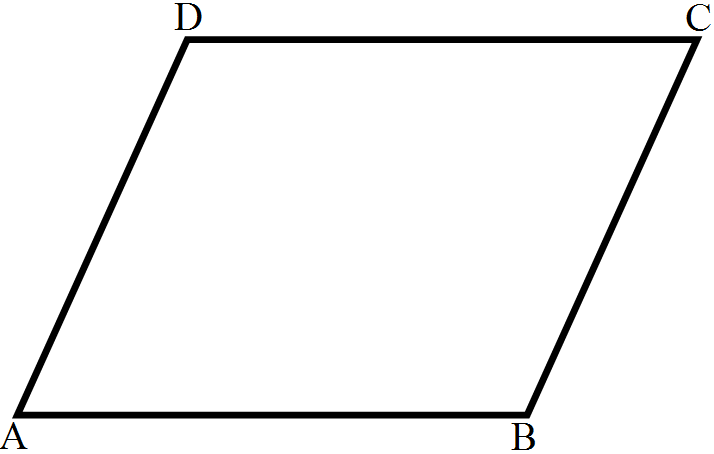
Indentify parallel line segments in the figures given below:
Answer
$AB\ ||\ DC$ and $AD\ ||\ BC.$
This is because these pairs of line segments do not intersect each other.
AB does not intersect $DC$ and $AD$ does not intersect $BC$.
View full question & answer
Question 81 Mark
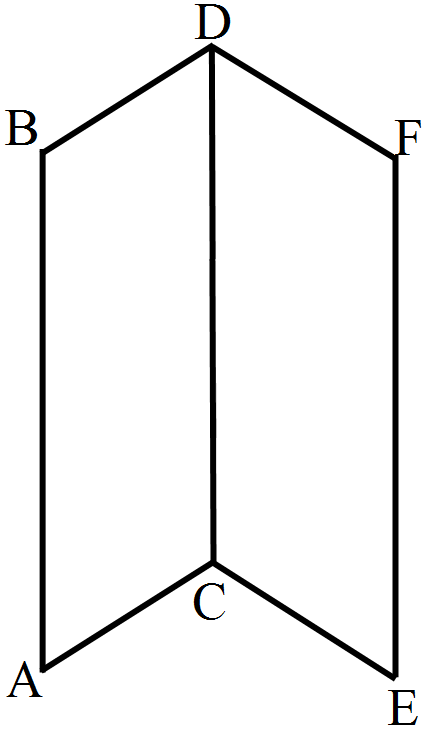
Indentify parallel line segments in the figures given below:
Answer
$AB\ ||\ DC, AB\ ||\ EF, DC\ ||\ EF, AC\ ||\ BD, CE\ ||\ DF$ These pairs of line segments are non-intersecting.
So, these pairs of lines are parallel.
View full question & answer
Question 91 Mark
The following statement are true and false?If two line segments do not intersect, they are parallel.
Answer
True.
If the corresponding lines are produced infinitely, they will not intersect. Hence, they are parallel.
View full question & answer
Question 101 Mark
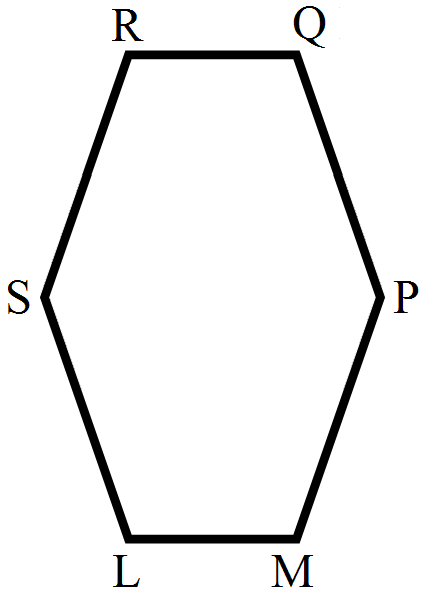
Indentify parallel line segments in the figures given below:
Answer
$LM\ ||\ RQ, RS\ ||\ PM$ and $LS\ ||\ PQ$
These pairs of line segments are non-intersecting.
So, these pairs of lines are parallel.
View full question & answer
Question 111 Mark
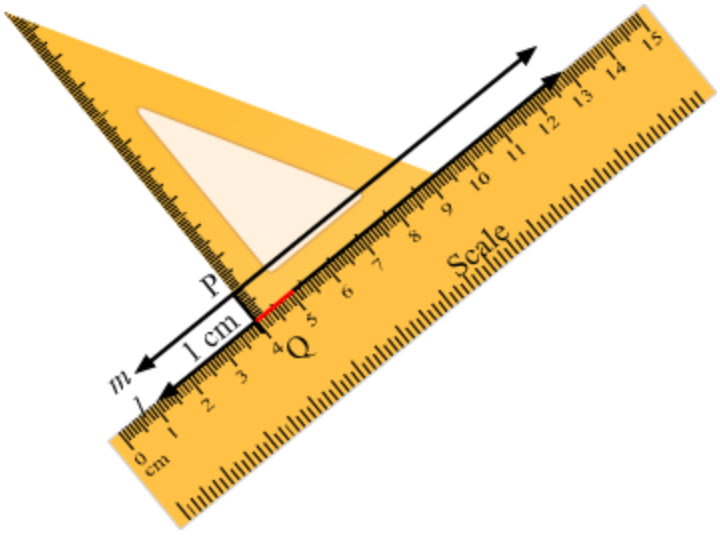
Find the distance between the parallel lines $l$ and $m$, using a set square.
Answer
Distance between $l$ and $m$ is $1\ cm.$ Place the ruler so that one of its measuring edges lies along the line $l$. Hold it with one hand. Now place a set square with one arm of the right angle coinciding with the edge of the ruler. Draw the line segment $PM$ along the edge of the set square, as shown in figure. Then, measure the distance $(PQ)$ between $l$ and $m$ as $1\ cm$.
View full question & answer