Questions

2 Marks Questions

Take a timed test

20 questions · self-marked practice — reveal the answer and mark yourself.

Question 12 Marks
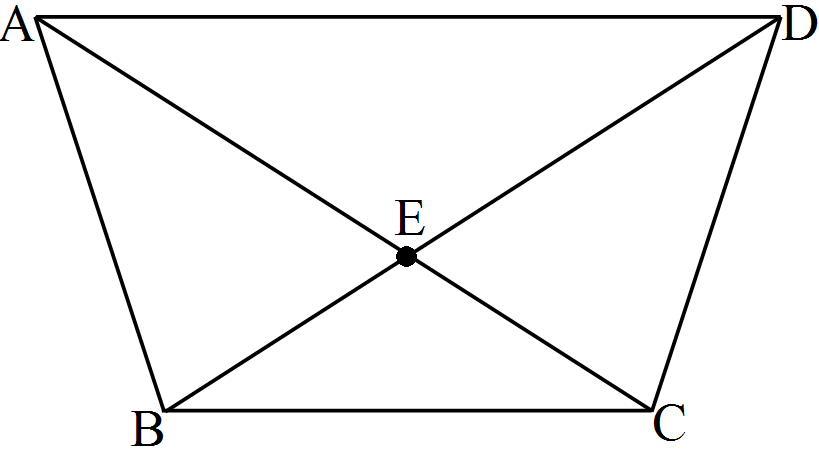
In Fig.,
$a.\ $What is $AE + EC?$
$b.\ $What is $AC - EC?$
$c.\ $What is $BD - BE?$
$d.\ $What is $BD - DE?$
Answer
From the figure, we observe that:
$a.\ AE + EC = AC$
$b.\ AC - EC = AE$
$c.\ BD - BE = ED$
$d.\ BD - DE = BE$
 
View full question & answer
Question 22 Marks
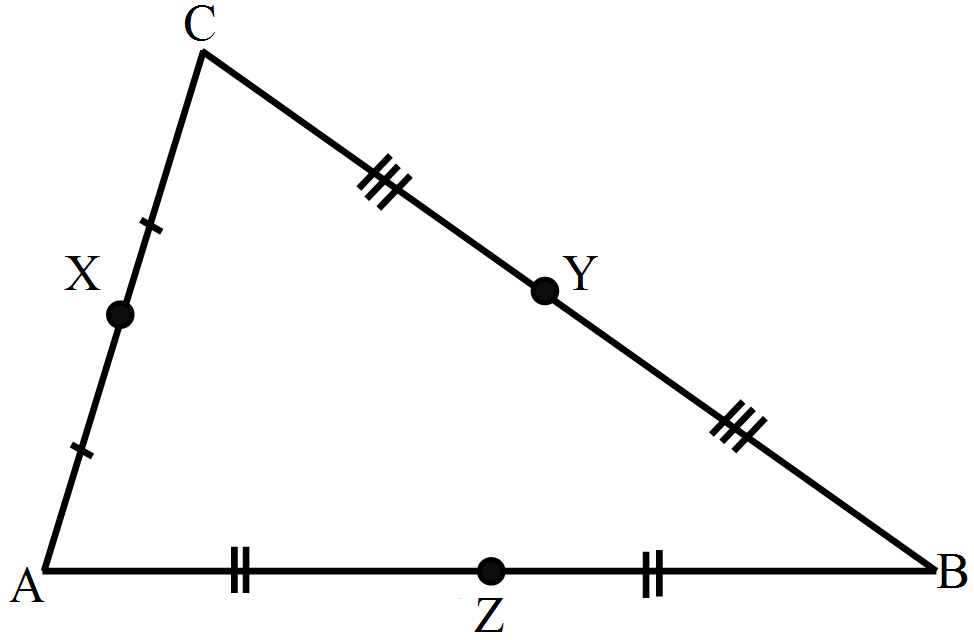
State the mid points of all the sides of Fig.
Answer
Mid-point of a line segment divides it into two equal parts. 
Clearly, from the figure, $AZ = ZB, AX = XC$ and $CY = YB.$
So $Z, X$ and $Y$ are the mid-points of $AS, AC$ and $CB,$
respectively. Hence, there are $3$ mid-points, i.e. $X, Z$ and $Y.$
View full question & answer
Question 32 Marks
In Fig.,
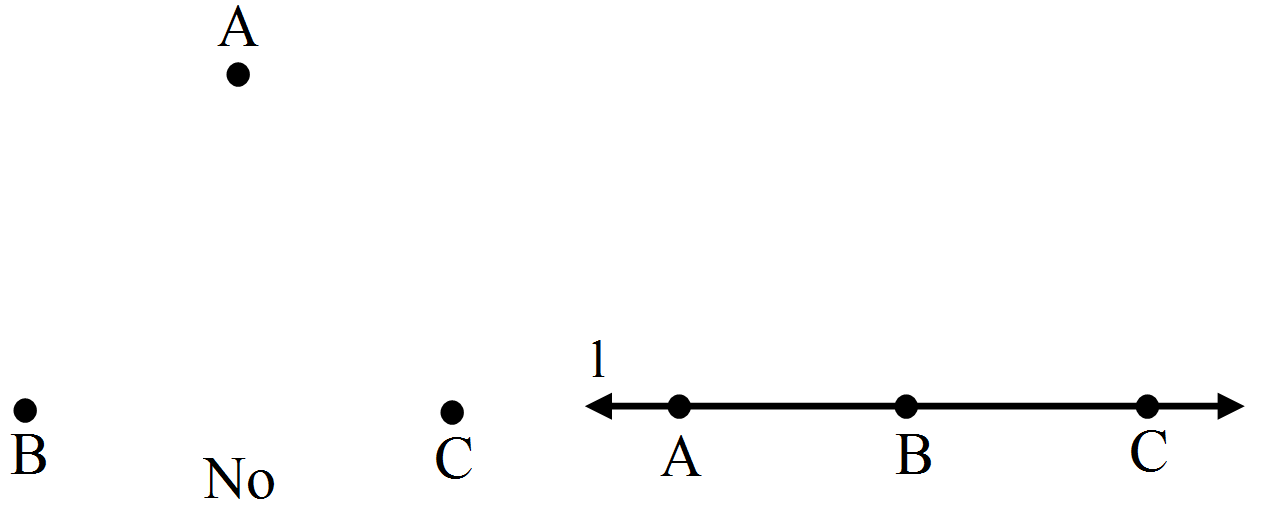
$a.\ $Is $AC + CB = AB?$
$b.\ $Is $AB + AC = CB?$
$c.\ $Is $ AB + BC = CA?$ 
Answer
$a.\ $Yes.
$b.\ $No, it is not possible.
$c.\ $No, it is not possible.
View full question & answer
Question 42 Marks
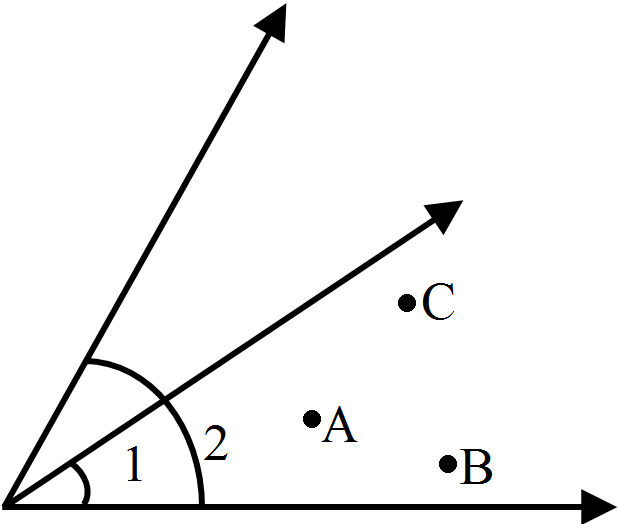
Look at Fig. Mark a point:
$1.A$ which is in the interior of both $\angle1$ and $\angle2$
$2.B$ which is in the interior of only $\angle1$
$3.$oint $C$ in the interior of $\angle1.$


Now, state whether points $B$ and $C$ lie in the interior of $\angle2$ also.
Answer
Yes, points $B$ and $C$ lie in the interior of $\angle 2$ also. Since, $\angle 1$ is in interior of $\angle 2, $ then all the points lying inside the $\angle1$, will also lie inside the $\angle2$
View full question & answer
Question 52 Marks
How many lines can be drawn which are perpendicular to a given line and pass through a given point lying outside it?
Answer
Perpendicular line from a given point to a given line is the shortest distance between them. Only one shortest distance is possible. Thus, only one perpendicular line is possible from the given point (outside the line) to a given line.
View full question & answer
Question 62 Marks
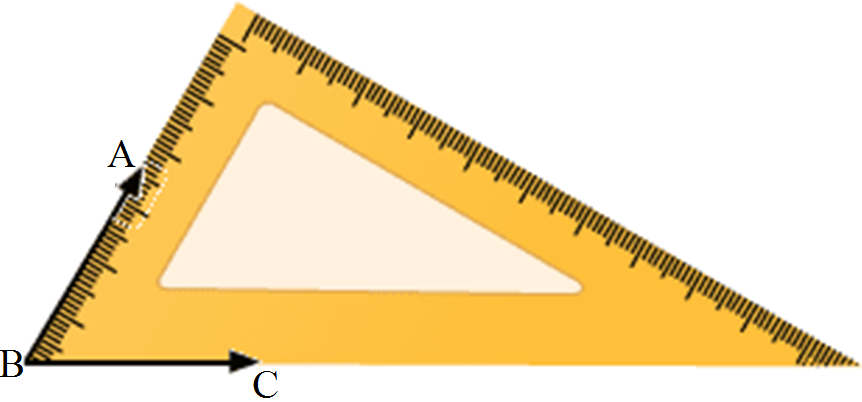
Construct the following angles using set-squares: $60^\circ $
Answer
$60^\circ $ Place $30^\circ $ set-square as shown in the figure. Draw the rays $BA$ and $BC$ along the edges from the vertex of $60^\circ $ The angle so formed is $60^\circ $
$\angle\text{ABC}=60^{\circ}$
View full question & answer
Question 72 Marks
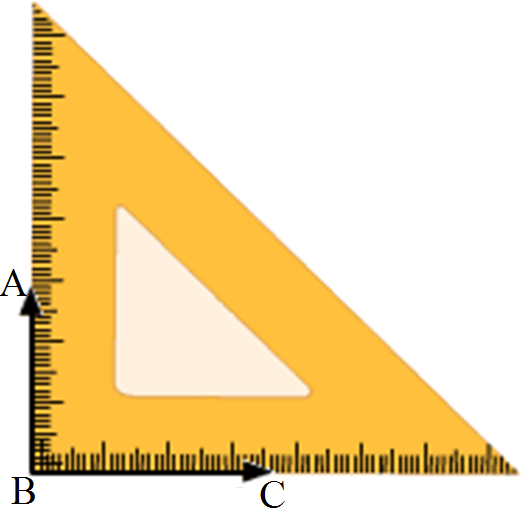
Construct the following angles using set-squares: $90^\circ $
Answer
$90^\circ $ Place $= 90^\circ $ set-square as shown in the figure. Draw two rays $BC$ and $BA$ along the edges from the vertex of $90^\circ $ angle. The angle so formed is $90^\circ $ angle. $\angle\text{ABC}=90^{\circ}$
View full question & answer
Question 82 Marks
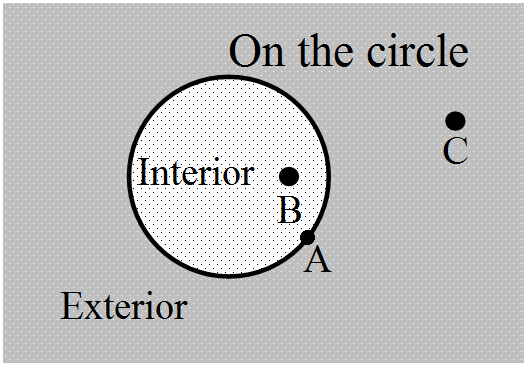
Draw any circle and mark points $A, B$ and $C$ such that:
$1.A$ is on the circle.
$2.B$ is in the interior of the circle.
$3.C$ is in the exterior of the circle.
Answer
We may draw a circle and three required points $A, B, C$ as following-
View full question & answer
Question 92 Marks
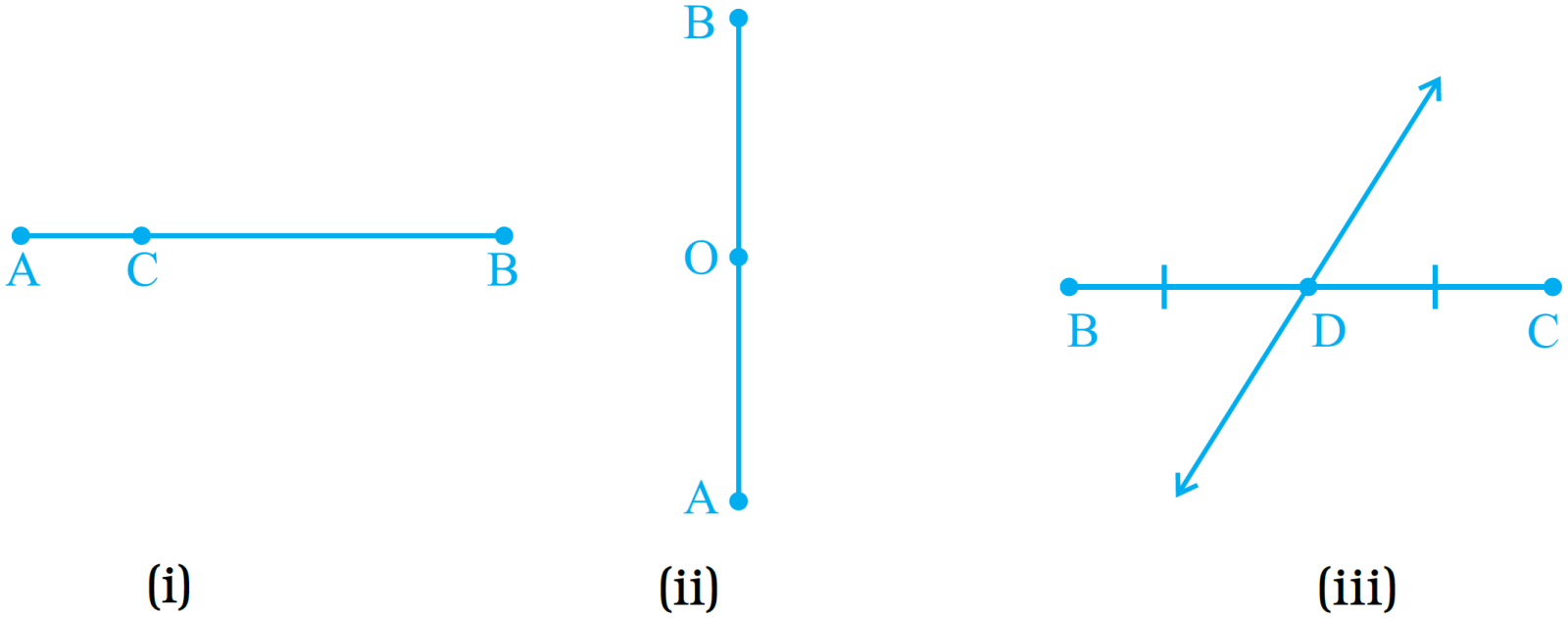
Which points in Fig., appear to be mid-points of the line segments? When you locate a mid-point, name the two equal line segments formed by it.
Answer
In figure $(ii),$ point $O$ appears to be the mid-point and equal line segments formed are $OA$ and $OB.$ Also, in figure $(iii),$ point $D$ appears to be the mid-point and equal line segments formed are $BD$ and $DC.$
View full question & answer
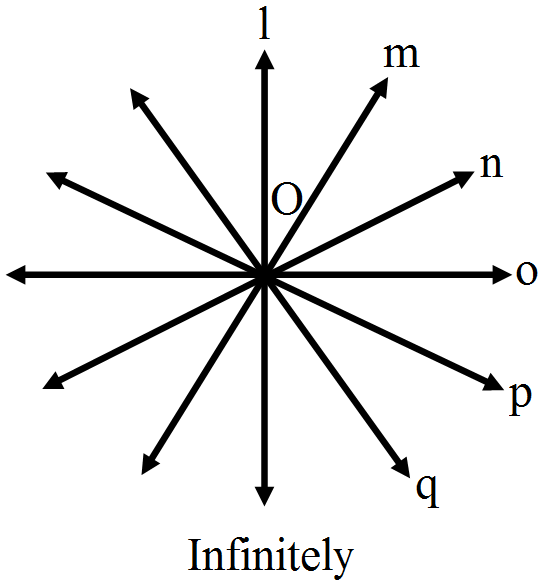
Question 102 Marks
How many lines can be drawn to pass through: A given point.
Answer
We can draw infinite number of lines passing through a given point.
View full question & answer
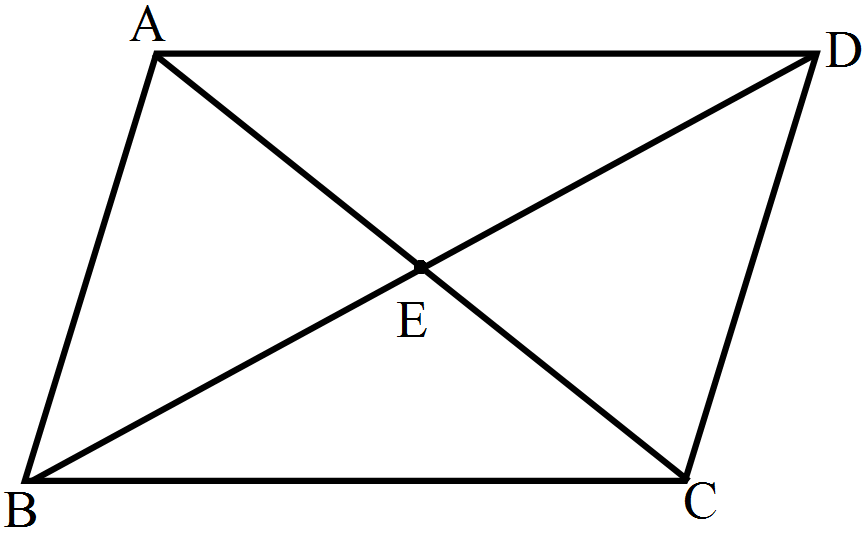
Question 112 Marks
In Fig.,
$a.$ Name any four angles that appear to be acute angles.
$b.$ Name any two angles that appear to be obtuse angles.

Answer
$1.$ The four angles that appear to be acute angles are $\angle\text{AEB}, \angle\text{ADE}, \angle\text{BAE}$ and $\angle\text{BCE}$
$2.$ $\angle\text{BCD}$ and $\angle\text{BAD}$ are angles that appear to be obtuse angles $($answer may vary$).$
View full question & answer
Question 122 Marks
Construct the following angles using set-squares: $45^\circ $
Answer
$45^\circ$ Place $45^\circ$ set-square. Draw two rays $AB$ and $AC$ along the edges from the vertex from the vertex of $45^\circ$ angle of the set- square. The angle so formed is a $45^\circ$ angle. $\angle\text{BAC}=45^{\circ}$
View full question & answer
Question 132 Marks
Using a pair of compasses construct the following angles: $120^\circ $
Answer
Only one line can be drawn with two given points.
View full question & answer
Question 142 Marks
Is it possible for the same:
$a.\ $Line segment to have two different lengths?
$b.\ $Angle to have two different measures?
Answer
$a.\ $No, it is not possible that the same line segments have two different lengths,
$b.\ $No, it is not possible that the same angles have two different measures.
View full question & answer
Question 152 Marks
How many lines can be drawn which are perpendicular to a given line and pass through a given point lying on it?
Answer
At any point on the line, we can draw only one perpendicular line. Thus, on the given line on a point, we can draw only one perpendicular line.
View full question & answer
Question 162 Marks
Can we have two obtuse angles whose sum is:
$a.\ $A reflex angle? Why or why not?
$b.\ $A complete angle? Why or why not?
Answer
$a.\ $Yes, the sum of two obtuse angles is always greater than $180^\circ .$ Hence, the sum of two obtuse angles may be a reflex angle.
$b.\ $No, the sum of two obtuse angles cannot be $360^\circ .$ Because each obtuse angle lies between $90^\circ $ to $180^\circ .$ So, the sum of the two obtuse angles lies between $180^\circ $ to $360^\circ .$
View full question & answer
Question 172 Marks
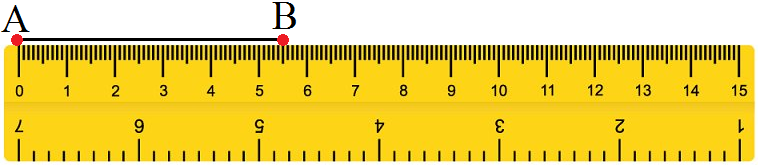
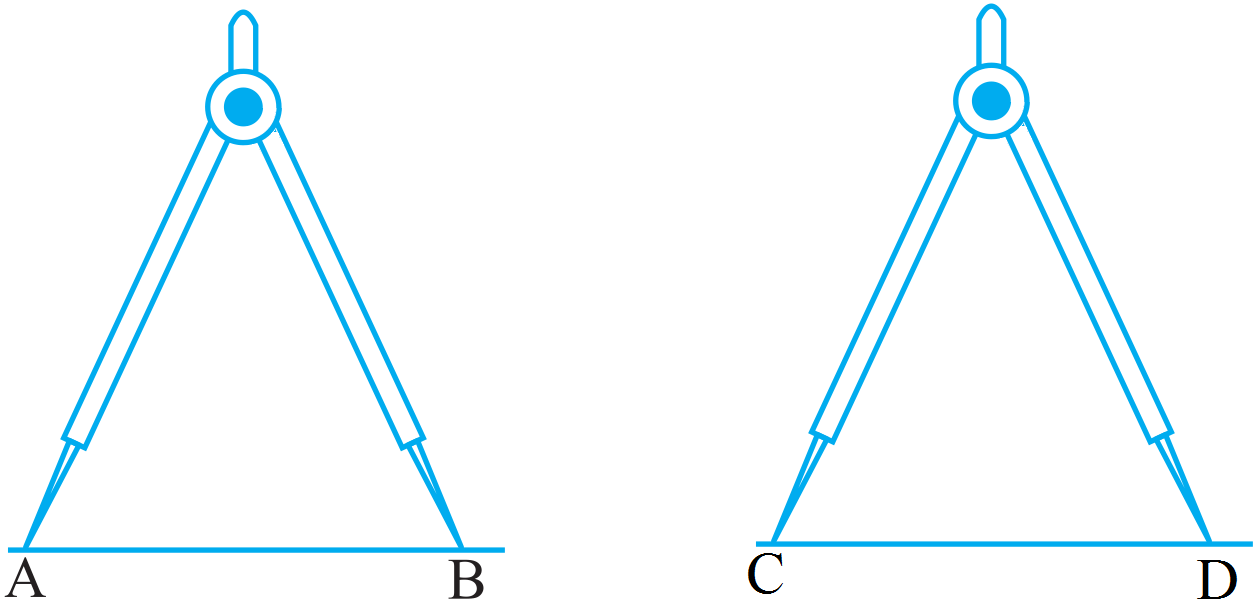
Mark two points, $A$ and $B$ on a piece of paper and join them. Measure this length. For each of the following draw a line segment $CD$ that is: Equal to the segment $AB.$
Answer
Mark two points, $A$ and $B$ on a piece of paper and join them as follows:

To measure the length of $AB,$ place the ruler with its edge along $AB,$ such that the zero mark of the \ cm side of the ruler coincides with point $A,$ as shown in the figure. Now, read the mark on the ruler, which corresponds to the point $B.$ The reading on the ruler at point $B$ is the length of the line segment $AB.$ Here, $AB = 5.6\ cm$ To draw the line segment $CD$ equal to $AB,$ take a divider and open it, such that the end-point of one of its arms is at $A$ and the end-point of the second arm is at $B,$ as shown in the figure. Then, lift the divider and without disturbing its opening, place the end-points of both hands on the paper, where we have to draw $CD$.
 
View full question & answer
Question 182 Marks
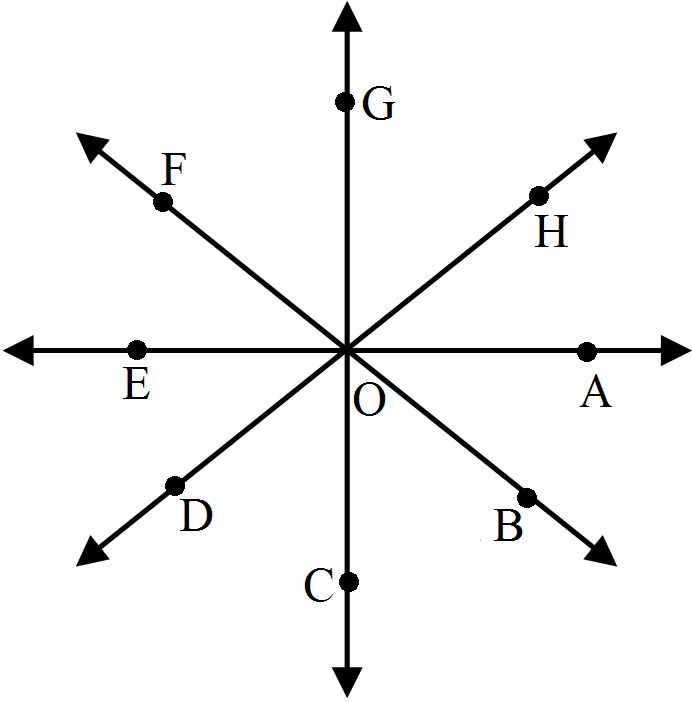
How many rays are represented in Fig.? Name them.
Answer
We know that a ray has fixed starting point and it can be drawn to infinity. If we take $0$ as starting point, we will have a ray in every given direction. So, our rays are, $\overrightarrow{\text{OA}},\overrightarrow{\text{OB}},\overrightarrow{\text{OC}},\overrightarrow{\text{OD}},\overrightarrow{\text{OE}},\overrightarrow{\text{OF}},\overrightarrow{\text{OG}},\overrightarrow{\text{OH}}.$ Thus, the number of rays in the figure is 8.
View full question & answer
Question 192 Marks
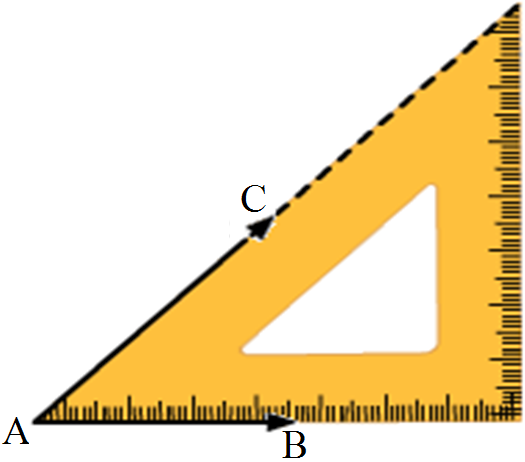
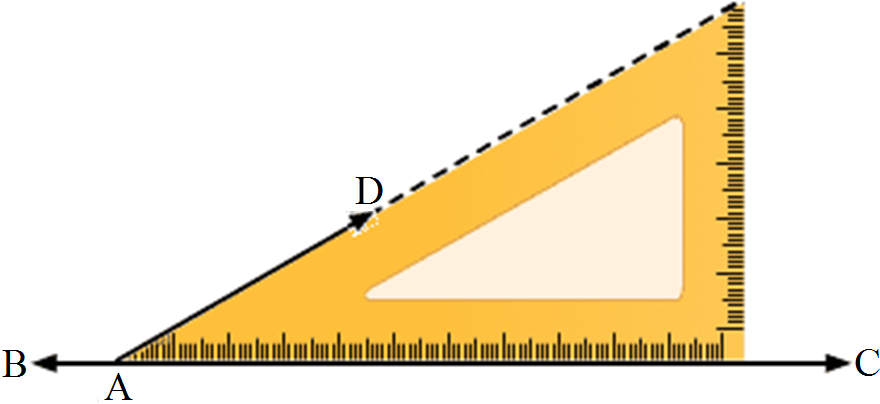
Given a line $BC$ and a point $A$ on it, construct a ray $AD$ using set squares so that $\angle\text{DAC}$ is: $30^\circ$
Answer
Draw a line $BC$ and take a point $A$ on it. Place $30^\circ $ set-square on the line $BC$ such that its vertex of $30^\circ$ angle lies on point $A$ and one edge coincides with the ray $AB$ as shown in figure. Draw the ray $AD.$

Thus $\angle\text{DAC}$ is the required angle of $30^\circ$.
View full question & answer
Question 202 Marks
Using a pair of compasses construct the following angles: $90^\circ $
Answer
We can draw one line with three given points if all the three point are collinear. But, if the points are not collinear, then we cannot draw any line passing through the points.
View full question & answer