Question 13 Marks
Draw the perpendicular bisector of $\overline{X Y}$ whose length is $10.3 \ cm.$
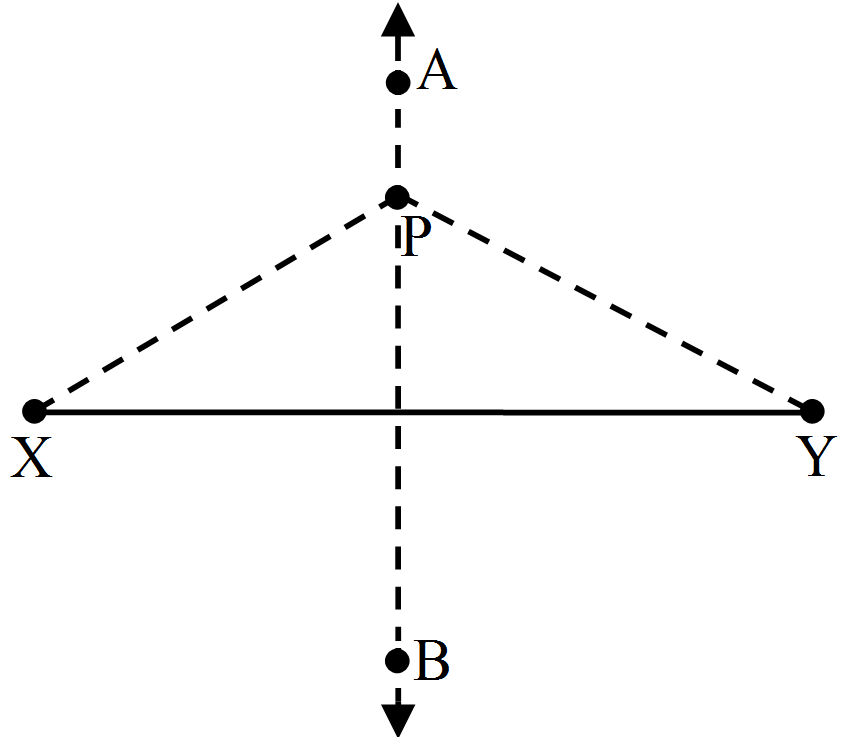
$a.\ $Take any point $P$ on the bisector drawn. Examine whether $PX = PY.$
$b.\ $If $M$ is the midpoint of $\overline{X Y}$, what can you say about the lengths $MX$ and $XY$?
Answer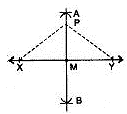
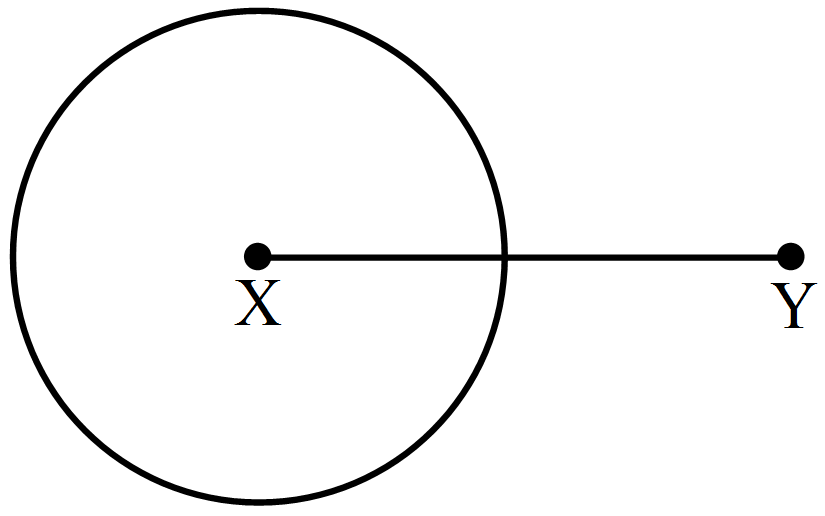
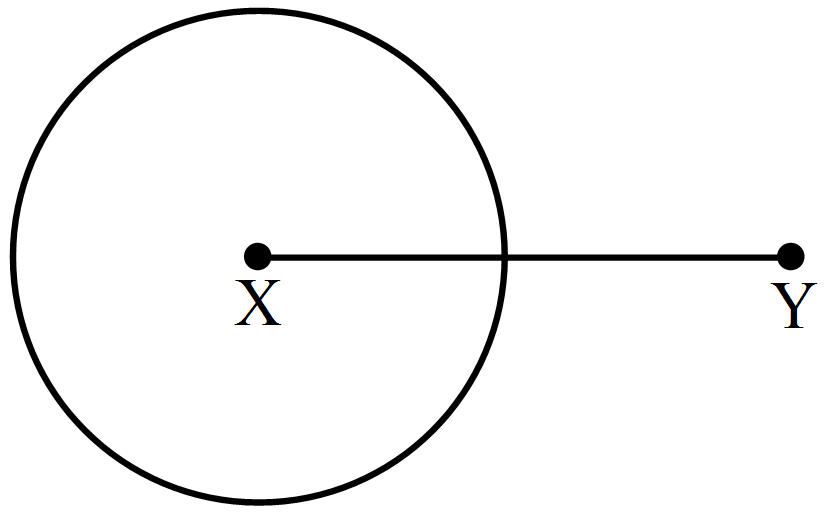
$i.\ $Draw a line segment $\overline{X Y}$ of length $10.3\ cm.$
$ii.\ $With $X$ as centre, using compasses, draw an arc. The radius of this arc should be more than half of the length of $\overline{X Y}$.
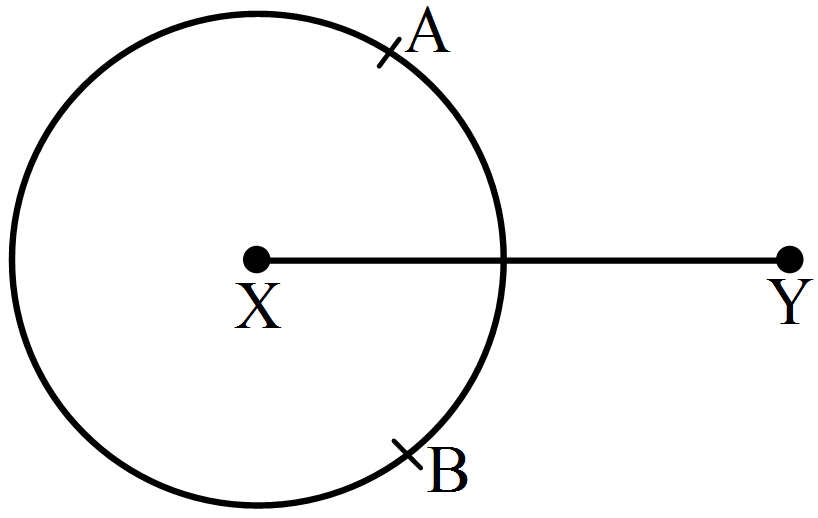
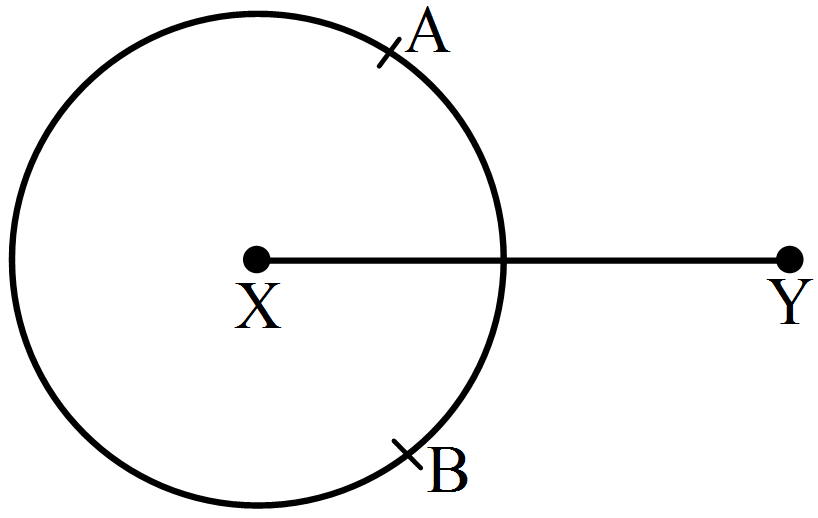
$iii.\ $With the same radius and with $Y$ as centre, draw another arc using compasses. Let it cut the previous arc at $A$ and $B$.
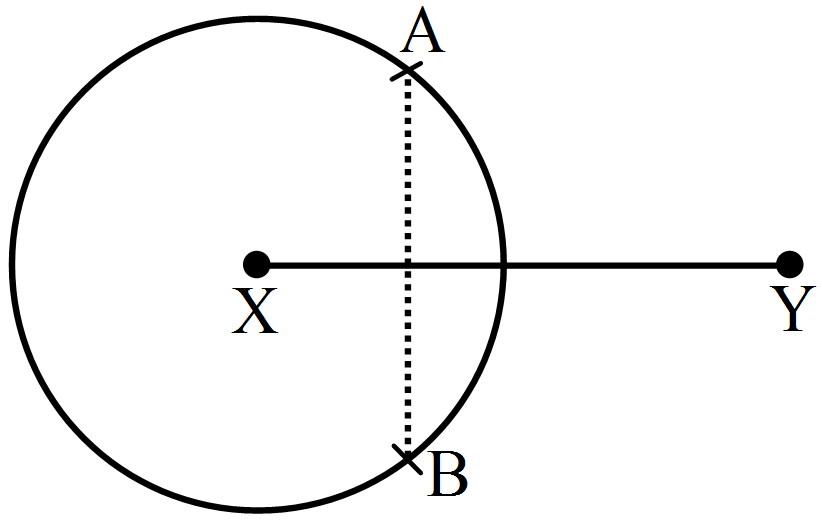
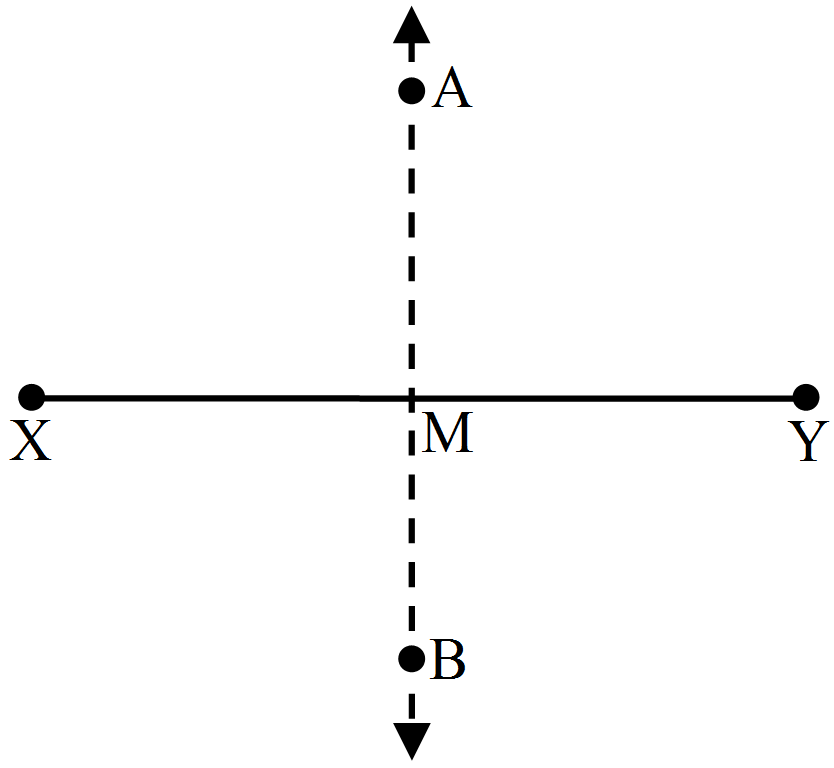
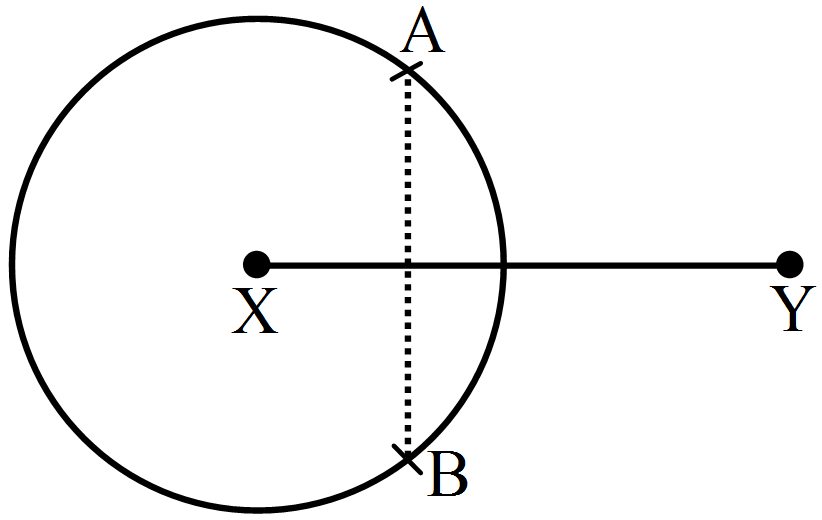
$iv.\ $Join $AB$. Then $\overline{A B}$ is the perpendicular bisector of the line segment $\overline{X Y}$.
$a.\ $ On examination, we find that $PX = PY.$
$b.\ $ We can say that the lengths of $MX$ is half of the length of $XY.$ View full question & answer→Question 23 Marks
Draw a line segment of length $9.5\ cm$ and construct its perpendicular bisector.
Answer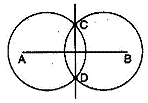
$i.\ $Draw a line segment $\overline {A B}$ of length $9.5\ cm.$
$ii.\ $With $A$ as centre, using compasses, draw a circle. The radius of this circle should be more than half of the length of $\overline {A B}$ .
$iii.\ $With the same radius and with $B$ as centre, draw another circle using compasses. Let it cut the previous circle at $C$ and $D$.
$iv.\ $Join $CD$. Then $\overline {CD}$ is the perpendicular bisector of the line segment $\overline {A B}$ . View full question & answer→Question 33 Marks
Draw $\overline {AB} $ of length $7.3 \ cm$ and find its axis of symmetry.
Answer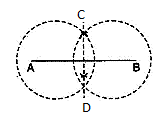
$i.\ $Draw a line segment $\overline {AB} $ of length $7.3\ cm.$
$ii.\ $With $A$ as centre, using compasses, draw a circle. The radius of this circle should be more than half of the length of $\overline {AB} $.
$iii.\ $With the same radius and with $B$ as centre, draw another circle using compasses. Let it cut the previous circle at $C$ and $D$.
$iv.\ $Join $CD$. Then, $\overline {CD} $ is the axis of symmetry of $\overline {AB} $. View full question & answer→Question 43 Marks
Given some line segment $\overline{AB}$, whose length you do not know, construct $\overline{PQ}$ such that the length of $\overline{PQ}$ is twice that of $\overline{AB}$ .
Answer$i.\ $Given $\overline{AB}$ whose length is not known.
$ii.\ $Fix the compasses pointer on $A$ and the pencil end on $B$. The opening of the instrument now gives the length of $\overline{AB}$.
$iii.\ $Draw any line $l$. Choose a point $P$ on $l$. Without changing the compasses setting, place the pointer on $P$.
$iv.\ $Strike an arc that cuts $l$ at a point, say, $X$.
$v.\ $Now fix the compasses pointer on $X$. Strike an arc away from $P$ that cuts $l$ at a point, say, $Q$. Now the length of $\overline{PQ}$ is twice that of $\overline{AB}$.
View full question & answer→Question 53 Marks
Draw any line segment $\overline{\mathrm{PQ}}$. Without measuring $\overline{\mathrm{PQ}}$, construct a copy of $\overline{\mathrm{PQ}}$.
Answer$i.\ $Given $\overline{\mathrm{PQ}}$ whose length is not known.
$ii.\ $Fix the compasses pointer on $P$ and the pencil end on $Q$. The opening of the instrument now gives the length of $\overline{\mathrm{PQ}}$.
$iii.\ $Draw any line $l$. Choose a point $A$ on $l$. Without changing the compasses setting, place the pointer on $A$.
$iv.\ $Strike an arc that cuts $l$ at a point, say, $B$. Now $\overline{A B}$ is a copy of $\overline{\mathrm{PQ}}$.
View full question & answer→Question 63 Marks
Construct a line segment of length $5.6\ cm$ using ruler and compass.
Answer
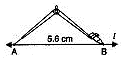
Steps of Construction:
Step 1: Draw a line $l$. Mark a point $A$ on line $l.$
Step 2: Place the compasses pointer on the zero mark on the ruler. Open it to place the pencil point upto the $5.6 \ cm$ mark.
Step 3: Without changing the opening of the compasses, place the pointer on $A$ and swing an arc to cut $l$ and $B$.
Step 4: $AB$ is a line segment of required length. View full question & answer→Question 73 Marks
Draw a circle and any two of its diameters. If you join the ends of these diameters, what is the figure obtained? What figure is obtained if the diameters are perpendicular to each other? How do you check your answer?
Answer$i.\ $On joining the ends of any two diameters of the circle, the figure obtained is a rectangle.

$ii.\ $On joining the end of any two diameters of the circle, perpendicular to each other, the figure obtained is a square.

To check the answer, we measured the sides and angles of the figure obtained. View full question & answer→Question 83 Marks
With the same centre $O$, draw two circles of radii $4 \ cm$ and $2.5 \ cm.$
AnswerSteps of Construction
$i.$ For circle of radius $4 \ cm$
$1.$ Open the compasses for the required radius $4 \ cm$, by putting the pointer on $0$ and opening the pencil upto $4 \ cm.$
$2.$ Place the pointer of the compasses at $O$.
$3.$ Turn the compasses slowly to draw the circle.
$ii.$ For circle of radius $2.5 \ cm$
$1.$ Open the compasses for the required radius $2.5 \ cm,$ by putting the pointer on $0$ and opening the pencil upto $2.5 \ cm.$
$2.$ place the pointer of the compasses at $O.$
$3.$ Turn the compasses slowly to draw the circle.
View full question & answer→Question 93 Marks
Draw a circle of radius $3.2\ cm.$
AnswerSteps of Construction:
$i.\ $Open the compasses for the required radius $3.2\ cm,$ by putting the pointer on $0$ and opening the pencil upto $3.2\ cm.$
$ii.\ $Draw a point with a sharp pencil and marks it as $O$ in the centre.
$iii.\ $Place the pointer of the compasses where the centre has been marked.
$iv.\ $Turn the compasses slowly to draw the circle.
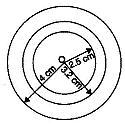
View full question & answer→Question 103 Marks
Mark two points, $A$ and $B$ on a piece of paper and join them. Measure this length. Draw a line segment $CD$ that is:
Half $AB.$
AnswerMark two points, $A$ and $B$ on a piece of paper and join them as follows:
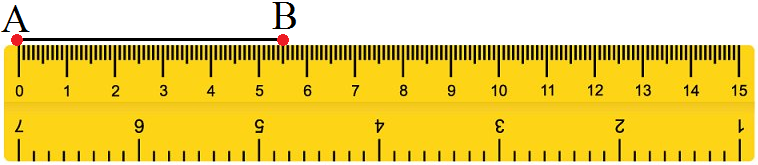
To measure the length of $AB$, place the ruler with its edge along $AB$, such that the zero mark of the $cm$ side of the ruler coincides with point $A$, as shown in the figure.
Now, read the mark on the ruler, which corresponds to the point $B$. The reading on the ruler at point $B$ is the length of the line segment $AB$.
Here, $AB = 5.6\ cm$ To draw the line segment that is half $AB$, we draw a line/ and take a point $C$ on it.
Now, using a ruler, we measure the line segment $AB$ and here, $AB = 5.6\ cm$ Half of $AB = 5.62 = 2.8\ cm$
Now, we take a divider and open it so much that its end of one hand is at $0$ and end of the another hand is at $2.8\ cm$.
Then, we lift the divider and place one end at $C$ and the other end on the line $l$ at point $D.$
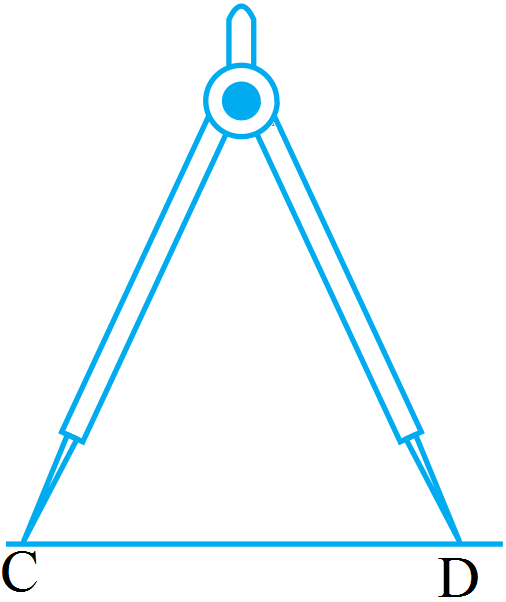
View full question & answer→Question 113 Marks
Mark two points, A and B on a piece of paper and join them. Measure this length. Draw a line segment $CD$ that is: Twice $AB.$
AnswerMark two points, $A$ and $B$ on a piece of paper and join them as follows:
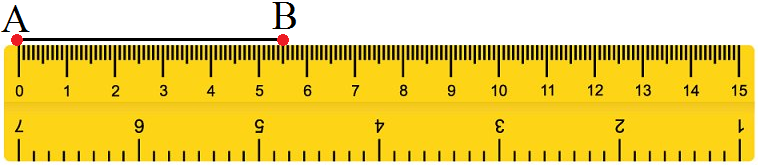
To measure the length of $AB$, place the ruler with its edge along $AB$, such that the zero mark of the cm side of the ruler coincides with point $A$, as shown in the figure. Now, read the mark on the ruler, which corresponds to the point $B$. The reading on the ruler at point $B$ is the length of the line segment $AB$. Here, $AB = 5.6\ cm$ To draw the line segment twice $AB$, draw a line/ and take a point $C$ on it. Now, take a divider and open it such that the end points of both its arms are at $A$ and $B$. Then, lift the divider and without disturbing its opening, place one end-point at $C$ and the other end-point on the line $1$, as shown in the figure. Lift the divider and place one end-point at $E$ and the other end-point on the line $1$, opposite $C$. Name this point $D$. 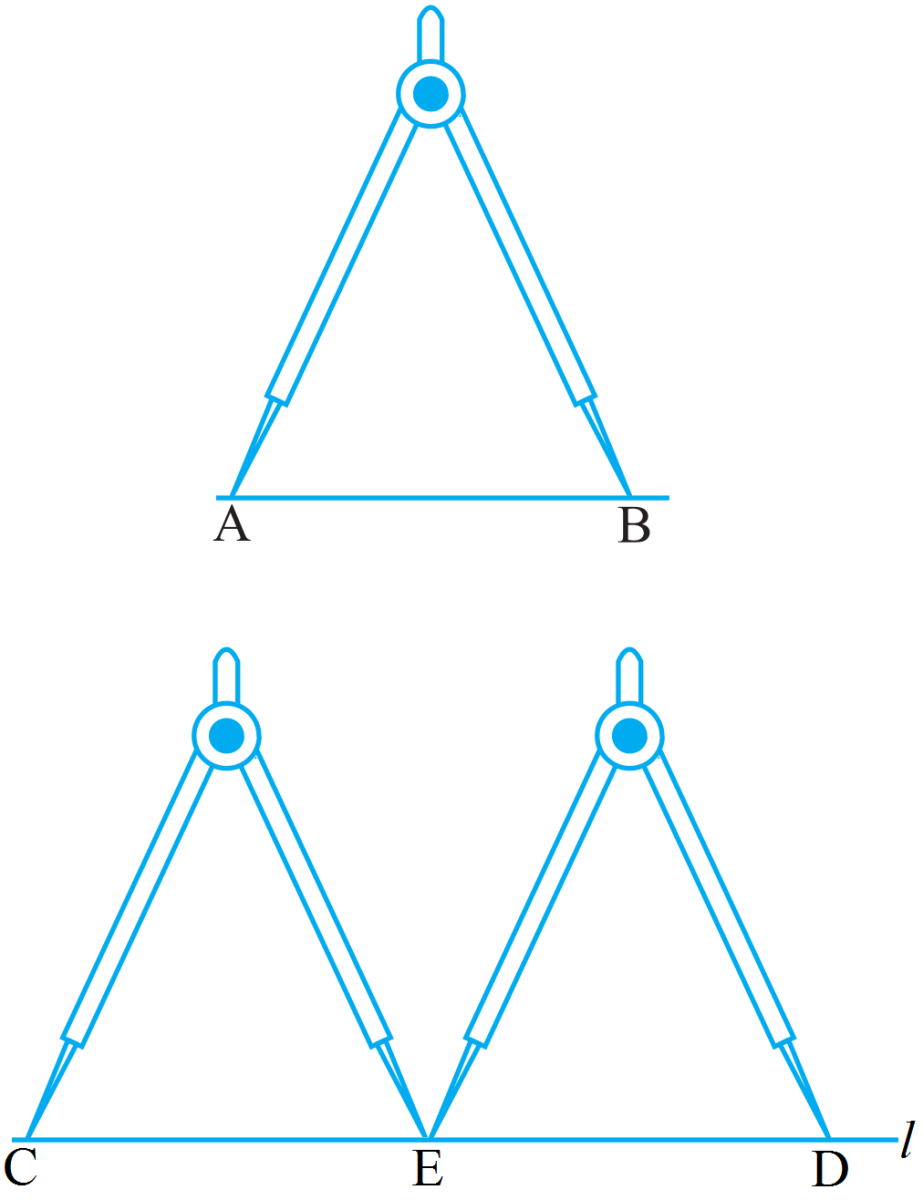
View full question & answer→Question 123 Marks
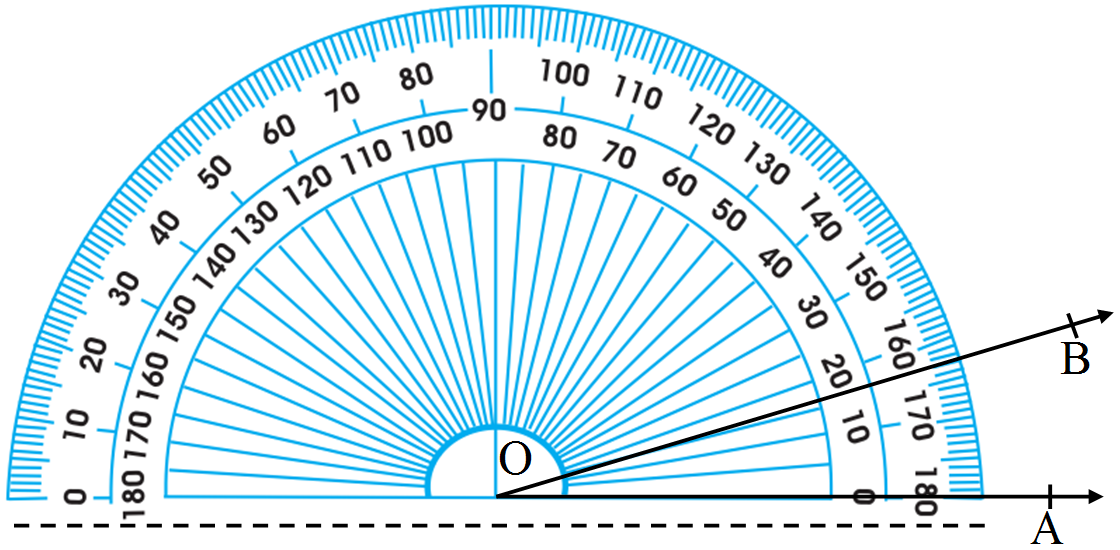
Draw ray $PQ$ as shown in the figure. Using the protractor, make an angle of $15^\circ $ with one hand $PQ.$

AnswerDraw a ray $PQ$ as given in the question.
Place the protractor on the ray $PQ$ such that its center coincides with the point $P$ and the diameter of the protractor coincides with $PQ.$ Mark a point $B$ against the mark of $15^\circ $ on the protractor. Remove the protractor and draw $PB$. $\angle\text{QPB}$ is the required angle of $15^\circ .$
View full question & answer→Question 133 Marks
Construct line segments whose lengths are: $4.8\ cm.$
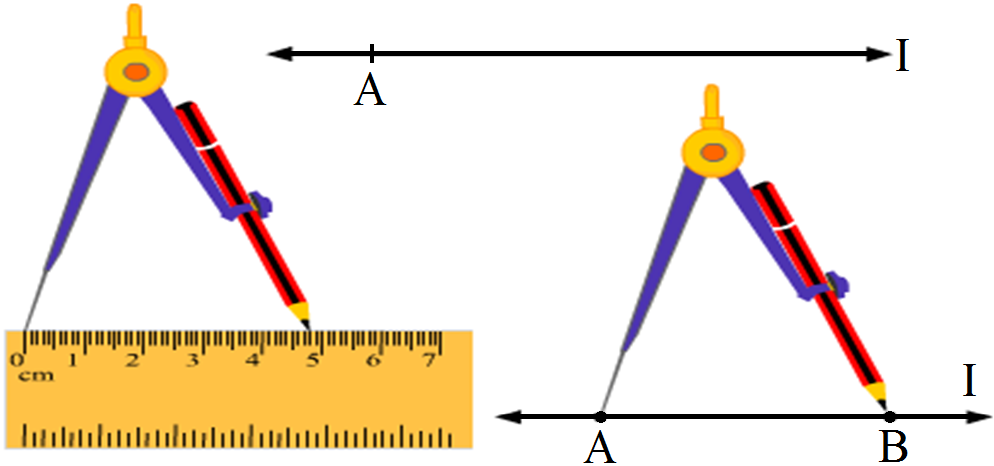
AnswerDraw a line L on the paper and mark a point $A$ on it.
Take a compass and place its metal point at zero mark of the ruler.
Adjust the compass such that the pencil point is at $4.8\ cm$ mark on the ruler.
Now, take the compass to L such that its metal point is on point $A$.
Mark a small mark at $B$ on $L$ corresponding to the pencil point of the compass.
$AB$ is the required line segment of $4.8\ cm.$
View full question & answer→Question 143 Marks
Construct the following angles using set-squares: $105^\circ $
AnswerPlace the vertex of $45^\circ $ of the set-square and make angle of $90^\circ $ by drawing the rays $BD$ and $BC$ as shown in the figure
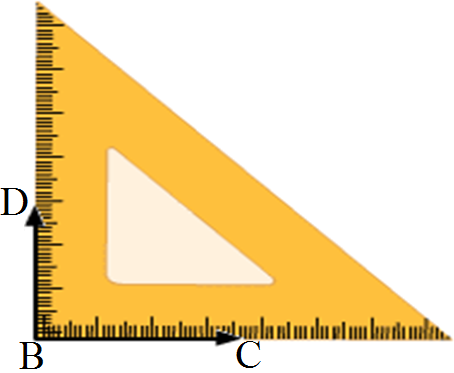
Now, place the vertex of $30^\circ $ of the set-square on the ray $BS$ as shown in the figure and draw the ray $BA$ The angle so formed is $150^\circ $. Therefore, $\angle\text{ABC}=150^{\circ}$
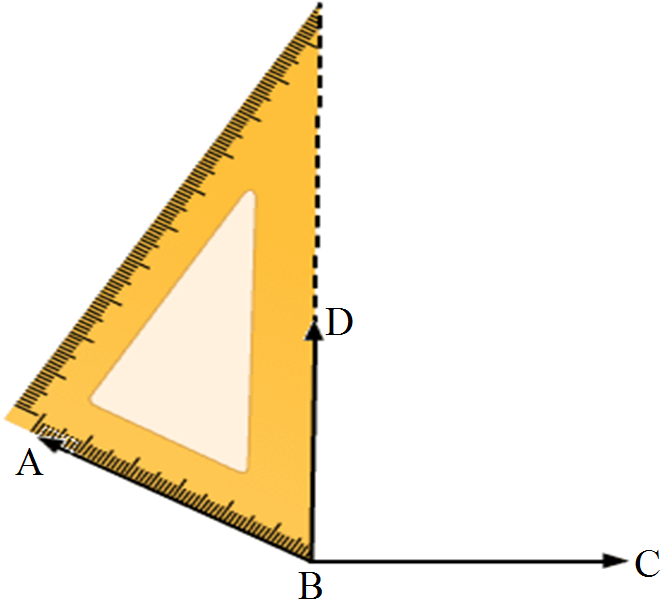
View full question & answer→Question 153 Marks
If $AB = 7.5\ cm$ and $CD = 2.5\ cm$, construct a segment whose length is equal to: $2AB$
AnswerGiven: $AB= 7.5\ cm$ and $CD = 2.5\ cm$ Draw $AB$ and $CD$

Draw a line $l$ and take a point $E$ on it. Now a take a divider and open it such that the ends of both its arms are at $A$ and $B$.
Then, we lift the divider and place its one end at $E$ and other end (say $F$) on the line $l$ as shown in the figure.
Again, lift the divider and place its one end $F$ and other end on the line $l$, opposite to $E$. Let this point be $G$.
$EG$ is required line segment, whose length is equal to $2AB.$
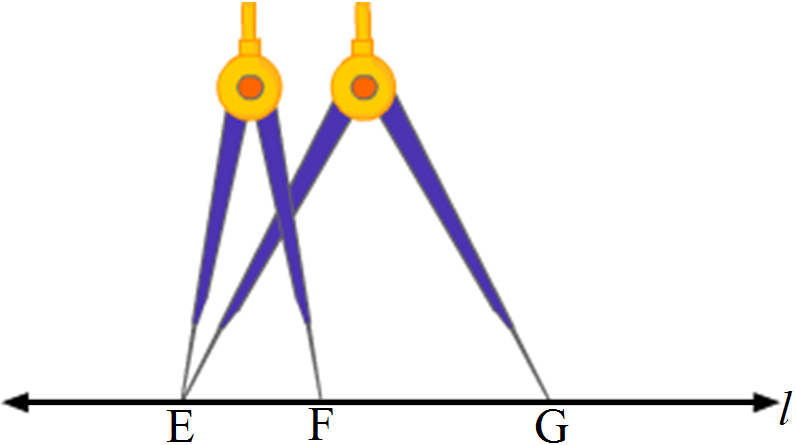
View full question & answer→Question 163 Marks
Construct line segments whose lengths are: $12\ cm\ 5mm$
AnswerDraw a line $L$ on the paper and mark a point $A$ on it.
Take a compass and place its metal point at zero mark of the ruler.
Adjust the compass such that the pencil point gets placed at the point which is $5$ small points from the mark of $12\ cm$ to $13\ cm$ of the ruler. Now, take the compass to $L$ such that its metal point is on $A$.
Mark a small mark at $B$ on $L$ corresponding to the pencil point of the compass.
$ AB$ is the required line segment of $12\ cm$ $5mm.$
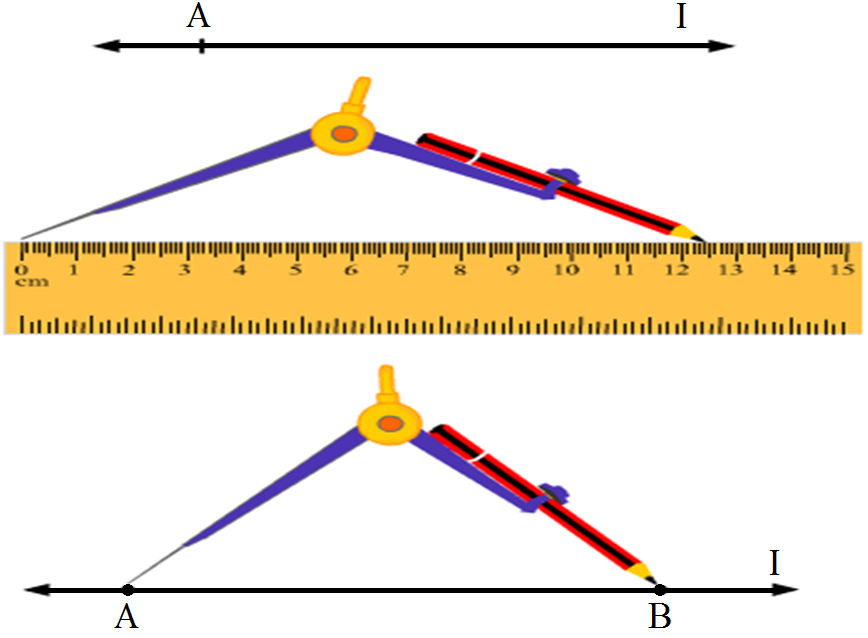
View full question & answer→Question 173 Marks
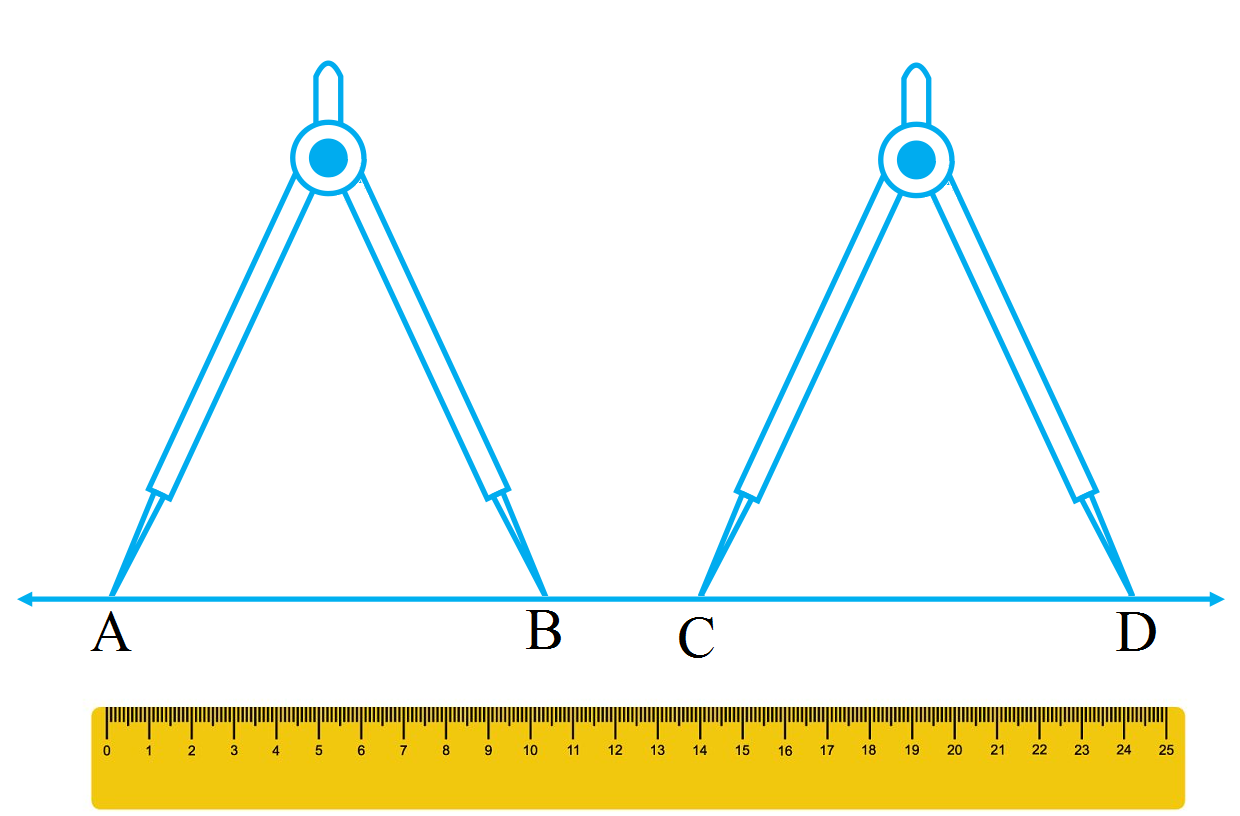
Mark two points, $A$ and $B$ on a piece of paper and join them. Measure this length. Draw a line segment $CD$ that is: Collinear with $AB$ and is equal to it.
AnswerMark two points, $A$ and $B$ on a piece of paper and join them as follows:
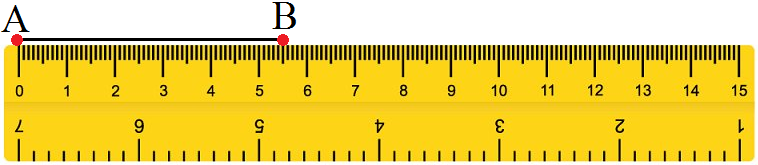
To measure the length of $AB$, place the ruler with its edge along $AB$, such that the zero mark of the $cm$ side of the ruler coincides with point $A$, as shown in the figure. Now, read the mark on the ruler, which corresponds to the point $B$.
The reading on the ruler at point $B$ is the length of the line segment $AB$.
Here, $AB = 5.6\ cm$
View full question & answer→Question 183 Marks
Draw a line segment of length $7.3\ cm$ using a ruler.
AnswerWe may draw a line segment of length $7.3\ cm$, using a rular as following-
$i.\ $Mark a point $A$ on the sheet.
$ii.\ $Put $0$ mark of rular at point $A.$
$iii.\ $Mark a point $B$ on the sheet at $7.3\ cm$ on ruler.
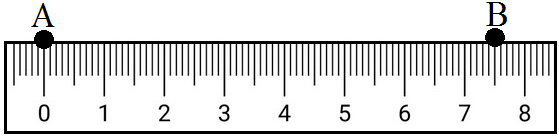
Join $A$ and $B$.
$\overline{\text{AB}}$ is the required line segment.

View full question & answer→Question 193 Marks
Write the name of:
$a.\ $Vertices.
$b.\ $Edges, and
$c.\ $Faces of the prism shown in Fig.
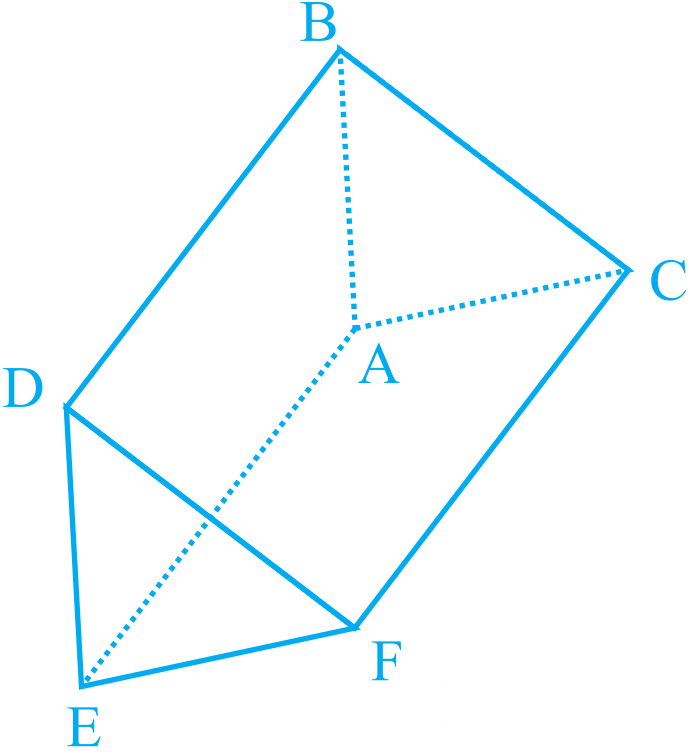
Answer$a.\ $Vertices shown in the figure are $A, B, C, D, E$ and $F.$
$b.\ $Edges shown in the figure are $AB, AC, BC, BD, DF, FC, EF, ED$ and $AE.$
$c.\ $Faces of prism shown in the figure are $ABC, DEF, AEFC, AEDB$ and $BDFC.$
View full question & answer→Question 203 Marks
Given $\overline{\text{AB}}$ of length $3.9\ cm$, construct $\overline{\text{PQ}}$ such that the length of $\overline{\text{PQ}}$ is twice that of $\overline{\text{AB}}$. Verify by measurement.

$($Hint: Construct $\overline{\text{PX}}$ such that length of $\overline{\text{PX}} =$ length of $\overline{\text{AB}}$; then cut off $\overline{\text{XQ}}$ such that $\overline{\text{XQ}}$ also has the length of $\overline{\text{AB}}).$ Answer
We may draw a line segment $\overline{\text{PQ}}$ such that the length of $\overline{\text{PQ}}$ is twice that of $\overline{\text{AB}}$ as following-
$1.$Draw a line $l$ and mark a point $P$ on it and let $AB$ be the given line segment of $3.9\ cm.$


$2.$By adjust the compasees up to the length of $AB$, draw an arc to cut the line at $x$, while taking the pointer of compasses at point $P.$

$3.$Again put pointer on point $x$, draw an arc to cut line $l$ again at $Q.$

$\overline{\text{PQ}}$ is the required line segment. By ruler we may measure the length of $\overline{\text{PQ}}$ which comes to $7.8\ cm.$
View full question & answer→Question 213 Marks
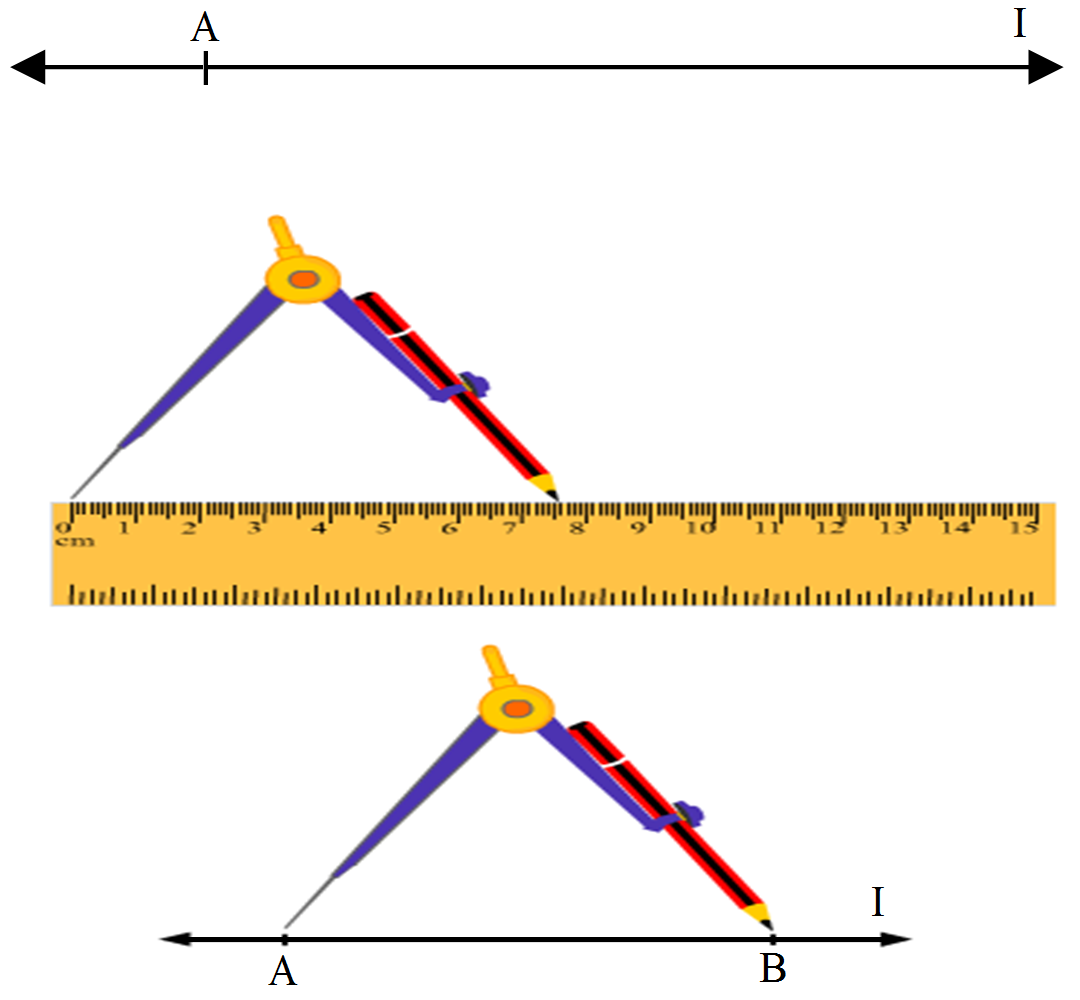
Construct line segments whose lengths are:
$7.6\ cm$
AnswerDraw a line $L$ on the paper and mark a point $A$ on it.
Take a compass and place its metal point at zero mark of the ruler.
Adjust the compass such that the pencil point gets placed at the point which is $6$ small points from the mark of $7\ cm$ to $8\ cm$ of the ruler.
Take the compass to $L$ such that its metal point is on $A.$
Mark a small mark at $B$ on the line $L$ corresponding to the pencil point of the compass.
$AB$ is the required segment of $7.6\ cm.$
View full question & answer→Question 223 Marks
The end-point $P$ of a line-segment $PQ$ is against $4\ cm$ mark and the end-point $Q$ is against the mark indicating $14.8\ cm$ on a ruler. What is the length of the segment $PQ$?
Answer
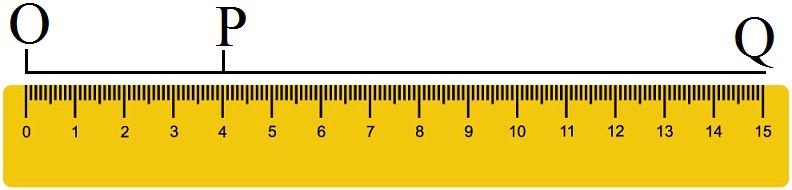
Extend the line segment $QP$ towards point zero of the ruler and take a point $0$ on the extended line $QP$ corresponding to point zero on the ruler.
From the figure, we can say:
$OP = 4\ cm$ and $OQ = 14.8\ cm$
Now, $PQ = OQ - OP$
$= (14.8 - 4)cm$
$= 10.8\ cm$ View full question & answer→Question 233 Marks
Draw all the diagonals of a pentagon $ABCDE$ and name them.
AnswerSince, a pentagon has five sides, i.e. $n = 5$. Hence, the number of diagonals $=\frac{5(5-3)}{2}=5$ 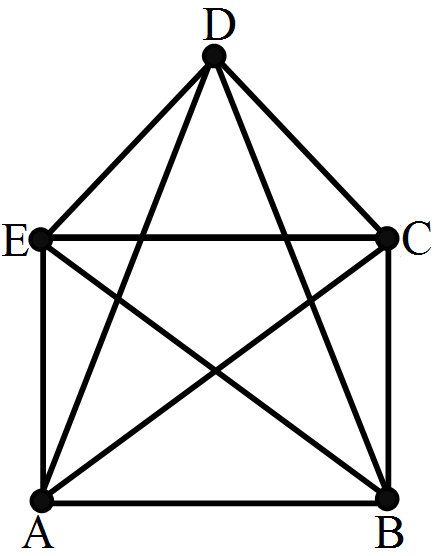
The diagonals of paentagon are $AC, AD, BE, BD$ and $CE.$ View full question & answer→Question 243 Marks
With the same centre $O$, draw two circles of radii $4\ cm$ and $2.5\ cm.$
AnswerThe required circle may be drawn as following:
Step 1: First open the compasses for the required radius $4\ cm.$
Step 2: Mark a point $O'$ where we want the centre of circle to be.
Step 3: Place the pointer of compasses on $O.$
Step 4: Turn the compass slowly to draw the circle.
Step 5: Now open the compasses for $2.5cm.$
Step 6: Again put pointer of compasses on point $'O'$ and from the compasses slowly to draw the circle. 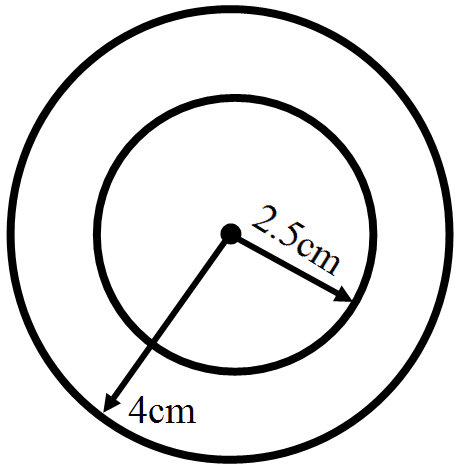
View full question & answer→Question 253 Marks
Draw a circle of radius $3.2\ cm.$
AnswerThe required circle may be drawn as following:
Step 1: First open the compasses for the required radius $3.2\ cm.$
Step 2: Mark a point $O'$ where we want the centre of circle to be.
Step 3: Place the pointer of compasses on $O$.
Step 4: Turn the compass slowly to draw the circle.
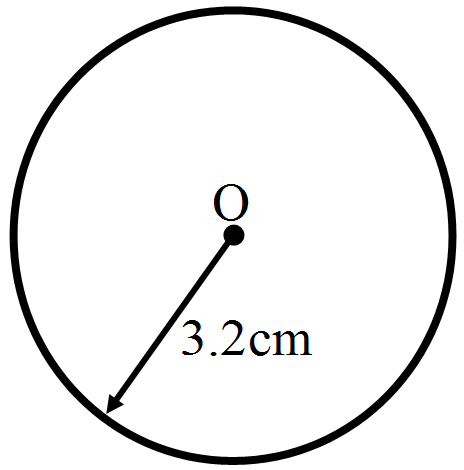
View full question & answer→Question 263 Marks
Given a line $BC$ and a point $A$ on it, construct a ray $AD$ using set squares so that $\angle\text{DAC}$ is: $150^\circ $
AnswerDraw a line $BC$ and take a point $A$ on it.
Place $30^\circ $ set-square on the line $BC$ such that its vertex of $30^\circ $ angle lies on point $A$ and one edge coincides with the ray $AB$ as shown in the figure. Draw the ray $AD.$
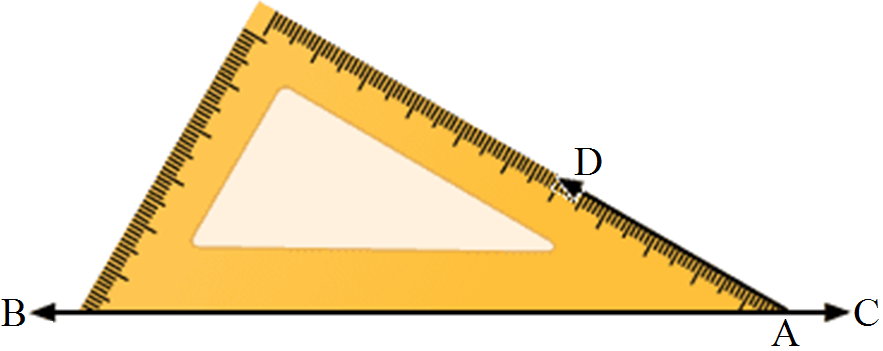
Therefore, $\angle\text{DAB}=30^{\circ}$ We know that angle on one side of the straight line will always add to $180^\circ $ Therefore, $\angle\text{DAB}+\angle{\text{DAC}}=180^{\circ}$ Therefore, $\angle\text{DAC}=150^{\circ}$ View full question & answer→Question 273 Marks
Draw a line $PQ$. Take a point $R$ on it. Draw a line perpendicular to $PQ$ and passing through $R$. Ruler and compasses.
AnswerDraw a line $PQ$ and take a point $R$ on it.
With $R$ as centre and taking a convenient radius, construct an arc touching the line $PQ$ at two points $A$ and $B$.
Now, with $A$ and $B$ as centres and radius greater than $AR$, construct two arcs cutting each other at $S$.
Join $RS$ and extend it in both directions. This is the required line, which is perpendicular to $PQ$ and passes through $R$. 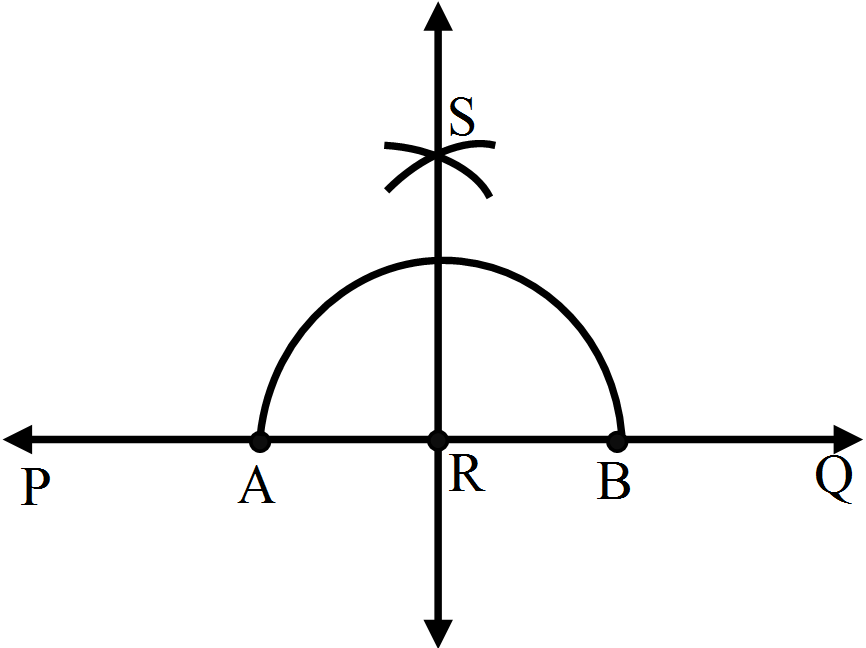
View full question & answer→Question 283 Marks
What is the difference between line, a line segment and a ray?
Answer
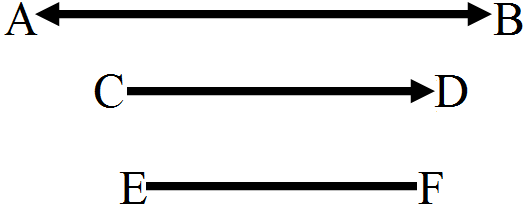
A line can be drawn to infinity in both the directions. $AB$ is a line.
A line segment has both ends fixed. $EF$ is a line segment.
A ray has one end fixed and another end can be drawn to infinity. $CD$ is a ray. View full question & answer→Question 293 Marks
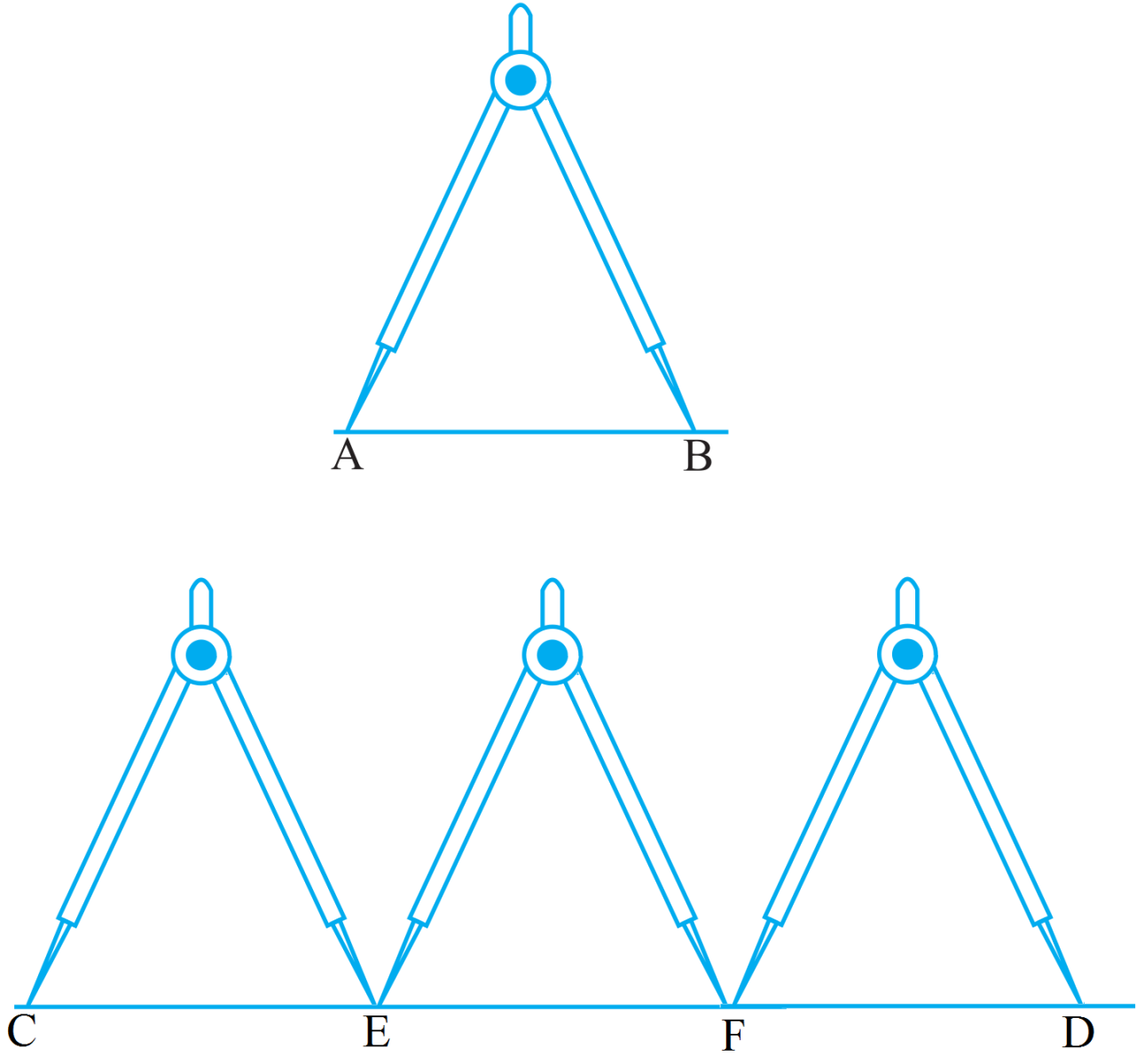
Mark two points, $A$ and $B$ on a piece of paper and join them. Measure this length. Draw a line segment $CD$ that is: Three times AB.
AnswerMark two points, $A$ and $B$ on a piece of paper and join them as follows:
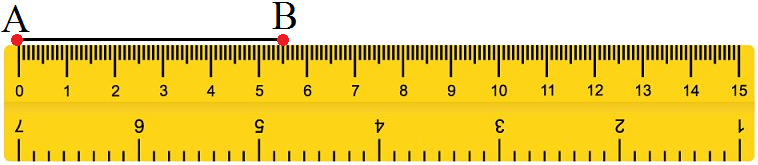
To measure the length of $AB$, place the ruler with its edge along $AB$, such that the zero mark of the $cm$ side of the ruler coincides with point $A$, as shown in the figure. Now, read the mark on the ruler, which corresponds to the point $B$.
The reading on the ruler at point $B$ is the length of the line segment $AB$.
Here, $AB = 5.6\ cm$ To draw the line segment three times $A$, we draw a line / and take a point $C$ on it.
Now take a divider and open it, such that the end-points of both its arms are at $A$ and $B.$
Then, we lift the divider and place one end-point at $C$ and the other end-point on the line $1$, as shown in the figure.
Let this point be $E$.
Again, lift the divider and place one end-pint at $E$ and the other end-point on the line $1$, opposite to $C.$
Let this point be $F$.
Again, lift the divider and place one end-point at $F$ and the other end-point on the line $1$, opposite to $C$.
Name this point $D$.
View full question & answer→Question 303 Marks
Draw the perpendicular bisector of $\overline{\text{XY}}$ whose length is $10.3\ cm.$
If $M$ is the mid point of $\overline{\text{XY}}$, what can you say about the lengths $\overline{\text{MX}}$ and $\overline{\text{XY}}$?
View full question & answer→Question 313 Marks
Draw the perpendicular bisector of $\overline{\text{XY}}$ whose length is $10.3\ cm$. Take any point $P$ on the bisector drawn. Examine whether $PX = PY$
View full question & answer→Question 323 Marks
If $AB = 7.5\ cm$ and $CD = 2.5\ cm$, construct a segment whose length is equal to: $AB + CD$
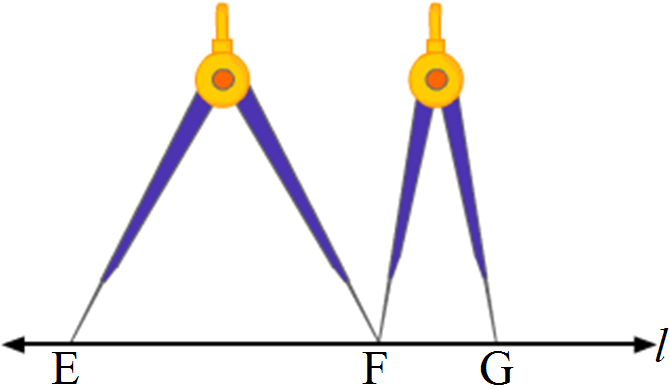
AnswerGiven: $AB= 7.5\ cm$ and $CD = 2.5\ cm$ Draw $AB$ and $CD$

We draw a line $l$ and take a point $E$ on it. Now, take a divider and open it such that the ends of both its arms are $A$ and $B$. The, we lift the divider end $(F)$ on the line $l$, as shown in the figure. Now, reset the divider in such a way that the end of its one hand is at $C$ and the end of the other hand is at $D$. Then, we lift the divider and place its one end at $F$ and another end $(G)$ on the line $l$ opposite to $E$ as shown in the figure. $EG$ is required line segment, whose length is equal to $(AB + CD)$
View full question & answer→Question 333 Marks
Construct a line segment of length $5.6\ cm$ using ruler and compasses.
Answer
We may draw a line segment of length $5.6\ cm$, using a ruler and compass as following-
$1.$Draw a line l and mark a point $A$ on this line.

$2.$Place the compasses ont he zero mark of the ruler. Open it ti place the pencil up to the $5.6\ cm$, mark.
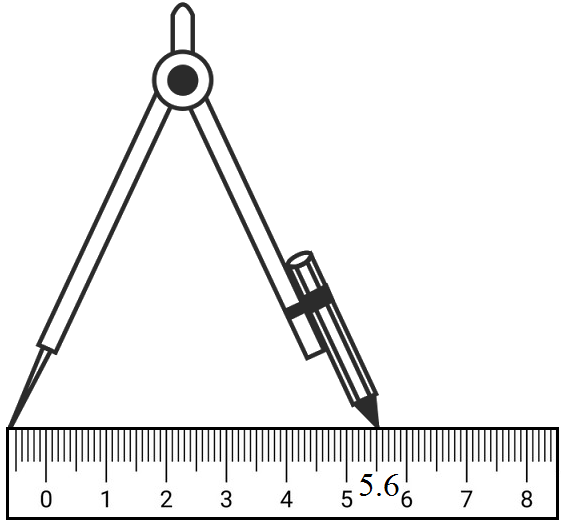
$3.$Place the pointer of compass on point $A$ and draw an arc to cut $l$ at $B$. $AB$ is the line segment of $5.6\ cm$ length.
$4.$
View full question & answer→Question 343 Marks
Construct the following angles using set-squares: $75^\circ $
AnswerPlace $45^\circ $ set-square and make an angle of $45^\circ $ by drawing the rays $BD$ and $BC$ as shown in the figure.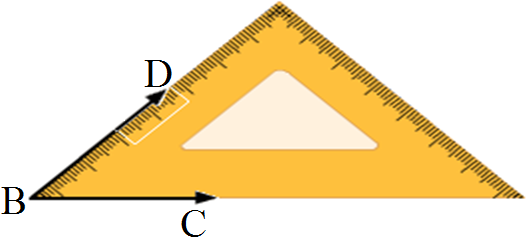
Now place the vertex of $30^\circ $ of the set- square on the ray $BD$ as shown in the figure and draw the ray $BA$. The angle so formed is $75^\circ $. Therefore, $\angle\text{ABC}=75^{\circ}$
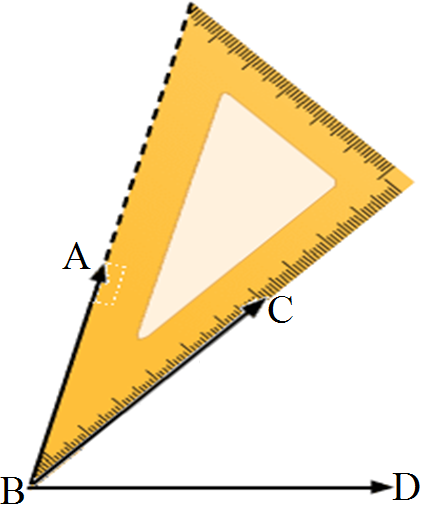
(Line $BD$ is hidden) View full question & answer→Question 353 Marks
Name the following angles of Fig, using three letters:
$a.\ \angle1$
$b.\ \angle2$
$c.\ \angle3$
$d.\ \angle1 + \angle2$
$e.\ \angle2 + \angle3$
$f.\ \angle1 + \angle2 + \angle3$
$g.\ \angle\text{CBA} - \angle1$
AnswerFrom the figure:
$a.\ \angle1=\angle\text{CBD}$
$b.\ \angle2=\angle\text{DBE}$
$c.\ \angle3=\angle\text{EBA}$
$d.\ \angle1+\angle2=\angle\text{CBD}+\angle\text{DBE}$
$=\angle\text{CBE}$
$e.\ \angle2+\angle3=\angle\text{DBE}+\angle\text{EBA}$
$=\angle\text{DBA}$
$f.\ \angle1+\angle2+\angle+3=\angle\text{CDB}+\angle\text{DBE}+\angle\text{EBA}$
$=\angle\text{CBA}\text{ or}\angle\text{ABC}$
$g.\ \angle\text{CBA}-\angle1=\angle\text{CBA}-\angle\text{CBD}$
$=\angle\text{DBA or }\angle\text{ABD}$
View full question & answer→Question 363 Marks
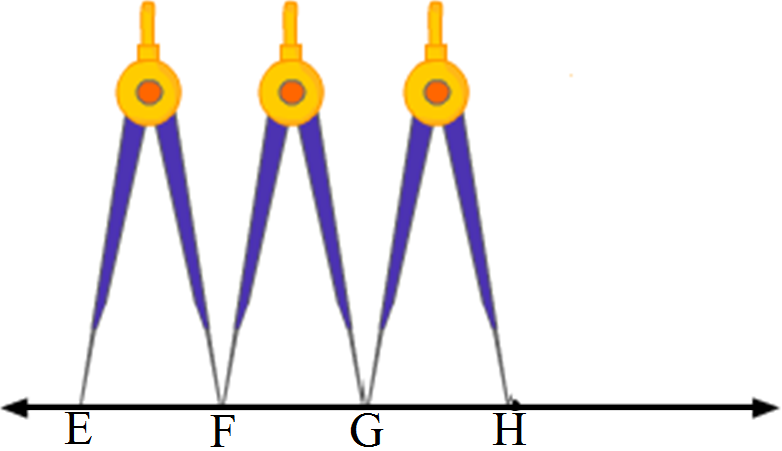
If $AB = 7.5\ cm$ and $CD = 2.5\ cm$, construct a segment whose length is equal to: $3CD$
AnswerGiven: $AB= 7.5cm$ and $CD = 2.5cm$ Draw $AB$ and $CD$

Draw a line $l$ and take a point $E$ on it.
Now take a divider and open it such that the ends of both its arms are at $C$ and $D$.
Then, we lift the divider and place its end at $E$ on it and other end $(F)$ on the line $l$, as shown in the figure.
Again, we lift the divider end $(G)$ on the $l$ opposite to $C$.
Again, lift the divider end $(G)$ on the line $l$ opposite to $C$.
Again, lift the divider and place its one end at $G$ and another end $(H)$ on the line $l$, opposite to $E$.
$EH$ is required line segment, whose length is equal to $3CD.$
View full question & answer→Question 373 Marks
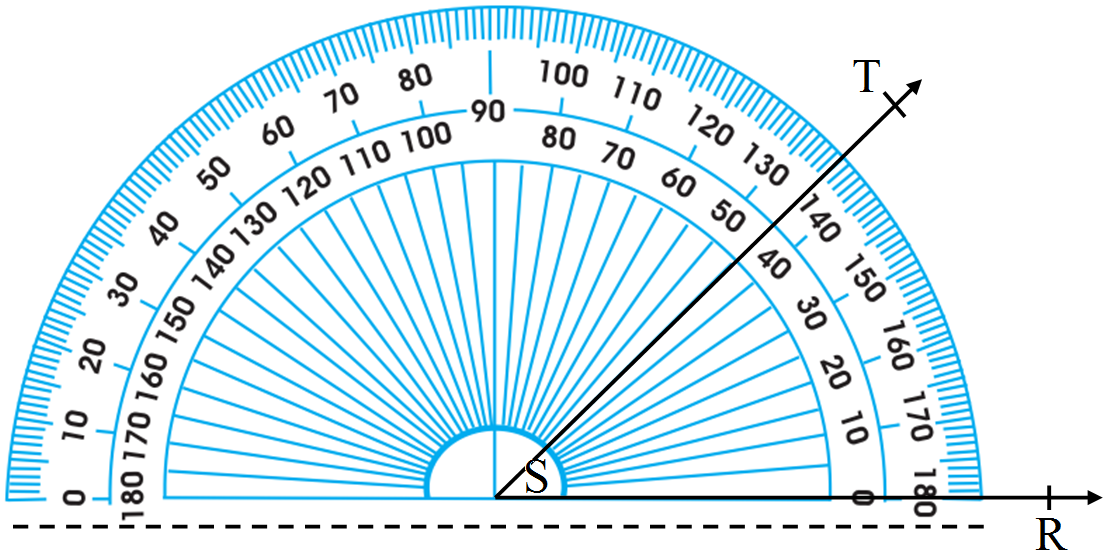
Draw ray $RS$ as shown in the figure. Using the protractor, make an angle of $138^\circ $ with one hand $PQ.$

AnswerDraw a ray $RS$ as given in the question. Place the protractor on ray $RS$ such that its centre coincides with the point $R$ and diameter of the protractor coincides with $RS$. Mark a point $T$ against the mark of $138^\circ $ on the protractor. Remove the protractor and draw $RJ$. $\angle\text{SRT}$ the required angle of $138^\circ $.
View full question & answer→Question 383 Marks
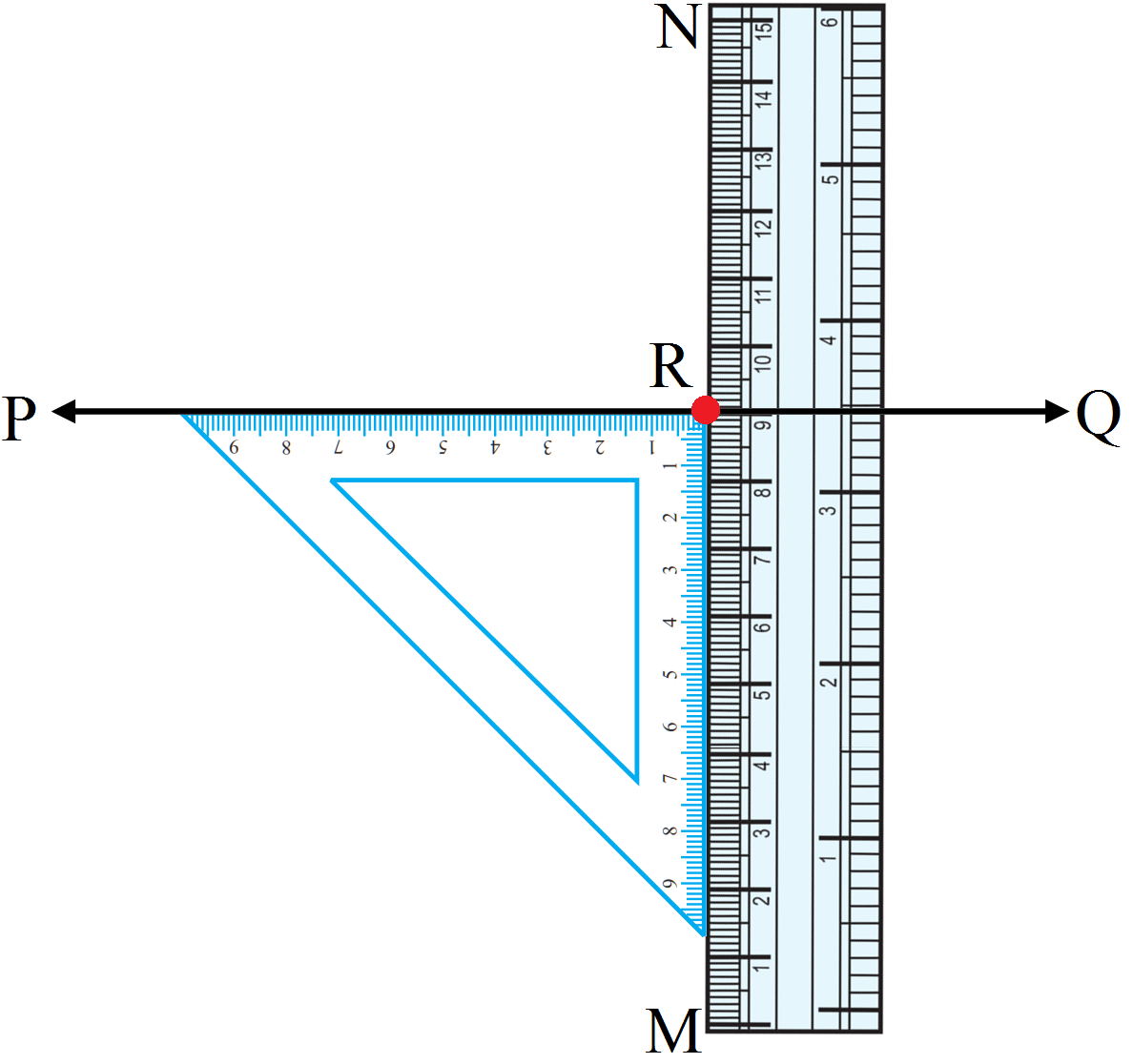
Draw a line $PQ$. Take a point $R$ on it. Draw a line perpendicular to $PQ$ and passing through $R.$
Using ruler and a set-square.
AnswerDraw a line $PQ$ and take a point $R$ on it.
Place a set-square, such that its one arm of the right angle is along the line $PQ$ .
Without disturbing the position of the set-square, place a ruler along its edge.
Now, without disturbing the position of the ruler, remove the set-square and draw a line $MN$ through point $R$.
$MN$ is the required line perpendicular to line $PQ$ passing through $R$.
View full question & answer→