MCQ 11 Mark
An angle of $75^\circ $ is drawn using a pair of compass and ruler by bisecting ___.
- A
$60^\circ $
- ✓
$60^\circ $ and $90^\circ $
- C
$0^\circ $ and $90^\circ $
- D
$120^\circ $ and $180^\circ $
AnswerCorrect option: B. $60^\circ $ and $90^\circ $
$60^\circ $ and $90^\circ $
View full question & answer→MCQ 21 Mark
Lines $a, b, p, q, m, n$ and $x$ have $a$ point $P$ common to all of them. What is the name of $P?$
AnswerA point common to multiple lines is called a point of concurrence as the lines are concurrent lines.
View full question & answer→MCQ 31 Mark
Rohan thinks he knows how to bisect angles and follows following steps to construct $45^\circ $ angle.
Step $1$: Construct an angle of $90^\circ $
Step $2$: Bisect the $90^\circ $ angle.
Step $3$: Bisect one of the angles obtained in step $2$.
- A
Step $1$
- B
Step $2$
- ✓
Step $3$
- D
Step $2$ and $3$
AnswerCorrect option: C. Step $3$
Step $3$
View full question & answer→MCQ 41 Mark
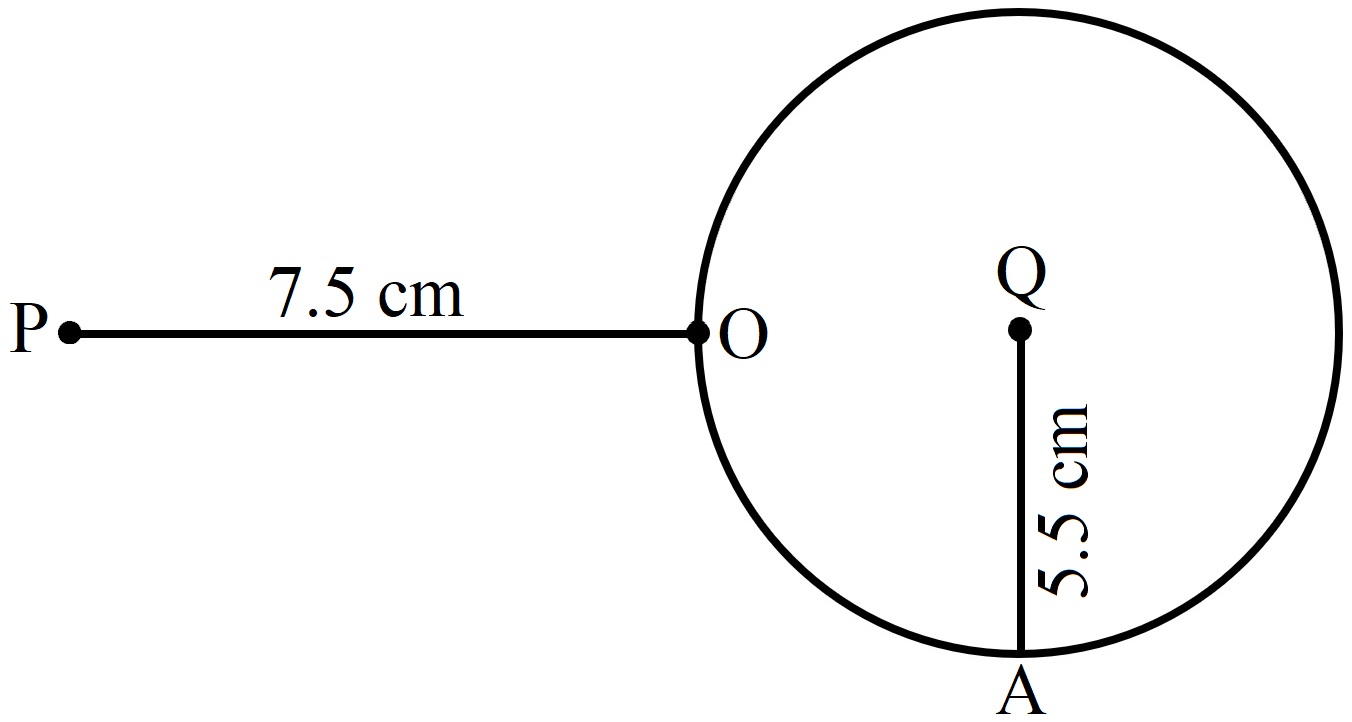
If $O$ is a point on the circle and $P$ is a point in the exterior of the circle. Length of $\overline{\text{OP}}=7.5$cm and radius of the circle is $5.5\ cm$. What will be the length of $\overline{\text{OP}},$ if $Q$ is the centre?
- A
$5.5\ cm$
- ✓
$3\ cm$
- C
$7.5\ cm$
- D
$13.5\ cm$
AnswerCorrect option: B. $3\ cm$
$OQ + OP = 5.5 + 7.5 = 13\ cm$
View full question & answer→MCQ 51 Mark
Identify the condition when a triangle can be constructed?
- ✓
One side and two acute angles are given.
- B
A side and an acute angle are given.
- C
Two obtuse angles are given.
- D
All given sides are equal.
AnswerCorrect option: A. One side and two acute angles are given.
One side and two acute angles are given.
View full question & answer→MCQ 61 Mark
Mark $(\checkmark)$ against the correct answer in the following:
$\frac{3}{2}$ right angles = .......
- A
$115^\circ $
- ✓
$135^\circ $
- C
$230^\circ $
- D
$270^\circ $
AnswerCorrect option: B. $135^\circ $
$32$ right angles $= 32 \times 90^\circ = 135^\circ $
$32$ right angles $= 32 \times 90^\circ = 135^\circ $
View full question & answer→MCQ 71 Mark
To construct a perpendicular to a line $(L)$ from a point $(P)$ outside the line, steps are given in jumbled form. Identify the fourth step from the following
$(1)$ Draw line $PQ$
$(2)$Draw a line $L$ and consider point $P$ outside the line
$(3)$Take $P$ as a center, draw $2$ arcs on line $L$ and name it as points $A$ and $B$ respectively
$(4)$Taking $A$ and $B$ as a center one by one and keeping the same distance in compass
draw the arcs on other side of the line. The point where these arcs intersect name that point as $Q$
AnswerThe correct sequence is: Step
$(1)$ Draw a line $L$ and consider a point $P$ outside the line.
$(2)$ Take $P$ as center and draw two arcs on line $L$ ans name the points $A$ and $B$ respectively.
$(3)$ Taking $A$ and $B$ as centres one by one and keeping the same distance in compass, draw the arcs on other side of the line .
$(4)$ The point where these arcs intersect name that as $Q$
$(5)$ Draw line $PQ$ So the fourth step is $1$
View full question & answer→MCQ 81 Mark
With the help of a ruler and a compass, it is possible to construct an angle of:
- A
$37.5^\circ$
- B
$40^\circ$
- ✓
$22.5^\circ$
- D
AnswerCorrect option: C. $22.5^\circ$
Using a ruler and compass it is possible to construct an angle of $22.5^\circ$
Step $1$: construct an angle of $90^\circ$
Step $2$: Draw angle bisector to get an angle of $45^\circ$
Step $3$: Again draw angle bisector to get an angle of $22.5^\circ$So option $C$ is correct.
View full question & answer→MCQ 91 Mark
A few lines in a plane have a point in common. What type of lines can they be?
- A
- B
- C
- ✓
Either $[a]$ or $[c]$
AnswerCorrect option: D. Either $[a]$ or $[c]$
If the lines are only two, then they are intersecting lines.
If there are more than two lines, then they are concurrent lines.
View full question & answer→MCQ 101 Mark
Identify the uses of a ruler.
- A
To draw a line segment of a given length
- B
To draw a copy of a given segment.
- C
To draw a diameter of a circle.
- ✓
AnswerA ruler is used to draw a line segment of a given length, to draw the copy of a given segment, and to draw a diameter of a circle.
Thus, all the given options are correct.
View full question & answer→MCQ 111 Mark
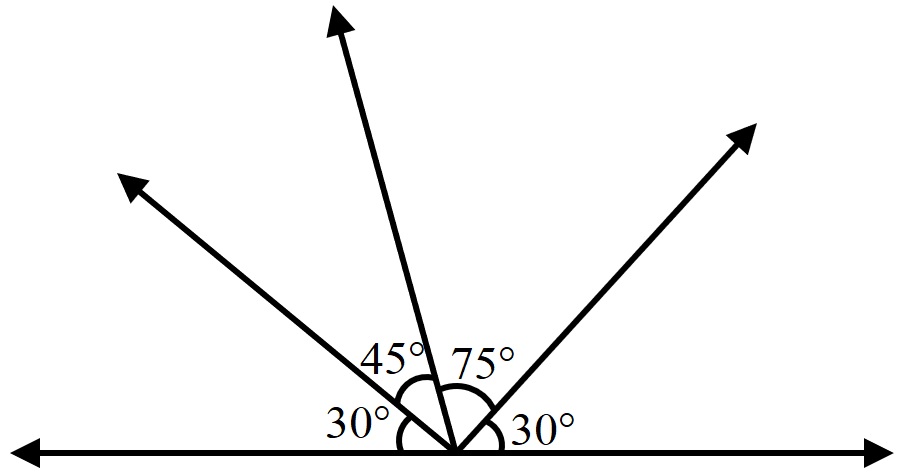
The number of obtuse angles is:
MCQ 121 Mark
The steps of construction of an $\angle\text{AOB}=45^\circ$ is given in jumbled order below:
$1.$ Place compass on intersection point.
$2.$ Place ruler on start point and where arc intersects perpendicular line.
$3.$ Adjust compass width to reach start point.
$4.$ Construct a perpendicular line.
$5.$ Draw $45$ degree line.
$6.$ Draw an arc that intersects perpendicular line.
$7.$ The third step in process is:
AnswerCorrect sequence is:
$1.$ Construct a perpendicular line
$2.$ Draw an arc that intersect the perpendicular line.
$3.$ Adjust the compass width to reach the start point .
$4.$ Place compass on intersection point.
$5.$ Place ruler on start point and where the arc intersects the perpendicular line.
$6.$ Draw $45$ degree line.
View full question & answer→MCQ 131 Mark
$P$ and $Q$ are the end points of a line segment $\overline{\text{PQ}}.$ If $R$ is any point on $\overline{\text{PQ}}.$ which of the given statements may be true?
- A
$PR = QR$
- B
$PR$ $QR$
- C
$PR$ $QR$
- ✓
Answer
Given that $R$ is any point on $\overline{\text{PQ}},$ $R$ may be Icoser to $P$ or $Q$ or exactly in between $P$ and $Q.$
Hence $PR = QR$ or $PR < QR$ or $PR > QR$ may be true. View full question & answer→MCQ 141 Mark
Choose the correct option in which a triangle $CANNOT$ be constructed with the given lengths of sides.
- A
$3\ cm, 13\ cm, 15\ cm$
- B
$6\ cm, 6\ cm, 6\ cm$
- ✓
$9\ cm, 6\ cm, 2\ cm$
- D
$13\ cm, 6\ cm, 8\ cm$
AnswerCorrect option: C. $9\ cm, 6\ cm, 2\ cm$
Difference of $2$ sides,
$[9 − 6 = 3]$
is greater than third side, whereas it should be lesser.
View full question & answer→MCQ 151 Mark
If $\angle{\text{ABC}}=60^\circ$ and $\angle{\text{ABX}}=30^\circ$ in what ratio does $\overrightarrow{\text{BX}}$ divide $\angle{\text{ABC}}$?
Answer$\angle{\text{ABC}}=60^\circ$ and $\angle{\text{ABX}}=30^\circ\Rightarrow\overrightarrow{\text{BX}}$ is the bisector of $\angle{\text{ABC}}\Rightarrow\overrightarrow{\text{BX}}$ divides $\angle{\text{ABC}}$ in the ratio $1:1$.
View full question & answer→MCQ 161 Mark
Through a line in a plane, number of lines that can be drawn is______.
MCQ 171 Mark
With the help of a ruler and a compass it is not possible to construct an angle of.
- A
$37.5^\circ$
- ✓
$40^\circ$
- C
$22.5^\circ$
- D
AnswerCorrect option: B. $40^\circ$
$\rightarrow $$37.5^\circ$ can be constructed by bisecting $150^\circ$ twice which can be done by compass.
$\rightarrow $$\angle $$22.5^\circ$ is the bisector of $90^\circ$ which can be also constructed using compass.
$\rightarrow $$\angle $$67.5^\circ$ is the bisector of $135^\circ$ whcih can also be drawn using compass.
But $40^\circ$ can not be drawn using ruler and compass.
So option $B$ is correct.
View full question & answer→MCQ 181 Mark
Which of the following is an obtuse angle?
- A
$30^\circ $
- B
$60^\circ $
- C
$87^\circ $
- ✓
$123^\circ $
AnswerCorrect option: D. $123^\circ $
$123^\circ $
View full question & answer→MCQ 191 Mark
Which property has been used to construct the triangle in $Q$ $33$?
- A
$RHS$ property
- B
$SSS$ property
- C
$SAS$ property
- ✓
$ASA$ property
AnswerCorrect option: D. $ASA$ property
It is important to identify the segments on which angle can be constructed.
Since given angle is $\angle{\text{C}}$ hence the segment will be $BC$.
View full question & answer→MCQ 201 Mark
With the help of ruler and compass, it is not possible to construct an angle of:
- A
$60^\circ$
- B
$15^\circ$
- ✓
$38^\circ$
- D
AnswerCorrect option: C. $38^\circ$
$60^\circ$ can be easily constructed by making a single arc on a supplementary angle using a compass.
$15^\circ$ can be constructed by bisecting $60^\circ$ twice.
$135^\circ$ can be constructed by first drawing an angle of $90^\circ$ and bisecting its obtuse side.
So $38^\circ$ can not be constructed using rule and compass.
View full question & answer→MCQ 211 Mark
$\angle{\text{PQR}}=\angle{\text{XYZ}}.$ If $\overrightarrow{\text{QM}}$ bisects $\angle{\text{PQR}},$ $\overrightarrow{\text{YN}}$ bisects $\angle{\text{XYZ}},$ which of the following statements are true?
$I.\ \angle{\text{PQM}}+\angle{\text{NYZ}}=\angle{\text{PQR}}$
$II.\ \angle{\text{MQR}}+\text{XYN}=\angle{\text{XYZ}}$
$III.\ \angle{\text{PQM}}=2\angle{\text{PQR}}$
$IV.\ \angle{\text{XYZ}}=2\angle{\text{MQR}}$
AnswerCorrect option: D. $(i), (ii)$ and $(iv)$ only
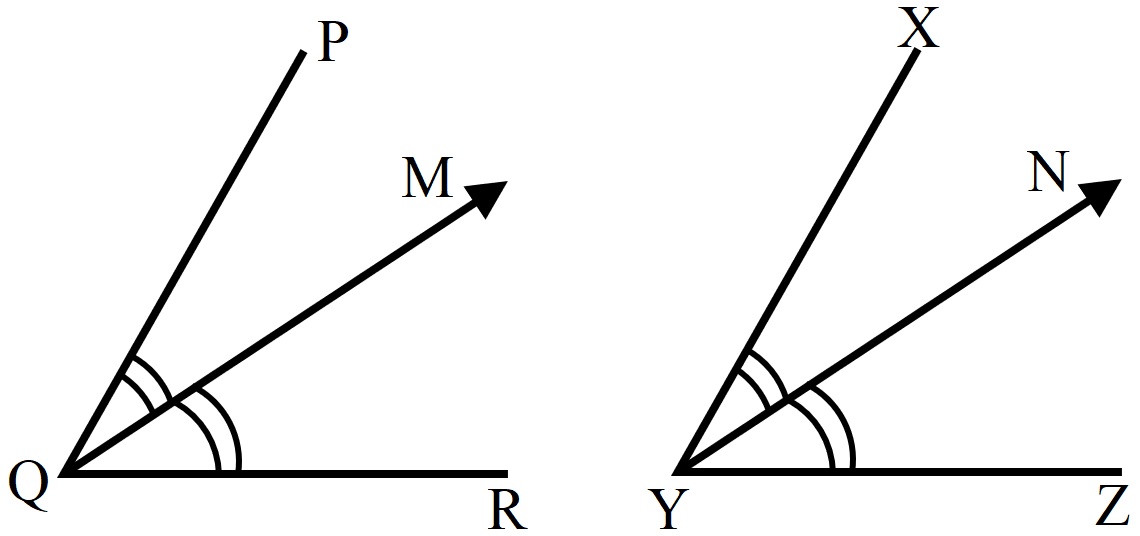
Given $\angle{\text{PQR}}=\angle{\text{XYZ}},\overrightarrow{\text{QM}}$ bisects $\angle{\text{PQR}},$ and $\overrightarrow{\text{YN}}$ bisects $\angle{\text{XYZ}},$ respectively.
$\Rightarrow\angle{\text{PQM}}+\angle{\text{MQR}}=\angle{\text{XYN}}=\angle{\text{NYZ}}$
$\Rightarrow\angle{\text{PQM}}+\angle{\text{MQR}}=\angle{\text{PQR}}$ s true.
$\angle{\text{MQR}}=\angle{\text{XYN}}=\angle{\text{XYZ}}$ is true $\angle{\text{PQM}}=2\angle{\text{PQR}}$ is false as $\angle{\text{PQM}}=\frac{1}{2}\angle{\text{PQR}}$.
$\angle{\text{XYZ}}=2\angle{\text{MQR}}$ is true since $2\angle{\text{MQR}}=\angle{\text{PQR}}=\angle{\text{XYZ}}$
Hence $(i), (ii)$ and $(iv)$ are true. View full question & answer→MCQ 221 Mark
$\text{p}|\text{q}$ $C$ and $D$ are two points on $p$ and $M$ and $N$ are two points on $q$, such that $M$ and $N$ are exactly opposite to $C$ and $D$ respectively. Identify the true statement.
AnswerCorrect option: C. Both $[a]$ and $[b]$
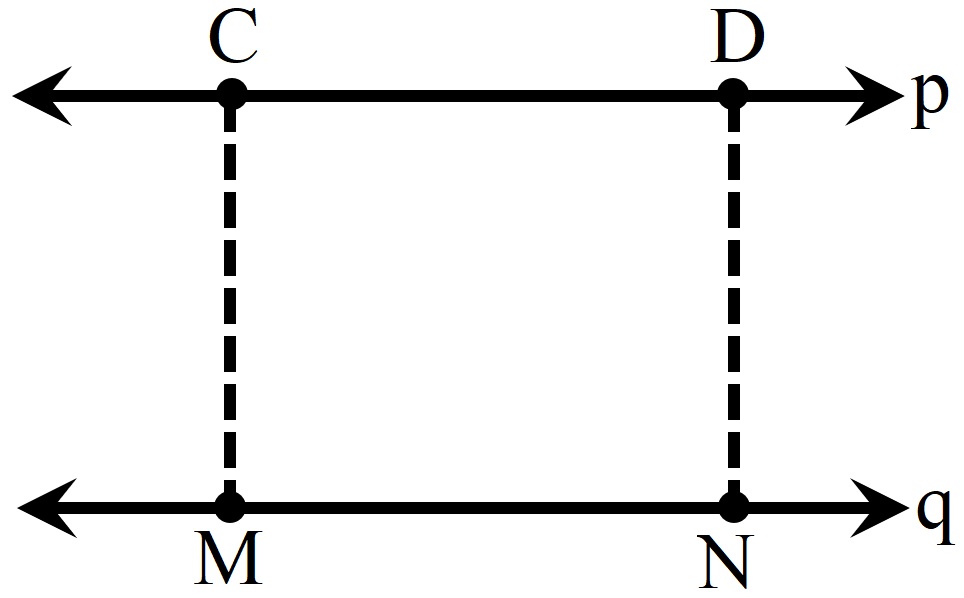
From the figure and the given data, clearly, $CDNM$ is a rectangle.
Also $ \overline{\text{CM}}=\overline{\text{DN}}$ as the distance between two parallel lines is the same throughout.
View full question & answer→MCQ 231 Mark
A perpendicular is drawn to a line segment $\overline{\text{MN}}$ at $N$ using protractor and point $P$ is marked on perpendicular, then _______.
- A
$\overline{\text{MP}}\perp\overline{\text{NP}}$
- B
$\overline{\text{MN}}\parallel\overline{\text{NP}}$
- C
$\overline{\text{MN}}\parallel\overline{MP}$
- ✓
$\overline{\text{MN}}\perp\overline{\text{Np}}$
AnswerCorrect option: D. $\overline{\text{MN}}\perp\overline{\text{Np}}$
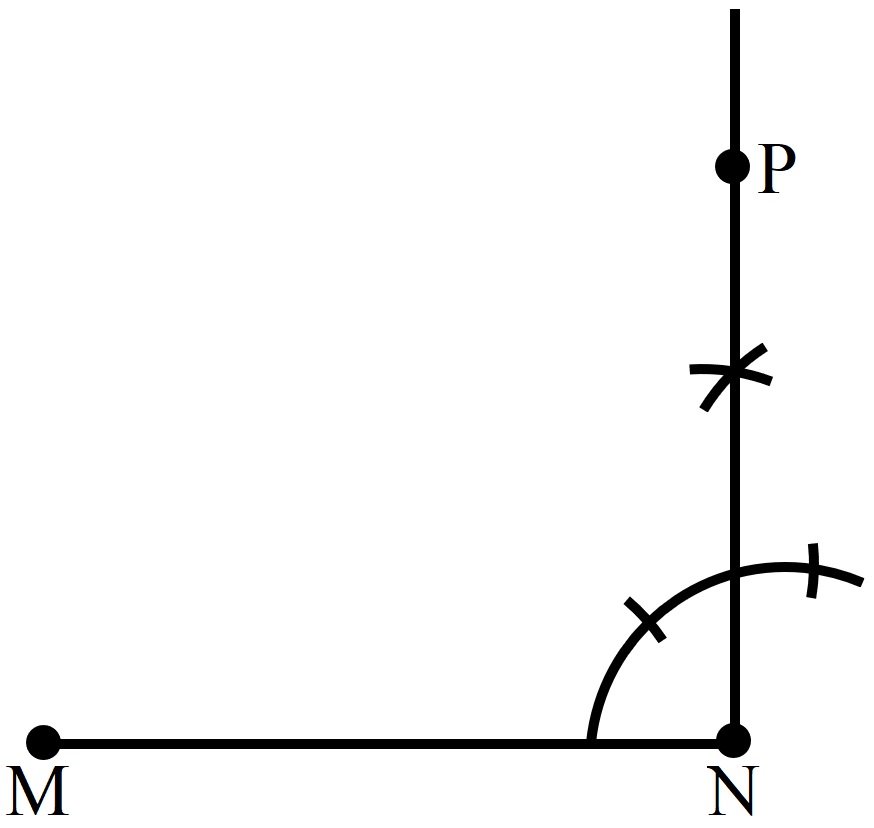
$\therefore \overline{\text{MN}}\perp\overline{\text{NP}}$ View full question & answer→MCQ 241 Mark
Sumit constructed an angle of $90^\circ $ and trisected it. Measure of two angles taken together will be:
- A
$20^\circ $
- B
$40^\circ $
- ✓
$60^\circ $
- D
AnswerCorrect option: C. $60^\circ $
$60^\circ $
View full question & answer→MCQ 251 Mark
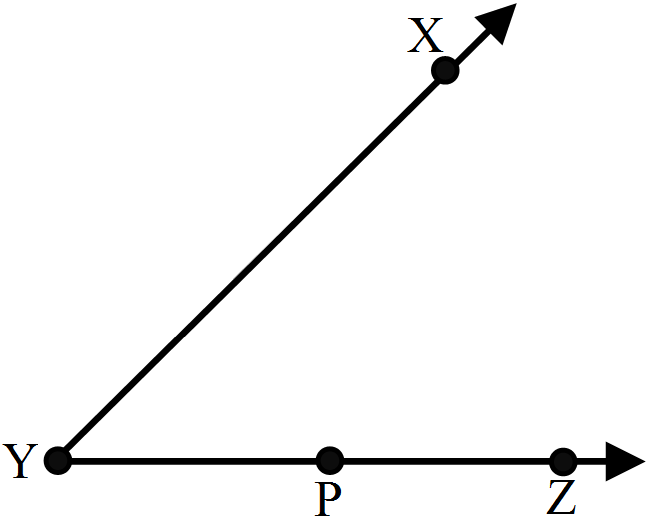
In Fig. $\angle\text{XYZ}$ cannot be written as:
- A
$\angle\text{Y}$
- ✓
$\angle\text{XYZ}$
- C
$\angle\text{ZYX}$
- D
$\angle\text{XYP}$
AnswerCorrect option: B. $\angle\text{XYZ}$
Since, $\angle\text{XYZ}$ can be written as $\angle\text{Y},\angle\text{ZYX},\angle\text{XYP}$ and $\angle\text{PYX.}$
So, $\angle\text{XYZ}$ cannot be written as $\angle\text{ZXY}.$
View full question & answer→MCQ 261 Mark
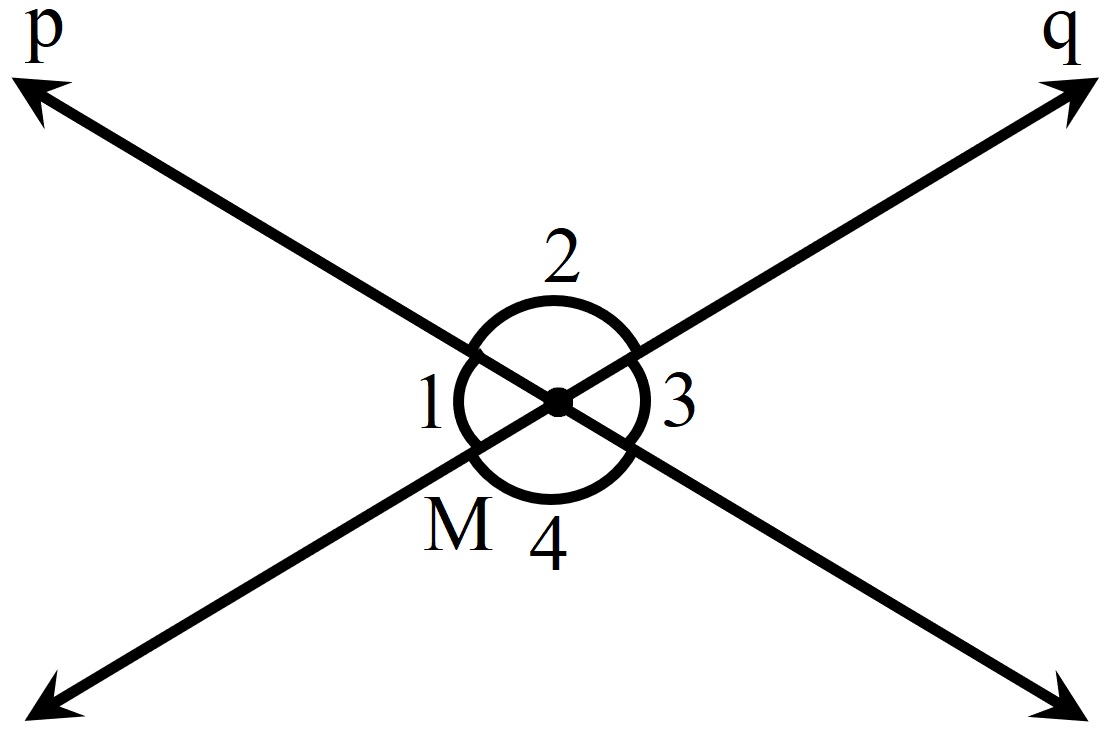
Lines $p$ and $q$ have a point $M$ in common. Identify the correct statement.
- ✓
$\angle1=−3$
- B
$\angle2=−3$
- C
$\angle3=\angle4$
- D
$\angle1=\angle2$
AnswerCorrect option: A. $\angle1=−3$
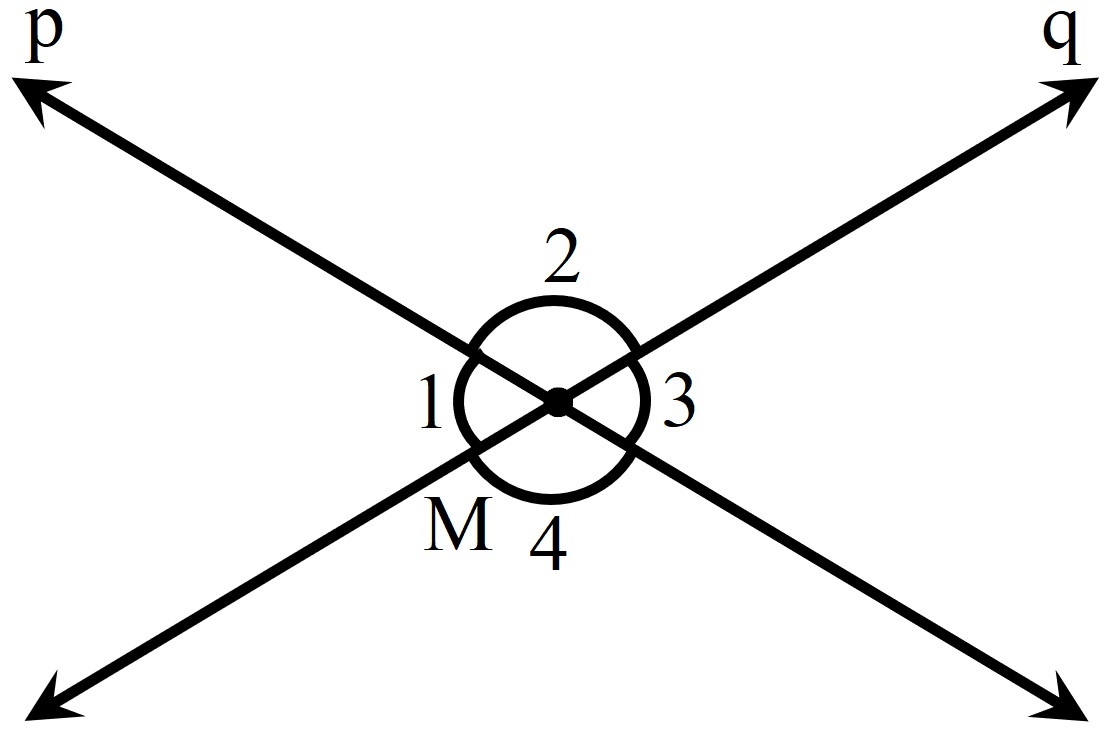
From the given figure and data, it is clear that $p$ and $q$ are intersecting lines.
So, the vertically opposite angles are equal.
Hence $ \angle1=\angle3.$
View full question & answer→MCQ 271 Mark
How many lines can be drawn passing through a given point?
AnswerInfinitely many points can be drawn passing through a given point.
View full question & answer→MCQ 281 Mark
$\text{l}\parallel\text{m}$ $P$ and $Q$ are points on land m respectively such that ${\text{PQ}}\perp{\text{l}}$. $R$ is a point on a line n in the same plane such that $\overline{\text{PQ}}=\overline{\text{QR}}$. Which of the following is true?
AnswerCorrect option: C. Both $[a]$ and $[b]$
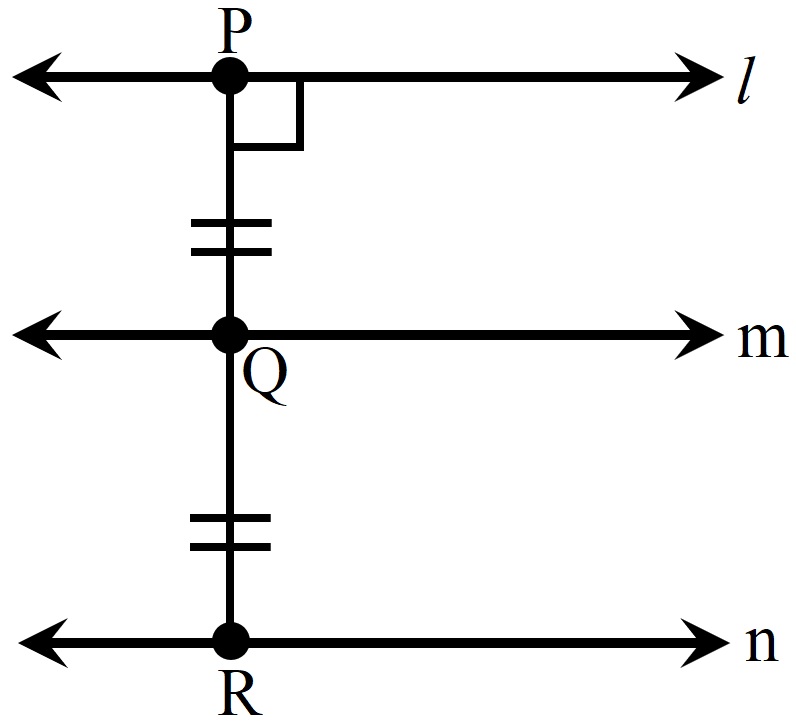
Clearly, from the given data and the figure, ${\text{l}}\parallel{\text{n}}\text{ and}{\text{ m}}\parallel{\text{n}}$ View full question & answer→MCQ 291 Mark
To construct a perpendicular to a line $(L)$ from a point $(P)$ outside the line, steps are given in jumbled form.Identify the third step from the following.
$1)$ Draw line $PQ.$
$2)$ Draw a line $L$ and consider point $P$ outside the line.
$3)$ Take $P$ as a center, draw $2$ arcs on line L and name it as points $A$ and $B$ respectively.
$4)$ Taking $A$ and $B$ as a center one by one and keeping the same distance in compass, draw the arcs on other side of the plane.The point where these arcs intersect name that point as $Q$.
AnswerThe correct sequence is:
Step $1$. Draw a line $L$ and consider a point $P$ outside the line.
Step $2$. Take $P$ as center and draw two arcs on line $L$ ans name the points $A$ and $B$ respectively.
Step $3$.Taking $A$ and $B$ as centres one by one and keeping the same distance in compass , draw the arcs on other side of the plane .The point where these arcs intersect name that as $Q$
Step $4$. Draw line $P$Q So the third step is $4$ Option $A$ is correct.
View full question & answer→MCQ 301 Mark
The last step in the process is:
AnswerCorrect sequence is :
$1.$ Draw a line $PQ$ and take a point $A$ anywhere outside the line.
$2.$ Place the pointed end of the compass on $A$ and with an arbitrary radius, mark two points $D$ and $E$ on line $PQ$ with the same radius.
$3.$ From points $D$ and $E$, mark two intersecting arcs on either side of $PQ$ and name them $R$ and $S$.
$4.$ Join $R − S$ passing through $A$.
So the last step is $1$.
View full question & answer→MCQ 311 Mark
Given $PQ = 6\ cm, QR = 55\ cm$ and $RP = 55\ cm$, what type of a triangle can be constructed?
- ✓
An acute angled triangle.
- B
An obtuse angled triangle
- C
- D
AnswerCorrect option: A. An acute angled triangle.
Since $QR = RP \Rightarrow $ it is isosceles $\triangle\text{le} $ and an isosceles $\triangle\text{le}$ is always acute $\angle\text{led}$
View full question & answer→MCQ 321 Mark
To draw an angle of $150^\circ$ using a pair of compass and ruler_____ .
- ✓
Bisect angle between $120^\circ$ and $180^\circ$
- B
Bisect angle between $60^\circ$ and $120^\circ$
- C
Bisect angle between $0^\circ$ and $160^\circ$
- D
AnswerCorrect option: A. Bisect angle between $120^\circ$ and $180^\circ$
$\Rightarrow $ To draw an angle of $150^\circ$ using a pair of compass and Bisect angle between $120^\circ$and $180^\circ$.
$\Rightarrow $ The difference angle between $120^\circ$ and $180^\circ$ is $60^\circ$.
So, when we bisect angle of $60^\circ$ we get $30^\circ$ angles each.
$\Rightarrow $ So, $120^\circ$ + $30^\circ$= $150^\circ$
View full question & answer→MCQ 331 Mark
In the adjoining figure line $L\ ||$ line $M$ and line $N$ is the transversal. Which of the following line is one of the pairs of alternative angles?
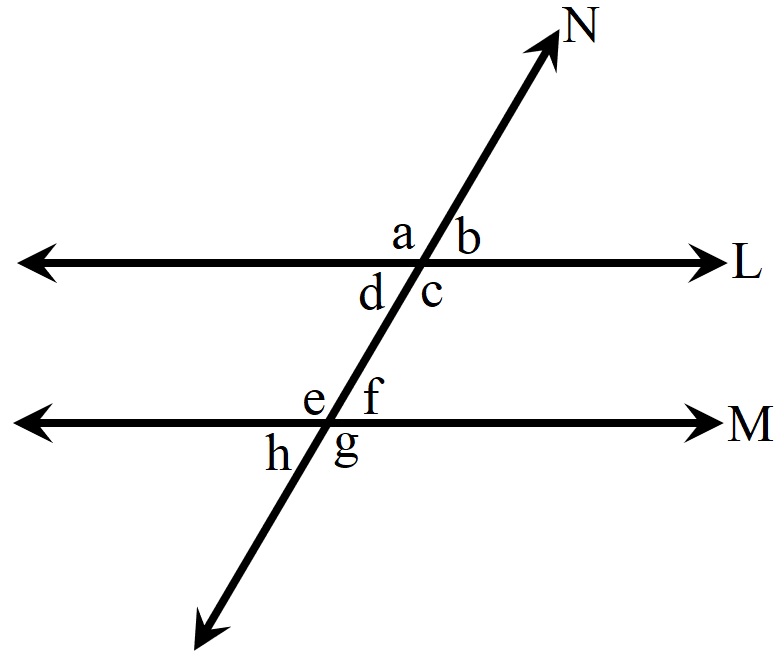
- A
$\angle{\text{a }}\text{&}\angle{\text{e}}$
- ✓
$\angle{\text{d }}\text{&}\angle{\text{F}}$
- C
$\angle{\text{b }}\text{&}\angle{\text{f}}$
- D
$\angle{\text{d }}\text{&}\angle{\text{e}}$
AnswerCorrect option: B. $\angle{\text{d }}\text{&}\angle{\text{F}}$
$\angle{\text{d }}$ and $\angle{\text{F}}$
View full question & answer→MCQ 341 Mark
To construct a perpendicular to a line $(L)$ from a point $(P)$ outside the line, steps are given in jumbled form.Identify the first step from the following.
$1)$ Draw line $PQ.$
$2)$ Draw a line $L$ and consider point $P$ outside the line.
$3)$Take $P$ as a center, draw $2$ arcs on line $L$ and name it as points $A$ and $B$ respectively.
$4)$Taking $A$ and $B$ as a center one by one and keeping the same distance in compass, draw the arcs on other side of the plane.The point where these arcs intersect name that point as $Q$.
AnswerThe correct sequence is:
Step $1$. Draw a line $L$ and consider a point $P$ outside the line.
Step $2$. Take $P$ as center and draw two arcs on line $L$ ans name the points $A$ and $B$ respectively.
Step $3$.Taking $A$ and $B$ as centres one by one and keeping the same distance in compass , draw the arcs on other side of the plane .The point where these arcs intersect name that as $Q$
Step $4$. Draw line $PQ$ So the first step is $2$ Option $C$ is correct.
View full question & answer→MCQ 351 Mark
Measures of the two angles between hour and minute hands of a clock at $9\ O’$ clock are:
- A
$60^\circ , 300^\circ $
- ✓
$270^\circ , 90^\circ $
- C
$75^\circ , 285^\circ $
- D
$30^\circ , 330^\circ $
AnswerCorrect option: B. $270^\circ , 90^\circ $
The positions of hour and minute hands of a clock at $9\ O’$ clock are represented in the following figure.
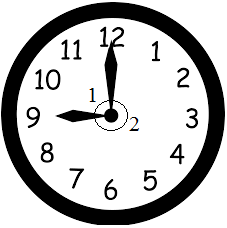
Clearly, $\angle1=90^\circ$
And $\angle2=\ \text{Reflex}\ \text{of}\ \angle1=360^\circ-90^\circ=270^\circ$
Note: A reflex angle is more than $180^\circ $ but less than $360^\circ $. For any acute angle $\theta,$ its reflex angle is $(360^\circ-\theta).$ View full question & answer→MCQ 361 Mark
Mark $(\checkmark)$ against the correct answer in the following:
Two planes intersect:
AnswerWhen the common points of two planes intersect, they form a line.
View full question & answer→MCQ 371 Mark
$X$ is the midpoint of $\overline{\text{AB}}.$If $\overline{\text{AX}}=9.3\text{cm}$ what is the measure of $\overline{\text{AB}}$?
- A
$4.65\ cm$
- ✓
$18.6\ cm$
- C
$9.3\ cm$
- D
$18\ cm$
AnswerCorrect option: B. $18.6\ cm$
$18.6\ cm$
View full question & answer→MCQ 381 Mark
Identify the pair of parallel lines.
$i.$ Lines $m$ and $n$ have two points in common.
$ii.$ Lines $p$ and $q$ do not have any point in common.
$iii.$ Lines $p$ and $q$ have a point $X$ in common.
- A
$(i)$ and $(ii)$ only
- ✓
$(ii)$ only
- C
$(ii)$ and $(iii)$ only
- D
$(i), (ii)$ and $(iii)$
AnswerCorrect option: B. $(ii)$ only
Parallel lines do not have any point in common.
View full question & answer→MCQ 391 Mark
The third step in the process will be:
AnswerCorrect sequence of steps is :
Step $1$: Draw segment $AB$ and take a point $P$ on it.
Step $2$: From point $P$, mark two equidistant points from $P$ on line $AB$, and name them $C$ and $D$
Step $3$ : From points $C$ and $D$ mark two intersecting arcs on either side of the line $AB$.
Name the intersection point as $E$
Step $4$: Join $E$ and $P. EP$ is the required perpendicular.
So the third step is !!So option $A$ is correct.
View full question & answer→MCQ 401 Mark
Which of the following is done to draw an angle of $150^\circ $ using compasses and a ruler?
- ✓
Bisecting $120^\circ $ and $180^\circ $ angles.
- B
Bisecting $60^\circ $ and $120^\circ $ angles.
- C
Bisecting $0^\circ $ and $60^\circ $ angles.
- D
Bisecting a $360^\circ$ angle.
AnswerCorrect option: A. Bisecting $120^\circ $ and $180^\circ $ angles.
Bisecting $120^\circ $ and $180^\circ $ angles.
View full question & answer→MCQ 411 Mark
$\overrightarrow{\text{BA}}\perp\overrightarrow{\text{XY}}$ Which of the following statements are incorrect?
$i.\ \angle{\text{ABX}}+\angle{\text{ABY}}=180^\circ$
$ii.\ \angle{\text{ABX}}=2{\text{right angle}}$
$iii\ \angle{\text{ABY}}=90^\circ$
$iv.\ \angle{\text{XBY}}=90^\circ$
- A
$(i)$ and $(ii)$ only
- ✓
$(ii)$ and $(iv)$ only
- C
$(ii)$ and $(iii)$ only
- D
$(i)$ and $(iv)$ only
AnswerCorrect option: B. $(ii)$ and $(iv)$ only
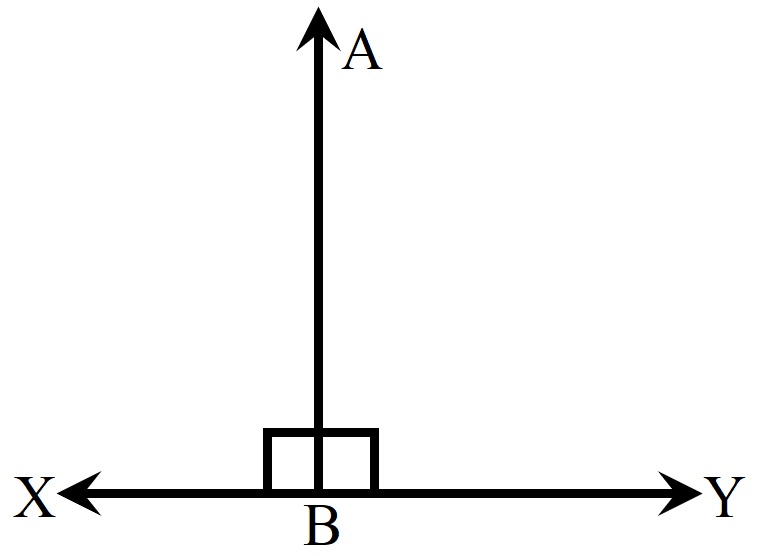
Since $\overrightarrow{\text{BA}}\perp\overrightarrow{\text{XY}}$
$\angle{\text{ABY}}=90^\circ$ and $\angle{\text{XBY}}=90^\circ$
$\therefore\angle{\text{ABX}}+\angle{\text{ABY}}=180^\circ$ is true.
$\angle{\text{ABX}}=90^\circ\Rightarrow\angle{\text{ABX}}=2$ right angles is false. $\angle{\text{ABY}}=90^\circ$ is true.
$\angle{\text{XBY}}=90^\circ$ is false since $\angle{\text{ABY}}=\angle{\text{XBA}}+\angle{\text{ABY}}=180^\circ$. View full question & answer→MCQ 421 Mark
$\triangle\text{PQR}$ is constructed with all its angles measuring $60^\circ $ each. Which of the following is correct?
- ✓
$\triangle\text{PQR}$ is an equilateral triangle.
- B
$\triangle\text{PQR}$ is isosceles triangle.
- C
$\triangle\text{PQR}$ is a scalene triangle.
- D
$\triangle\text{PQR} $ is a right angled triangle.
AnswerCorrect option: A. $\triangle\text{PQR}$ is an equilateral triangle.
$\triangle\text{PQR}$ is an equilateral triangle.
View full question & answer→MCQ 431 Mark
Given $AB = 3\ cm, AC = 5.2\ cm$, and $\angle\text{B} = 35^∘.$ $\angle\text{ABC}$ cannot be uniquely constructed, with $AC$ as base, why?
AnswerCorrect option: D. The vertex $A$ coincides with the vertex $C$.
Use $RHS$ property to Contruct the Ale as. Shown:
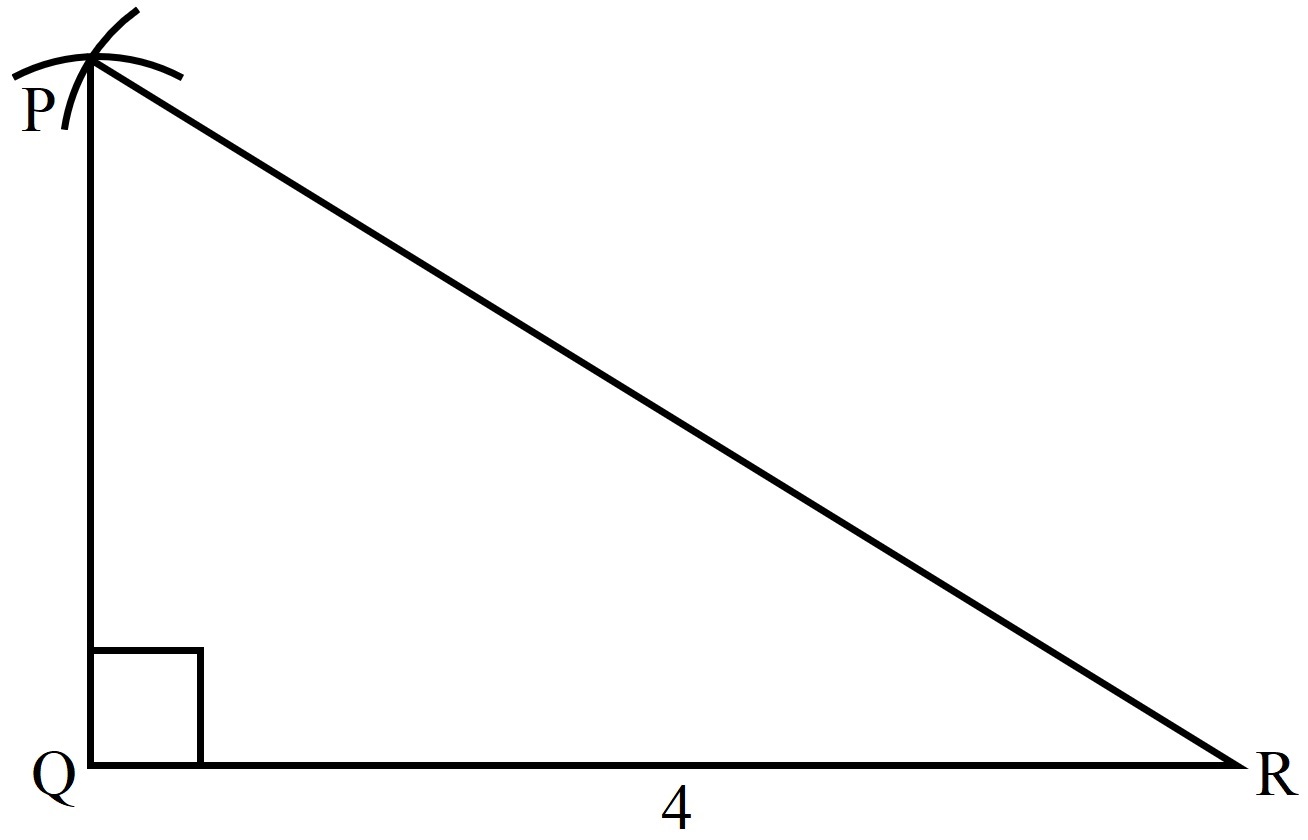
View full question & answer→MCQ 441 Mark
A triangle$ \triangle\text{PQR}$ with $ \angle\text{Q} = 90^∘,$$QR = 4\ cm$ and $PR = 5cm$ is constructed. What would be the measure of $PQ$?
- ✓
$2\ cm$
- B
$6\ cm$
- C
$7\ cm$
- D
$3\ cm$
AnswerCorrect option: A. $2\ cm$
$2\ cm$
View full question & answer→MCQ 451 Mark
There is a rectangular sheet of dimension $\big(2\text{m-1}\big)\times\big(2\text{n-1}\big),$ (where $m > 0, n > 0$). It has been divided into square of unit area by drawing lines perpendicular to the sides. Find number of rectangles having sides of odd unit length?
AnswerTotal no. of horizontal line $= 2m$ Total no. of vertical lines $= 2n$ $($$\because$ Each line is at unit distance and hence, total no. of lines = Distance/lenght $+1).$
To form a square from three lines,we mustselect one even and one odd numbered horizontal and vertical line
$\therefore$ Ways possible of selecting such squares $=(\text{c}_{1}^\text{m})\times(\text{c}_{1}^\text{m})\times$ $(\text{c}_{1}^\text{n}\times\text{c}_{1}^\text{n})=$ $\text{c}_{1}^\text{m}\times\text{c}_{1}^\text{m}\times\text{c}_{1}^\text{n}\times\text{c}_{1}^\text{n}=$ $\text{m}^2\times\text{n}^2=\text{m}^2\text{n}^2$
View full question & answer→MCQ 461 Mark
Which of the following steps is $INCORRECT$ while constructing an angle of $60^\circ $?
Step $1:$ Draw a line $EF$ and mark a point $O$ on it.
Step $2:$ Place the pointer of the compass at $O$ and draw an arc of convenient radius which cuts the line $EF$ at point $P$.
Step $3:$ With the pointer at $A$ (as centre) now draw an arc that passes through $O$.
Step $4:$ Let the two arcs intersect at $Q$. Join $OQ$. We get $\angle{\text{QOP}}$ whose measure is $60^\circ $ .
AnswerCorrect option: C. Only Step - $3$
Step-3 is incorrect it should be written as: with the pointer at $P$ (as centre) now draw an arc that passes through $0$.
View full question & answer→MCQ 471 Mark
$\overrightarrow{\text{MN}}$ is the perpendicular bisector of $\overleftrightarrow{\text{AB}}$ Which of the given statements is correct?
$i.\ \angle{\text{ANM}}+\angle{\text{MNB}}=90^\circ$
$ii.\ \overline{\text{AN}}=\overline{\text{NB}}$
$iii.\ \overline{\text{AN}}=2\overline{\text{NB}}$
$iv.\ \angle{\text{MNB}}=\frac{1}{2}\angle{\text{ANM}}$
- A
$(i)$ and $(iii)$ only
- B
$(ii)$ and $(iv)$ only
- ✓
$(i)$ and $(ii)$ only
- D
$(ii)$ and $(iii)$ only
AnswerCorrect option: C. $(i)$ and $(ii)$ only
$\overrightarrow{\text{NM}}\perp\overleftrightarrow{\text{AB}}$ and $\overrightarrow{\text{NM}}$ divides $\overleftrightarrow{\text{AB}}$ into two congruent parts.
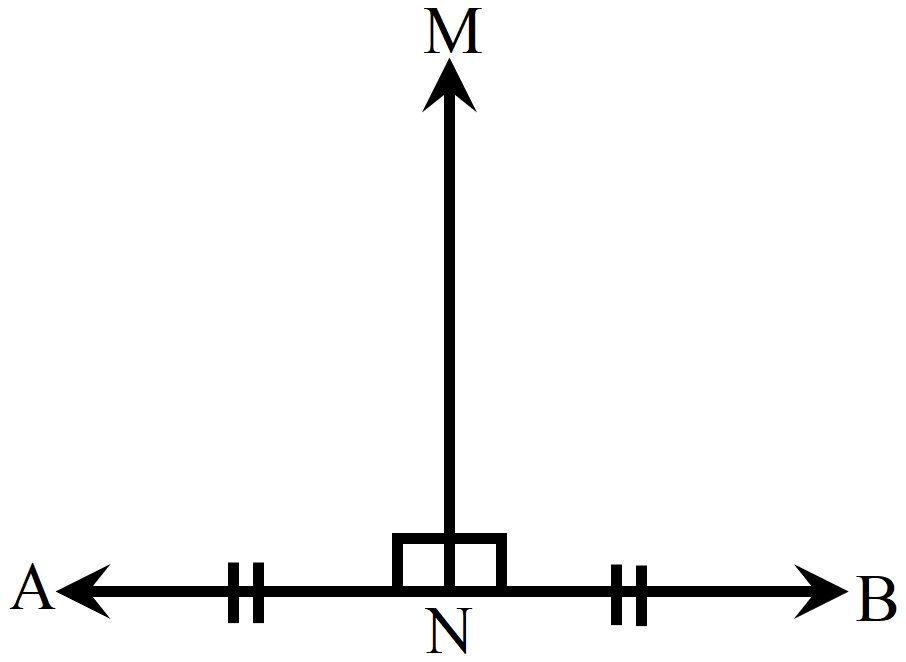
Clearly $\angle{\text{ANM}}+\angle{\text{MNB}}=90^\circ$ is true.
$\overline{\text{AN}}=\overline{\text{NB}}$ is true since $\overrightarrow{\text{NM}}\perp\overleftrightarrow{\text{AB}}$ $\overline{\text{AN}}=2\overline{\text{NB}}$ is false, and $\angle{\text{MNB}}=\frac{1}{2}\angle{\text{ANM}}$ is false.
Thus, only $(i)$ and $(ii)$ are correct. View full question & answer→MCQ 481 Mark
How do you draw a $90^\circ $ angle?
- ✓
By drawing a perpendicular to a line from a point lying on it.
- B
By bisecting a $120^\circ $ angle.
- C
By bisecting a $60^\circ $ angle.
- D
By drawing multiples of $45^\circ $ angle.
AnswerCorrect option: A. By drawing a perpendicular to a line from a point lying on it.
By drawing a perpendicular to a line from a point lying on it.
View full question & answer→MCQ 491 Mark
If the sum of two angles is greater than $180^\circ $, then which of the following is not possible for the two angles?
- A
One obtuse angle and one acute angle.
- B
One reflex angle and one acute angle.
- C
- ✓
AnswerBecause sum of two right angles is equal to $180^\circ .$
Note:
An acute angle is less than $90^\circ .$
A right angle is equal to $90^\circ .$
An obtuse angle is more than $90^\circ $ but less than $180^\circ .$
A reflex angle is more than $180^\circ $ but less than $360^\circ .$
View full question & answer→MCQ 501 Mark
If the sum of two angles is equal to an obtuse angle, then which of the following is not possible?
- A
One obtuse angle and one acute angle.
- B
One right angle and one acute angle.
- C
- ✓
AnswerBecause sum of two right angles is equal to $180^\circ $.
View full question & answer→MCQ 511 Mark
The steps of construction of an $\angle AOB = 45^\circ$ is given in jumbled order below:
$1.$ Place compass on intersection point.
$2.$ Place ruler on start point and where arc intersects perpendicular line.
$3.$ Adjust compass width to reach start point.
$4.$ Construct a perpendicular line.
$5.$ Draw $45$ degree line.
$6.$ Draw an arc that intersects perpendicular line.
Which step comes last ?
AnswerCorrect sequence is:
$1.$ Construct a perpendicular line.
$2.$ Draw an arc that intersect the perpendicular line.
$3.$ Adjust the compass width to reach the start point.
$4.$ Place compass on intersection point.
$5.$ Place ruler on start point and where the arc intersects the perpendicular line.
$6.$ Draw $45$ degree line. So the last step is $5$ Option $D$ is correct.
View full question & answer→MCQ 521 Mark
A quadrilateral is a rhombus but not a square if:
- A
its diagonals do not bisect each other
- B
its diagonals are not perpendicular
- C
opposite angles are not equal
- ✓
the length of diagonals are not equal
AnswerCorrect option: D. the length of diagonals are not equal
The length of diagnols are not equal
View full question & answer→MCQ 531 Mark
In $\triangle\text{XYZ},$ $a, b, c$ denote the three sides, which of the following is incorrect?
- ✓
$a − b > c$
- B
$a + c > b$
- C
$a − b < c$
- D
$a + b > c$
AnswerCorrect option: A. $a − b > c$
Actually, $a − b < c\ ∀ a, b, c$ $($the symbol$, ∀ a, b, c$ means for all $a, b, c)$ This implies that $b − c < a; c − a < b$
View full question & answer→MCQ 541 Mark
With the help of ruler and compass, it is not possible to construct an angle of:
- A
$37.5^\circ $
- ✓
$40^\circ $
- C
$22.5^\circ $
- D
AnswerCorrect option: B. $40^\circ $
With the help of a ruler and a compass, we can construct the angels, $90^\circ , 60^\circ , 45^\circ , 22.5^\circ , 30^\circ ,$
etc.i.e., the multiples of $15^\circ $ and its bisector of an angle.
So, it is not possible to construct an angle of $40^\circ $
View full question & answer→MCQ 551 Mark
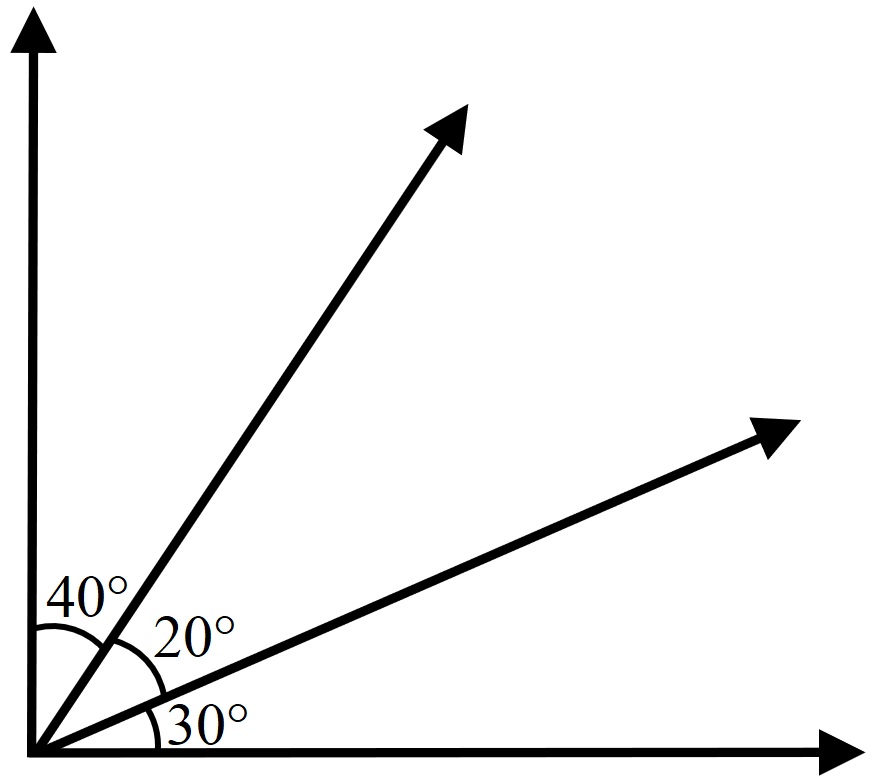
The number of angles in Fig. is:
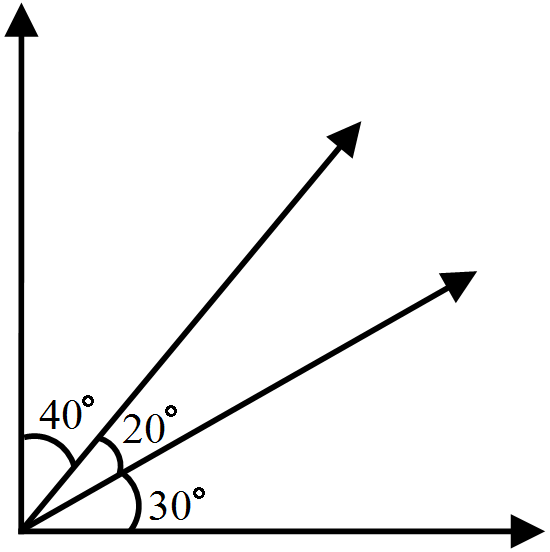
AnswerAngles shown in the figure are $40^\circ , 20^\circ , 30^\circ , 60^\circ , 50^\circ $ and $90^\circ $. Therefore, there are $6$ angles,
View full question & answer→MCQ 561 Mark
A perpendicular is drawn using:
AnswerA perpendicular is drawn using scale, protractor as well as set squares.
View full question & answer→MCQ 571 Mark
A triangle $\triangle\text{PQR}$ with $ \angle\text{Q}=90^∘,$ $QR = 4\ cm$ and $PR = 5\ cm$ is constructed. What would be the measure of $PQ$?
- ✓
$2\ cm$
- B
$6\ cm$
- C
$7\ cm$
- D
$3\ cm$
AnswerCorrect option: A. $2\ cm$
$2\ cm$
View full question & answer→MCQ 581 Mark
In $\triangle\text{ABC},$ $\overline{\text{AB}}>\overline{\text{BC}}>\overline{\text{CA}}$ which of the following is the smallest angle?
AnswerCorrect option: B. $\angle{\text{B}}$
$\angle{\text{B}}$
View full question & answer→MCQ 591 Mark
With the help of a ruler and a compass, it is possible to construct an angle of:
- A
$35^\circ$
- B
$40^\circ$
- ✓
$37.5^\circ$
- D
AnswerCorrect option: C. $37.5^\circ$
Using ruler and compass it is possible to construct $37.5^\circ$
Step $1$: Construct angle of $150^\circ$
Step $2$: Bisect the angle to get $75^\circ$
Step $3$: Again bisect the angle to get $37.5^\circ$
View full question & answer→MCQ 601 Mark
$X$ and $Y$ are two distinct points in a plane. How many lines can be drawn passing through both $X$ and $Y$?
View full question & answer→MCQ 611 Mark
Mark $(\checkmark)$ against the correct answer in the following:
Where does the vertex of an angle lie?
AnswerThe vertex of an angle is the point where two rays begin or meet, where two line segments join or meet, where two lines intersect (cross), or any appropriate combination of rays, segments and lines that result in two straight "sides" meeting at one place.
View full question & answer→MCQ 621 Mark
Into what type of parts is a figure divided by bisecting it?
MCQ 631 Mark
Number of lines passing through five points such that no three of them are collinear is:
MCQ 641 Mark
The number of diagonals in a septagon is:
AnswerWe know that, if a polygon has n sides, then Number of diagonals $=\frac{\text{n}(3-2)}{2}$
A septagon is a polygon having seven sides, i.e. $n = 7$
Number of diagonals in septagon $=\frac{7(7-3)}{2}=14$
Note: A diagonal is a line segment joining two non-consecutive vertices of a polygon.
View full question & answer→MCQ 651 Mark
In which of the following figures the adjacent sides are not necessarily be equal?
Answer$(a)$ & $(c)$ Both parallelogram and rectangle.
View full question & answer→MCQ 661 Mark
The steps for constructing a perpendicular from point $A$ to line $P$ $Q$ is given in jumbled order as follows: $(A$ does not lie on $PQ)$
$1.$ Join $R$ − $S$ passing through $A$.
$2.$ $P$lace the pointed end of the compass on $A$ and with an arbitrary radius, mark two points $D$ and $E$ on line $P$$Q$ with the same radius.
$3.$ From points $D$ and $E$, mark two intersecting arcs on either side of $P$ $Q$ and name them $R$ and $S$.
$4.$ $D$raw a line $P$ $Q$ and take a point $A$ anywhere outside the line.The second step in the process is:
Answer
Correct sequence is:
$1.$ Draw a line $P$ $Q$ and take a point $A$ anywhere outside the line.
$2.$ $P$lace the pointed end of the compass on $A$ and with an arbitrary radius, mark two points $D$ and $E$ on line $P$ $Q$ with the same radius.
$3.$ From points $D$ and $E$, mark two intersecting arcs on either side of $P$ $Q$ and name them $R$ and $S$.
$4.$ Join $R$ − $S$ passing through $A.$
$5.\ S$o the second step is $2$.
View full question & answer→MCQ 671 Mark
The last step in the process is:
AnswerCorrect sequence is
Step $1$. Draw a ray $QR$
Step $2$. Place the pointed end of the compass on $Q$ and draw a semi circular arc with arbitrary radius.
Step $3$. Mark a point $B$ on the same arc with the same radius from point $A$. Similarly, mark a point $C$ from $B$.
Step $4$. Draw two intersecting arcs from $B$ and $C$ and mark the intersection as point $D$.
Step $5$. Join $Q-D$ and extend it to obtain $QP$.
View full question & answer→MCQ 681 Mark
Read the statements carefully.
Statement 1: Two lines are said to be perpendicular if they intersect each other at an angle of $90^\circ $.
Statement 2: A unique circle can be drawn passing through the given centre.
Which of the following options holds?
- A
Both Statement - $1$ and Statement - $2$ are true.
- ✓
Statement - $1$ is true and Statement - $2$ is false.
- C
Statement -$1$ is false and Statement - $2$ is true.
- D
Both Statement -$1$ and Statement - $2$ are false.
AnswerCorrect option: B. Statement - $1$ is true and Statement - $2$ is false.
Statement - $1$ is true and Statement - $2$ is false.
View full question & answer→MCQ 691 Mark
At $7\ a.m$. the angle between the Sun's ray and the ground at a point is $43^\circ $ What would be the angle at $10\ a.m.$?
AnswerCorrect option: C. Between $43^\circ $ and $90^\circ $
Let QP be the sun's ray and RP be the ground.
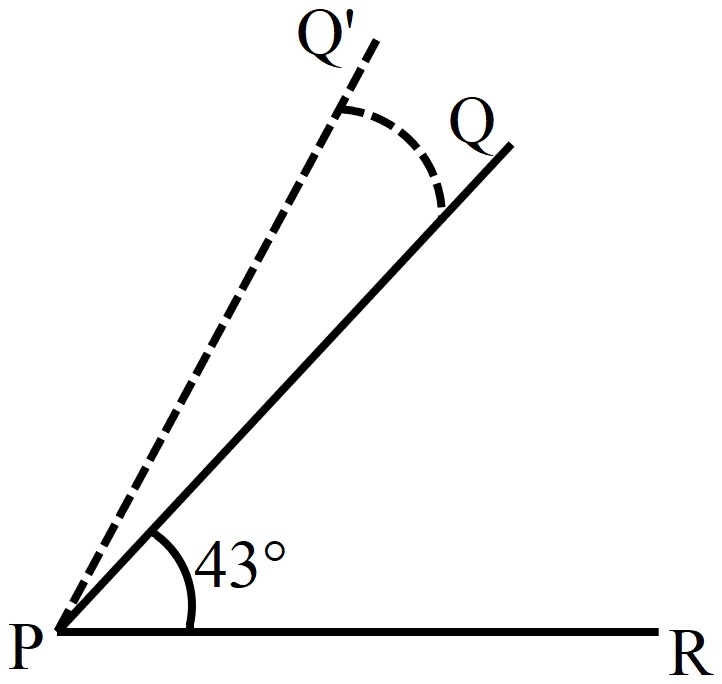
The angle between $QP$ and $PR$ at $P$ is $43^\circ $ at $7\ a.m.$ At $10\ a.m$., the sun's ray is $Q'P$.
We know that at $12$ noon the sun is exactly above our head.
So, the sun's ray will be perpendicular to the ground.
So, clearly at $10\ am$, the required angle will be between $43^\circ $ and $90^\circ $. View full question & answer→MCQ 701 Mark
A vertex of square is $(3,4)$ and diagonals equation is given by $x + 2y = 1,$
then the second diagonal which passes through given vertex will be
- A
$2x - y + 2 = 0$
- B
$x + 2y = 11$
- ✓
$2x - y = 2$
- D
AnswerCorrect option: C. $2x - y = 2$
$2x - y = 2$
View full question & answer→MCQ 711 Mark
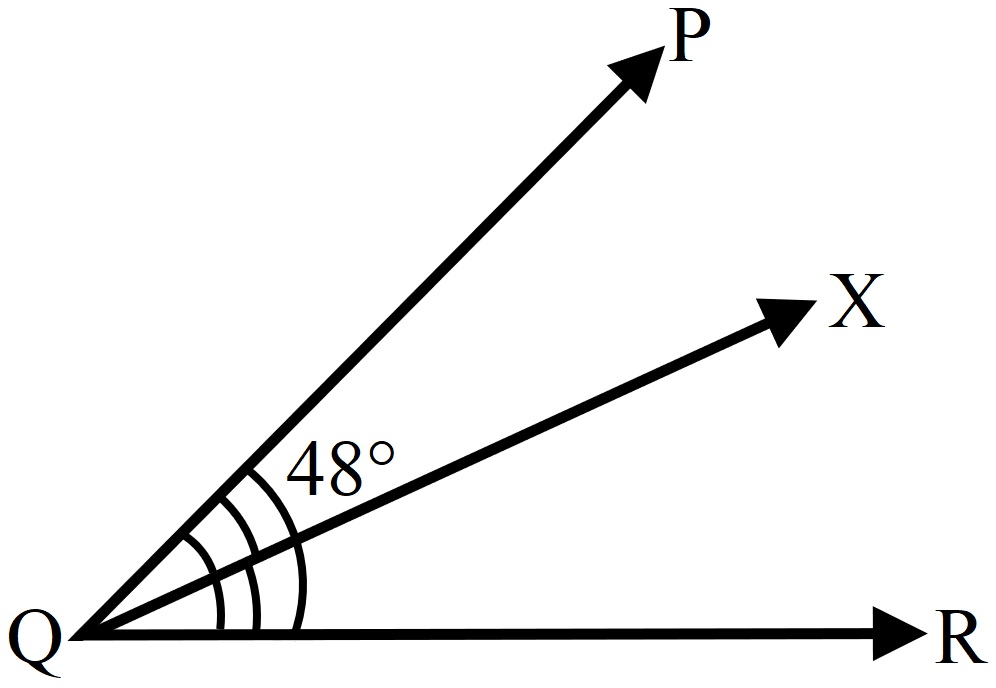
The figure shows $\angle{\text{PQR}}$ which measures 48° $\overrightarrow{\text{QX}}$ is drawn such that $\angle{\text{PQX}}=\angle{\text{XQR}}.$ What is $\overrightarrow{\text{QX}}$ called?
- A
- B
- ✓
- D
Either $[a]$ or $[b]$
View full question & answer→MCQ 721 Mark
A line segment has ______ end points.
MCQ 731 Mark
A maths teacher asked his students to draw a pair of parallel lines. Which instrument $(s)$ are the students most likely to use?
AnswerCorrect option: D. Both $[b]$ and $[c]$
The lines drawn using the two edges of a ruler are parallel.
Also a ruler and a setsquare can be used to draw a pair of parallel lines.
View full question & answer→MCQ 741 Mark
The fourth step in the process is:
Answer$0^\circ <$ acute angle $< 90^\circ <$ obtuse angle $< 180^\circ $.
View full question & answer→MCQ 751 Mark
An angle of $15$ is drawn using a pair of compasses and a ruler. How is it done?
- A
Bisecting $60^\circ $ angle.
- B
Bisecting $60^\circ$ and $120^\circ $ angles.
- ✓
Bisecting $60^\circ $ and then bisecting it again.
- D
Bisecting a $60^\circ $ and $180^\circ $ angles.
AnswerCorrect option: C. Bisecting $60^\circ $ and then bisecting it again.
Bisecting $60^\circ $ and then bisecting it again.
View full question & answer→MCQ 761 Mark
An angle which can be constructed using a pair of compass and ruler is
- A
$20^\circ $
- B
$80^\circ $
- ✓
$60^\circ $
- D
AnswerCorrect option: C. $60^\circ $
An angle which can be constructed using a pair of compass and ruler is $60^\circ $ as multiples of
$15^\circ $ can be drawn using a compass.
View full question & answer→MCQ 771 Mark
A polygon has prime number of sides. Its number of sides is equal to the sum of the two least consecutive primes. The number of diagonals of the polygon is:
AnswerThe two least consecutive primes are $2$ and $3$.
$2 + 3 = 5$
So, sides of polygon $(n) = 5$
Number of diagonals $=\frac{\text{n}(\text{n}-3)}{2}=\frac{5(5-3)}{2}=5$
View full question & answer→MCQ 781 Mark
Identify the condition to be checked before constructing a triangle.
MCQ 791 Mark
The measurements of $\triangle\text{DEF}$ are $\text{EF}=8.4\text{cm},$ $\angle\text{E}=100^∘$ and $\angle=82^∘$. Which of the following is correct?
- A
$ADEF$ can be constructed.
- B
$ADEF$ is an obtuse angled triangle.
- ✓
- D
$ADEF$ is an acute angled triangle.
Answer$\triangle\text{le} $ cannot be constructed as sum of only two $\triangle\text{les}$ $\angle\text{E}$ & $\angle\text{F}>180^∘(\angle\text{E}+\angle\text{F}=182^∘),$ which is not possible in a Ale.
View full question & answer→MCQ 801 Mark
Which of the following statement is true about the given figure?
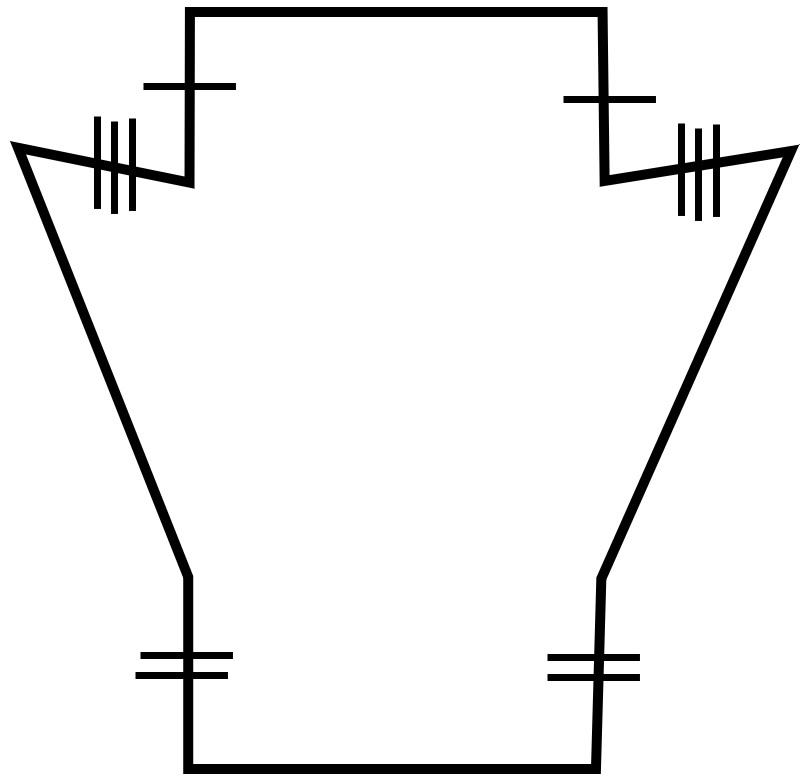
AnswerGiven figure is a polygon.
View full question & answer→MCQ 811 Mark
What do you call two lines intersecting at a point?
MCQ 821 Mark
Mark $(\checkmark)$ against the correct answer in the following:
Which of the following has no end points?
AnswerA line has no end points. We can produce it infinitely in both directions.
View full question & answer→MCQ 831 Mark
How many complete turns is equivalent to $90^\circ ?$
- A
$2$
- B
$1$
- C
$\frac{1}{2}$
- ✓
$\frac{1}{4}$
AnswerCorrect option: D. $\frac{1}{4}$
$\frac{1}{4}$
View full question & answer→MCQ 841 Mark
The steps to construct a line perpendicular to $XY$ and passing through $P$ is given in random order :
$1.$ Move the set square along $XY$ so the other short side touches Point $P$.
$2.$ Use the edge of the set square to draw a line through Point $P$.
$3.$ Draw a line $XY$ and mark point $P$.
$4.$ Place one short side of the set square on the line $XY$.
Which of the following will be the first step:
Answer$1.$ Draw a line $XY$ and mark a point $P$ on it.
$2.$ Place one short side of the set square on the line $XY$.
$3.$ Move the set square along $XY$ so the other short side touches point $P$.
$4.$ Use the edge of the set square to draw a line through point $P$.
$5.$ So is the second step.Option $D$ is correct.
View full question & answer→MCQ 851 Mark
The first step in the process will be:
AnswerCorrect sequence of steps is :
Step $1$: Draw segment $AB$ and take a point $P$ on it.
Step $2$: From point $P$, mark two equidistant points from $P$ on line $AB$, and name them $C$ and $D$
Step $3$ : From points $C$ and $D$ mark two intersecting arcs on either side of the line $AB$. Name the intersection point as $E$
Step $4$: Join $E$ and $P$. $EP$ is the required perpendicular. So the first step is $4$
So option $D$ is correct.
View full question & answer→MCQ 861 Mark
When two line segments meet at a point forming right angle they are said to be __________ to each other.
AnswerWhen two line segments meet at a point forming right angle
they are said to be perpendicular to each other.
View full question & answer→MCQ 871 Mark
When a perpendicular is drawn to a given line, in what ratio is the line divided into?
- A
$1 : 1$
- B
$1 : 2$
- C
$2 : 1$
- ✓
AnswerA line does not have a definite length.Hence, when a perpendicular is drawn to the given line,
nothing can be said about the ratio it gets divided into.
View full question & answer→MCQ 881 Mark
A line segment $\overrightarrow{\text{TP}}$is bisected at I. What is the measure of $\overrightarrow{\text{Tl}}$?
- A
$\frac{1}{2}\overrightarrow{\text{ IP}}$
- ✓
$\overrightarrow{\text{IP}}$
- C
$\overrightarrow{\text{TP}}$
- D
$\frac{1}{3}\overrightarrow{\text{ TP}}$
AnswerCorrect option: B. $\overrightarrow{\text{IP}}$
$\overrightarrow{\text{TI}}=\frac{1}{2}\overrightarrow{\text{ TP}}=\text{IP}$
View full question & answer→MCQ 891 Mark
When two lines are perpendicular to each other, the angle is said to be _______ angle.
AnswerTwo given lines are perpendicular means the angle between them is $90^\circ$, i.e. a right angle.
View full question & answer→MCQ 901 Mark
Which of the following angles is possible to construct using a compass?
- ✓
$60^\circ$
- B
$32^\circ$
- C
$51.25^\circ$
- D
AnswerCorrect option: A. $60^\circ$
An angle of $60^\circ$ can be constructed using a compass.
Step $1$ : Make a compelete arc on a straight line.
Step $2$ : Make an arc on the previous arc with the same opening of compass from the start point of previous arc.
Step $3$: Draw a line through the centre of arc and point of intersection.
View full question & answer→MCQ 911 Mark
The line segment connecting $(x, 6)$ and $(9, y)$ is bisected by the point $(7, 3)$ Find the values of $x$ and $y$
- A
$15, 6$
- B
$33, 12$
- ✓
$5, 0$
- D
$14, 6$
AnswerCorrect option: C. $5, 0$
Since line segment connecting $(x,6)$ and $(9,y)$ is bisected by the point $(7,3)$
Therefore, $\frac{\text{x}+9}{2}=7\Rightarrow\text{x}=5$ and $\frac{6+\text{y}}{2}=3\Rightarrow\text{y}=0$
$\therefore\text{x}=5,\text{y}=0$
View full question & answer→MCQ 921 Mark
Each angle of equilateral triangle is $60^\circ$. The angles are bisected then each angle will be of:
- A
$60^\circ$
- ✓
$30^\circ$
- C
$90^\circ$
- D
$120^\circ$
AnswerCorrect option: B. $30^\circ$
Angle bisector divide the angle in two equal parts.
$\therefore$ bisected angle $=\frac{60{^\circ}}{2}=30{^\circ}$ So option $B$ is correct.
View full question & answer→MCQ 931 Mark
Which of the following can be drawn on a piece of paper?
AnswerA line segment can be drawn on a paper.
View full question & answer→MCQ 941 Mark
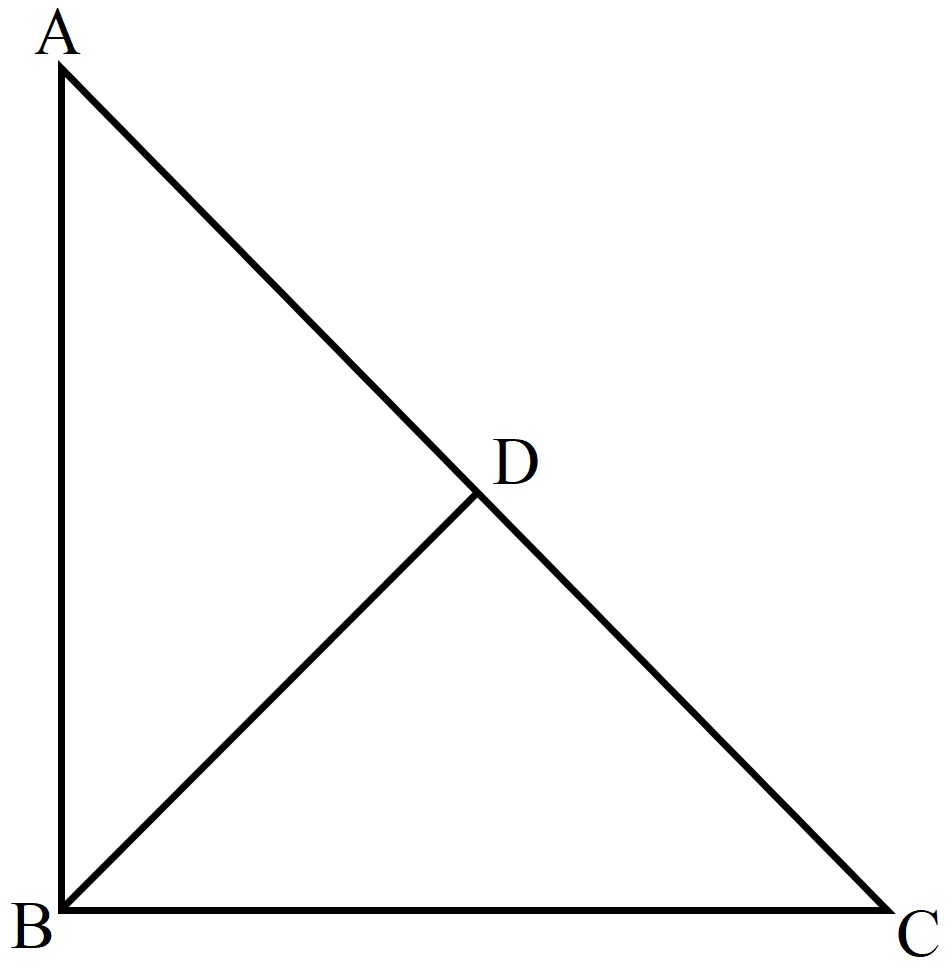
In Fig. $AB = BC$ and $AD = BD = DC.$
The number of isoscles triangles in the figure is:
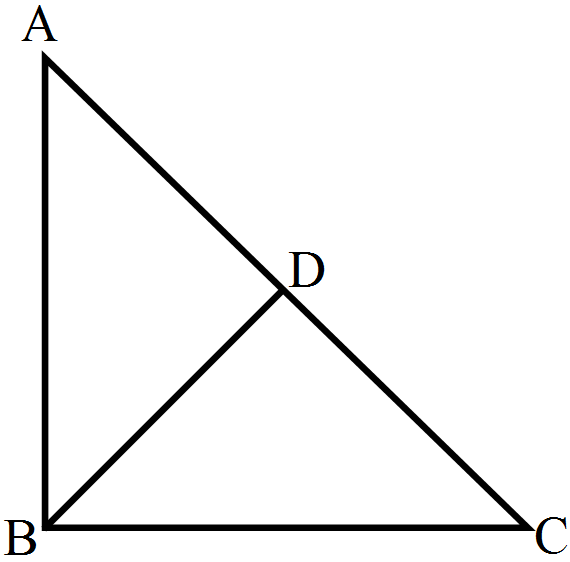
AnswerA triangle, in which two sides are equal, is known as an isosceles triangle.
Hence, there are $3$ isosceles triangles in the given figure,
i.e. $A ABC, AABD$ and $ABDC. [AB = BC, AD = DB$ and $BD = DC]$
View full question & answer→MCQ 951 Mark
Which of the following is used to draw a line parallel to a given line?
MCQ 961 Mark
Which of the following can be used to construct a $30o$ angle?
AnswerCorrect option: A. Construct $60o$ angle using compasses and bisect it.
Construct $60o$ angle using compasses and bisect it.
View full question & answer→MCQ 971 Mark
Number of line segments in Fig is:

AnswerA line segment is a part of a line that has finite length and is bounded by two distinct end points.
In the given figure, the line segments are $AS, SC, CD, DE, AC, AD, BD, BE, CE$ and $AE$.
Hence, there are $10$ line segments in the given figure.
View full question & answer→MCQ 981 Mark
Mark $(\checkmark)$ against the correct answer in the following:
An angle measuring $270^\circ $ is:
AnswerThis is because it is more than $180^\circ $ and less than $360^\circ $.
View full question & answer→MCQ 991 Mark
Mark $(\checkmark)$ against the correct answer in the following:
Which of the following has two end point?
AnswerA line segment has two end points and both of them are fixed. Thus, a line segment has a fixed length.
View full question & answer→MCQ 1001 Mark
Two lines are said to be perpendicular to each other when they meet at ____angle.
- A
$180^\circ $
- ✓
$90^\circ $
- C
$60^\circ $
- D
$360^\circ $
AnswerCorrect option: B. $90^\circ $
$90^\circ $
View full question & answer→MCQ 1011 Mark
To draw an angle of $150^\circ $ using a pair of compass and ruler _______.
- ✓
Bisect angle between $120^\circ $ and $180^\circ $
- B
Bisect angle between $60^\circ $ and $120^\circ $
- C
Bisect angle between $0^\circ $ and $160^\circ $
- D
AnswerCorrect option: A. Bisect angle between $120^\circ $ and $180^\circ $
Bisect angle between $120^\circ $ and $180^\circ $
View full question & answer→MCQ 1021 Mark
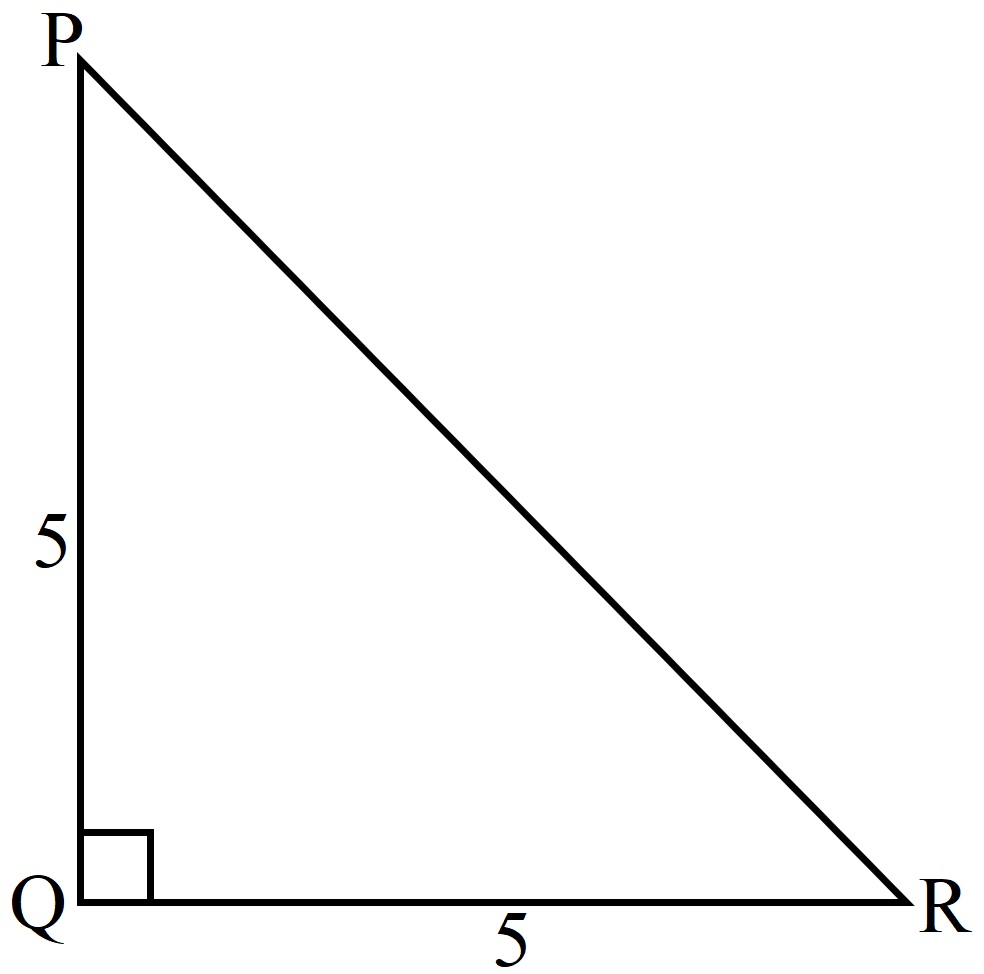
In Fig. ${\text{PQ}}\perp{\text{RQ}}$, $PQ = 5\ cm$ and $QR = 5\ cm$. Then$ \triangle{\text{PQR}}$ is:
- A
a right triangle but not isosceles
- ✓
an isosceles right triangle
- C
isosceles but not a right triangle
- D
neither isosceles nor right triangle
AnswerCorrect option: B. an isosceles right triangle
an isosceles right triangle
View full question & answer→MCQ 1031 Mark
A line segment $\overline{\text{PQ}}=8.2\text{cm}$ is bisected at $O$, then length of $\overline{\text{PO}}$ is _______.
- A
$4.2\ cm$
- B
$4\ cm$
- ✓
$4.1\ cm$
- D
$16.4\ cm$
AnswerCorrect option: C. $4.1\ cm$
Length of $PO$ $=\big(\frac{8.2}{2}\big)$ $cm = 4.1 \ cm$

View full question & answer→MCQ 1041 Mark
In Fig. $\angle\text{BAC}-90^\circ$ and $\text{AD}\perp\text{BC}.$
The number of right triangles in the figure is:
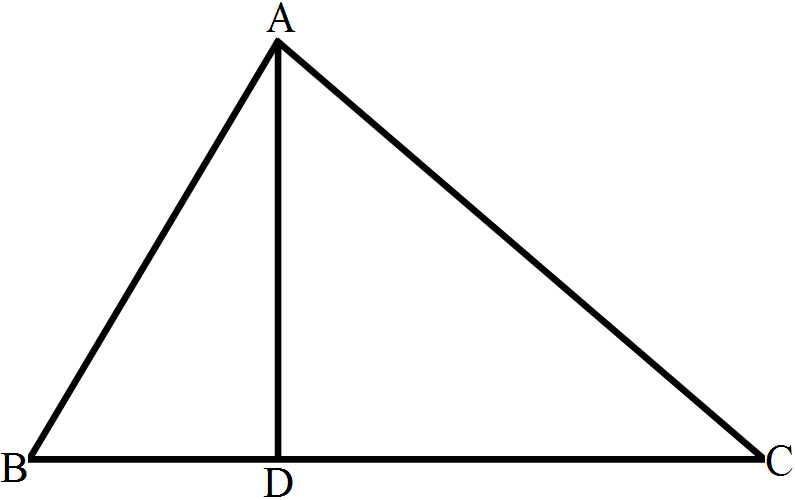
AnswerA triangle, in which one angle is equal to $90^\circ $, is called a right angled triangle. Since, $\angle\text{BAC}=90^\circ$
$ABAC$ is a right angled triangle.
Also, $\angle\text{ADB}=\angle\text{ADC}=90^\circ$ $[AD$ Perpendicular to $BC]$
$A ADB$ and $A ADC$ are also right angled triangles.
Hence, there are $3$ right angled triangles.
View full question & answer→MCQ 1051 Mark
Which among the following is sufficient to construct a triangle?
- ✓
The lengths of the three sides
- B
The perimeter of the triangle
- C
The measures of three angles
- D
The names of three vertices.
AnswerCorrect option: A. The lengths of the three sides
The lengths of the three sides
View full question & answer→MCQ 1061 Mark
The second step in the process is:
AnswerCorrect sequence is: step
$1.$ Draw a ray $BC.$
$2.$ Place the pointed end of the compass on $B$ and draw a semi $-$ circular arc with arbitrary radius and name its intersection with the ray $BC$ as $D$.
$3.$ From $D$ mark a point $E$ on the arc with the same radius.
$4.$ From point $E$, mark a point $F$ on the same arc with same radius.
$5.$ Join $B − F$ and extend it to obtain ray $BA$ So the second step is $2$
View full question & answer→MCQ 1071 Mark
An angle $\angle{\text{XYZ}}=75^\circ $ is bisected by an angular bisector $\overrightarrow{\text{YU}}.$Then what is the measure of $\angle{\text{UYZ}}$?
- A
$37^\circ $
- ✓
$37.5^\circ $
- C
$47.5^\circ $
- D
$47^\circ $
AnswerCorrect option: B. $37.5^\circ $
$37.5^\circ $
View full question & answer→MCQ 1081 Mark
A line segment $ \overline{\text{IP}}$is bisected at $T$. Which of the following equals $\overline{\text{IT}}$?
- ✓
$\overline{\text{IP}}$
- B
$\overline{\text{TP}}$
- C
$\overline{\text{TC}}$
- D
$\overline{\text{IQ}}$
AnswerCorrect option: A. $\overline{\text{IP}}$
$\overline{\text{TP}}$
View full question & answer→MCQ 1091 Mark
In Fig. if point $A$ is shifted to point $B$ along the ray $PX$ such that $PB = 2PA$, then the measure of $\angle\text{BPY}$ is:
- A
Greater than $45^\circ $
- ✓
$45^\circ $
- C
Less than $45^\circ $
- D
$90^\circ $
AnswerCorrect option: B. $45^\circ $
There will be no change in the measure of $\angle\text{BPY}$
View full question & answer→MCQ 1101 Mark
Identify the instruments used to bisect a given line segment.
MCQ 1111 Mark
The first step in the process is:
MCQ 1121 Mark
Identify the one with no definite length.
AnswerCorrect option: A. $\overleftrightarrow{\text{AB}}$
$\overleftrightarrow{\text{AB}}$ has no definite length.
View full question & answer→MCQ 1131 Mark
The point $M$ on $\overleftrightarrow{\text{AB}}$ is such that $\overline{\text{AM}}=\overline{\text{MB}}$ Which of the following is a false statement?
- A
$M$ is the mid-point of $\overleftrightarrow{\text{AB}}$.
- B
$\overline{\text{AM}}=\frac{1}{2}\overline{\text{AB}}$
- ✓
$\overline{\text{MB}}=2\overline{\text{AB}}$
- D
The point $M$ bisects $AB$.
AnswerCorrect option: C. $\overline{\text{MB}}=2\overline{\text{AB}}$
$M$ is a point on $\overleftrightarrow{\text{AB}}$ such that $\overline{\text{AM}}=\overline{\text{MB}}$ Then $M$ is the midpoint of $\overleftrightarrow{\text{AB}}$, $\overline{\text{AM}}=\frac{1}{2}\overline{\text{AB}}$ and $\overrightarrow{\text{M}}$ bisects $\overleftrightarrow{\text{AB}}$ are true.
Hence the only false statement is $\overline{\text{MB}}=2\overline{\text{AB}}$
View full question & answer→MCQ 1141 Mark
Identify the false statement.
- A
A triangle with three equal sides is called an equilateral triangle.
- B
A triangle with a right angle is called a right angled triangle.
- ✓
A triangle with two equal sides is called a scalene triangle.
- D
A right angled triangle has two acute angles and a right angle.
AnswerCorrect option: C. A triangle with two equal sides is called a scalene triangle.
In $[c],$ such a $\triangle\text{le}$ is called isosceles $\triangle\text{le}$
View full question & answer→MCQ 1151 Mark
Number of perpendicular bisectors for a line segment is
MCQ 1161 Mark
Number of lines passing through five points such that no three of them are collinear is:
AnswerLet $A, B, C, D$ and $E$ be five points such that no three of them are $4$ collinear.
Lines passing through these five points are $AB, BC, CD, DE, EA, BA, BD, CE, AC$ and $AD$.
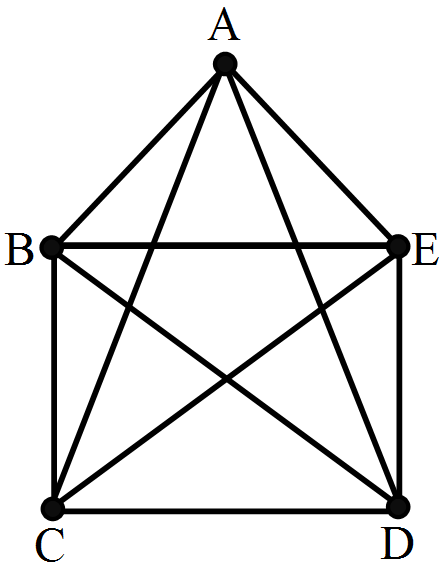
Hence, the number of lines is $10$.
Note: Three or more points are said to be collinear, if they lie on a single straight line. View full question & answer→MCQ 1171 Mark
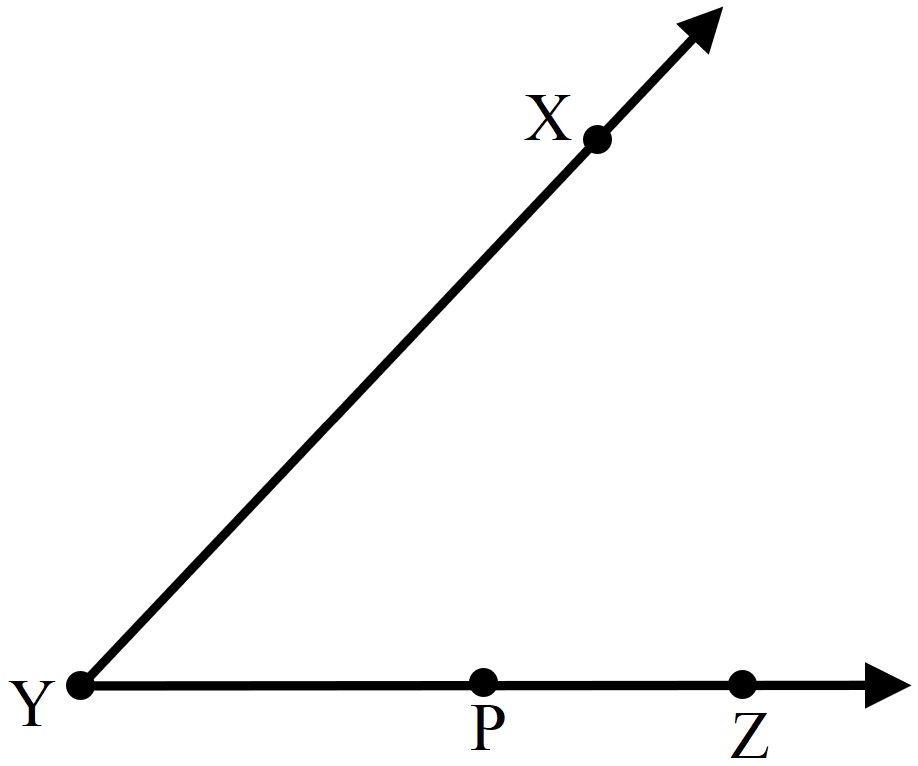
In Fig.$ −DXYZ$ cannot be written as:
- A
$\angle{\text{Y}}$
- ✓
$\angle{\text{ZXY}}$
- C
$\angle{\text{ZYX}}$
- D
$\angle{\text{XYP}}$
AnswerCorrect option: B. $\angle{\text{ZXY}}$
$\angle{\text{ZXY}}$
View full question & answer→MCQ 1181 Mark
The steps of construction of an $\angle\text{AOB}=45^\circ$ is given in jumbled order below:
$1.$ Place compass on intersection point.
$2.$ Place ruler on start point and where arc intersects perpendicular line.
$3.$ Adjust compass width to reach start point.
$4.$ Construct a perpendicular line.
$5.$ Draw $45$ degree line.
$6.$ Draw an arc that intersects perpendicular line.
$7.$ The third step in process is:
AnswerCorrect sequence is:
$1.$ Construct a perpendicular line.
$2.$ Draw an arc that intersect the perpendicular line.
$3.$ Adjust the compass width to reach the start point.
$4.$ Place compass on intersection point.
$5.$ Place ruler on start point and where the arc intersects the perpendicular line.
$6.$ Draw $45$ degree line.
View full question & answer→MCQ 1191 Mark
In which of the following cases can a triangle be constructed?
- A
Measures of three sides are given.
- B
Measures of two sides and an included angle are given.
- C
Measures of two angles and the side between them are given.
- ✓
View full question & answer→MCQ 1201 Mark
If a bicycle wheel has $48$ spokes, then the angle between a pair of two consecutive spokes is:
- A
$\Big(5\frac{1}{2}\Big)$
- ✓
$\Big(7\frac{1}{2}\Big)$
- C
$\Big(\frac{2}{11}\Big)$
- D
$\Big(\frac{2}{15}\Big)$
AnswerCorrect option: B. $\Big(7\frac{1}{2}\Big)$
Given, number of spokes$ = 48$ A complete angle $= 360^\circ .$
Angle between a pair of two consecutive spokes = Complete angle,
Number of spokes $48.2$
View full question & answer→MCQ 1211 Mark
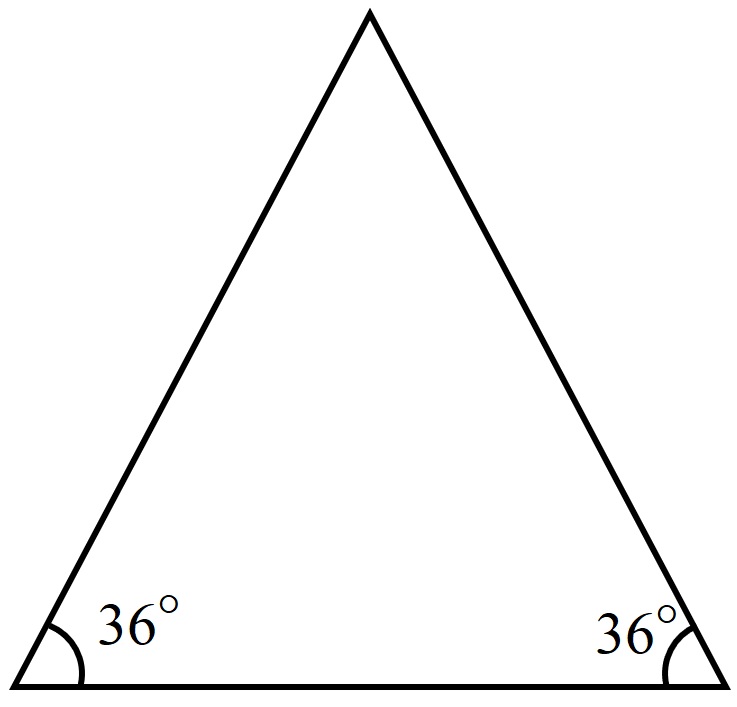
Which of the following best describes the given triangle.
- A
- B
- C
Equilateral obtuse triangle
- ✓
Isosceles obtuse triangle
AnswerCorrect option: D. Isosceles obtuse triangle
Isosceles obtuse triangle.
View full question & answer→MCQ 1221 Mark
Identify the uses of a ruler.
- A
To draw a line segment of a given length
- B
To draw a copy of a given segment.
- C
To draw a diameter of a circle.
- ✓
AnswerA ruler is used to draw a line segment of a given length, to draw the copy of a given segment, and to draw a diameter of a circle.
Thus, all the given options are correct.
View full question & answer→MCQ 1231 Mark
In order to duplicate agiven angle, which of the following instruments can be used?
AnswerA Compass can be used to make the duplicate of any angle. A protractor can also be used
to duplicate angles but only of integral values.So option A is correct.
View full question & answer→MCQ 1241 Mark
$\overrightarrow{\text{XY}}$ bisects $\angle{\text{AXB}}.$ If $\angle{\text{YXB}}=37.5,$ what is the measure of $\angle{\text{AXB}}$?
- A
$37.5^\circ $
- B
$74^\circ $
- C
$64^\circ $
- ✓
$75^\circ $
AnswerCorrect option: D. $75^\circ $
$75^\circ $
View full question & answer→MCQ 1251 Mark
If sum of two angles of a triangle is $60^\circ.$ Then, the measure of third angle of a triangle is:
- A
$60^\circ$
- B
$90^\circ$
- ✓
$120^\circ$
- D
$180^\circ$
AnswerCorrect option: C. $120^\circ$
Let the angles be $x, y$ and $z$ Sum of two angles $= x + y$
Given $x + y = 60^\circ$
Using angle sum property $x + y + z = 180^\circ 60^\circ + z = 180 z = 120^\circ$
View full question & answer→MCQ 1261 Mark
Angles to be bisected to obtain an angle of $90^\circ $ are:
AnswerCorrect option: B. $60^\circ $ and $120^\circ $
Angles to be bisected to obtain an angle of $90^\circ$ are $60^\circ$ and $120^\circ $ as it exactly lies between
these two angles. $\frac{60^\circ + 120^\circ}{2}$
$= 90^\circ $ Hence, option $B$.
View full question & answer→MCQ 1271 Mark
If two lines have only one point in common, what are they called?
AnswerIntersecting lines have only one point in common.
View full question & answer→MCQ 1281 Mark
Arrange the given steps in $CORRECT$ order of constructing a perpendicular using ruler and compases. Steps of construction:
$1.$ With $A$ and $B$ as centres and a radius greater than $AP$ construct two arcs, which cut each other at $Q$.
$2.$ Join $PQ$. Then $\overline{\text{PQ}}$ is perpendicular to $l$. We write $0$ $\overline{\text{PQ}}\perp\text{l}$
$3.$ With $P$ as centre and a convenient radius, construct an arc intersecting the line l at two points $A$ and $B$.
$4.$ Given a point $P$ on a line $l$
- ✓
$4 - 3 - 1 - 2$
- B
$3 - 4 - 2 - 1$
- C
$4 - 1 - 3 - 2$
- D
$1 - 2 - 3 - 4$
AnswerCorrect option: A. $4 - 3 - 1 - 2$
$4 - 3 - 1 - 2$
View full question & answer→MCQ 1291 Mark
The number of angles in Fig. is:
MCQ 1301 Mark
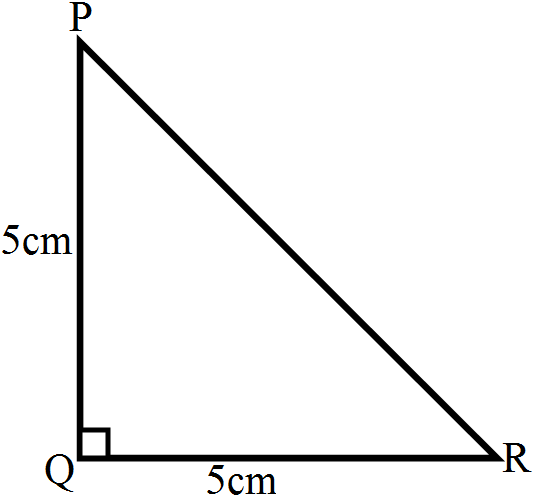
In Fig. $\text{PQ}\perp\text{RQ},\text{PQ}=5\text{cm}$ and $\text{QR}=5\text{cm}.$ Then $\triangle\text{PQR}$ is:
- A
A right triangle but not isosceles.
- ✓
An isosceles right triangle.
- C
Isosceles but not a right triangle.
- D
Neither isosceles nor right triangle.
AnswerCorrect option: B. An isosceles right triangle.
Since, $PQ$ Perpendicular to $RQ$,
So, $\triangle\text{PQR}=90^\circ$
$\therefore\triangle\text{PQR}$ is right angled triangle.
Also, in $\triangle\text{PQR},$
$\text{PQ}=\text{QR}$
$\triangle\text{PQR}$ is an isosceles triangle.
Hence, $\triangle\text{PQR}$ is an isosceles right angled triangle.
View full question & answer→MCQ 1311 Mark
In Fig. $AB = BC$ and $AD = BD = DC$. The number of isosceles triangles in the figure is:
View full question & answer→MCQ 1321 Mark
Number of line segments in Fig. is:

MCQ 1331 Mark
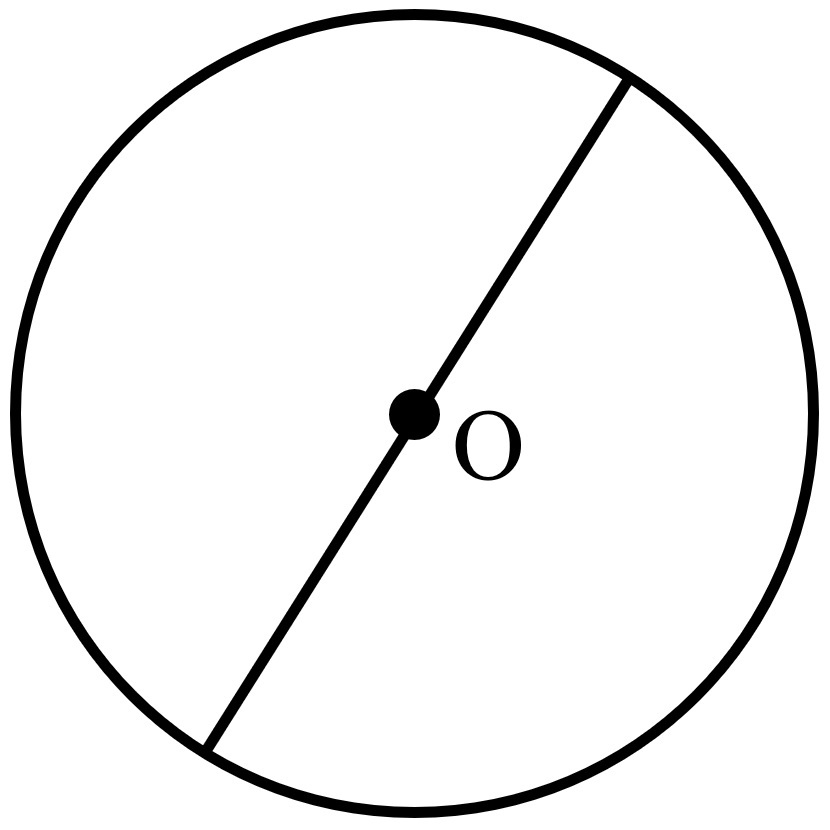
Anitha's maths book has the figure given. Which instrument $(s)$ did she use to draw the figure?
- ✓
The compasses and a ruler
- B
- C
- D
AnswerCorrect option: A. The compasses and a ruler
The compasses and a ruler
View full question & answer→MCQ 1341 Mark
$ABC$ is a triangle. The bisectors of theinternal angle $\angle B$ and external angle $\angle C$ intersect at $D$. if $\angle BDC = 60^\circ$ then $\angle A$ is
- A
$120^\circ$
- B
$180^\circ$
- ✓
$60^\circ$
- D
AnswerCorrect option: C. $60^\circ$
Consider $△ABC$ Let $BC$ be extended to $E$ Since Angular bisectors Meet at $D \angle ABD = \angle DBC ⋯ (1)$
$\angle ACD =\angle DCE ⋯ (2)$
Consider $△DBC$ By External sum property $\angle DCE = \angle BDC + \angle DBC $
$⟹ 2 \angle DCE = 2(60^\circ ) + 2 \angle DBC $
$⟹ \angle ACE = 120^\circ +\angle ABC $
By external sum property of
$△ABC \angle ACE = \angle BAC + \angle ABC$
$⟹ \angle A = 60^\circ$
View full question & answer→MCQ 1351 Mark
Draw perpendicular to the line of length $99\ cm$ so that the perpendicular divides the line in the ratio $1:21:2$. Then length of the line on the left will be:
- ✓
$3 \ cm$
- B
$4 \ cm$
- C
$5 \ cm$
- D
AnswerCorrect option: A. $3 \ cm$
Draw a line say $B$ of length $9 \ cm$ using a ruleNow we have to divide the line in $1:2.$
Let the length of left part be $x$ then length of right part is$2\text{x}\Rightarrow{\text{x + 2x =9}}\Rightarrow{\text{3x = 9}}\Rightarrow{\text{x = }}\frac{9}{3}=3$$cm$
So, the lenght of left part is $3 \ cm$ So, option $A$ is correct.
View full question & answer→MCQ 1361 Mark
$\overrightarrow{\text{QZ}}$ is the bisector of $\angle{\text{PQZ}}=\angle{\text{PQR}}$ Which of the following is true?
- A
$\angle{\text{PQZ}}=\angle{\text{PQR}}$
- B
$\angle{\text{PQZ}}=\angle{\text{ZQR}}$
- C
$\angle{\text{PQZ}}=\frac{1}{2}\angle{\text{ZQR}}$
- ✓
$\text{Both [b] and [c]} $
AnswerCorrect option: D. $\text{Both [b] and [c]} $
$\overrightarrow{\text{QZ}}$ bisects $\angle{\text{PQZ}}$ (Given) )
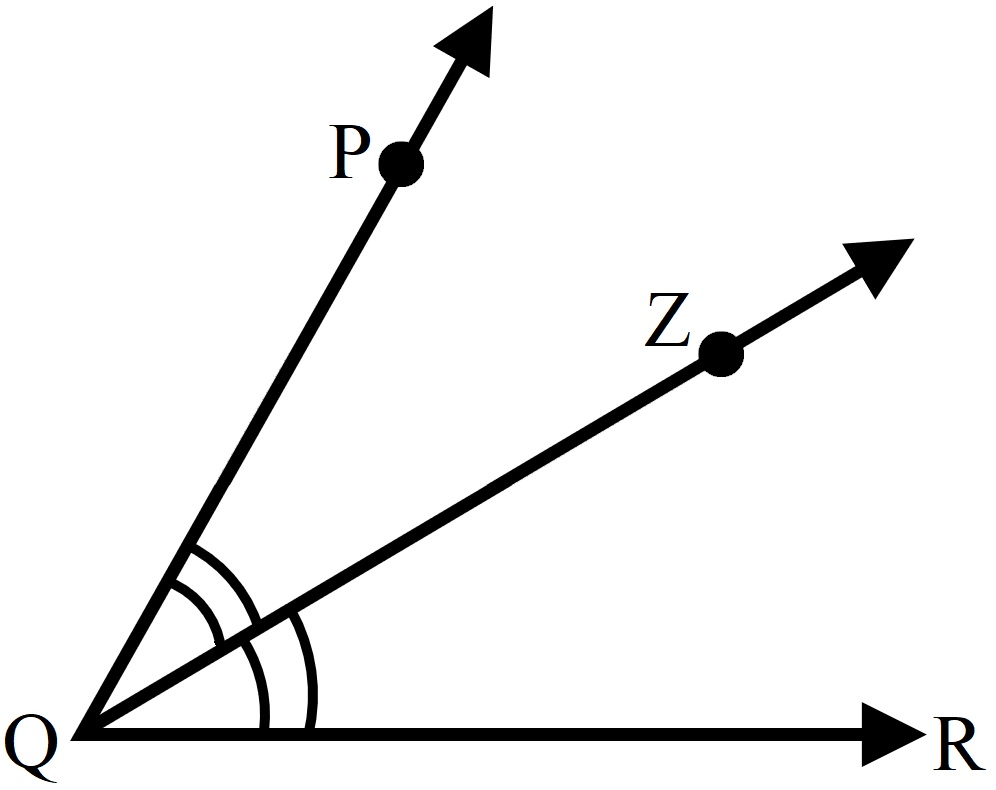
Thus. $\angle{\text{PQZ}}=\angle{\text{ZQR}}=\frac{1}{2}\angle{\text{PQR}}$ View full question & answer→MCQ 1371 Mark
The number of triangles in Fig. is:
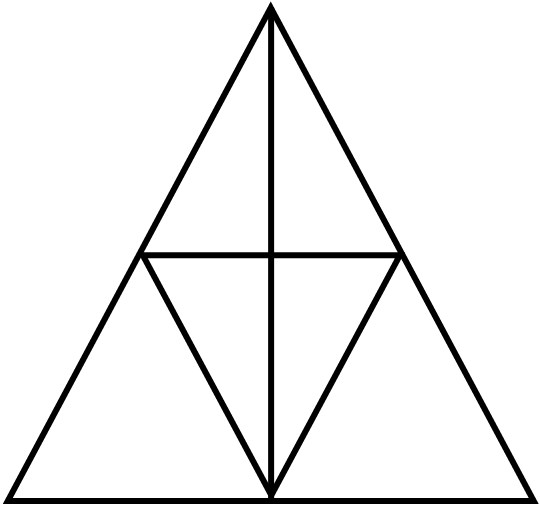
AnswerBy observing the figure, we can say that, number of triangles is $13$.
View full question & answer→MCQ 1381 Mark
The steps to construct a line perpendicular to $XY$ and passing through $P$ is given in random order :
$1.$ Move the set square along $XY$ so the other short side touches Point $P$.
$2.$ Use the edge of the set square to draw a line through Point $P$.
$3.$ Draw a line $XY$ and mark point $P$.
$4.$ Place one short side of the set square on the line $XY$.
Which of the following will be the fourth step:
Answer
$1.$ Draw a line $XY$ and mark a point $P$ on it.
$2.$ Place one short side of the set square on the line $XY$.
$3.$ Move the set square along $XY$ so the other short side touches point $P.$
$4.$ Use the edge of the set square to draw a line through point $P.$
So $2$. is the fourth step.Option $B$ is correct.
View full question & answer→MCQ 1391 Mark
Which of the following is an angle that can be constructed using compasses and a ruler?
- A
$20^\circ $
- B
$80^\circ $
- ✓
$60^\circ $
- D
$110^\circ $
AnswerCorrect option: C. $60^\circ $
$60^\circ $
View full question & answer→MCQ 1401 Mark
Which of the following can be drawn on a piece of paper?
AnswerA line segment can be drawn on a paper.
View full question & answer→MCQ 1411 Mark
To construct a perpendicular to a line $(L)$ from a point $(P)$ outside the line, steps are given in jumbled form. Identify the second step from the following.
$1.$ Draw line $PQ.$
$2.$ Draw a line $L$ and consider point $P$ outside the line.
$3.$ Take $P$ as a center, draw $2$ arcs on line L and name it as points $A$ and $B$ respectively.
$4.$ Taking $A$ and $B$ as a center one by one and keeping the same distance in compass,
draw the arcs on other side of the plane.The point where these arcs intersect name that point as $Q$.
Answer
The correct sequence is:
$a.\ $Draw a line $L$ and consider a point $P$ outside the line.
$b.\ $Take $P$ as center and draw two arcs on line $L$ ans name the points $A$ and $B$ respectively.
$c.\ $Taking $A$ and $B$ as centres one by one and keeping the same distance in compass, draw the arcs on other side of the plane .The point where these arcs intersect name that as $Q$.
$d.\ $Draw line $PQ$ So the second
Option $B$ is correct.
View full question & answer→MCQ 1421 Mark
A perpendicular is drawn to a line segment $\overline{\text{NM}}$ at $N$ using a protractor and a point $P$ is marked on it. Which of the following is true?
- A
$\overline{\text{MP}}\perp\overline{\text{NP}}$
- B
$\overline{\text{MN}}\perp\overline{\text{MP}}$
- C
${\text{M}\perp{P}}$
- ✓
$\overline{\text{NM}}\perp\overline{\text{NP}}$
AnswerCorrect option: D. $\overline{\text{NM}}\perp\overline{\text{NP}}$
View full question & answer→MCQ 1431 Mark
Number of set squares in geometry box is:
MCQ 1441 Mark
Which type of triangle is in the classification based on angles only?
MCQ 1451 Mark
The number of obtuse angles in Fig. is:
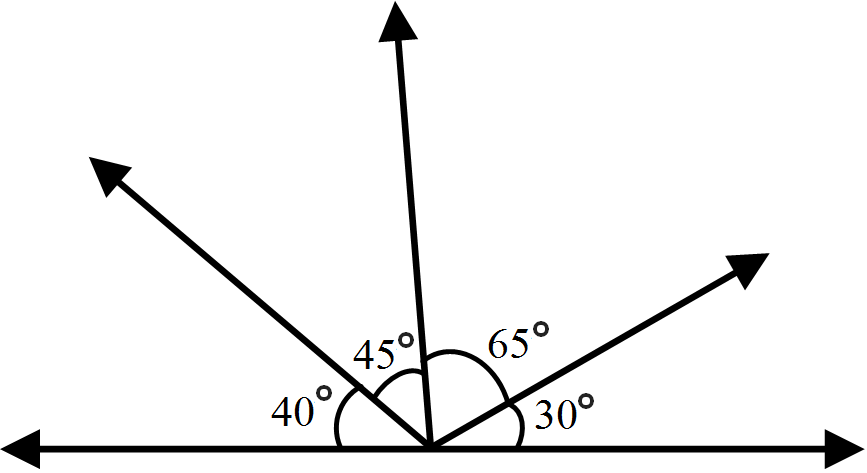
AnswerThere are $4$ obtuse angles.
$1.\ 30^\circ + 65^\circ = 95^\circ $
$2.\ 30^\circ + 65^\circ + 45^\circ = 140^\circ $
$3.\ 65^\circ + 45^\circ = 110^\circ $
$4.\ 65^\circ + 45^\circ + 40^\circ = 150^\circ [$van obtuse angle is more than $90^\circ $ but less than $180^\circ ]$
View full question & answer→MCQ 1461 Mark
The steps to construct a line perpendicular to $XY$ and passing through $P$ is given in random order :
$1.$ Move the set square along $XY$ so the other short side touches Point $P$
$2.$ Use the edge of the set square to draw a line through Point $P$.
$3.$ Draw a line $XY$ and mark point $P$.
$4.$ Place one short side of the set square on the line $XY$.
Which of the following will be the second step:
AnswerDraw a line $XY$ and mark a point $P$ on it.
Place one short side of the set square on the line $XY.$
Move the set square along $XY$ so the other short side touches point $P$.
Use the edge of the set square to draw a line through point $P$.
So $3$. is the first step.Option $C$ is correct.
View full question & answer→MCQ 1471 Mark
If a quadrilateral with two pairs of adjacent sides equal but opposite sides are not equal then it is called.
MCQ 1481 Mark
Identify the instruments used to bisect a given line segment.
MCQ 1491 Mark
An angle of $15^\circ $ is drawn using a pair of compasses and a ruler. How is it done?
- A
Bisecting $60^\circ $ angle.
- B
Bisecting $60^\circ $ and $120^\circ $ angles.
- ✓
Bisecting $60^\circ $ and then bisecting it again.
- D
Bisecting a $60^\circ $ and $180^\circ $ angles.
AnswerCorrect option: C. Bisecting $60^\circ $ and then bisecting it again.
Bisecting $60^\circ $ and then bisecting it again.
View full question & answer→MCQ 1501 Mark
How do you draw a $90^\circ $ angle?
- ✓
By drawing a perpendicular to a line from a point lying on it.
- B
By bisecting a $120^\circ $ angle.
- C
By bisecting a $60^\circ $ angle.
- D
By drawing multiples of $45^\circ $ angle.
AnswerCorrect option: A. By drawing a perpendicular to a line from a point lying on it.
By drawing a perpendicular to a line from a point lying on it.
View full question & answer→MCQ 1511 Mark
A line segment $IP$¯¯¯¯¯¯ is bisected at $T$. Which of the following equals $IT$¯¯¯¯¯¯?
- A
$IP$¯¯¯¯¯¯
- ✓
$TP$¯¯¯¯¯¯¯
- C
$TC$¯¯¯¯¯¯¯
- D
$IQ$¯¯¯¯¯¯¯
AnswerCorrect option: B. $TP$¯¯¯¯¯¯¯
$TP$¯¯¯¯¯¯¯
View full question & answer→MCQ 1521 Mark
Two lines are said to be perpendicular to each other when they meet at ____angle.
- A
$180^\circ $
- ✓
$90^\circ $
- C
$60^\circ $
- D
$360^\circ $
AnswerCorrect option: B. $90^\circ $
$90^\circ $
View full question & answer→MCQ 1531 Mark
If two lines have only one point in common, what are they called?
MCQ 1541 Mark
Identify the one with no definite length.
AnswerCorrect option: A. $AB\leftarrow\rightarrow $
$AB\leftarrow\rightarrow $
View full question & answer→MCQ 1551 Mark
Identify the pair of parallel lines.
- A
$(i)$ and $(ii)$ only
- ✓
$(ii)$ only
- C
$(ii)$ and $(iii)$ only
- D
$(i), (ii)$ and $(iii)$
AnswerCorrect option: B. $(ii)$ only
$(ii)$ only
View full question & answer→MCQ 1561 Mark
$QZ−\rightarrow −$ is the bisector of $\angle PQZ = \angle PQR$. Which of the following is true?
- A
$\angle PQZ = \angle PQR$
- B
$\angle PQZ = \angle ZQR$
- C
$\angle PQZ = 12 \angle ZQR$
- ✓
Both $[b]$ and $[c]$
AnswerCorrect option: D. Both $[b]$ and $[c]$
Both $[b]$ and $[c]$
View full question & answer→MCQ 1571 Mark
Lines $a, b, p, q, m, n$ and $x$ have a point $P$ common to all of them. What is the name of $P$?
View full question & answer→MCQ 1581 Mark
$X$ and $Y$ are two distinct points in a plane. How many lines can be drawn passing through both $X$ and $Y$?
View full question & answer→MCQ 1591 Mark
$XY−\rightarrow −$ bisects $\angle AXB$. If $\angle YXB = 37.5^\circ$, what is the measure of $\angle AXB?$
- A
$37.5^\circ$
- B
$74^\circ $
- C
$64^\circ $
- ✓
$75^\circ $
AnswerCorrect option: D. $75^\circ $
$75^\circ $
View full question & answer→MCQ 1601 Mark
$P$ is the midpoint of $AB$¯¯¯¯¯¯¯¯. $M$ and $N$ are midpoints of $AP$¯¯¯¯¯¯¯¯ respectively. What is the measure of $MN$¯¯¯¯¯¯¯¯¯¯?
- A
$13$ $AB$¯¯¯¯¯¯¯¯
- ✓
$12$ $AB$¯¯¯¯¯¯¯¯
- C
$12$ $AP$¯¯¯¯¯¯¯¯
- D
$32$ $AB$¯¯¯¯¯¯¯¯
AnswerCorrect option: B. $12$ $AB$¯¯¯¯¯¯¯¯
$12$ $AB$¯¯¯¯¯¯¯¯
View full question & answer→MCQ 1611 Mark
Identify the uses of a ruler.
- A
To draw a line segment of a given length
- B
To draw a copy of a given segment.
- C
To draw a diameter of a circle.
- ✓
View full question & answer→MCQ 1621 Mark
$MN−\rightarrow −$ is the perpendicular bisector of $AB\leftarrow\rightarrow $. Which of the given statements is correct?
- A
$(i)$ and $(iii)$ only
- B
$(ii)$ and $(iv)$ only
- ✓
$(i)$ and $(ii)$ only
- D
$(ii)$ and $(iii)$ only
AnswerCorrect option: C. $(i)$ and $(ii)$ only
$(i)$ and $(ii)$ only
View full question & answer→MCQ 1631 Mark
$XY−\rightarrow −$ divides $\angle MXN = 72^\circ $ in the ratio $1 : 2$. What is the measure of $\angle YXN$?
- ✓
$48^\circ $
- B
$24^\circ $
- C
$72^\circ $
- D
$96^\circ $
AnswerCorrect option: A. $48^\circ $
$48^\circ $
View full question & answer→MCQ 1641 Mark
At $7\ a.m.$ the angle between the Sun’s ray and the ground at a point is $43^\circ $. What would be the angle at $10\ a.m.$?
AnswerCorrect option: C. Between $43^\circ $ and $90^\circ $
Between $43^\circ $ and $90^\circ $
View full question & answer→MCQ 1651 Mark
$l\ ||\ m$. $P$ and $Q$ are points on land m respectively such that $PQ ⊥ lR$ is a point on $a$ line $n$ in the same plane such that $PQ$¯¯¯¯¯¯¯¯ $= QR$¯¯¯¯¯¯¯¯. Which of the following is true?
- A
$l\ ||\ n$
- B
$m\ ||\ n$
- ✓
Both $[a]$ and $[b]$
- D
Neither $[a]$ nor $[b]$
AnswerCorrect option: C. Both $[a]$ and $[b]$
Both $[a]$ and $[b]$
View full question & answer→MCQ 1661 Mark
Which of the following can be drawn on a piece of paper?
MCQ 1671 Mark
A line segment $TP−\rightarrow −$ is bisected at I. What is the measure of $TI−\rightarrow $?
- A
$12TP−\rightarrow −$
- ✓
$IP−\rightarrow $
- C
$TP−\rightarrow −$
- D
$ 13 TP−\rightarrow −$
AnswerCorrect option: B. $IP−\rightarrow $
$IP−\rightarrow $
View full question & answer→