Questions

3 Marks Question

Take a timed test

13 questions · self-marked practice — reveal the answer and mark yourself.

Question 13 Marks
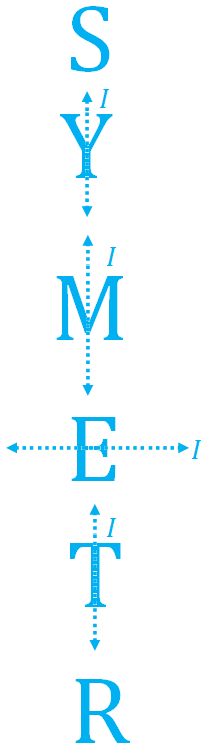
Write the number of lines of symmetry in each letter of the word $‘SYMMETRY’.$
Answer
The given word is '$SYMMETRY'$. The letter $S$ has one line of symmetry. The letter $Y$ hase one line of symmetry. The letter $M$ hase one line of symmetry. The letter $E$ hase one line of symmetry. The letter $T$ hase one line of symmetry. The letter $R$ hase one line of symmetry.
View full question & answer
Question 23 Marks
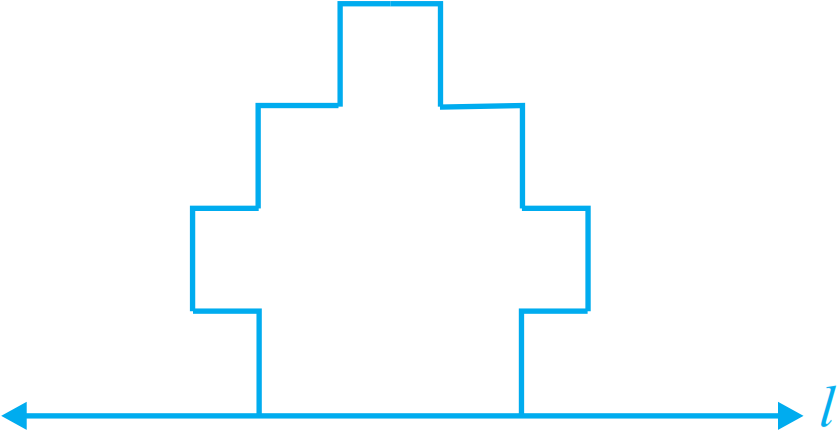
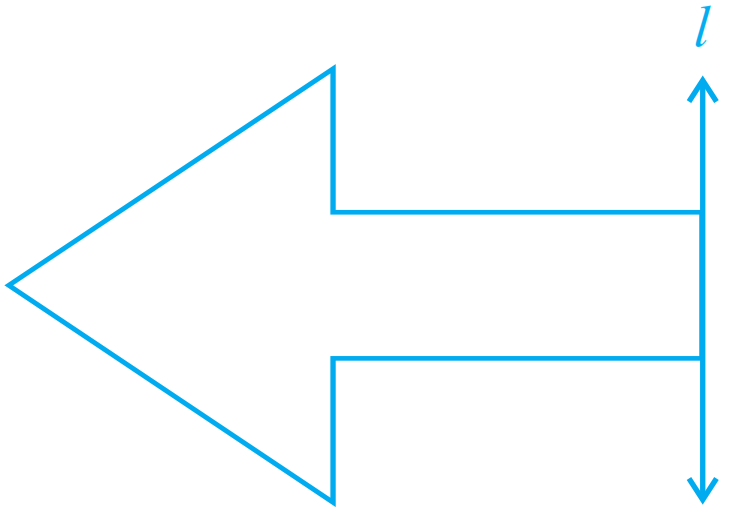
Complete the figure so that line l becomes the line of symmetry of the whole figure.
Answer
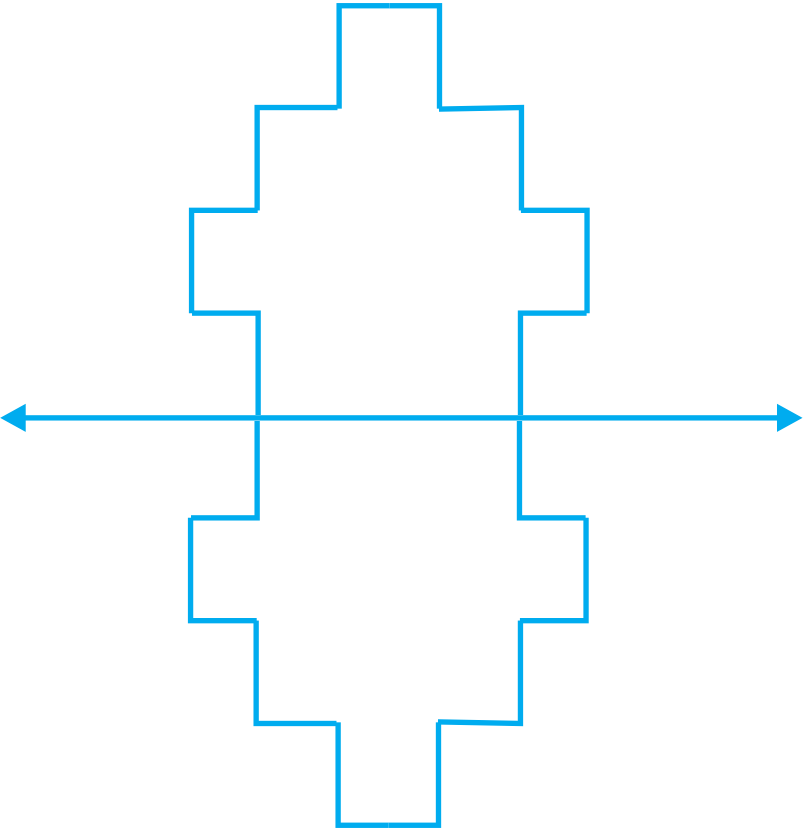
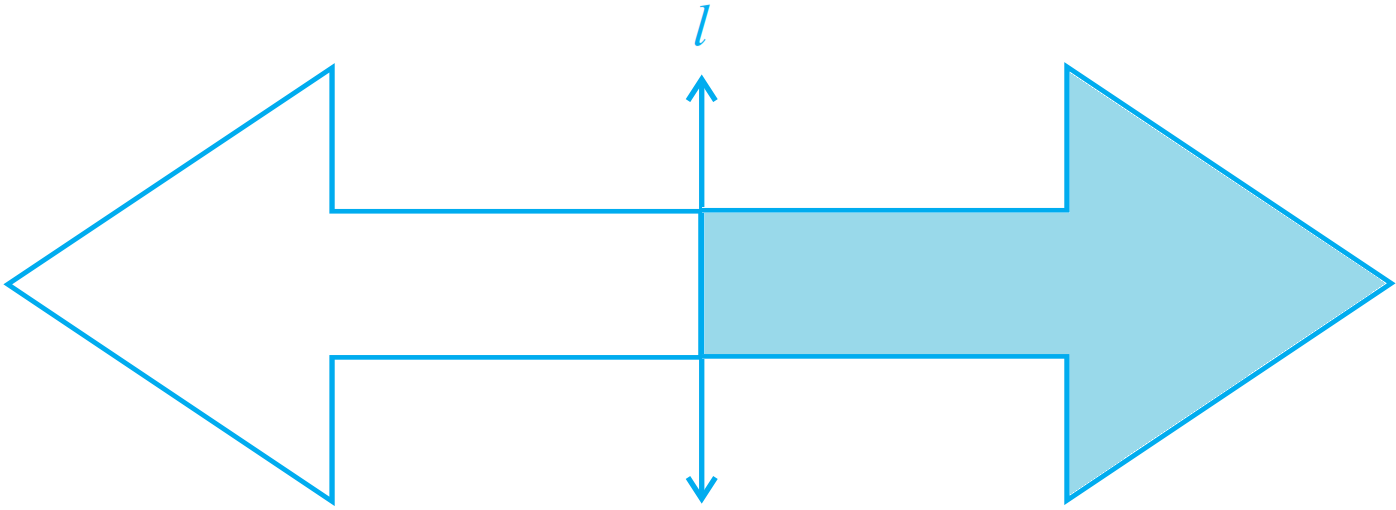
As we know that, a line of symmetry divides a figure into two parts, such that when the figure is folded about the line, the two parts of the figure coincide. The complete figure is shown below.
View full question & answer
Question 33 Marks
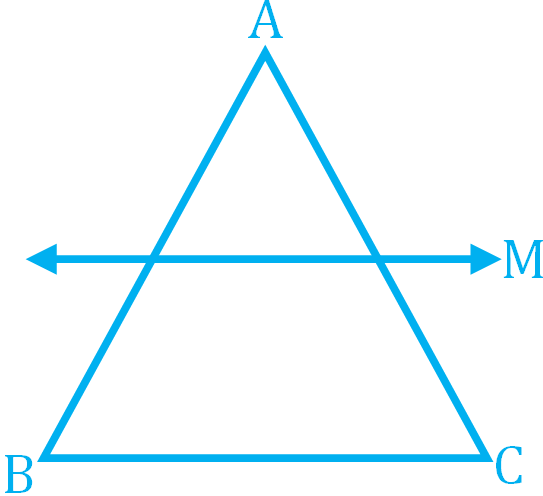
Draw the images of the points $A, B$ and $C$ in the line m figure. Name them as $A', B'$ and $C',$ respectively and join them in pairs. Measure $AB, BC, CA, A'B', B'C'$ and $C'A'.$
Is $AB = A'B', BC = B'C'$ and $CA = C'A'?$
Answer
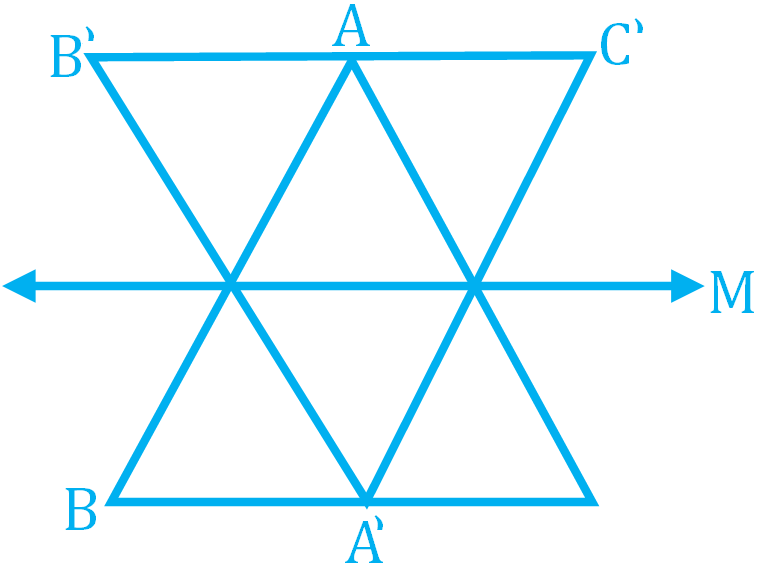
The images of the points $A, B$ and $C$ in the line m are $A’, B’$ and $C’$ respectively as shown below.

It is clear that, $AB = A’B’, BC = B’C’$ and $CA = C’A’.$
View full question & answer
Question 43 Marks
Complete figure by taking l as the line of symmetry of the whole figure.
Answer
As we know that, a line of symmetry divides a figure into two parts, such that when the figure is folded about the line, the two parts of the figure coincide.$\therefore$ The complete figure is as shown below.
View full question & answer
Question 53 Marks
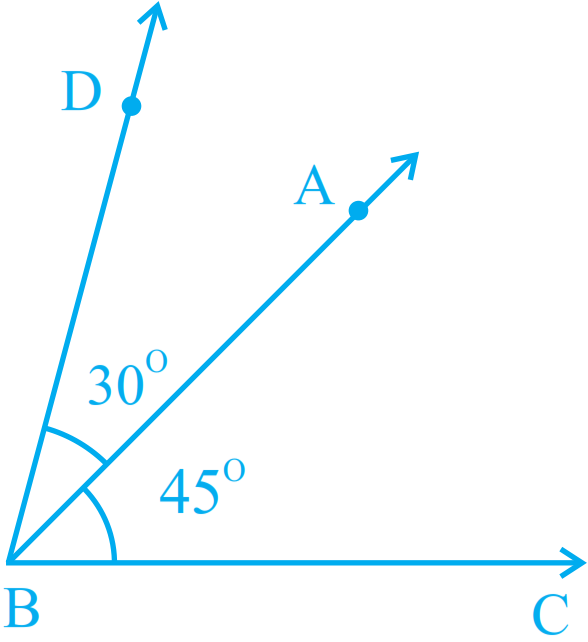
Draw an angle $ABC$ of measure $45^\circ$, using ruler and compasses. Now draw an angle $DBA$ of measure $30^\circ$, using ruler and compasses as shown in Figure. What is the measure of $\angle\text{DBC}?$
Answer
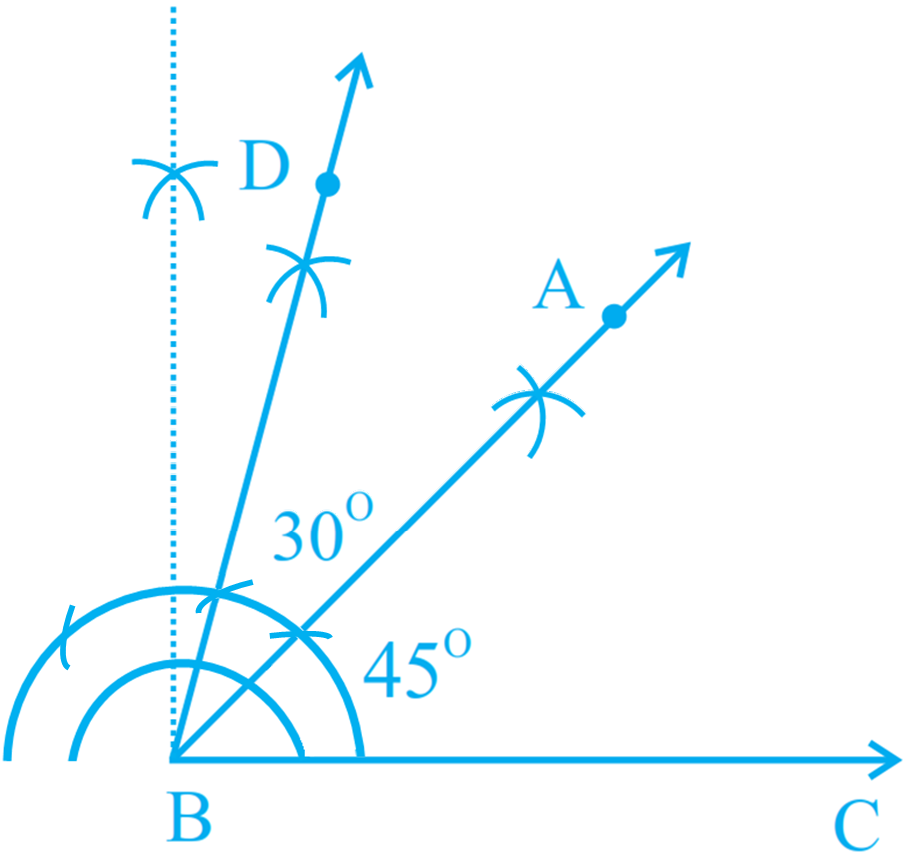
To draw an angle, we use following steps of construction:
Step I: Draw a line segment $BC$ of any length.

Step II: Place the compass pointer at $B$ and draw a right angle $(90^\circ )$.
Step III: Draw the angle bisector of the right angle, such that $\angle\text{ABC}= \frac12(90^\circ)=45^\circ.$
Step IV: Place the compass pointer at $B$ and draw an angle of $30^\circ $ on the base $\text{BA} (\angle\text{DBA).}$
Step V: By the help of protractor, we get $\angle\text{DBC} =75^\circ.$
View full question & answer
Question 63 Marks
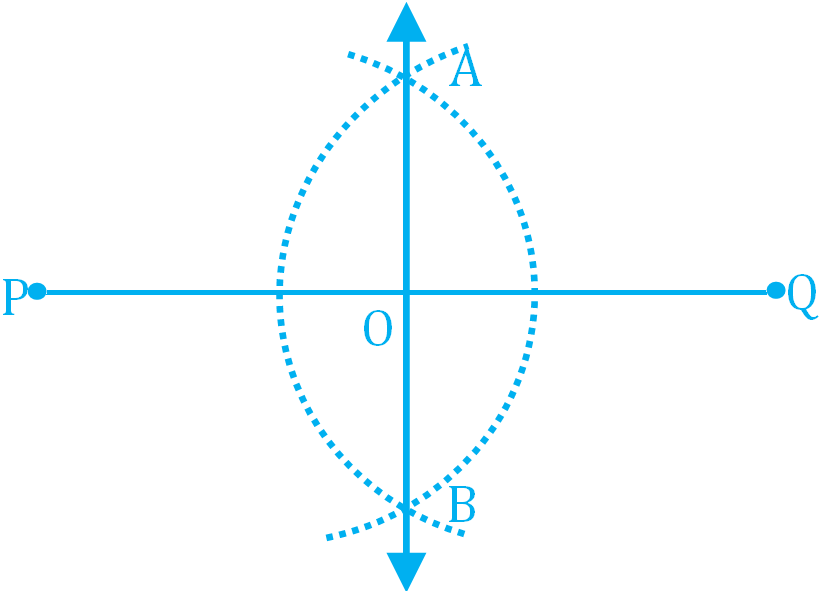
Draw a line segment of length $6\ cm$. Construct its perpendicular bisector. Measure the two parts of theline segment.
Answer
Steps of construction are as follows:
Step I: Draw a line segment $PQ = 6\ cm.$

Step II: With $P$ as centre and a convenient radius (more than $\frac12$ $PQ$), draw an arc.
Step III: With $O$ as centre and same radius, draw another arc, such that it intersects the previous arc at $A$ and $B$.

Step IV: Join $A$ and $B.$
Thus, $AB$ is perpendicular bisector of $PQ$ i.e. $\text{OP} = \text{OQ} =\frac12\times\text{PQ} =\frac12\times 6=3 \text{cm}.$
View full question & answer
Question 73 Marks
Write the letters of the word $‘MATHEMATICS’$ which have no line of symmetry.
Answer
The given word is $'MATHEMATICS'$. The letter $M$ has one line of symmetry. The letter $A$ hase one line of symmetry. The letter $T$ hase one line of symmetry. The letter $H$ hase one line of symmetry. The letter $E$ hase one line of symmetry. The letter I hase one line of symmetry. The letter $C$ hase one line of symmetry. And the letter $S$ hase one line of symmetry. Hence, only letter $'S'$ in word $'MATHEMATICS'$ has no line of symmetry.


View full question & answer
Question 83 Marks
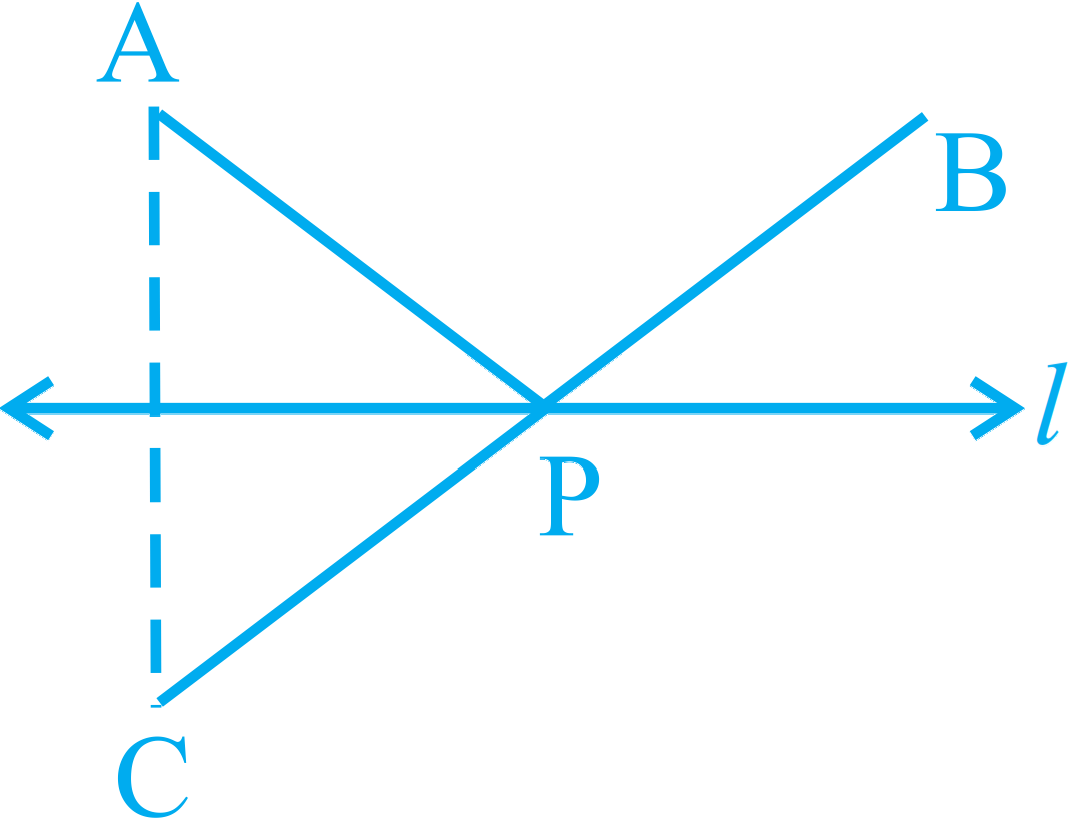
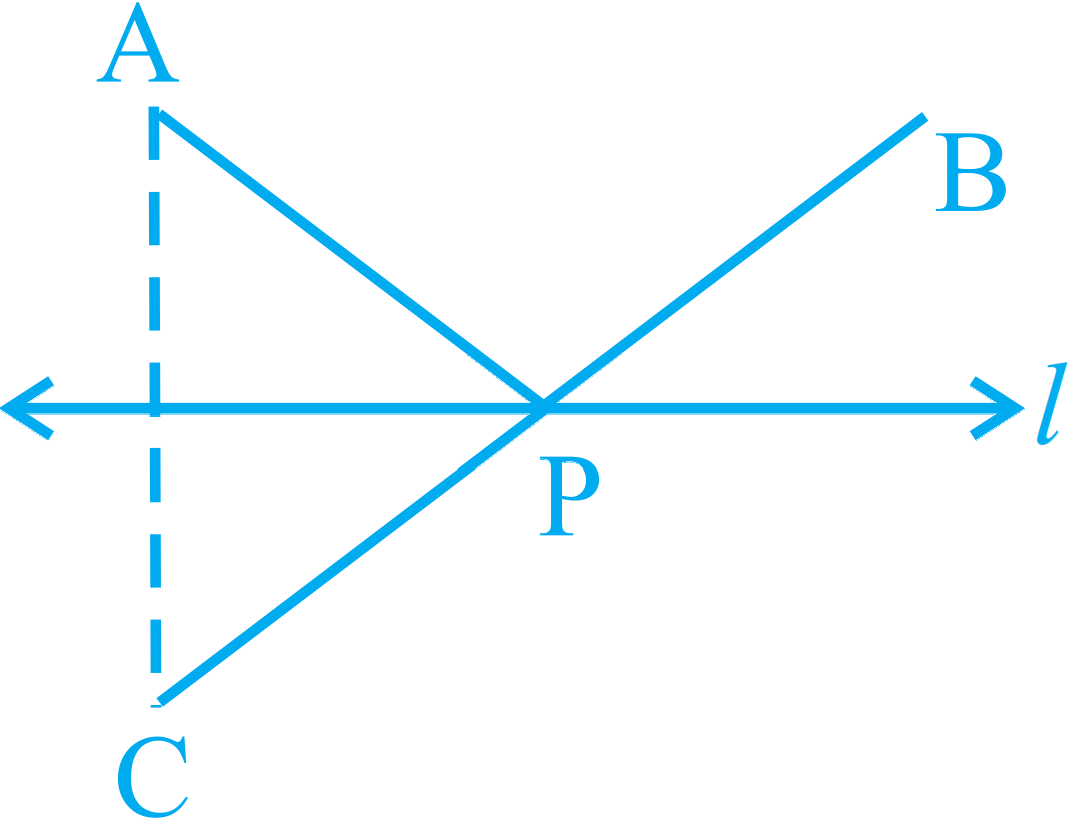
In Figure, the point $C$ is the image of point $A$ in line $l$ and line segment $BC$ intersects the line $l$ at $P.$
$a.\ $Is the image of $P$ in line $l$ the point $P$ itself?
$b.\ $Is $PA = PC?$
$c.\ $Is $\text{PA + PB = PC + PB?}$
$d.\ $Is $P$ that point on line l from which the sum of the distances of points $A$ and $B$ is minimum?
Answer
Given, in figure, the image of the point $A$ is $C$, in the line $l$.

$a.\ $Yes, the image of P in line l is the point it self.
$b.\ $Yes, $PA = PC.$
$c.\ $Yes, $PA + PB = PC + PB$ because the distance, $PA = PC.$
$d.\ $Yes, from the point $P$ in the line $l$, the sum of the distances of points $A$ and $B$ is minimum.
View full question & answer
Question 93 Marks
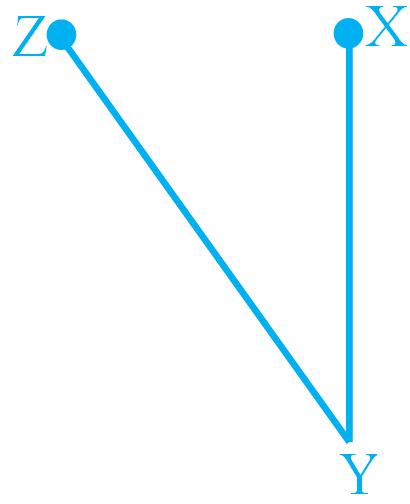
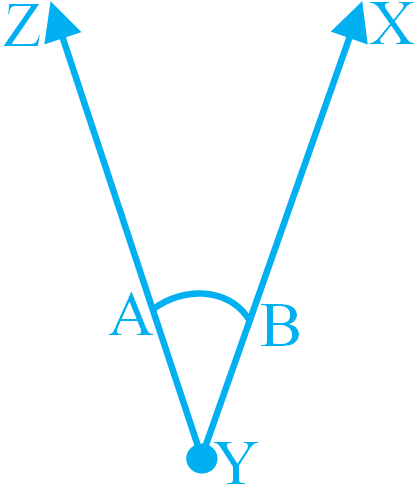
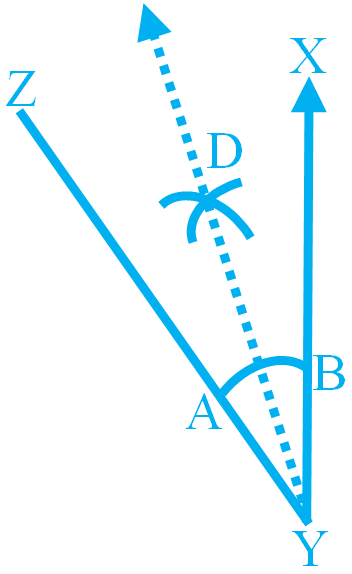
Bisect $\angle\text{XYZ}$ of Figure.
Answer
Steps of construction are as follows:
Step I: With $Y$ as a centre and using compass, draw an arc that cuts both rays of $\angle\text{Y.}$ Label point of intersection as $A$ and $8$.

Step II: With $A$ as centre, draw $($in the interior of $\angle\text{Y})$ an arc, whose radius is more than half the length $AB.$
Step III: With $B$ as centre and the same radius draw another arc in the interior of $\angle\text{Y.}$ Let the two arcs intersect at $D$. Join $YD$ Then, $YD$ is the required bisector of $\angle\text{XYZ.}$
View full question & answer
Question 103 Marks
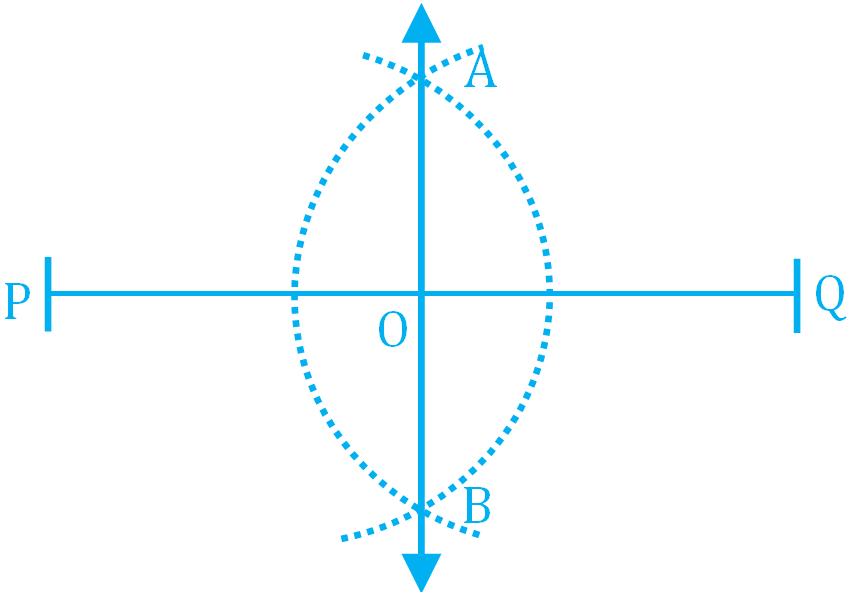
Draw a line segment of length $7\ cm$. Draw its perpendicular bisector, using ruler and compasses.
Answer
Steps of construction are as follows:
Step I: Draw a line segment, $PQ = 7\ cm.$ 

Step II: With $P$ as centre and a convenient radius $($more than $\frac12\text{PQ})$, draw arc.
Step III: With $Q$ as centre and same radius, draw another arc, such that it intersects the previous arc at $A$ and $B$.
Step IV: Join $A$ and $B$. Thus, AB is perpendicular bisector of $PQ$ i.e. $OP = OQ = 3.5\ cm$.
View full question & answer
Question 113 Marks
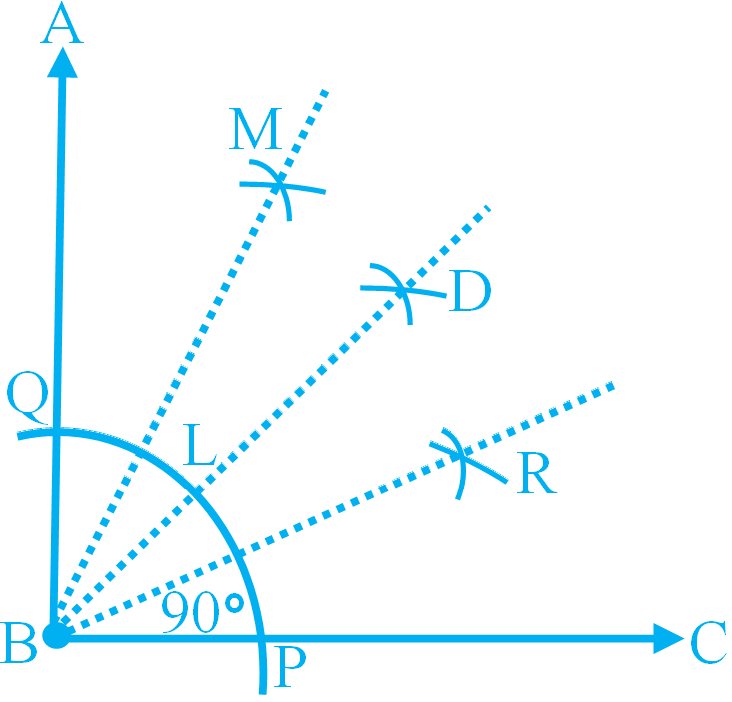
Bisect a right angle, using ruler and compasses. Measure each part. Bisect each of these parts. What will be the measure of each of these parts?
Answer
Steps of construction are as follows:
Step I: Construct an angle, $\angle\text{ABC}= 90^\circ$
Step II: With $B$ as centre, using compass, draw an arc which cuts both rays of $\angle\text{B}$ at $P$ and $Q.$
Step III: With $P$ as centre, draw $($in the interior of $\angle\text{B})$ an arc, whose radius is more than half of $PQ.$
Step IV: With $Q$ as centre and the same radius, draw another arc in the interior of $\angle\text{B}.$ Let the two arcs intersect at $D.$ Join $BD$, cutting arc $PQ$ at $L$. Then, $BD$ divides the $\angle\text{ABC}$ into two equal parts.
​​​​​​​Step V: Now, taking $P$ and $L$ as centre having radius more than half of $PL$, draw two arcs respectively, which cut each other at $R.$
View full question & answer
Question 123 Marks
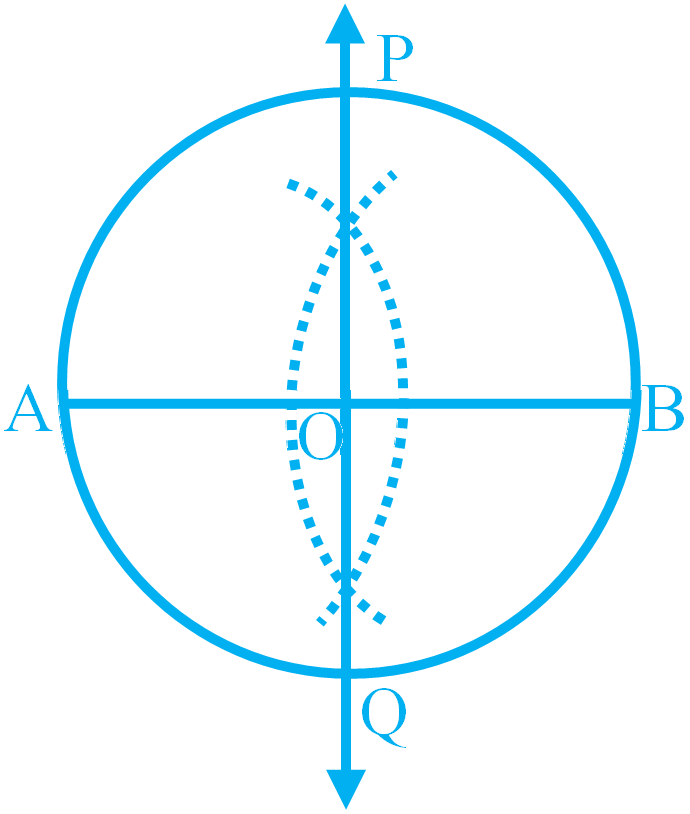
Draw a circle of radius $6\ cm$ using ruler and compasses. Draw one of its diameters. Draw the perpendicular bisector of this diameter. Does this perpendicular bisector contain another diameter of the circle?
Answer
Steps of construction are as follows:
Step I: Open the compass for the required radius $6\ cm$ by putting the pointer on $0$ and open the pencil upto 6cm.
Step II: Place the pointer of the compass at $O$.
Step III: Turn the compass slowly to draw the circle.
Step IV: Draw a diameter $AS.$
Step V: Draw the perpendicular bisector of $AS$, which intersect $AS$ at $0$.
 
Clearly, the perpendicular bisector of $AS$, i.e. $PQ$ is another diameter of the circle. Yes, the perpendicular bisector of $AS$ contain another diameter of the circle.
View full question & answer
Question 133 Marks
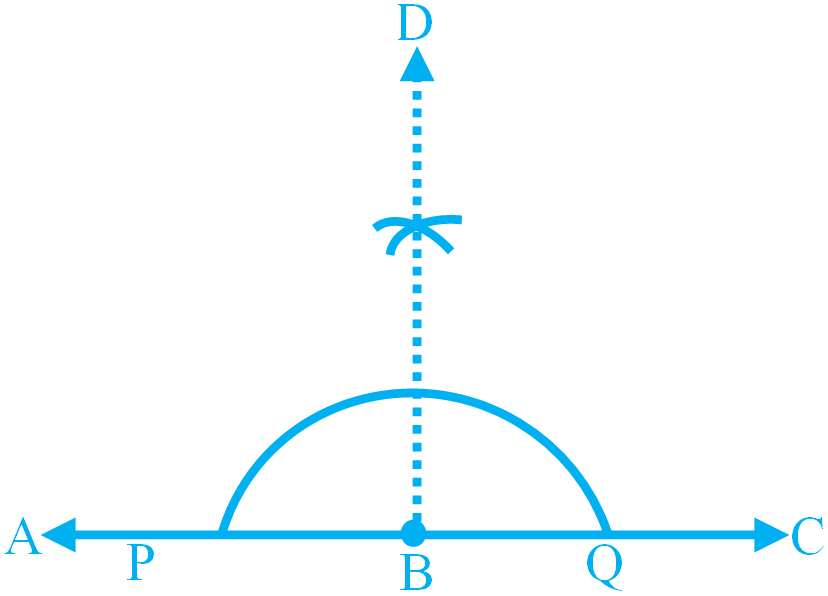
Bisect a straight angle, using ruler and compasses. Measure each part.
Answer
Steps of construction are as follows:
Step I: Draw an angle $\angle\text{ABC}=180^\circ.$
Step II: With $S$ as a centre and using compass, draw an arc which cuts both rays of $\angle\text{B.}$ Label point of intersection as $P$ and $Q$.
Step III: With $P$ as centre, draw an arc whose radius is more than half the length $PQ.$
Step IV: With $Q$ as centre and the same radius draw another arc. Let the two arcs intersect at $D.$
Then, $BD$ is the required bisector of $\angle\text{B.}$
Thus, the required angles are $\angle\text{ABD}$ and $\angle\text{CBD.}$
On measuring, $\angle\text{ABD}=\angle\text{CBD}=90^\circ$
View full question & answer