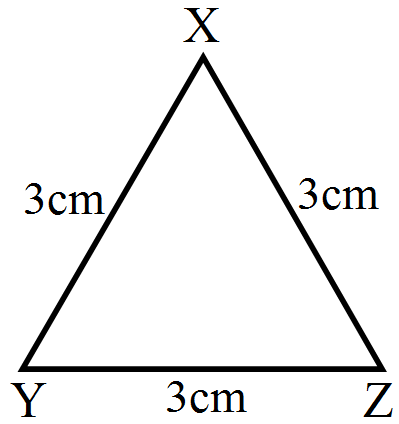
In the given figure some triangles have been given. State for each triangle whether it is scalene, isosceles or equilateral.
Answer
Equilateral $XY = YZ = ZX = 3\ cm$ Equilateral Triangle: A triangle whose all three sides are equal in length and each of the three angles measures $60^\circ .$ Isosceles Triangle: A triangle whose two sides are equal in length and the angles opposite them are equal to each other. Scalene Triangle: A triangle whose all three sides and angles are unequal in measure.
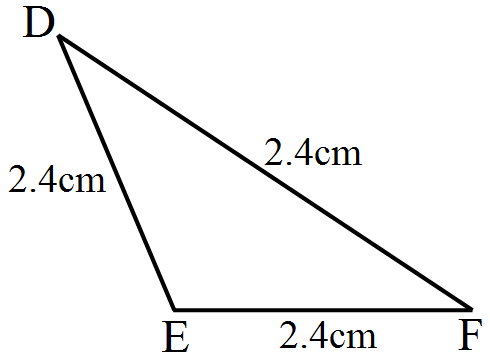
In the given figure some triangles have been given. State for each triangle whether it is scalene, isosceles or equilateral.
Answer
Isosceles
$DE = EF = 2.4\ cm$ Equilateral Triangle: A triangle whose all three sides are equal in length and each of the three angles measures $60^\circ .$ Isosceles Triangle: A triangle whose two sides are equal in length and the angles opposite them are equal to each other. Scalene Triangle: A triangle whose all three sides and angles are unequal in measure.
In the given figure some triangles have been given. State for each triangle whether it is scalene, isosceles or equilateral.
Answer
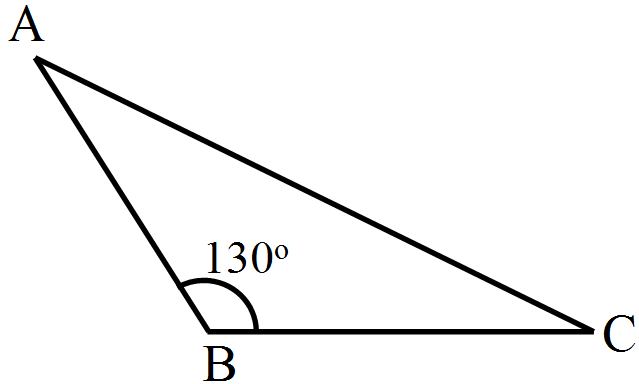
Scalene
All the sides are unequal. Equilateral Triangle: A triangle whose all three sides are equal in length and each of the three angles measures $60^\circ .$ Isosceles Triangle: A triangle whose two sides are equal in length and the angles opposite them are equal to each other. Scalene Triangle: A triangle whose all three sides and angles are unequal in measure.
In the given figure some triangles have been given. State for each triangle whether it is scalene, isosceles or equilateral.
Answer
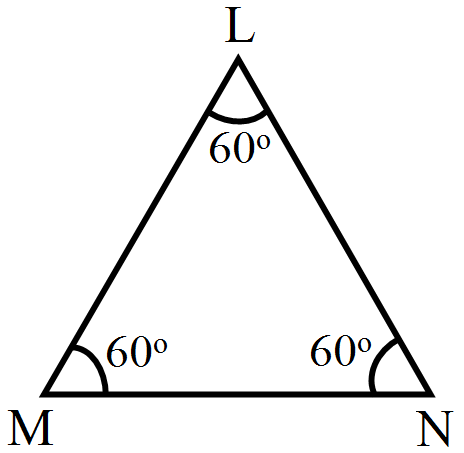
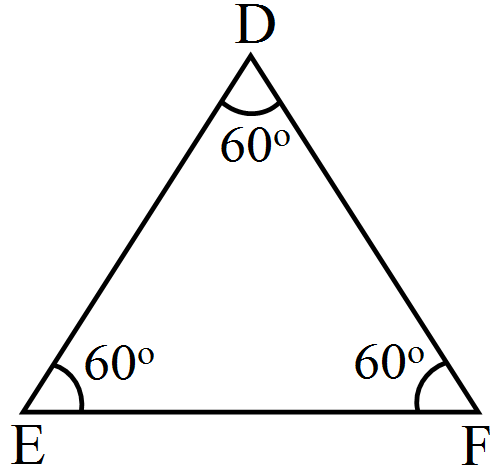
Equilateral
All three angles are $60^\circ .$ Equilateral Triangle: A triangle whose all three sides are equal in length and each of the three angles measures $60^\circ .$ Isosceles Triangle: A triangle whose two sides are equal in length and the angles opposite them are equal to each other. Scalene Triangle: A triangle whose all three sides and angles are unequal in measure.
Can a triangle have: Each angles less than $60^\circ $?
Answer
No. For example:
Let the two angles be $50^\circ $ and $40^\circ $, which on adding, gives $90^\circ .$
Thus, they cannot form a triangle whose third angle is $180^\circ - 90^\circ = 90^\circ ,$ which is greater than $60^\circ .$
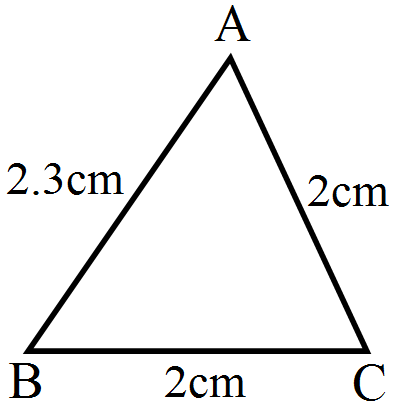
In the given figure some triangles have been given. State for each triangle whether it is scalene, isosceles or equilateral.
Answer
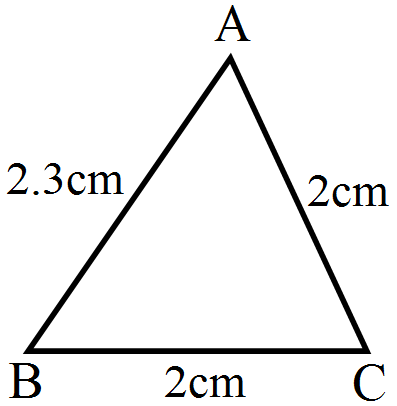
Isosceles $AC = CB = 2\ cm$ Equilateral Triangle: A triangle whose all three sides are equal in length and each of the three angles measures $60^\circ .$ Isosceles Triangle: A triangle whose two sides are equal in length and the angles opposite them are equal to each other. Scalene Triangle: A triangle whose all three sides and angles are unequal in measure.
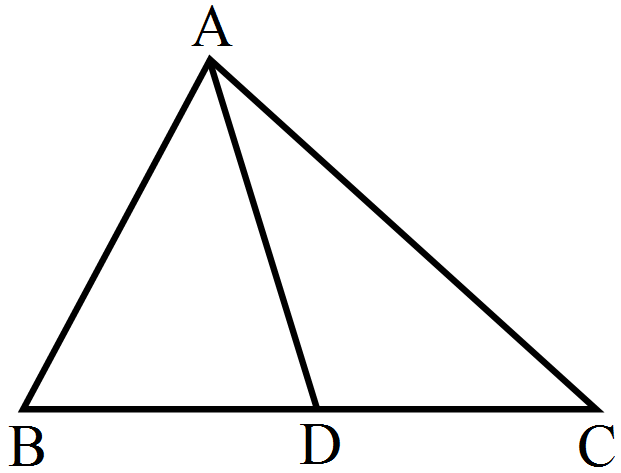
Draw a $\triangle\text{ABC}$. Take a point $D$ on $BC$. Join $AD$. How many triangles do you get? Name them.
Answer
In $\triangle\text{ABC},$ D is a point on $BC$ and $AD$ is joined.
Now we get triangles $\triangle\text{ABC},$ $\triangle\text{ABD}$ and $\triangle\text{ADC}.$
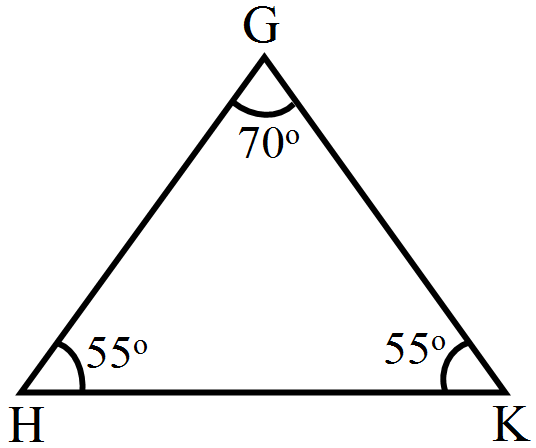
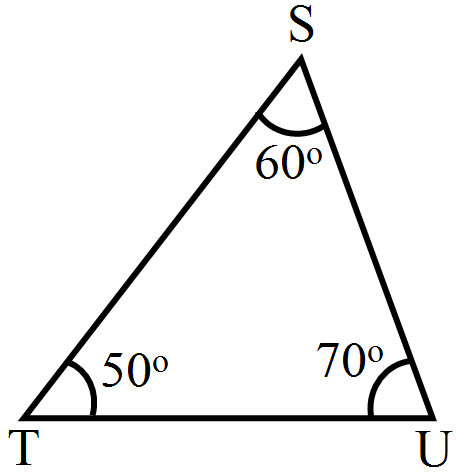
In the given figure some triangles have been given. State for each triangle whether it is scalene, isosceles or equilateral.
Answer
Scalene All the angles are unequal. Equilateral Triangle: A triangle whose all three sides are equal in length and each of the three angles measures $60^\circ .$ Isosceles Triangle: A triangle whose two sides are equal in length and the angles opposite them are equal to each other. Scalene Triangle: A triangle whose all three sides and angles are unequal in measure.
Can a triangle have: Each angles more than $60^\circ $?
Answer
No. For example:
Let the two angles be $70^\circ $ and $80^\circ $, which on adding, gives $150^\circ .$
They cannot form a triangle whose third angle is $180^\circ - 150^\circ = 30^\circ ,$ which is less than $60^\circ .$
Yes. For example:
Let the two angles be $50^\circ $ and $60^\circ $, which on adding, gives $110^\circ $.
They can easily form a triangle whose third angle is $180^\circ - 110^\circ = 70^\circ .$