Question 12 Marks
A figure is said to be regular, if its sides are equal in length and angles are equal in measure. Can you identify the regular quadrilateral?
AnswerA square is a 'regular' quadrilateral.
View full question & answer→Question 22 Marks
Give reason for square is also a parallelogram.
AnswerIn a parallelogram opposite sides are equal and parallel and in a square opposite side are equal and all the sides have same length. So, yes a square is a special parallelogram.
View full question & answer→Question 32 Marks
Give reason for squares, rectangles, parallelograms are all quadrilaterals.
AnswerSquares, rectangles, parallelograms are all quadrilaterals because all of them have four line segments and all are closed figures.
View full question & answer→Question 42 Marks
Give reason for a square can be thought of as a special rhombus.
AnswerAll side of a rhombus are equal and a square also has all of its sides equals to each other with all the interior angles of $90^{\circ}$. A rhombus with each angle a right angle becomes a square. So, a square can be thought of as a special rhombus.
View full question & answer→Question 52 Marks
Give reason that a rectangle can be thought of as a special parallelogram.
AnswerA rectangle has all its angles of $90^{\circ}$ and opposite sides are equals and parallel to each other. A parallelogram also has opposite sides equal and parallel to each other. So we can say that a parallelogram with all of its angles as right angles becomes a rectangle and this rectangle can be thought of as a special parallelogram.
View full question & answer→Question 62 Marks
Give reason for a square can be thought of as a special rectangle.
AnswerYes, a square is a special rectangle, as a rectangle has its all angle of $90^\circ$ and opposite sides are equals to each other. In the case of a square, all the angles are also $90^\circ$ and it has all the sides equals to each other. So, it is a special rectangle.
View full question & answer→Question 72 Marks
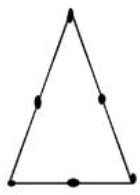
Try to construct triangle using $6$ match sticks. Some are shown here.
Name the type of triangle in given case. If you cannot make a triangle, think of reasons for it.
AnswerWith the help of $6$ matchsticks we can form a triangle as shown in figure below.
View full question & answer→Question 82 Marks
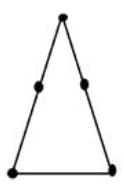
Try to construct triangle using $5$ match sticks. Some are shown here.
Name the type of triangle in given case. If you cannot make a triangle, think of reasons for it.
AnswerYes, we can form a triangle by using $5$ matchsticks as shown in figure below.
View full question & answer→Question 92 Marks
Try to construct triangle using $4$ match sticks. Some are shown here.
Name the type of triangle in given case. If you cannot make a triangle, think of reasons for it.
AnswerBy using $4$ matchsticks it is not possible to make a triangle as in a triangle, sum of the two sides is greater than the length of the remaining side.
View full question & answer→Question 102 Marks
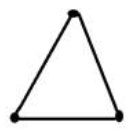
Try to construct triangle using $3$ match sticks. Some are shown here.
Name the type of triangle in given case. If you cannot make a triangle, think of reasons for it.
AnswerClearly, we can make a triangle by using $3$ matchsticks. According to the property of a triangle, the sum of two sides is greater than the length of the remaining side. It is an equilateral triangle as it has all equal sides.
View full question & answer→Question 112 Marks
Name triangle in two different ways: (you may judge the nature of the angle by observation)
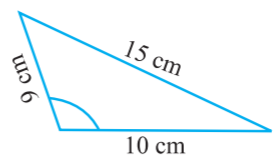
AnswerIt is an Obtuse-angled and scalene triangle.
As we can see one angle is greater than $90^\circ$ and three unequal sides and according to the property of triangles only scalene triangle has this property.
View full question & answer→Question 122 Marks
Name triangle in two different ways: (you may judge the nature of the angle by observation)
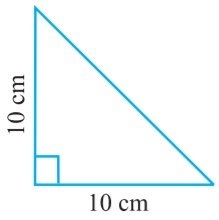
AnswerIt is a Right-angled and isosceles triangle. As it has one angle of $90^\circ$ and two equal sides which is the property of an isosceles triangle.
View full question & answer→Question 132 Marks
Name triangle in two different ways: (you may judge the nature of the angle by observation)
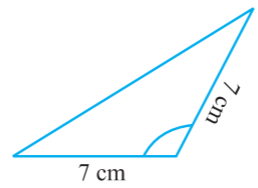
AnswerIt is an Obtuse-angled and isosceles triangle. Since we can see one angle is greater than $90^\circ$ and it has two equal sides which are the property of the isosceles triangle.
View full question & answer→Question 142 Marks
Name triangle in two different ways: (you may judge the nature of the angle by observation)
AnswerIt is a Right-angled scalene triangle. Since the triangle has one right angle and three unequal sides and these are the property of right-angled and scalene triangle.
View full question & answer→Question 152 Marks
Name the type of triangle: $\triangle LMN$ with $\angle L = 30^\circ , \angle M = 70^\circ $ and $\angle N = 80^\circ $.
Answer$\triangle LMN$ is an acute angle as it has all angles less than $90^\circ$ and according to property of acute angles it is a triangle with all three angles as acute (less than $90^\circ$).
View full question & answer→Question 162 Marks
Name the type of triangle: $\triangle PQR$ such that $PQ = QR = PR = 5 \ cm.$
Answer$\triangle PQR$ is equilateral triangle as all sides of triangle are equal and according to the property of equilateral triangle has all equal sides.
View full question & answer→Question 172 Marks
Study the diagram. The line l is perpendicular to line m, Is $BC < EH?$
AnswerYes, $BC < EH$
Because, length of $BC = 1$ units
Length of $EH = 3$ units
View full question & answer→Question 182 Marks
Study the diagram. The line l is perpendicular to line $m$ Is $CD = GH?$
AnswerYes, $CD = GH$
Since both are of the same length viz. $1$ unit
View full question & answer→Question 192 Marks
Study the diagram. The line l is perpendicular to line m, Is $AC > FG?$
AnswerYes, $AC > FG$ is True
As length of $AC = 2$ units
Length of $FG = 1$ units
View full question & answer→Question 202 Marks
Study the diagram. The line l is perpendicular to line m identify any two line segments for which $PE$ is the perpendicular bisector.
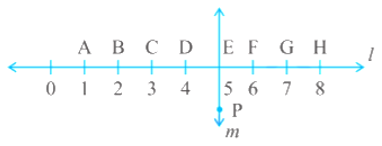
AnswerThe two line segments can be taken as $BH$ and $CG.$
View full question & answer→Question 212 Marks
Study the diagram. The line $l$ is perpendicular to line m does $PE$ bisect $CG?$
AnswerYes, $PE$ bisect $CG$ as $E$ is the mid-point of $CG$ and $PE$ divides the line segment into two equal parts which is $CE = EG$
View full question & answer→Question 222 Marks
Study the diagram. The line l is perpendicular to line $m$ is $CE = EG?$
AnswerYes, $CE = EG$ as both have same distance of $2$ units from the point of intersection.
View full question & answer→Question 232 Marks
There are two set-squares in your box. What are the measure of the angles that are formed at their corners? Do they have any angle measure that is common?
AnswerOne is a $30^\circ - 60^\circ - 90^\circ $ set square; the other is a $45^\circ - 45^\circ - 90^\circ $ set square.
The angle of measure $90^\circ $ (i.e. a right angle) is common between them.
View full question & answer→Question 242 Marks
Let $\overline{\mathrm{PQ}}$ be the perpendicular to the line segment $\overline{X Y}$ . Let $\vec{P Q}$ and $\overline{X Y}$ intersect in the point $A.$ What is the measure of $\angle PAY?$
AnswerThe measure of $\angle PAY$ is $90^\circ$.
View full question & answer→Question 252 Marks
Which of the following are models for perpendicular lines :
$a.\ $The adjacent edges of a table top.
$b.\ $The lines of a railway track.
$c.\ $The line segments forming the letter $"L".$
$d.\ $The letter $V.$
Answer$(a)$ and $(c)$ are models for perpendicular lines.
View full question & answer→Question 262 Marks
From these two angles which has larger measure? Estimate and then confirm by the measuring them.
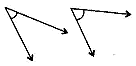
AnswerMeasure of first angle $= 45^\circ $
Measure of second angle $= 60^\circ .$
The second angle has larger measure.
View full question & answer→Question 272 Marks
Which angle has a large measure? First estimate and then measure.
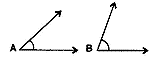
Measure of Angle $A,$ Measure of Angle $B.$ AnswerMeasure of Angle $A = 40^\circ .$
Measure of Angle $B = 65^\circ .$
The angle $B$ has a larger measure.
View full question & answer→Question 282 Marks
Where will the hour hand of a clock stop if it starts from $7$ and turns through $2$ straight angles$?$
AnswerAs we know one complete revolution is $360^\circ $ which is consists of $4$ right angles. By looking at the clock we can say that if the hour hand of the clock starts from $7$ and make $2$ straight angles then it will surely stop at $7.$
View full question & answer→Question 292 Marks
Where will the hour hand of a clock stop if it start from $10$ and turns through $3$ right angles$?$
AnswerAs we know one complete revolution is of $360^\circ $ which consists of $4$ right angles.
By looking at the clock we can say that if the hour hand of the clock start from $10$ and make $3$ right angles then it will stop at $7.$
View full question & answer→Question 302 Marks
Where will the hour hand of a clock stop if it start from $8$ and turns through $2$ right angles$?$
AnswerAs we know one complete revolution is of $360^\circ $ which consists of $4$ right angles.
By looking at the clock we can say that If the hour hand of the clock start from $8$ and make $2$ right angles then it will stop at $2.$
View full question & answer→Question 312 Marks
Where will the hour hand of a clock stop if it starts from $6$ and turns through $1$ right angle$?$
AnswerAs we know that one complete revolution is of $360^\circ $ which consists of $4$ right angles. By looking at the clock we can say that If the hour hand of the clock start from $6$ and make $1$ right angle then it will stop at $9.$
View full question & answer→Question 322 Marks
Find the number of right angles turned through by the hour hand of a clock when it goes from $12$ to $6.$
AnswerWe know that clock hand makes an angle of $360^\circ $ in on complete round which is also made of $4$ right angles. When a clock hand goes from $12$ to $6,$ it makes $2$ right angles as it covers half of the complete revolution which is of $180^\circ .$
View full question & answer→Question 332 Marks
Find the number of right angle turned through by the hour hand of a clock when it goes from $12$ to $9.$
AnswerWe know that clock hand makes an angle of $360^\circ $ in one complete round which is also made of $4$ right angles. When a clock hand moves from $12$ to $9,$ it makes $3$ right angles as it covers three fourth of the complete revolution which is of $270^\circ .$
View full question & answer→Question 342 Marks
Find the number of right angle turned through by the hour hand of a clock when it goes from $10$ to $1$
AnswerWe know that clock hand makes an angle of $360^\circ $ in on complete round which is also made of $4$ right angles. When a clock hand goes from $10$ to $1$ it makes only $1$ right angle as it covers only one-fourth of the complete revolution.
View full question & answer→Question 352 Marks
Find the number of right angles turned through by the hour hand of a clock when it goes from $5$ to $11$
View full question & answer→Question 362 Marks
Find the number of right angles turned through by the hour hand of a clock when it goes from $2$ to $8$
AnswerWe know that a clock hand makes an angle of $360^\circ $ in on complete round which is also made of $4$ right angles. When a clock hand goes from $2$ to $8,$ it makes $2$ right angles as it covers half of the complete revolution which is $180^\circ .$
View full question & answer→Question 372 Marks
Find the number of right angle turned through by the hour hand of a clock when it goes from $3$ to $6.$
AnswerA clock hand makes an angle of $360^\circ $ in one complete round which also makes of $4$ right angles.
When a clock hand moves from $3$ to $6$ it covers only one right angle as it covers only one fourth of one complete revolution.
View full question & answer→Question 382 Marks
Where will the hand of a clock stop if it starts at $12$ and makes $\frac{1}{2}$ of a revolution, clockwise?
AnswerIn one complete revolution the hand of clock covers the $360^\circ .$
When hand of the clock starts from $5$ and makes one fourth of a revolution clockwise, which is a right angle $(90^\circ ),$ It will stop at $8.$
View full question & answer→Question 392 Marks
Where will the hand of a clock stop if it starts at $5$ and makes $\frac{3}{4}$ of a revolution, clockwise$?$
AnswerIn one complete revolution the hand of clock covers the $360^\circ .$
When the hand of a clock starts from $5$ and makes $\frac34th$ of the revolution clockwise which is of $120^\circ ,$ so it will stop at $2.$
View full question & answer→Question 402 Marks
Where will the hand of a clock stop if it starts at $5$ and makes $\frac{1}{4}$ of a revolution, clockwise$?$
AnswerIn one complete revolution the hand of clock covers the $360^\circ .$
When hand of the clock starts from $5$ and makes one fourth of a revolution clockwise, which is a right angle $(90^\circ ),$ It will stop at $8.$
View full question & answer→Question 412 Marks
Where will the hand of a clock stop if it starts at $2$ and makes $\frac{1}{2}$ of a revolution, clockwise$?$
AnswerIn one complete revolution the hand of clock covers the $360^\circ .$
When hand of the clock starts from $5$ and makes one fourth of a revolution clockwise, which is a right angle $(90^\circ ),$ It will stop at $8.$
View full question & answer→Question 422 Marks
Verify whether $D$ is the mid-point of $\overline{A G}$ .
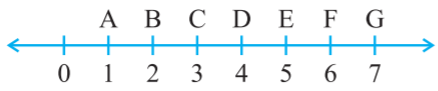
AnswerIn one complete revolution the hand of clock covers the $360^\circ .$
When hand of the clock starts from $5$ and makes one fourth of a revolution clockwise, which is a right angle $(90^\circ ),$ It will stop at $8.$
View full question & answer→Question 432 Marks
Why is it better to use a divider than a ruler, while measuring the length of a line segment?
AnswerWe know that clock hand makes an angle of $360^\circ $ in on complete round which is also made of $4$ right angles. When a clock hand goes from $10$ to $1$ it makes only $1$ right angle as it covers only one-fourth of the complete revolution.
View full question & answer→Question 442 Marks
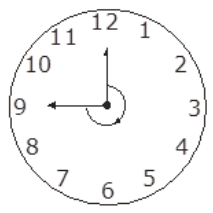
What is the disadvantage in comparing line segments by mere observation?
AnswerBy looking at the clock we can see when the hour hand goes from $12$ to $9$ it basically covers three right angles which is of $= 90 + 90 + 90 = 270^\circ .$
Therefore, required Fraction = $\frac{270}{260}$ = $\frac{3}{4}$
View full question & answer→