Question 15 Marks
For the cuboid shown:
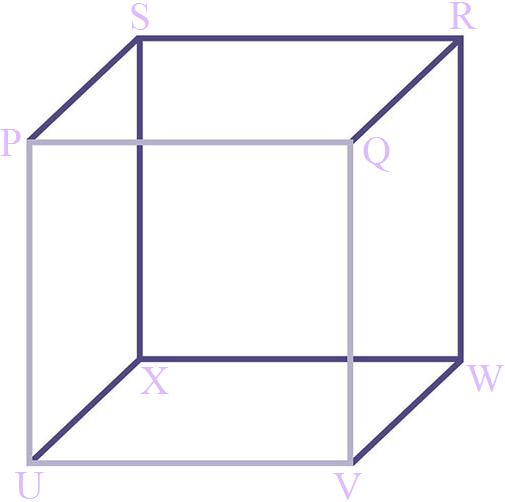
$i.\ $What is the base of this cuboid?
$ii.\ $What are the lateral faces of this cuboid?
$iii.\ $Name one pair of opposite faces. How many pairs of opposite faces are there. Name them.
$iv.\ $Name all the faces of this cuboid which have $X$ as a vertex. Also, name those which have $VW$ as a side.
$v.\ $Name the edges of this cuboid which meet at the vertex $P.$ Also name those faces which meet at this vertex.
$i.\ $What is the base of this cuboid?
$ii.\ $What are the lateral faces of this cuboid?
$iii.\ $Name one pair of opposite faces. How many pairs of opposite faces are there. Name them.
$iv.\ $Name all the faces of this cuboid which have $X$ as a vertex. Also, name those which have $VW$ as a side.
$v.\ $Name the edges of this cuboid which meet at the vertex $P.$ Also name those faces which meet at this vertex.
Answer
View full question & answer→$i.\ \text{UVWX}$ is the base of a cuboid.
$ii.\ $The lateral faces for the base $\text{UVWX}$ are $\text{UXSP, QVWR, PQVU}$ and $\text{SXWR.}$
$iii.\ $Any one pair of opposite faces among the lateral faces of the base are $\text{PQVU}$ and $\text{SXWR}$ or $\text{UXSP}$ and $\text{QVWR.}$
There are two pairs of opposite faces among the lateral faces of the base of the cuboid.
$iv.\ $The faces, which have one of the vertex as $X,$ are $\text{UVWX, UXSP}$ and $\text{SXWR.}$ The faces, which have $\text{VW}$ as side, are $\text{QVWR}$ and $\text{UVWX.]}$
$v.\ $Edges which meet at $P$ are $\text{UP, SP,}$ and $\text{PQ.}$ Faces which meet at vertex $P$ are $\text{PQRS, UPSX,}$ and $\text{PQVU.}$
$ii.\ $The lateral faces for the base $\text{UVWX}$ are $\text{UXSP, QVWR, PQVU}$ and $\text{SXWR.}$
$iii.\ $Any one pair of opposite faces among the lateral faces of the base are $\text{PQVU}$ and $\text{SXWR}$ or $\text{UXSP}$ and $\text{QVWR.}$
There are two pairs of opposite faces among the lateral faces of the base of the cuboid.
$iv.\ $The faces, which have one of the vertex as $X,$ are $\text{UVWX, UXSP}$ and $\text{SXWR.}$ The faces, which have $\text{VW}$ as side, are $\text{QVWR}$ and $\text{UVWX.]}$
$v.\ $Edges which meet at $P$ are $\text{UP, SP,}$ and $\text{PQ.}$ Faces which meet at vertex $P$ are $\text{PQRS, UPSX,}$ and $\text{PQVU.}$