MCQ 11 Mark
$n^2 + n + 1$ is a or an ______ number for all $\text{n}\in\text{N}$
AnswerConsider $n^2$$+ n = n (n + 1)$
We know that if $n$ is a number, then $n +1$ will be its consecutive number And product of a number and its consecutive number is always even.
For example, $2 \times 3$ $= 6; 9 \times 10$ $= 90$ And as $n^2$$+ n$ is an even number.
Then $n^2$ $+ n + 1$ will be the next consecutive number of the even number, which is an odd number.
Hence, $n^2$ $+ n + 1$ will always be an odd number for all natural numbers.
View full question & answer→MCQ 21 Mark
If $a$ and $b$ are whole numbers, then $a - b$ is:
Answer If $a$ and $b$ are whole numbers, then there may be the following $3$ cases:
Case $1$: When $a > b$ Then, $a - b \Rightarrow $ Whole/ Natural number
Case $2$: When $a < b$Then, $a - b \Rightarrow $ Integer
Case $3$: When $a = 0$ and $b = 0$ Then, $a - b \Rightarrow $ Whole number.
Hence, option $D$ is correct.
View full question & answer→MCQ 31 Mark
Which of the following satisfies closure property for whole numbers?
- A
$12 + 0 = 12$
- B
$13 + 0 = 13$
- C
$16 + 6 = 22$
- ✓
Answer All numbers are whole numbers. For closure property, whole number $+$ whole number $=$ whole number.
In all the cases, the above property is satisfied.
View full question & answer→MCQ 41 Mark
The successor of the smallest prime number is:
Answer The smallest prime number is $2$
So, Successor of $2 = 2 + 1 = 3$
View full question & answer→MCQ 51 Mark
$100$ million is equal to:
AnswerCorrect option: C. $10$ Crore
$ 100$ million $= 100,000,000100,000,000$
$= 10,00,00,000 = 10 = 10,00,00,000 = 10$ crore
View full question & answer→MCQ 61 Mark
The smallest natural number is:
Answer We know that natural numbers start from $1, 2, 3, ...$
So, the smallest natural number $=1$
View full question & answer→MCQ 71 Mark
The value of $1735 \times 1232 - 1735 \times 232$ is:
- A
$17350$
- B
$173500$
- ✓
$1735000$
- D
$173505$
AnswerCorrect option: C. $1735000$
Using distributive law of multiplication over subtraction, we get
$1735 \times 1232 - 1735 \times 232 = 1735 (1232 - 232)$
$= 1735 \times 1000$
$= 1735000$
Hence, the correct option is $(c).$
View full question & answer→MCQ 81 Mark
Multiplying a negative integer for odd times gives a _____ result:
Answer$ (-1) \times (-1) \times (-1).......$odd times $=$ Negative sign.
View full question & answer→MCQ 91 Mark
$A$ and $b$ are two co-primes. Which of the following is/ are true$?$
AnswerCorrect option: C. Both $(a)$ and $(b).$
A set of numbers which do not have any other common factor other than $1$ are called co-prime.
The $LCM$ of two co-prime numbers is equal to their product.
The $HCF$ of two co-prime numbers is $1.$
View full question & answer→MCQ 101 Mark
How many $4$ digit numbers, in all are there$?$
AnswerCorrect option: C. $9000$
$\Rightarrow $ The smallest $4 −$ digit number $= 1000.$
$\Rightarrow $ The greatest $4 −$ digit number $= 9999.$
$\Rightarrow $ Total $4 −$ digit numbers $= (9999 - 1000) + 1$
$= 8999 + 1$
$= 9000$
So, we say that we have $9000$ four - digit numbers.
View full question & answer→MCQ 111 Mark
$67 + 33 = 33 + 67$ is an example of:
Answer$67 + 33 = 33 + 67$ is an example of commutative property of addition.
View full question & answer→MCQ 121 Mark
In whole numbers closure property is not satisfied w.r.t. operation:
- A
$(+, ÷)$
- B
$(+, \times )$
- C
$(−, \times )$
- ✓
AnswerClosure property in whole number states that if we do the operation between two whole number we should get a whole number. $2, 5$ are
whole number. $2 - 5 = (-3)$ is not a whole number. $\frac{2}{5} = 0.4$ is not a whole number.
Closure property is not satisfied w.r.t. subtraction and division in whole numbers.
View full question & answer→MCQ 131 Mark
$4 \times 538 \times 25 = ?$
- A
$32280$
- B
$26900$
- ✓
$53800$
- D
$10760$
AnswerCorrect option: C. $53800$
$4 \times 538 \times 25$
$= 100 \times 538$
$= 53800$
View full question & answer→MCQ 141 Mark
The difference between the greatest and least numbers of $\frac{5}{9},\frac{1}{9},\frac{11}{9}$ is-
- A
$ \frac{9}{2}$
- B
$ \frac{10}{9}$
- C
$ \frac{3}{8}$
- ✓
AnswerThe ascending order of given numbers is $ \frac{1}{9},\frac{5}{9},\frac{11}{9}$ Here denominator is equal, so greater the numerator greater will be the value.
$ \therefore$ Required difference
$\frac{11}{9}- \frac{1}{9}=\frac{10}{9}$
View full question & answer→MCQ 151 Mark
Multiplicative identity of whole number is given by:
- ✓
$1$
- B
$0$
- C
Both $0$ and $1$
- D
AnswerThe multiplicative identity property states that any time you multiply a number by $1,$ the result, or product, is that original number.
So it is clear that multiplicative property is given by
View full question & answer→MCQ 161 Mark
The natural number which is a multiple of every number is ________.
AnswerThere is no such number which is a multiple of every number!
View full question & answer→MCQ 171 Mark
Which of the following when added to the additive identity element results $0?$
AnswerThe additive identity element is $0.$ We know that the sum of $0$ and any number is the number itself.
Let the number be $x.$
$\therefore x + 0 = 0$
$\Rightarrow x = 0$
View full question & answer→MCQ 181 Mark
The smallest number which is neither prime nor composite is:
MCQ 191 Mark
The sum of two odd numbers is:
AnswerThe sum of two odd numbers is an even number.
Example: $5 + 3 = 8$
View full question & answer→MCQ 201 Mark
Mark the correct alternative in the following: Additive inverse of $28$ is:
- A
$\frac{1}{28}$
- B
$0$
- ✓
$-28$
- D
$82$
AnswerHere, the given number is $28.$
Additive inverse of a given number is a number which when added to the given number gives zero.
Now $28 + (-28) = 0$
Thus, $-28$ is the additive inverse of $28.$
Hence, the correct option is $(c).$
View full question & answer→MCQ 211 Mark
Whole numbers are not closed under ......... operation.
Answer Whole numbers are not closed under subtraction operation because when any two whole numbers are considered and from them one is subtracted from the other, the difference so obtained is not necessarily a whole number.
Eg. $2 - 5 = -3.$
View full question & answer→MCQ 221 Mark
$- 174 □ - 170 = - 174$ then the symbol in blank is:
AnswerCorrect option: C. $+$ or $-$
$\frac{4}{-17}+\frac{0}{-17} =\frac{4}{-17}$
$\frac{4}{-17}-\frac{0}{-17}= \frac{4}{-17}$
Therefore we use both $+$ or $-$
View full question & answer→MCQ 231 Mark
Which of the following statement is true$?$
- A
Every whole number is a natural number.
- ✓
Every natural number is a whole number.
- C
'1' is the least whole number.
- D
AnswerCorrect option: B. Every natural number is a whole number.
Natural numbers set is $1, 2, 3, ......$
Whole numbers set is $0, 1, 2, 3, .....$
Clearly every natural number is a whole number.
View full question & answer→MCQ 241 Mark
Which of the following operations are not associative with respect to whole numbers?
- A
- ✓
- C
Addition and multiplication
- D
Multiplication and division
AnswerAssociative property does not hold good w.r.t. subtraction:
$\text A - (\text{B - C}) \neq (\text{A - B}) - \text{C}$
Associative property does not hold good w.r.t. division as well:
$\text{A}\div(\text{B}\div\text{C})\neq(\text{A}\div\text{B})\div\text{C}$
View full question & answer→MCQ 251 Mark
Which one of the following is the smallest odd whole number$?$
AnswerThe natural numbers along with $0$ form the collection of whole numbers.
So, the numbers $0, 1, 2, 3, 4, …$ form the collection of whole numbers.
A natural number which is not divisible by $2$ is called an odd whole number.
So, in the collection $“0, 1, 2, 3, 4, …”, 1$ is the smallest odd whole number.
Hence, the correct option is $(b).$
View full question & answer→MCQ 261 Mark
When we multiply a whole number and the multiplicative identity of whole numbers, then we get _____.
- ✓
- B
The multiplicative identity
- C
$0$
- D
AnswerThe product of the multiplicative identity of whole number i.e.,
$1$ and a whole number we get the number itself.
View full question & answer→MCQ 271 Mark
$1001 \div 11$ of $13 = ?$
Answer$= 1001 \div 11$ of $13$
$= 1001 \div (11 \times 13)$
$= 1001 \div 143 = 7$
View full question & answer→MCQ 281 Mark
What whole number is nearest to $457$ which is divisible by $11?$
Answer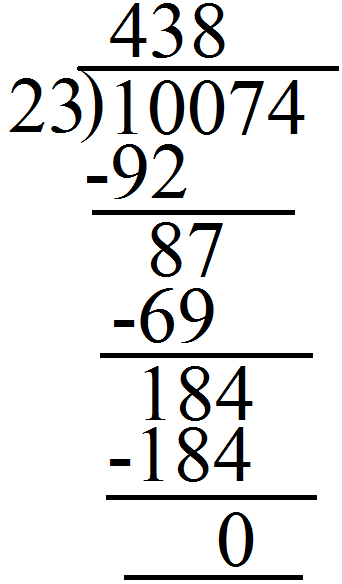
Hence, $462$ is divisible by $11.$
Here, the numbers given in options $(b)$ and $(d)$ are divisible by $11.$
However, we want a whole number nearest to $457$ which is divisible by $11.$
So, $462$ is whole number nearest to $457$ and divisible by $11.$ View full question & answer→MCQ 291 Mark
If $n$ is a whole number such that $n + n = n$ then $n = ?$
Answer$n + n = n^2n = n$ Clearly $n = 0$, satisfies
So $n = 0$ is the final answer.
View full question & answer→MCQ 301 Mark
The number of surjections from$\text{ A }= {1, 2,...\text{n}},\text{ n} \leq 2$ onto $B = \{a, b\}$ is:
- A
$^\text{n}\text{P}_2$
- ✓
$2^\text{n}-2 $
- C
$2^\text{n}-1 $
- D
AnswerCorrect option: B. $2^\text{n}-2 $
$A = \{1, 2, 3, ........, n\} $
$B = \{a, b\}$
A has $n$ elements. $B$ has $2$ elements.
$\therefore$ No. of surjection is $ 2^{\text{n}}-2$
View full question & answer→MCQ 311 Mark
Whole numbers are not closed under ......... operation:
AnswerWhole numbers are not closed under subtraction operation because when any two whole numbers are considered and from them one is subtracted from the other,
the difference so obtained is not necessarily a whole number.
Eg. $2 - 5 = −3.$
View full question & answer→MCQ 321 Mark
If we write natural numbers from $1$ to $100,$ the number of times the digit $5$ has been written is:
Answer If we write natural numbers from $1$ to $100,$ the number of times the digit $5$ has been written is $20.$
View full question & answer→MCQ 331 Mark
The largest number of $6$ digits which is exactly divisible by $16$ is:
- A
$999980$
- B
$999982$
- ✓
$999984$
- D
$999964$
AnswerCorrect option: C. $999984$
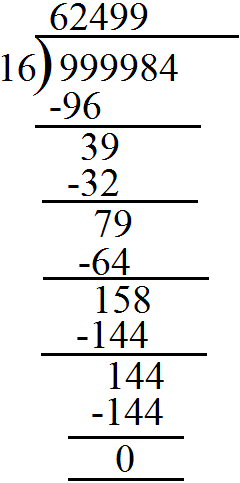
Hence, $999984$ is exactly divisible by $16.$
The largest six-digit number which is exactly divisible by $16$ is $999984.$ View full question & answer→MCQ 341 Mark
Which one of the following whole numbers does not have a predecessor$?$
AnswerThe numbers $0, 1, 2, 3, 4, ….$ form the collection of whole numbers.
The smallest whole number is $0.$
So, $0$ does not have a predecessor.
Hence, the correct option is $(b).$
View full question & answer→MCQ 351 Mark
Let $x$ be a real variable, and let $3 < x < 4.$ Which of the following values, $x$ might have$?$
- A
$-3.1$
- ✓
$\sqrt{11}$
- C
$\sqrt{\frac{10}{11}}$
- D
AnswerCorrect option: B. $\sqrt{11}$
$x$ can have any values between $3$ and $4$ so it can be rational or irrational.
option $c = 0.9$ and options $A$ and $D$ are outside the given range.
View full question & answer→MCQ 361 Mark
The property represented by $a \times (b + c) = a \times b + a \times c$ is:
AnswerDistributive property say that multiplication an division can be distributed over parenthesis.
$a \times (b + c) = a \times b + a \times c$
View full question & answer→MCQ 371 Mark
The counting numbers $1, 2, 3, 4, ....$ are called:
AnswerNatural numbers are the set of whole numbers $($except $0).$
The numbers $1,2,3,4,5.......$ are called natural numbers.
View full question & answer→MCQ 381 Mark
Simplify using distributive property: $14 \times 6 + 14 \times 4 = ...........$
AnswerThe Distributive Property is easy to remember if you recall that "multiplication distributes over addition".
Formally, they write this property as $"a(b + c) = ab + ac".$
$14 \times 6 + 14 \times 4$
$= 14 \times (6 + 4) ($distributive property$)$
$= 14 \times 10$
$= 140.$
View full question & answer→MCQ 391 Mark
Which of the following shows the distributive property of multiplication over addition$?$
- A
$(x + 0) \times (y + 0) = x \times y$
- B
$x \times y = y \times x$
- C
$x \times 1 = x$
- ✓
$x (y + z) = (x \times y) + (x \times z)$
AnswerCorrect option: D. $x (y + z) = (x \times y) + (x \times z)$
$x(y + z) = (x \times y) + (x \times z)$ shows the distributive property of multiplication over addition.
View full question & answer→MCQ 401 Mark
How many whole numbers are there between $1018$ and $1203?$
AnswerNumber of whole numbers $= (1203 - 1018) - 1$
$= 185 - 1$
$= 184$
View full question & answer→MCQ 411 Mark
$587 \times 99 = ?$
- A
$57213$
- B
$58513$
- ✓
$58113$
- D
$56413$
AnswerCorrect option: C. $58113$
$587 \times 99$
$= 587 \times (100 - 1)$
$= 587 \times 100 - 587 \times 1$
$= 58700 - 587$
$= 58113$
View full question & answer→MCQ 421 Mark
$24679 \times 92 + 24679 \times 8 = ?$
- A
$493580$
- B
$1233950$
- ✓
$2467900$
- D
AnswerCorrect option: C. $2467900$
By using the distributive property, we have:
$24679 \times 92 + 24679 \times 8$
$= 24679 \times (92 + 8)$
$= 24679 \times 100$
$= 2467900$
View full question & answer→MCQ 431 Mark
Which of the following statements is incorrect$?$
- A
$0$ is the additive identity for natural numbers
- B
$0$ is the additive identity for whole numbers
- C
$0$ is the additive identity for integers
- ✓
$1$ is the additive identity for rational numbers
AnswerCorrect option: D. $1$ is the additive identity for rational numbers
We know that, the sum of $0$ and any rational number is the number itself.
Thus, $0$ is the additive identity for rational numbers.
View full question & answer→MCQ 441 Mark
The least number divisible by each of the numbers $15, 20, 24$ and $32$ is:
Answer$LCM$ of $15, 20, 24$ and $32$ is given by
$15 = 3 \times 5 = 3^1 \times 5^1$
$20 = 2 \times 2 \times 5 = 2^2 \times 5^1$
$24 = 2 \times 2 \times 2 \times 3 = 2^3 \times 3^1$
$32 = 2 \times 2 \times 2 \times 2 \times 2 = 2^5$
$LCM = 2^5 \times 3^1 \times 5^1 = 480$
View full question & answer→MCQ 451 Mark
Which of the following expressions is equal to $83 \times 5?$
- A
$8 \times (3 + 5)$
- B
$5 \times (8 + 3)$
- ✓
$5 \times (80 + 3)$
- D
$80 \times (3 + 5)$
AnswerCorrect option: C. $5 \times (80 + 3)$
$83 \times 5 = (80 + 3) \times 5$
View full question & answer→MCQ 461 Mark
The number of whole numbers between the smallest whole number and the greatest $2$ digit number is:
AnswerSmallest whole number $= 0$
Greatest $2-$digit whole number $= 99$
The whole numbers between $0$ and $99$ are $1, 2, 3, 4 …… 97, 98.$
To find the number of whole numbers between $0$ and $99,$
Subtract $1$ from the difference of $0$ and $99.$
Therefore, Number of whole numbers between $0$ and $99 = (99 - 0) - 1$
$= 99 - 1$
$= 98$
Hence, the correct option is $(d).$
View full question & answer→MCQ 471 Mark
For any integer $′a′,$ the value of $a + 0 = ..........$
View full question & answer→MCQ 481 Mark
The predecessor of $1$ million is:
- A
$9999$
- B
$99999$
- ✓
$999999$
- D
$1000001$
AnswerCorrect option: C. $999999$
We have:
$1$ million $= 10,00,000$
Predecessor of $1$ million,
$= 10,00,000 - 1 = 9,99,999$
View full question & answer→MCQ 491 Mark
On a vertical number line positive numbers are placed ____ $0.$
AnswerPositive number are located above 0 and negative numbers are located below $0$ on a vertical number line.
View full question & answer→MCQ 501 Mark
Mark the correct alternative in the following:
What is the additive identity element in the set of whole numbers$?$
AnswerAn additive identity is a number which when added to any number, the number is unchanged.
For example: $0 + 7 = 7, 0 + 9 = 9, 0 + (- 11) = -11$ etc.
Thus, $0$ is the additive identity in the set of whole numbers.
Hence, the correct option is $(a).$
View full question & answer→MCQ 511 Mark
$RHS$ part of the equation $36(8 + 3) =$ _______
AnswerCorrect option: C. $(36 \times 8) + (36 \times 3)$
Using distributive formula ,
We can write, $a(b + c) = a \times b + a \times c$
So, $36(8 + 3) = (36 \times 8) + (36 \times 3)$
View full question & answer→MCQ 521 Mark
Mark the correct alternative in the following:
$x + 12 = 12 + 7,$ then by commutativity of addition $x =$
AnswerHere, $x + 12 = 12 + 7.$
But, by commutative of addition,
We have $7 + 12 = 12 + 7$
So, comparing $x + 12 = 12 + 7$ and $7 + 12 = 12 + 7$
We have $x = 7$
Hence, the correct option is $(b).$
View full question & answer→MCQ 531 Mark
Mark the correct alternative in the following:
Which one of the following is not a natural numbers$?$
AnswerThe numbers $1, 2, 3, 4, 5, ...$ form the collection of natural numbers.
Thus, $0$ is not a natural number.
Hence, the correct option is $(c).$
View full question & answer→MCQ 541 Mark
Simplify using distributive property: $[5 \times (6)] + [5 \times 3] = .....$
Answer$[5 \times (6)] + [5 \times 3] = 5[(6) + 3] (\therefore$ distributive property$)$
$=5[9]$
$=45.$
View full question & answer→MCQ 551 Mark
The sum of zero and any rational number is ........
AnswerZero is called the identity element for addition of rational numbers.
Thus, the sum of $0$ and any rational number is the number itself.
View full question & answer→MCQ 561 Mark
The greatest number which divides $134$ and $167$ leaving $2$ as remainder in each case is:
AnswerFirst we subtract the required remainder from $134$ and $167.$
Thus, we will get $132$ and $165.$
$132 = 2 \times 2 \times 3 \times 11 = 2^2 \times 3 \times 11$
$165 = 3 \times 5 \times 11 = 3^1 \times 5 \times 11$
$HCF = 3 \times 11 = 33$
Thus, the greatest number which divides $134$ and $167$ leaving $2$ as remainder in each case is $33$
View full question & answer→MCQ 571 Mark
$(0, -3 )$ lies on _______ .
- A
Positive $x - $axis
- B
Negative $x - $axis
- C
Positive $y - $axis
- ✓
AnswerGiven Coordinate of Point $P$ are $(0, -3)$
$x - $coordinate $= 0$
$y -$ coordinate $= -3$
$\Rightarrow$ Point $P$ lies of $y -$ axis
Also, As $y -$ coordinate $ < 0$ Point $P (0, -3)$ lies on Negative $y -$ axis.
View full question & answer→MCQ 581 Mark
How many whole numbers are between $437$ and $487?$
AnswerNo. of whole numbers in between
$= (487 - 437) - 1 = 50 -1 = 49$
View full question & answer→MCQ 591 Mark
If $\frac{-8}{17}+\text{ x}=\frac{-8}{17}$. Then the value of $x$ is:
Answer$\frac{-8}{17}+\text{x}=\frac{-8}{17}\Rightarrow\text{x}=0$
View full question & answer→MCQ 601 Mark
Closure property is satisfied in whole numbers w.r.t. to ____ and ____
- A
- B
- ✓
Addition and multiplication
- D
Multiplication and division
AnswerCorrect option: C. Addition and multiplication
Closure Property. Two whole numbers add up to give another whole number.
This is the closure property of the whole numbers.
It means that the whole numbers are closed under addition and multiplication.
View full question & answer→MCQ 611 Mark
Mark the correct alternative in the following:
If $n$ is an odd natural number greater than $1,$ then the product of its successor and predecessor:
- A
Is an odd natural number.
- ✓
Is an even natural number.
- C
- D
AnswerCorrect option: B. Is an even natural number.
The successor and predecessor of an odd natural number are both even.
Here, $n = o$ dd. So
Successor of $n = n + 1 ($Even natural number$)$
Predecessor of $n = n - 1 ($Even natural number$)$
Product $= (n + 1) \times (n - 1) =$ even $\times $ even $=$ even
Thus, the product of the successor and predecessor of $n$ is an even number.
Hence, the correct option is $(b).$
View full question & answer→MCQ 621 Mark
$16 - 2 ÷ 7 + 6 \times 2 = ?$
- A
$16$
- B
$14$
- ✓
$27\frac{5}{7}$
- D
AnswerCorrect option: C. $27\frac{5}{7}$
$ 16 - 2 ÷ 7 + 6 \times 2$
$=16-\Big(\frac{2}{7}\Big)+6\times2$ [Performing division]
$=16-\Big(\frac{2}{7}\Big)+12$ [performing multiplication]
$=25-\Big(\frac{2}{7}\Big)$ [Performing addition]
$=\frac{28}{1}-\frac{2}{7}=\frac{(196-2)}{7}=\frac{194}{7}=27\frac{5}{7}$ [performing substractrion]
View full question & answer→MCQ 631 Mark
Find the missing term: $24 \times (6 \times 5) = (24 \times 6) \times ........$
AnswerMultiplication is associative for whole numbers.
i.e. $a \times (b \times c) = (a \times b) \times c$
$\therefore 24 \times (6 \times 5) = (24 \times 6) \times 5.$
View full question & answer→MCQ 641 Mark
The successor of $1$ million is:
- A
$10001$
- B
$100001$
- ✓
$1000001$
- D
$10000001$
AnswerCorrect option: C. $1000001$
We have:
$1$ million $= 10,00,000$
Predecessor of $1$ million,
$= 10,00,000 + 1 = 10,00,001$
View full question & answer→MCQ 651 Mark
Which of the following statements is incorrect ?
- A
Whole numbers are closed under addition
- B
Whole numbers are closed under multiplication
- ✓
Whole numbers are closed under subraction
- D
Whole numbers are not closed under subtraction
AnswerCorrect option: C. Whole numbers are closed under subraction
The difference of two whole numbers is not necessarily a whole number.
The statement whole numbers are closed under subtraction is an incorrect statement.
View full question & answer→MCQ 661 Mark
$54 ÷ 3$ of $6 + 9 = ?$
- A
$117$
- ✓
$12$
- C
$\frac{6}{5}$
- D
Answer$= 54 ÷ 3 of 6 + 9$
$= 54 ÷ (3 ÷ 6) + 9$
$= 54 ÷ 18 + 9$
$= 3 + 9 = 12$
View full question & answer→MCQ 671 Mark
The property represented by $a \times (b + c) = a \times b + a \times c$ is:
AnswerDistributive property can bre written as
$a \times (b + c) = a\times b + a \times c$
View full question & answer→MCQ 681 Mark
If $a, b$ and $c$ are whole numbers, then $a + (b + c) = (a + b) + c.$ This property is called:
Answer$a + (b + c) = (a + b) + c$ is associative property of whole numbers.
View full question & answer→MCQ 691 Mark
$32-\Big[48\div\big[36-\big(27-\overline{16-9}\big)\big]\Big]=\ ?$
- ✓
$29$
- B
$\frac{520}{17}$
- C
- D
$19$
AnswerGiven expression:
$32-\Big[48\div\big[36-\big(27-\overline{16-9}\big)\big]\Big]$
$= 32 - [48 ÷ \{36 - (27 - 7)\}] [$Removing bar$]$
$= 32 - [48 ÷ \{36 - 20\}] [$Removing parentheses$]$
$= 32 - [48 ÷ 16] [$Removing braces$]$
$= 32 - 3 [$Removing square brackes$]$
$= 29$
View full question & answer→MCQ 701 Mark
Additive inverse of $36$ is:
- A
$\frac{1}{36}$
- B
$0$
- ✓
$-36$
- D
AnswerThe additive inverse of $36$ is $-36.$
i.e., $36 + (-36) = 0$
View full question & answer→MCQ 711 Mark
Find the missing values: $25 \times (15 \times ......) = (...... \times 15) \times 10$
- A
$10, 15$
- B
$10, 10$
- C
$15, 25$
- ✓
AnswerMultiplication is associative for whole numbers.
i.e. $a \times (b \times c) = (a \times b) \times c$
$\therefore 25 \times (15 \times 10) = (25 \times 15) \times 10$
$\therefore $ The missing terms are $10, 25.$
View full question & answer→MCQ 721 Mark
$38 + 83 = 83 + 38$ is an example of:
AnswerCommutative property of addition: Changing the order of addends does not change the sum.
For example, $a + b = b + a$
View full question & answer→MCQ 731 Mark
Find the missing values: $14 \times (....... \times .......) = (14 \times 2) \times 10$
AnswerCorrect option: A. $2, 10$
Multiplication is associative for whole numbers.
i.e. $a \times (b \times c) = (a \times b) \times c$
$\therefore 14 \times (2 \times 10) = (14 \times 2) \times 10$
$\therefore $ The missing terms are $2, 10.$
View full question & answer→MCQ 741 Mark
A number when divided by $46$ gives $11$ as quotient and $15$ as remainder. The number is
AnswerDivisor $= 46$
Quotient $= 11$
Remainder $= 15$
Dividend $=$ Divisor $\times $ quotient $+$ remainder
$= 46 \times 11 + 15$
$= 506 + 15$
$= 521$
View full question & answer→MCQ 751 Mark
Number of whole numbers lying between $-5$ and $5$ is:
AnswerOption $D$ is right.
Number of whole numbers lying between $-5$ and $5$ are $0, 1, 2, 3$ and $4.$
View full question & answer→MCQ 761 Mark
The value of $(147 + 0) + (123 + 0)$ is:
Answer$(147 + 0) + (123 + 0) = 147 + 123$
$= 270$
$( \therefore 147 + 0 = 147, 123 + 0 = 123)$
View full question & answer→MCQ 771 Mark
Which of the following numbers is not a natural number$?$
AnswerThe counting numbers $1, 2, 3, 4, .....$ are called natural numbers.
The set of natural numbers does not include $0.$
View full question & answer→MCQ 781 Mark
The predecessor of the smallest $3$ digit number is:
AnswerSmallest $3-$digit number $= 100$
Predecessor of $3-$digit number,
$= 100 - 1 = 99$
Hence, the correct option is $(b).$
View full question & answer→MCQ 791 Mark
Which of the following represents whole numbers?
- A
$2, 3, 4, 5,.....$
- B
$...., −5, −4, −3, −2, −1, 0, 1, 2, 3, 4, 5, ....$
- C
$1, 2, 3, 4, 5, .....$
- ✓
$0, 1, 2, 3, 4, 5, .....$
AnswerCorrect option: D. $0, 1, 2, 3, 4, 5, .....$
The number $′0′$ along with the natural numbers gives us the number set $\{0, 1, 2, 3, 4, .....\}$ which is known as set of whole numbers.
Hence, $0, 1, 2, 3, 4....$ are whole numbers.
View full question & answer→MCQ 801 Mark
The smallest natural number is:
MCQ 811 Mark
Which of the following is not zero?
- A
$0\times0$
- B
$\frac{0}{2}$
- C
$\frac{(8-8)}{2}$
- ✓
$2+0$
Answer$0\times0=0$
$\frac02=0$
$\frac{(8-8)}{2}=\frac02=0$
$2+0=2 $
View full question & answer→MCQ 821 Mark
The smallest even whole number is:
AnswerThe smallest even whole number is $2.$
Zero is neither an even number nor an odd number.
View full question & answer→MCQ 831 Mark
Multiplicative identity is:
AnswerDefinition of multiplicative identity : an identity element $($such as $1$ in the group of rational numbers without $0)$ that in a given mathematical system leaves unchanged any element by which it is multiplied.
If we multiply $1$ with any number we will get the same number.
View full question & answer→MCQ 841 Mark
Which one of the following is the smallest whole number$?$
AnswerThe set of whole numbers is $\{0, 1, 2, 3, 4, …\}$
So, the smallest whole number is $0$
Hence, the correct option is $(c).$
View full question & answer→MCQ 851 Mark
The sum of the smallest natural number and the smallest whole number is ............
AnswerThe smallest natural number is $1$ and the smallest whole number is $0.$
$\therefore 1 + 0 = 1$
View full question & answer→MCQ 861 Mark
If $x$ and $y$ are co-primes, then their $LCM$ is:
AnswerA set of numbers which do not have any other common factor other than $1$ are called co-prime.
The $LCM$ of two co-prime numbers is equal to their product.
View full question & answer→MCQ 871 Mark
$13 - (12 - 6 ÷ 3) = ?$
Answer$= 13 - (12 - 6 ÷ 3)$
$= 13 - (12 - 2)$
$= 13 - 10 = 3$
View full question & answer→MCQ 881 Mark
The distance between $-9$ and $0$ is:
AnswerThe distance between two numbers is the absolute value of the difference of the numbers.=$\left| -9-0 \right| =\left| -9 \right| =9$
View full question & answer→MCQ 891 Mark
The rational number $\frac{-18}{5}$ lies between:
- A
$- 2$ and $- 3$
- ✓
$- 3$ and $- 4$
- C
$- 4$ and $- 5$
- D
AnswerCorrect option: B. $- 3$ and $- 4$
$\dfrac{-18}{5} = -3.6$
Therefore, it lies between $-3$ and $-4.$
View full question & answer→MCQ 901 Mark
Mark the correct alternative in the following:
What is the multiplicative identity element in the set of whole numbers?
Answer A multiplicative identity is a number which when multiplied with any number, the number is unchanged.
For example: $1 \times 7 = 7, 1 \times 9 = 9, 1 \times 100 = 100$ etc.
Thus, $1$ is multiplicative identity in the set of whole numbers is $1.$
Hence, the correct option is $(c).$
View full question & answer→MCQ 911 Mark
$27-\Big[18-\big[16-\big(5-\overline{4-1}\big]\Big]=\ ?$
Answer Given expression:
$27-\Big[18-\big[16-\big(5-\overline{4-1}\big]\Big]$
$= 27 - [18 - \{16 - (5 - 3)\}] [$Removing bar$]$
$= 27 - [18 - \{16 - 2\}] [$Removing parentheses$]$
$= 27 - [18 - 14] [$Removing braces$]$
$= 27 - 4 [$Removing square brackes$]$
$= 23$
View full question & answer→MCQ 921 Mark
The product of two odd numbers is:
Answer The product of two odd numbers is an odd number.
Example: $5 \times 3 = 15$
View full question & answer→MCQ 931 Mark
$80808080$ comes just after.
- A
$80808099$
- B
$80808081$
- ✓
$80808079$
- D
AnswerCorrect option: C. $80808079$
$ 80808080 - 1 = 80808079$
View full question & answer→MCQ 941 Mark
The value of $47 \times 99$ is:
- A
$4635$
- ✓
$4653$
- C
$4563$
- D
$6453$
AnswerCorrect option: B. $4653$
Since, $99 = 100 - 1$
Therefore, $47 \times 99 = 47 \times (100 - 1)$
$= 47 \times 100 - 47$
$= 4700 - 47$
$= 4653$
Thus, the value of $47 \times 99$ is $4653.$
Hence, the correct option is $(b).$
View full question & answer→MCQ 951 Mark
Mark the correct alternative in the following:
If $n$ is an even number, then the product of its successor and predecessor
- A
Is an even natural number.
- ✓
Is an odd natural number.
- C
- D
AnswerCorrect option: B. Is an odd natural number.
Here, $n$ is an even number.
Successor of $n = n + 1$
Predecessor of $n = n − 1$
Product $= (n + 1) \times (n − 1) = odd \times odd = odd$
Thus, the product of the successor and the predecessor of n is an odd natural number.
Hence, the correct option is $(b).$
View full question & answer→MCQ 961 Mark
If $a,b$ and $c$ are whole numbers, then $a + (b + c) = (a + b) + c.$ This property is called:
Answer$ a + (b + c) = (a + b) + c$ is associative property of whole numbers.
View full question & answer→MCQ 971 Mark
Closure property is applicable to ......... operation of whole numbers.
MCQ 981 Mark
For any rational number $\frac{\text{a}}{\text{b}} + 0 $, such that $\text{b}\neq 0$, the value of $\ \frac {\text{a}}{\text{b}} + 0 $ will be
AnswerCorrect option: B. $\frac {\text{a}}{\text{b}}$
The sum of $0$ and any rational number is the number itself.
Thus, for any rational number $\frac {\text{a}}{\text{b}}$
we have $\frac {\text{a}}{\text{b}} + 0 = \frac {\text{a}}{\text{b}}$
View full question & answer→MCQ 991 Mark
Mark the correct alternative in the following:
Which of the following is not zero?
- A
$0\times0$
- B
$\frac{0}{2}$
- C
$\frac{(6-6)}{2}$
- ✓
$4+0$
Answer In the product of two numbers, if one of the numbers (or both) is (are) zero, then the product is zero.
$\therefore0\times0=0$
In a division, if the numerator is zero, then the answer is zero.
$\therefore\frac{0}{2}=0$
Similarly, $\frac{(6-6)}{2}=\frac{0}{2}=0$
Here, $0$ is an additive identity in the set of whole numbers.
$\therefore4 + 0 =4$
Thus, $4 + 0$ is not zero.
Hence, the correct option is $(d).$
View full question & answer→MCQ 1001 Mark
Mark the correct alternative in the following:
If $(31 + 15) + x = 31 + (15 + 23),$ then by associativity of addition $x =?$
AnswerHere, $(31 + 15) + x = 31 + (15 + 23).$
But, by associativity of addition,
We have $(31 + 15) + 23 = 31 + (15 + 23)$
So, comparing $(31 + 15) + x = 31 + (15 + 23)$ and $(31 + 15) + 23 = 31 + (15 + 23),$
We have $x = 23$
Hence, the correct option is $(c).$
View full question & answer→MCQ 1011 Mark
The $HCF$ of two co-primes is:
AnswerA set of numbers which do not have any other common factor other than $1$ are called co-prime.
View full question & answer→MCQ 1021 Mark
$8 - [28 ÷ \{34 - (36 - 18 ÷ 9 \times 8)\}] = ?$
AnswerGiven expression:
$= 8 - [28 ÷ \{34 - (36 - 18 ÷ 9 × 8)\}] [$Performing division$]$
$= 8 - [28 ÷\{34 - (36 - 2 × 8)\}] [$Performing multiplication$]$
$= 8 - [28 ÷ \{34 - (36 - 16)\}]$
$= 8 - [28 ÷ \{34 - 20\}] [$Removing parentheses$]$
$= 8 - [28 ÷ 14] [$Removing braces$]$
$= 8 - 2$
$= 6 [$Removing square brackets$]$
View full question & answer→MCQ 1031 Mark
Additive identity element of $24$ is:
View full question & answer→MCQ 1041 Mark
The product of a whole number (other than zero) and its successor is:
- ✓
- B
- C
Divisible by $4$
- D
Divisible by $3$
AnswerWe have:
Whole number $= 1$
Successor of $1 = 1 + 1 = 2$
Their product $= 1 \times 2 = 2$
Thus, $2$ is an even number.
View full question & answer→MCQ 1051 Mark
$7589 - ? = 3434$
AnswerCorrect option: C. $4155$
Let $7589 - x = 3434$
Then, $x = 7589 - 3434 = 4155$
View full question & answer→MCQ 1061 Mark
$100 \times 10 - 100 + 2000 ÷ 100 = ?$
AnswerGiven expression:
$= 100 \times 10 - 100 + 2000 ÷ 100$
$= 100 \times 10 - 100 + 20 [$performing division$]$
$= 1000 - 100 + 20 [$performing multiplication$]$
$= 1020 - 100 [$performing addition$]$
$= 920 [$performing subtraction$]$
View full question & answer→MCQ 1071 Mark
Whole numbers are not closed under __________ operation.
AnswerWhen any whole number is divided by another whole number, the result is not always a whole number.
Eg. $2\div 3 = \dfrac {2}{3}=0.666.$ Thus, whole numbers are not closed under division operation.
View full question & answer→MCQ 1081 Mark
The $HCF$ of two co-primes is:
AnswerThe smallest prime number is $2.$
Thus, when we multiply any natural number we will always get an even number.
View full question & answer→MCQ 1091 Mark
The property represented by $a + b = b + a$ is:
AnswerCommutative property of addition: Changing the order of addends does not change the sum.
For example, $a + b = b + a$
View full question & answer→MCQ 1101 Mark
Closure property is applicable to ........ operation of whole numbers.
MCQ 1111 Mark
On dividing a number by $53$ we get $8$ as quotient and $5$ as remainder. The number is:
AnswerDivisor $= 53,$ Quotient $= 8,$ Remainder $= 5$ and Dividend $= ?$
Now, Dividend $=$ Quotient $\times $ Divisor $+$ Remainder
$= 8 \times 53 + 5$
$= 429$
View full question & answer→MCQ 1121 Mark
How many whole numbers are between $437$ and $487?$
AnswerThe whole numbers between $437$ and $487$ are $438, 439, 440, 441, … , 484, 485$ and $486.$ To find the required number of whole numbers,
We need to subtract $437$ from $487$ and then subtract again $1$ from the result.
Thus, there are $(487 - 437) - 1$ whole numbers between $437$ and $487.$
Now, $(487 - 437) - 1$
$= 50 - 1 = 49$
Hence, the correct option is $(b).$
View full question & answer→MCQ 1131 Mark
The predecessor of $1$ in whole numbers is:
AnswerPredecessor of $1 = 1 - 1 = 0$
View full question & answer→MCQ 1141 Mark
The product of the predecessor and successor of an odd natural number is always divisible by:
AnswerThe predecessor of an odd number is an even number.
The successor of an odd number is also an even number.
These two even numbers are two consecutive even numbers, and the product of two consecutive even numbers is always divisible by $8.$
View full question & answer→MCQ 1151 Mark
The additive identity of any rational number is _____.
AnswerThe additive identity property says that if you add a real number to zero or add zero to a real number, then you get the same real number back.
The number zero is known as the identity element.
Then zero $(0)$ is the additive identity of a real number and all rational numbers are real.
Hence, $0$ is the additive identity of rational numbers.
View full question & answer→MCQ 1161 Mark
Every counting number has an infinite number of:
AnswerMultiples are what we get after multiplying the number by any number.
Thus, every counting number has an infinite number of multiples
View full question & answer→MCQ 1171 Mark
The product of the successor and predecessor of $99$ is:
- ✓
$9800$
- B
$9900$
- C
$1099$
- D
$9700$
AnswerCorrect option: A. $9800$
We have:
Successor of $99 = 99 + 1 = 100$
Predecessor of $99 = 99 - 1 = 98$
Their product $= 100 \times 98 = 9800$
View full question & answer→MCQ 1181 Mark
If $a$ is a whole number such that $a + a = a,$ then $a = ?$
AnswerGiven: a is a whole number such that $a + a = a$ If $a = 1,$
then $1+1=2\ne1$
If $a = 2,$ then $2+2=4\ne1$
If $a = 3,$ then $3+3=6\ne1$
View full question & answer→MCQ 1191 Mark
The identity element for addition of whole numbers is ........
Answer The sum of any whole number and $0$ is the number itself.
Therefore, the identity element for addition of whole numbers is $0.$
View full question & answer→MCQ 1201 Mark
$1568 \times 185 - 1568 \times 85 = ?$
- A
$7840$
- B
$15680$
- ✓
$156800$
- D
AnswerCorrect option: C. $156800$
By using the distributive property, we have;
$1568 \times 185 - 1568 \times 85$
$= 1568 \times (185 - 85)$
$= 1568 \times 100$
$= 156800$
View full question & answer→MCQ 1211 Mark
Which of the following does not satisfy closure property for whole numbers$?$
- A
$6 \times 5 = 30$
- B
$4 \times 4 = 16$
- ✓
$5 - 8 = -3$
- D
AnswerCorrect option: C. $5 - 8 = -3$
$ 5$ and $8$ are whole numbers but $-3$ is not a whole number.
View full question & answer→MCQ 1221 Mark
Example of distributive property specific to whole numbers is:
- A
$-2 \times (1 + 10) = (-2 \times 1) + (-2 \times 10)$
- ✓
$(9 + 0) \times 5 = (9 \times 5) + (0 \times 5)$
- C
$12 \times (-2 −8) = (12 \times -2) − (12 \times 8)$
- D
AnswerCorrect option: B. $(9 + 0) \times 5 = (9 \times 5) + (0 \times 5)$
Apart from $B,$ the other options contain a negative sign.
Negative numbers do not belong to whole numbers.
View full question & answer→MCQ 1231 Mark
The whole number which has no predecessor is:
AnswerThe whole number which has no predecessor is $0.$
i.e., $0 - 1 = -1,$ which is not a whole number.
View full question & answer→MCQ 1241 Mark
The difference between successor and predecessor of any number is:
AnswerLet the number is $n$
Then the successor of the number $= n + 1$
and the predecessor of the number $= n − 1$
Difference $= n+1−(n−1)$
$= n + 1 − n + 1$
$= 2$
View full question & answer→MCQ 1251 Mark
What least number should be subtracted from $10004$ to get a number exactly divisible by $12?$
AnswerHere we have to tell what least number should be subtracted from $10004$ to get a number exactly divisible by $12.$
So, we will first divide $10004$ by $12.$
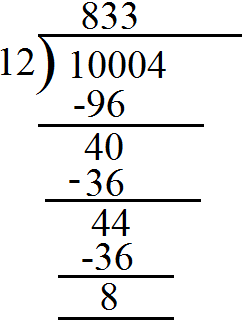
Remainder $= 8$
So, $8$ should be subtracted from $10004$ to get the number exactly divisible by $12.$
i.e., $10004 - 8 = 9996$
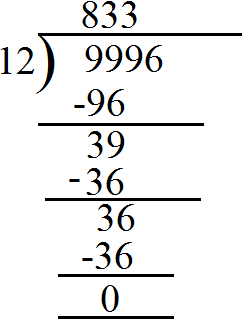
Hence, $9996$ is exactly divisible by $12.$
View full question & answer→MCQ 1261 Mark
Which is equal to $(4 \times 8) + (4 \times 60)?$
- ✓
$4 \times (60 + 8)$
- B
$8 \times (60 + 4)$
- C
$12 \times (60 + 4)$
- D
$16 \times (60 + 8)$
AnswerCorrect option: A. $4 \times (60 + 8)$
The distributive property of multiplication states that a number is multiplied by the sum of two numbers, when the first number can be distributed to both of those numbers and multiplied by each of them separately, then adding the two products together for the same result as multiplying the first number by the sum.
So $(4 \times 8) + (4 \times 60) = 4 \times (8 + 60)$
View full question & answer→MCQ 1271 Mark
The number of whole numbers between the smallest whole number and the greatest $2 -$ digit number is:
AnswerThe smallest whole number is $0$ and the two - digit greatest whole number is $99.$
So the numbers between $0$ and $99$ are $1, 2, ...., 98$
i.e. there are $98$ whole numbers between $0$ and $99.$
View full question & answer→MCQ 1281 Mark
Commutative property for ........... operation holds true in case of whole numbers.
AnswerCommutative property for addition holds true in the case of whole numbers.
For example:
$7 + 4 = 11$
$4 + 7 = 11$
$\Rightarrow 7 + 4 = 4 + 7$
View full question & answer→MCQ 1291 Mark
Simplify using associative property: $(18 + 59) + 1$
Answer$(18 + 59) + 1 = 18 + (59 + 1) ($associative property$)$
$= 18 + 60$
$= 78$
$($Here, to find the result, we avoided $18 + 59,$ which could be time consuming$).$
View full question & answer→MCQ 1301 Mark
Which of the following statements is incorrect?
- A
Whole numbers are closed under addition
- B
Whole numbers are closed under multiplication
- ✓
Whole numbers are closed under subraction
- D
Whole numbers are not closed under subtraction
AnswerCorrect option: C. Whole numbers are closed under subraction
The difference of two whole numbers is not necessarily a whole number. The statement whole numbers are closed under subtraction is an incorrect statement.
View full question & answer→MCQ 1311 Mark
Smallest whole and natural number are respectively ________.
- A
$1, 2$
- ✓
$0, 1$
- C
$2, 1$
- D
$10, 9$
AnswerCorrect option: B. $0, 1$
Smallest whole number is $0$ and natural number is $1$
View full question & answer→MCQ 1321 Mark
The number of whole numbers between $-6$ and $6$ is:
AnswerNumber $-5, -4, -3, -2, -1, 0, 1, 2, 3, 4, 5$ lies between $-6$ and $6.$
Among them $0, 1, 2, 3, 4, 5$ are whole numbers.
$\therefore 6$ whole numbers lies between $-6$ and $6$
View full question & answer→MCQ 1331 Mark
Multiplicative identity of whole number is given by
- ✓
$1$
- B
$0$
- C
Both $0$ and $1$
- D
AnswerThe multiplicative identity property states that any time you multiply a number by $1,$ the result, or product, is that original number.
So it is clear that multiplicative property is given by
View full question & answer→MCQ 1341 Mark
For any two whole numbers, $x$ and $y, x + y = ..........$
AnswerCorrect option: A. $y + x$
Addition of whole numbers is commutative.
So, for any two whole numbers, $x$ and $y, x + y = y + x$
View full question & answer→MCQ 1351 Mark
$133 + 28 \div 7 - 8 \times 2 = ?$
AnswerGiven expression:
$= 133 + 28 \div 7 - 8 \times 2$
$= 133 + 4 - 8 \times 2 [$performing division$]$
$= 133 + 4 - 16 [$performing multiplication$]$
$= 137 - 16 [$performing addition$]$
$= 121 [$performing subtraction$]$
View full question & answer→MCQ 1361 Mark
The product of the predecessor and successor of an even natural number is:
- A
Divisible by $2$
- B
Divisible by $3$
- C
Divisible by $4$
- ✓
AnswerEven natural number $= 2$
Predecessor of $2 = 2 - 1 = 1$
Successor of $2 = 2 + 1 = 3$
Their product $= 1 \times 3 = 3$
Thus, the product is an odd number.
View full question & answer→MCQ 1371 Mark
Find the missing values: $571 + (...... + 394) = (..... + 429) + 394$
- A
$571, 394$
- ✓
$429, 571$
- C
$571, 429$
- D
AnswerCorrect option: B. $429, 571$
Addition is associative for whole numbers
i.e. $a + (b + c) = (a + b) + c$
$\therefore 571 + (429 + 394) = (571 + 429) + 394$
$\therefore$ The missing terms are $429, 571.$
View full question & answer→MCQ 1381 Mark
$\frac{-4}{7} □\frac{0}{9}=\frac{-4}{7}$ then the answer is:
AnswerCorrect option: C. $+$ or $-$
$\frac{-4}{7}+\frac{0}{9}=\frac{-4}{7}$
$\frac{-4}{7}-\frac{0}{9}=\frac{-4}{7}$
Therefore we use both $+$ or $-$
View full question & answer→MCQ 1391 Mark
The smallest whole number is:
AnswerThe smallest whole number is $0.$
View full question & answer→MCQ 1401 Mark
Number of whole numbers between $38$ and $68$ is:
AnswerOption $C$ is rightWhole number starts from $0$ and increase by $1$ each
They are $0, 1, 2, 3...$.
Whole numbers between $39$ and $68$ are
$39, 40, 41... 66, 67$
Hence $29$ whole numbers between $38$ and $68$
View full question & answer→MCQ 1411 Mark
The given below input rearranges step-by-step in particular order according to a set of rules. In this case the last step of arranged input is Step $V.$
Input : $85\ 16\ 36\ 04\ 19\ 97\ 63\ 09$
Step $I$ : $97\ 85\ 16\ 36\ 04\ 19\ 63\ 09$
Step $II$ : $97\ 85\ 63\ 16\ 36\ 04\ 19\ 09$
Step $III$ : $97\ 85\ 63\ 36\ 16\ 04\ 19\ 09$
Step $IV$ : $97\ 85\ 63\ 36\ 19\ 16\ 04\ 09$
Step $V$ : $97\ 85\ 63\ 36\ 19\ 16\ 09 \ 04$
Study the above arrangement carefully and then answer the following question.
Which of the following will be step III for their input below?
Input : $09\ 25\ 16\ 30\ 32\ 18\ 17\ 06$
- ✓
$\text{32 30 25 09 16 18 17 06.}$
- B
$\text{32 30 09 25 16 18 17 06.}$
- C
$\text{32 09 25 16 30 18 17 06.}$
- D
$\text{32 30 09 25 16 19 17 08.}$
AnswerCorrect option: A. $\text{32 30 25 09 16 18 17 06.}$
In every step, the series progresses towards getting its elements arranged in a descending order.
So, in every step, the largest elements of the input come to the front.
Input : $\text{09 25 16 30 32 18 17 06}$
Step $I$ : $\text{32 09 25 16 30 18 17 06}$
Step $II$ : $\text{32 30 09 25 16 18 17 06}$
Step $III$ : $\text{32 30 25 09 16 18 17 06}$
View full question & answer→MCQ 1421 Mark
The successor of $-18$ is:
AnswerSince in succession we move from left to the right on the number line.
And , $-17$ lies on right side of $-18$
Hence, $-17$ is the successor of $-18$
View full question & answer→MCQ 1431 Mark
Mark the correct alternative in the following:
The number of whole numbers between the smallest whole number and between the greatest three digit number is:
Answer The smallest whole number is $0.$
Greatest three digit number $= 999$
The number of whole numbers from $0$ to $999$ is $1000.$
So, the number of whole numbers between $0$ and $999 ($excluding $0$ and $999)$ is $1000 - 2 = 998.$
Hence, the correct option is $(c).$
View full question & answer→MCQ 1441 Mark
The predecessor of $1$ in natural numbers is:
View full question & answer→MCQ 1451 Mark
$(888 + 777 + 555) = (111 \times ?)$
Answer$ (888 + 777 + 555) = (111 \times ?)$
$\Rightarrow (888 + 777 + 555) = 111 \times (8 + 7 + 5) [$by taking $111$ common$]$
$= 111 \times 20 = 2220$
View full question & answer→MCQ 1461 Mark
The number which when divided by $53$ gives $8$ as quotient and $5$ as remainder is:
AnswerHere, Divisor $= 53,$ Quotient $= 8$ and Remainder $= 5.$
Now, using the relation Dividend $=$ Divisor $\times $ Quotient $+$ Remainder
We get Dividend,
$= 53 \times 8 + 5$
$= 424 + 5$
$= 429$
Thus, the required number is $429.$
Hence, the correct option is $(c).$
View full question & answer→MCQ 1471 Mark
........... are not associative for whole numbers.
- A
Addition and multiplication
- B
- C
Multiplication and division
- ✓
AnswerSubtraction and division are not associative for whole numbers, because by changing the order while performing these operations, the result would also change (mostly).
View full question & answer→MCQ 1481 Mark
The smallest natural number is:
MCQ 1491 Mark
Multiplicative identity of whole numbers is ..........
- ✓
$1$
- B
$0$
- C
$2$
- D
Both $A$ and $B$
AnswerMultiplicative identity is a number with which when multiplied should give the result as the same number.
View full question & answer→MCQ 1501 Mark
$\frac{11}{4}$ is a number between:
- A
$1$ and $2$
- ✓
$2$ and $3$
- C
$3$ and $4$
- D
AnswerCorrect option: B. $2$ and $3$
$\frac{11}{4}=2\frac{3}{4}$
So $\frac{11}{4}$ lies between $2$ and $3.$
View full question & answer→MCQ 1511 Mark
Find the missing values: $52 + (53 + 55) = (..... + ......) + 55$
- A
$55, 52$
- B
$55, 53$
- ✓
$52, 53$
- D
AnswerCorrect option: C. $52, 53$
Addition is associative for whole numbers. i.e. $a + (b + c) = (a + b) + c$
$\therefore 52 + (53 + 55) = (52 + 53) + 55$
$\therefore$ The missing terms are $52, 53.$
View full question & answer→MCQ 1521 Mark
If $a$ and $b$ are any two whole numbers, then the result of ......... is always a whole number:
- A
$a + b$ and $a - b$
- ✓
$a + b$ and $a \times b$
- C
$a \times b$ and $a ÷ b$
- D
AnswerCorrect option: B. $a + b$ and $a \times b$
Whole numbers are closed under addition and multiplication because when any two whole numbers are added or multiplied the result is also a whole number.
View full question & answer→MCQ 1531 Mark
Natural numbers are also known as ...........
Answer$ 1, 2, 3, 4, 5, .....$ are called "natural numbers" and are also known as counting numbers.
View full question & answer→MCQ 1541 Mark
The value of $4 \times 378 \times 25$ is:
- ✓
$37800$
- B
$3780$
- C
$9450$
- D
$30078$
AnswerCorrect option: A. $37800$
By regrouping, we get
$4 \times 378 \times 25 = 4 \times 25 \times 378$
$= 100 \times 378$
$= 37800$
Hence, the correct option is $(a).$
View full question & answer→MCQ 1551 Mark
If two numbers are equal, then:
- ✓
Their $LCM$ is equal to their $HCF.$
- B
Their $LCM$ is less than their $HCF.$
- C
Their $LCM$ is equal to two times their $HCF.$
- D
AnswerCorrect option: A. Their $LCM$ is equal to their $HCF.$
If two numbers are equal, then their $LCM$ is equal to their $HCF.$
View full question & answer→MCQ 1561 Mark
The product of the successor $999$ and predecessor of $1001$ is:
Answer Successor of $999 = 999 + 1 = 1000$
Predecessor of $1001 = 1001 - 1 = 1000$
Now,
Product$ = ($Successor of $999) × ($Predecessor of $1001)$
$= 1000 × 1000$
$= 1000000$
$=$ One million
Hence, the correct option is $ (c).$
View full question & answer→MCQ 1571 Mark
For any two whole numbers a and b which of the following statements is incorrect$?$
AnswerCorrect option: C. $a + b = a \times b$
The sum of any two whole numbers and the product of the same are not necessarily equal.
Eg. $2 + 2 = 4 = 2 \times 2,$ but $3 + 3 = 6$ and $3 \times 3 = 9$ which are not equal.
Rest all options depicts commutative property which whole numbers satisfy.
View full question & answer→MCQ 1581 Mark
Which of the following numbers is a prime number$?$
AnswerSince, factors of,
$91 = 1 \times 7 \times 13$
$81 = 1 \times 3 \times 3 \times 3 \times 3$
$87 = 1 \times 3 \times 29$
$97 = 1 \times 97$
Thus, $81, 87$ and $91$ all are not prime numbers.
View full question & answer→MCQ 1591 Mark
The product of two numbers is $1530$ and their $HCF$ is $15.$ The $LCM$ of these numbers is:
AnswerProduct of two numbers $= HCF$ of two numbers $\times \ LCM$ of two numbers.
$\Rightarrow 1530 = 15 \times LCM$ of two numbers
$\Rightarrow LCM$ of two numbers $= 153015 = 102$
$\Rightarrow 1530 = 15 \times LCM$ of two numbers
$\Rightarrow LCM$ of two numbers $= 153015 = 102$
View full question & answer→MCQ 1601 Mark
The whole number which does not have a predecessor is:
AnswerStep $1$: Check which of these numbers has a predecessor.
Whole numbers are $0, 1, 2, 3...$ and so on.
Predecessor of a number is the number that comes before it.
But since there is no whole number before $0,$ the whole number which does not have a predecessor is $0.$
View full question & answer→MCQ 1611 Mark
The whole number n satisfying $n + 35 = 101$ is:
AnswerHere, $n + 35 = 101.$
Adding $-\ 35$ on both sides, we get
$n + 35 + (-35) = 101 + (-35)$
$n + 0 = 66$
$n = 66$
Hence, the correct option is $(d).$
View full question & answer→MCQ 1621 Mark
Where does the natural numbers ends$?$
AnswerNatural numbers start at $1$ and as we add $1$ to a natural number, we get the next natural number.
So if we keep adding $1,$ we keep getting next natural numbers, so the natural numbers never ends.
View full question & answer→MCQ 1631 Mark
The successor of $1001$ is:
AnswerCorrect option: B. $1002$
Successor of $1001 = 1001 + 1 = 1002$
View full question & answer→MCQ 1641 Mark
$3640 - 14 ÷ 7 \times 2 = ?$
AnswerCorrect option: A. $3636$
Given expression:
$= 3640 - 14 ÷ 7 \times 2$
$= 3640 - 2 \times 2 [$performing division$]$
$= 3640 - 4 [$performing multiplication$]$
$= 3636 [$performing subtraction$]$
View full question & answer→MCQ 1651 Mark
$15 + 5 ÷ 5 \times 2 = ?$
AnswerWe have:
$15 + 5 ÷ 5 \times 2$
$= 15 + 1 \times 2 ($Performing division$)$
$= 15 + 2 ($Performing multiplication$)$
$= 17$
View full question & answer→MCQ 1661 Mark
Identify the number which when multiplied to the number $82,$ gives the same number.
- A
$82$
- B
$0$
- C
$\frac {1}{82}$
- ✓
Answer$1$ is the only number which when multiplied to any number $82,$ gives the same number.
View full question & answer→MCQ 1671 Mark
Which of the following depicts associative property under addition$?$
AnswerCorrect option: C. $a + (b + c) = (a + b) + c$
Associative property for addition states that for any three numbers,
it does not matter which two are added first and then their sum is added to the third integer the final result will be same$\therefore a + (b + c) = (a + b) + c$
View full question & answer→MCQ 1681 Mark
What least number should be added to $10056$ to get a number exactly divisible by $23?$
AnswerHere, we have to tell that what least number must be added to $10056$ to get a number exactly divisible by $23.$
So, first we will divide $10056$ by $23.$
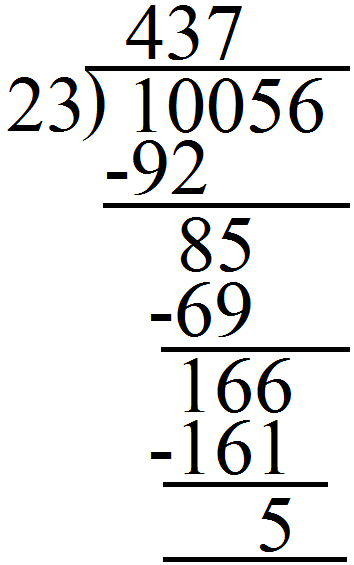
Remainder $= 5$
Required number $= 23 - 5 = 18$
So, $18$ must be added to $10056$ to get a number exactly divisible by $23.$
i.e., $10056 + 18 = 10074$
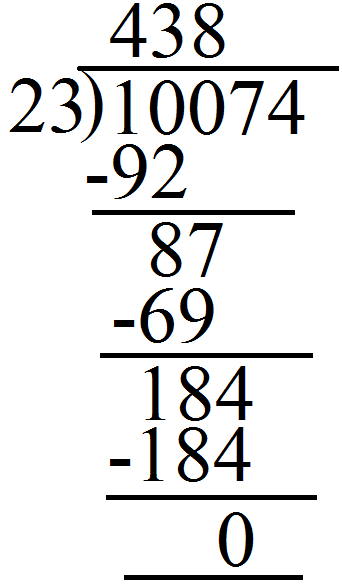
Hence, $10074$ is exactly divisible by $23.$
View full question & answer→MCQ 1691 Mark
Which of the following options defines associative property for whole numbers$?$
- ✓
$0 + (8 + 5) = (0 + 8) + 5$
- B
$0 \times (8 + 5) = (0 + 8) \times 5$
- C
$0 - (8 ÷ 5) = (0 - 8) ÷ 5$
- D
$0 ÷ (8 ÷ 5) = (0 ÷ 8) ÷ 5$
AnswerCorrect option: A. $0 + (8 + 5) = (0 + 8) + 5$
$LHS = 0 + (8 + 5) = 0+ 13 = 13$
$RHS = (0 + 8) + 5 = (0 + 8) + 5 = 13$
$LHS = RHS$
View full question & answer→MCQ 1701 Mark
Which of the following depicts associative law for multiplication$?$
AnswerCorrect option: D. $(a \times b) \times c = a \times (b \times c)$
Associative property for multiplication states that the product of any three or more numbers remains the same irrespective of the order in which the multiplication is carried out.
$\therefore (a \times b) \times c = a \times (b \times c).$
View full question & answer→MCQ 1711 Mark
Select the correct order for defining the following terms:
$i.$ Natural number
$ii.$ imaginary number
$iii.$ rational number
$iv.$ integer
- ✓
$I, IV, III, II$
- B
$I, II, III, IV$
- C
$I, III, II, IV$
- D
$IV, I, III, II$
AnswerCorrect option: A. $I, IV, III, II$
Here natural numbers are subset of integers , integers are subset of rational numbers and
rational numbers are subset of imaginary numbers
Therefore the correct order of defining them is shown in option $A$
View full question & answer→MCQ 1721 Mark
Which of the following numbers cannot be arranged as a rectangle?
MCQ 1731 Mark
Which of the following numbers is not a triangular number$?$
View full question & answer→MCQ 1741 Mark
Which of the following numbers cannot be shown by two rectangles$?$
View full question & answer→MCQ 1751 Mark
First triangular number is
MCQ 1761 Mark
Which of the following numbers can be shown as square?
MCQ 1771 Mark
The number $10$ cannot be shown as a
View full question & answer→MCQ 1781 Mark
The number $6$ cannot be shown as a
View full question & answer→MCQ 1791 Mark
The number $5$ can be arranged as a
View full question & answer→MCQ 1801 Mark
Which of the following is true?
- ✓
The number $2$ can be arranged as a line.
- B
The number $2$ can be arranged as a square.
- C
The number $2$ can be arranged as a triangle.
- D
The number $2$ can be arranged as a rectangle
AnswerCorrect option: A. The number $2$ can be arranged as a line.
The number $2$ can be arranged as a line.
View full question & answer→MCQ 1811 Mark
I purchased $10$ litres of milk in the morning and 5 litres of milk in the evening. If the milk costs $₹ 30$ per litre, how much money will I have to pay to the milkman?
View full question & answer→MCQ 1821 Mark
$‘2 \times (3 + 4) = (2 \times 3) + (2 \times 4)’$ The above is known as
- ✓
distributivity of multiplication over addition
- B
associativity of addition
- C
associativity of multiplication
- D
AnswerCorrect option: A. distributivity of multiplication over addition
distributivity of multiplication over addition
View full question & answer→MCQ 1831 Mark
$‘(2 \times 3) \times 4 = 2 \times (3 \times 4)’ $ The above is known as
- A
commutativity of addition
- B
associativity of addition
- C
commutativity of multiplication
- ✓
associativity of multiplication
AnswerCorrect option: D. associativity of multiplication
commutativity of addition
View full question & answer→MCQ 1841 Mark
$‘(1 + 2) + 3 = 1 + (2 + 3)’$ The above is known as
- A
commutativity of addition
- ✓
associativity of addition
- C
commutativity of multiplication
- D
associativity of multiplication
AnswerCorrect option: B. associativity of addition
associativity of addition
View full question & answer→MCQ 1851 Mark
$‘3 + 5 = 5 + 3’$ The above is known as
- A
$50600, 8500, 7235, 4000$
- ✓
$50600, 8500, 4000, 7200$
- C
$50600, 7235, 8500, 4000$
- D
$50600, 7235, 4000, 8500$
AnswerCorrect option: B. $50600, 8500, 4000, 7200$
$50600, 8500, 4000, 7200$
View full question & answer→MCQ 1861 Mark
Whole numbers are closed under addition and multiplication.’ This property is known as
- ✓
$7500, 2000, 525, 132$
- B
$132, 525, 2000, 7500$
- C
$132, 525, 7500, 2000$
- D
$7500, 2000, 132, 525$
AnswerCorrect option: A. $7500, 2000, 525, 132$
$7500, 2000, 525, 132$
View full question & answer→MCQ 1871 Mark
$1 ÷ 0 =$
View full question & answer→MCQ 1881 Mark
Which of the following will not represent zero?
- ✓
$0 + 1$
- B
$0 × 0$
- C
$0/2$
- D
$(2-2)/2$
AnswerCorrect option: A. $0 + 1$
$0 + 1$
View full question & answer→MCQ 1891 Mark
Find $(24 ÷ 4) – 2.$
View full question & answer→MCQ 1901 Mark
Find $27 ÷ (9 ÷ 3).$
View full question & answer→MCQ 1911 Mark
How many natural numbers are there between $1$ and $10?$
View full question & answer→MCQ 1921 Mark
Which of the following statement is true$?$
AnswerCorrect option: A. The whole number $0$ has no predecessor.
The whole number $0$ has no predecessor.
View full question & answer→MCQ 1931 Mark
Which of the following statement is true$?$
- ✓
$1$ is the smallest natural number.
- B
$50$ is the predecessor of $49.$
- C
$1$ is the smallest whole number.
- D
$599$ is the successor of $600$
AnswerCorrect option: A. $1$ is the smallest natural number.
$1$ is the smallest natural number.
View full question & answer→MCQ 1941 Mark
Which of the following is true$?$
- ✓
$210 > 201$
- B
$210 < 201$
- C
$210 = 201$
- D
AnswerCorrect option: A. $210 > 201$
$210 > 201$
View full question & answer→MCQ 1951 Mark
Which of the following statement is true$?$
AnswerCorrect option: A. All natural numbers are also whole numbers.
All natural numbers are also whole numbers.
View full question & answer→MCQ 1961 Mark
The smallest whole number is
MCQ 1971 Mark
To find the successor of a number, we have to add the number itself.
MCQ 1981 Mark
To find the predecessor of a number, we have to subtract from the number itself.
MCQ 1991 Mark
The difference between the successor and the predecessor of a number is
MCQ 2001 Mark
The difference between the predecessor of a number and the number it self is
MCQ 2011 Mark
The difference between the successor of a number and the number it self is
MCQ 2021 Mark
The natural number that has no predecessor is
MCQ 2031 Mark
The predecessor of $36$ is
View full question & answer→MCQ 2041 Mark
The successor of $27$ is
View full question & answer→MCQ 2051 Mark
The predecessor of $100$ is
View full question & answer→MCQ 2061 Mark
The successor of $99$ is
View full question & answer→