Question types

Changes Around Us question types

379 questions across 9 question groups — pick any mix to generate a Science paper with step-by-step answer keys.

379
Questions
9
Question groups
5
Question types
Sample Questions

Changes Around Us questions

One sample from each question group in this chapter. Select any group above to see the full set with answer keys.

Which of these is not a physical change?
  • A
    Sulphur dissolved in carbon disulphide.
  • B
    Resin dissolved in alcohol.
  • The fermentation of cane juice.
  • D
    The glowing of an electric bulb.

Answer: C.

View full solution
Which among the following is not an example of a reversible change?
  • A
    Dissolving sugar in water.
  • Changing of wheat to flour.
  • C
    Folding up of a paper.
  • D
    Melting of coal tar.

Answer: B.

View full solution
Directions: The questions in this segment consists of two statements, one labelled as "Assertion $A"$ and the other labelled as "Reason $R"$. You are to examine these two statements carefully and decide if the Assertion $A$ and Reason $R$ are individually true and if so, whether the reason is a correct explanation of the assertion. Select your answers to these items using codes given below.
Assertion A: The process of conversion of liquid water to its vapours by heating the liquid is called boiling.
Reason R: The process of conversion of water vapours to liquid by cooling the vapours is called condensation.
  • A
    Both $A$ and $R$ are true and $R$ is the correct explanation of $A$
  • Both $A$ and $R$ are true but $R$ is not the correct explanation of $A$
  • C
    $A$ is true but $R$ is false
  • D
    $A$ is false but $R$ is true

Answer: B.

View full solution
Directions: The questions in this segment consists of two statements, one labelled as "Assertion $A"$ and the other labelled as "Reason $R"$. You are to examine these two statements carefully and decide if the Assertion $A$ and Reason $R$ are individually true and if so, whether the reason is a correct explanation of the assertion. Select your answers to these items using codes given below.
Assertion A: Burning of paper is a physical change.
Reason R: The products formed on burning of paper cannot be easily converted back to paper.
  • A
    Both $A$ and $R$ are true and $R$ is the correct explanation of $A$
  • B
    Both $A$ and $R$ are true but $R$ is not the correct explanation of $A$
  • C
    $A$ is true but $R$ is false
  • $A$ is false but $R$ is true

Answer: D.

View full solution
Directions: The questions in this segment consists of two statements, one labelled as "Assertion $A"$ and the other labelled as "Reason $R"$. You are to examine these two statements carefully and decide if the Assertion $A$ and Reason $R$ are individually true and if so, whether the reason is a correct explanation of the assertion. Select your answers to these items using codes given below.
Assertion A: The explosion of a fire cracker sis a physical changes.
Reason R: A physical change is a reversible change.
  • A
    Both $A$ and $R$ are true and $R$ is the correct explanation of $A$
  • B
    Both $A$ and $R$ are true but $R$ is not the correct explanation of $A$
  • C
    $A$ is true but $R$ is false
  • $A$ is false but $R$ is true

Answer: D.

View full solution
Which of the following changes cannot be reversed?
  1. Blowing of a balloon.
  2. Folding a paper to make a toy aeroplane.
  3. Rolling a ball of dough to make roti.
  4. Baking cake in an oven.
  5. Drying a wet cloth.
  6. Making biogas from cow dung.
  7. Burning of a candle.
View full solution
Boojho’s sister broke a white dove, a symbol of peace, made of Plaster of Paris $(POP)$. Boojho tried to reconstruct the toy by making a powder of the broken pieces and then making a paste by mixing water. Will he be successful in his effort? Justify your answer.
View full solution
A potter working on his wheel shaped a lump of clay into a pot. He then baked the pot in an oven. Do these two acts lead to the same kind of changes or different? Give your opinion and justify your answer.
View full solution
Paheli mixed flour and water and:
  1. Made a dough.
  2. Rolled the dough to make a chapati.
  3. Baked the chapati on a pan.
  4. Dried the chapati and ground it in a grinder to make powder. Identify the changes (i) to (iv) as the changes that can be reversed or that cannot be reversed.
View full solution
Give one example in each case:
  1. Change which occurs on heating but can be reversed.
  2. Change which occurs on heating but cannot be reversed.
  3. Change which occurs on cooling but can be reversed.
  4. Change which occurs on mixing two substances, but can be reversed.
  5. Change which occurs on mixing two substances, but cannot be reversed.
View full solution
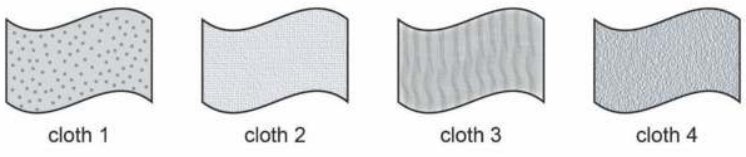
Shilpa wanted to ind out which dye creates a permanent stain on clothes.Image

She poured one drop each of four different dyes on separate pieces of cloth.
Shilpa then washes each piece of cloth with a detergent.
The table below shows what happened after the clothes were washed.
Dye Was the stain removed after washing?
Dye $1$ yes
Dye $2$ no
Dye $3$ yes
Dye $4$ yes
$9.$ Which dye produced a permanent stain on the cloth?
$A.$ Dye$ 1$
$B.$ Dye $2$
$C.$ Dye $3$
$D.$ Dye $4$
$10.$ What must Shilpa keep the same for all the four clothes in her activity?
View full solution
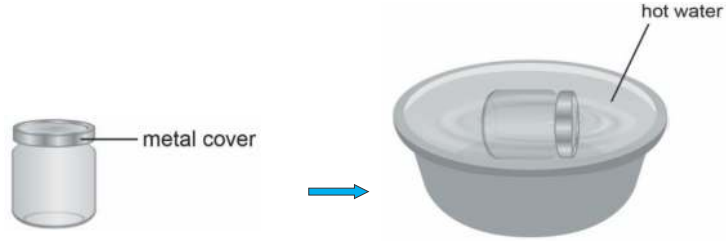
Leena had a glass container with butter cubes in it.
She could not open the metal cover as it was too tight.
Leena placed the container in a tumbler of hot water.Image
Leena took the container out of the hot water after $15$ minutes.
She was then able to remove the metal cover.
$5.$ How did hot water help in removing the metal cover?
$6.$ What is Leena likely to ind after taking the container out of hot water?
$A.$ Butter cubes have melted.
$B.$ Butter cubes have got larger.
$C.$ Butter cubes have got harder.
$D.$ Butter cubes have changed to a new substance
$7.$ Which of the following changes can be reversed?
Circle $‘Yes’$ or $‘No’$ to mark your response.
Can this change be reversed? $Yes$ or $No$
Melting of wax Yes/No
Shredding of paper Yes/No
Bending of rubber pipe Yes/No
$8.$ Which condition must be true for a permanent change?
$A.$ Change in shape
$B.$ Change in volume
$C.$ Loss or gain of heat
$D.$ New substance is formed
View full solution
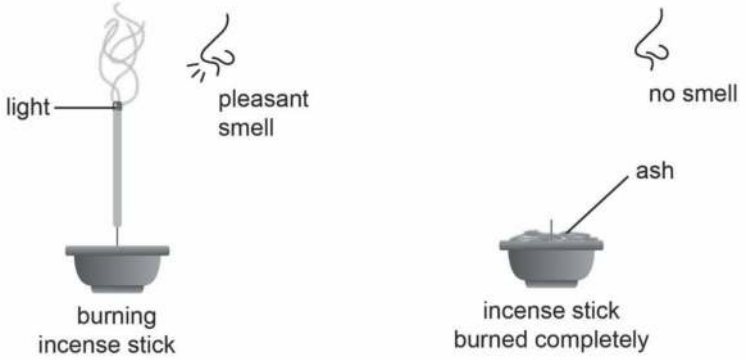
Mary lit an incense stick.
She sensed a pleasant smell for as long as the stick was burning.
The incense stick burned up completely, leaving some ash behind.Image
$3.$ What can be concluded from Mary’s activity?
Circle $‘Yes’$ or $‘No’$ to mark your response.
Can this be concluded from the activity? $Yes$ or $No$
Incense sticks contain chemicals that produce smell when burnt Yes/No
Burning of incense sticks produces light. Yes/No
A new substance is formed by the burning of incense sticks. Yes/No
$4.$ Which of these changes can be reversed?
$A.$ Boiling of egg
$B.$ Burning of wood
$D.$ Making curd from milk
$C.$ Melting of ice cream
View full solution
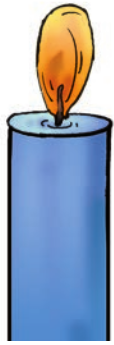
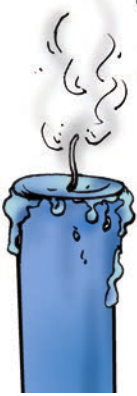
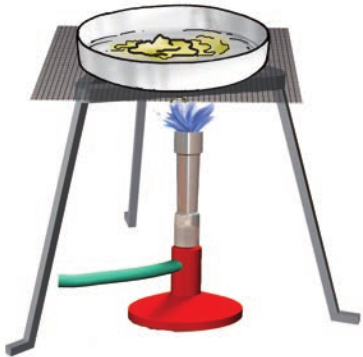
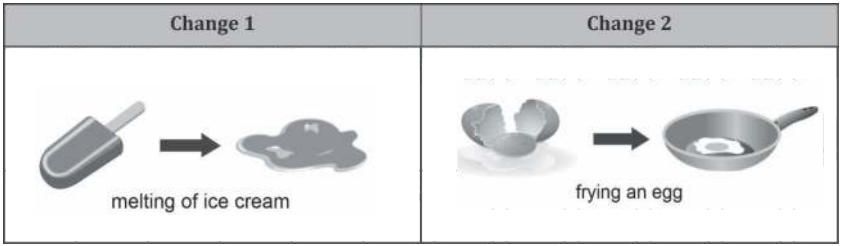
The pictures show two types of change in objects.Image
Which statement about the two changes is true?
Circle $'Yes'$ or $'No'$ for the correct response.
  $Yes$ or $No$
Change $1$ can be reversed. $Yes/No$
A new substance is formed in change $2.$ $Yes/No$
Change $1$ requires cooling but change $2$ requires heating. $Yes/No$
View full solution
Paheli had bought a new bottle of pickle from the market. She tried to open the metal cap to taste it but could not do so. She then took a bowl of hot water and immersed the upper end of the bottle in it for five minutes. She could easily open the bottle now. Can you give the reason for this?
View full solution

Generate a Changes Around Us paper free

Pick question groups from the list above, set marks and difficulty, and export a branded PDF with step-by-step answer keys. First 3 chapters free — no signup.

Download App