Question types

Separation of Substances question types

358 questions across 9 question groups — pick any mix to generate a Science paper with step-by-step answer keys.

358
Questions
9
Question groups
5
Question types
Sample Questions

Separation of Substances questions

One sample from each question group in this chapter. Select any group above to see the full set with answer keys.

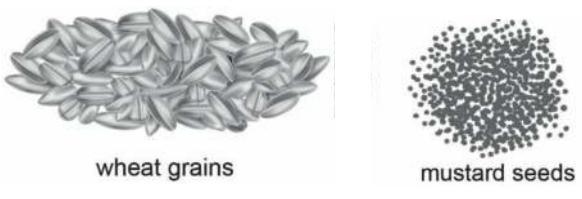
While preparing chapatis, Paheli found that the flour to be used was mixed with wheat grains. Which out of the following is the most suitable method to separate the grains from the flour?
  • A
    Threshing.
  • Sieving.
  • C
    Winnowing.
  • D
    Filtration.

Answer: B.

View full solution
$X$ is a separation technique used only when the components of a solid-solid mixture have different sizes. Identify $X.$
  • A
    Winnowing.
  • Sieving.
  • C
    Threshing.
  • D
    Magnetic separation.

Answer: B.

View full solution
Direction: Read the passages given below and answer the questions that follow. Passage. Mohan's Mother bought rice from market. Before cooking rice Mohan and his mother observed that rice contains impurities such as pebbles, husk and chaff in it. Mohan said that he will not eat these rice as it contain various impurities. But his mother told him that before cooking these impurities are removed by different methods. Which process is used for separation of husk and chaff from rice?
  • A
    Winnowing.
  • B
    Sedimentation.
  • C
    Sieving.
  • Both $(a)$ and $(b).$

Answer: D.

View full solution
Assertion – for separation of heavier and lighter components of a mixture by wind or by blowing air.
Reason – The process which is used to separate rain from stalks are known as winnowing.
  • A
    Assertion and reason both are correct statement and reason is correct explanation for assertion.
  • B
    Assertion and reason both are correct statement and reason is not correct explanation for assertion.
  • Assertion is correct statement but reason is wrong statement. 
  • D
    Assertion is wrong statement but reason is correct statement.

Answer: C.

View full solution
Assertion – when the heavier component in a mix settles after water is added to it the process is called sedimentation. Reason – when the water along with the dust is removed the process called decantation.
  • A
    Assertion and reason both are correct statement and reason is correct explanation for assertion.
  • Assertion and reason both are correct statement and reason is not correct explanation for assertion.
  • C
    Assertion is correct statement but reason is wrong statement.
  • D
    Assertion is wrong statement but reason is correct statement.

Answer: B.

View full solution
Assertion – evaporation can be used to separate a solid dissolved in a liquid. Reason- Evaporation is the process in which liquid gets converted into it’s vapour.
  • Assertion and reason both are correct statement and reason is correct explanation for assertion.
  • B
    Assertion and reason both are correct statement and reason is not correct explanation for assertion.
  • C
    Assertion is correct statement but reason is wrong statement.
  • D
    Assertion is wrong statement but reason is correct statement.

Answer: A.

View full solution
Assertion- Separation of stones from rice is one of the separation method. Reason – The above separation method is handpicking method of separation.
  • Assertion and reason both are correct statement and reason is correct explanation for assertion.
  • B
    Assertion and reason both are correct statement and reason is not correct explanation for assertion.
  • C
    Assertion is correct statement but reason is wrong statement.
  • D
    Assertion is wrong statement but reason is correct statement.

Answer: A.

View full solution
DIRECTIONS: The questions in this segment consists of two statements, one labelled as "Assertion and the other labelled as "Reason $R$ ". You are to examine these two statements carefully and decide if he Assertion $A$ and Reason $R$ are individually true and if so, whether the reason is a correct explanation if the assertion. Select one of the current options, and given below in each questions.
Assertion A: The process of settling of heavier insoluble particles from a suspension of a substance in water known as decantation.
Reason R: This process along with sedimentation is used to get clear water from muddy water.
  • A
    Both $A$ and $R$ are true and $R$ is the correct explanation of $A$
  • B
    Both $A$ and $R$ are true but $R$ is not the correct explanation of $A$
  • $A$ is true but $R$ is false
  • D
    $A$ is false but $R$ is true

Answer: C.

View full solution
Mention the methods that can be used for the separation of the following mixtures:
  1. Wheat, sugar and husk
  2. Rice, gram and iron fillings
  3. Sand, Mack gram (urad) and husk.
View full solution
Activity.Take two glasses and pour half a cup of water in each of them. Add a teaspoon of salt to one glass and stir till the salt dissolves. Go on adding salt, one teaspoon at a time, till the solution saturates. Record the number of spoons of salt that dissolved in the water, in Table. Now, repeat the same activity with sugar. Repeat this with some other substances that are soluble in water.
What do you notice from Table? Do you find that water dissolves different substances in different amounts?
View full solution
Read the story titled $\text{“WISE FARMER”}$ and tick the correct option to complete the story.
A farmer was,
  1. Sad/ happy to see his healthy wheat crop ready for harvest. He harvested the crops and left it under the.
  2. Sun/ rain to dry the stalks. To separate the seeds from the bundles of the stalk he.
  3. Handpicked/ threshed them. After gathering the seed grains, he wanted to separate the stones and husk from it. His wife.
  4. Winnowed/ threshed them to separate the husk and later.
  5. Sieved/ handpicked to remove stones from it. She ground the wheat grains and.
  6. Sieved/ filtered the flour. The wise farmer and his wife got a good price for the flour.
View full solution
Both Sarika and Mohan were asked to make salt solution. Sarika was given a teaspoonful of salt and half a glass of water, whereas Mohan was given twenty teaspoons full of salt and half a glass of water.
  1. How would they make salt solutions?
  2. Who would be able to prepare saturated solution?
View full solution
Match the mixtures in Column $I$ with their method of separation in Column $II$.
 
$COLUMN\ I$
 
$COLUMN\ II$
$a$
Oil mixed in water
$i$
Sieving
$b$
Iron powder mixed with flour
$ii$
Hand picking
$c$
Salt mixed with water
$iii$
Decantation
$d$
Lady's finger mixed with french beans
$iii$
Magnet
$e$
Rice flour mixed with kidney beans
$iv$
Evaporation
View full solution
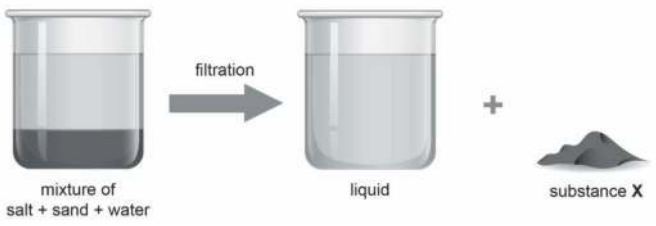
A beaker contains a mixture of salt, sand and water.
The mixture is iltered using ilter paper.Image
$8.$ What is substance $X$?
$9.$ Write a single separation method by which water can be separated from a mixture of salt, sand and water.
View full solution
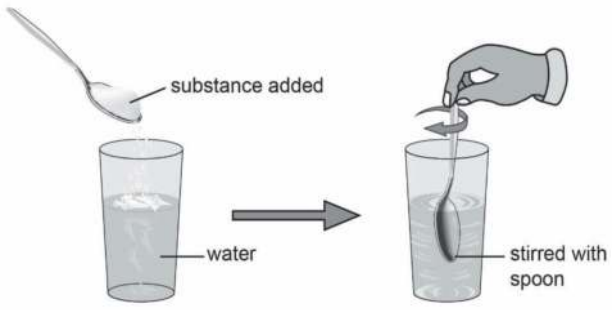
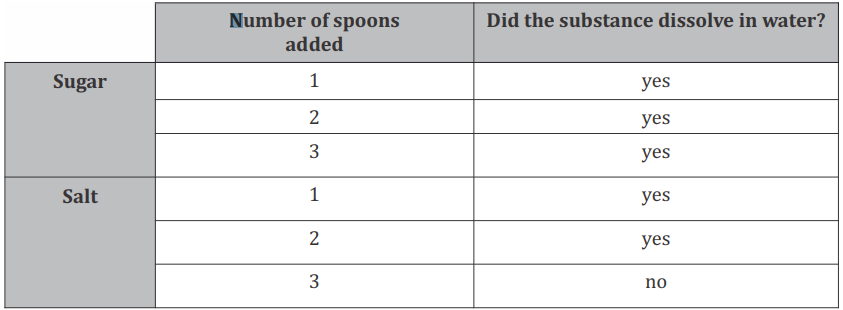
Anu adds sugar and salt to two separate glasses of water.
She stirs the mixture in each glass every time she adds salt or sugar to it.Image

She notes her indings in a table.
Image
$3.$ What can Anu conclude from her activity?
$A.$ Sugar and salt dissolve equally in water.
$C.$ Stirring helps in dissolving all substances in a liquid.
$B.$ Sugar is more soluble than salt in water.
$D.$ Sugar forms a saturated solution in water but salt does not.
$4.$ Anu used two spoons of the same size to add sugar and salt to water.
What else did Anu need to keep the same for her activity?
$5.$ Anu repeats the activity using hot water.
Will the results in the table remain the same? Explain your answer
$6.$ Which of these processes could be used to separate the salt dissolved in the glass of water?
$A.$ Filtration
$B.$ Evaporation
$C.$ Condensation
$D.$ Sedimentation


View full solution
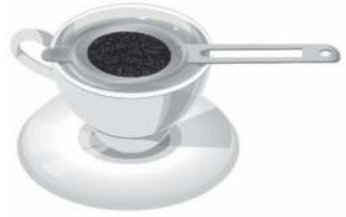
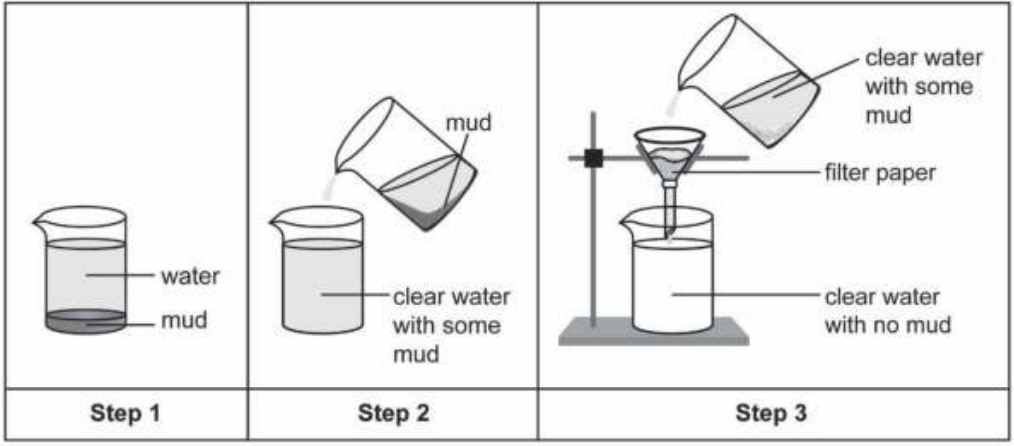
Saroj collected muddy water from a pond.
He separated the water from the mud in three steps as shown in the pictures below.
Image
$1.$ Which separation method did Saroj use at each step?
Select the correct row.
  Step $1$ Step $2$ Step $3$
$A.$ Evaporation Sedimentation Decantation
$B.$ Sedimentation Decantation Filtration
$C.$ Decantation Sedimentation Condensation
$D.$ Sedimentation Filtration Decantation
$2.$ Did Which of these properties did Saroj use to separate mud from water?
$A.$ Mud loats on water.
$B.$ Mud dissolves in water.
$C.$ Mud turns water cloudy.
$D.$ Mud is heavier than water.
View full solution

Generate a Separation of Substances paper free

Pick question groups from the list above, set marks and difficulty, and export a branded PDF with step-by-step answer keys. First 3 chapters free — no signup.

Download App