Questions

[2 Mark Questions]

Take a timed test

21 questions · self-marked practice — reveal the answer and mark yourself.

Question 12 Marks
Do you think that the life of farmers and herders who supplied food to the Harappan cities was different from that of the farmers and herders? Give reasons for your answer.
Answer
The farmers and herders who gave food to the Harappan cities knew about agriculture and domestication of animals. So they supplied food to the city dwellers. The farmers and herders in the earlier period cultivated the fields themselves and domesticated the animals. So they provided their own food.
View full question & answer
Question 22 Marks
Make a list of all the terracotta toys shown in the lesson. Which do you think children would have enjoyed playing with the most?
Answer
Most of the terracotta toys are the models of clay, which show animal figures. Most probably the toys are models of cattle, rhinoceros, cow etc.
View full question & answer
Question 32 Marks
How do archaeologists know that cloth was used in the Harappan civilisation?
Answer
Archaeologists know that people in the in the Harappan civilization use cloth because they have found pieces of cloth attached to the lid of a silver vase. They have also found spindle whorls, made of terracotta and faience. They were used to spin thread.
View full question & answer
Question 52 Marks
When did earliest cities emerge in India?
Answer
The earliest cities of the Indian subcontinent emerged around 4,700 years in the region drained by Indus and its tributaries in the North-West.
View full question & answer
Question 62 Marks
What are the two important salient features about the constructions excavated in the Indus Valley Civilisation?
Answer
  1. It has been found that baked bricks were used in all buildings.
  2. These bricks were laid in an interlocking pattern to make strong walls.
View full question & answer
Question 72 Marks
Write two main characteristics of houses in the Harappan city.
Answer
  1. Generally, houses were either one or two storeys high with a single room built around a courtyard.
  2. Most houses had a separate bathing area and some had wells to supply water.
View full question & answer
Question 82 Marks
Write a short note on the Script of the Harappan people.
Answer
  1. Historians believe that the people of the Indus-Valley civilisation were literate. Many seals have been discovered. We can note lines (or symbols) of signs on the top of several seals of the Harappan people. These are parts of what historians call a script. This is the earliest form of writing known in the subcontinent.
  2. Scholars have made many efforts to read these signs (or decipher the Harappan script), but we still do not know exactly what they mean.
View full question & answer
Question 92 Marks
Write down the names of the main earliest cities?
Answer
The names are:Mohenjodaro, Harappa, Kalibangan, Rakhi Garhi, Chanhudaro, Dholavira, Surkotada, Lothal and Sotkakoh.
View full question & answer
Question 102 Marks
Describe the Great Bath.
Answer
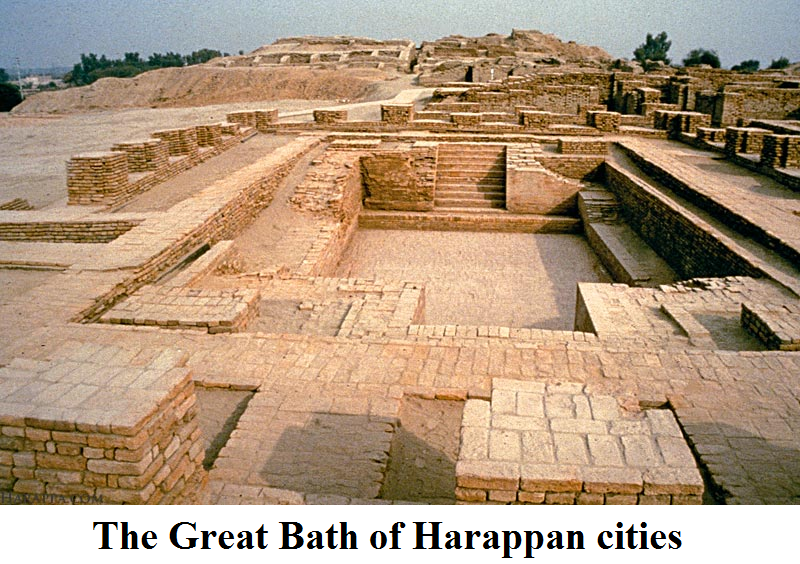
The Great Bath is a tank excavated in Mohenjodaro. It has steps leading from two sides. The bath was lined with bricks and coated with bitumen to make it water proof.
View full question & answer
Question 112 Marks
What was special about the roads in the Indus Valley Civilization?
Answer
The roads were wide and cut each other at right angles. Houses were built on both sides and covered drains ran along the streets.
View full question & answer
Question 122 Marks
Make a list of what Harappans ate, and put a tick mark against the things you eat today.
Answer
The people of Harappans grew wheat, barely, pulses, peas, rice, sesame, linseed and mustard. We today eat all these things they collected ber, hunted wild animal and caught fish.
View full question & answer
Question 132 Marks
What does ‘raw material’ mean?
Answer
Raw materials are substances that are either found naturally or produced by farmers or herders. These are then processed to produce finished goods.
View full question & answer
Question 142 Marks
Into how many parts were the cities of the Mohenjodaro and Harappa divided?
Answer
Both cities were divided into two main parts:
  1. Upper part and
  2. Lower part.
View full question & answer
Question 152 Marks
What was the main food of people in the cities?
Answer
The main food of the Harrappans were wheat, barley, pulses, peas, rice, sesame, linseed and mustard together with meat, milk and milk products.
View full question & answer
Question 162 Marks
List features of The Great Bath.
Answer
The Great Bath was lined with bricks, coated with plaster and made water tight with a layer of natural tar. There were steps leading down from two sides into the tank.
View full question & answer
Question 172 Marks
What were the main Harappan towns in Gujrat?
Answer
The main Harappan towns in Gujrat were Dholavira, located on Khadir Beyt in the Rann of Kutch and Lothal that stood beside a tributary of the Sabarmati, close to the gulf of Khambat.
View full question & answer
Question 182 Marks
Write about Harappan seals.
Answer
Harappan seals had pictures of animals that relate to a wet and marshy environment. Rhinoceroses, elephants, and tigers were placed in the midst of marshy plants.
View full question & answer
Question 192 Marks
What type of houses were found in the earlier cities?
Answer
In Harrappan city, which is the first urban site in India, houses were either one or two storeys high, with rooms built around a courtyard.
View full question & answer
Question 202 Marks
When was cotton cultivated at Mehrgarh?
Answer
Cotton was probably grown at Mehragarh about 7000 years ago. Mehragarh was also the first site in India where agricultural activities took place.
View full question & answer
Question 212 Marks
What was the use of the Great Bath? What materials were used in the great bath?
Answer
Important people (priests, rulers) took ritual baths in this tank. The tank was lined with kiln burnt bricks, plaster of gypsum and bitumen was used to make the tank water resistant.
View full question & answer