Questions

[5 marks Questions]

🎯

Test yourself on this topic

13 questions · timed · auto-graded

Question 15 Marks
Give historical background of maps.
Answer
The science of map making is termed as cartography.
Ancient map makers did not know the shape of the Earth:
  1. Babylonians drew maps assuming that the Earth is flat.
  2. An Egyptian geographer, (cartographer) Ptolemy first represented the Earth as a sphere.
Maps were drawn on different materials:
  1. Eskimos used animal skin.
  2. Egyptians engraved maps on metal plates.
  3. Babylonians made maps of clay tablets.
Today maps are made on computers:
  1. These maps are very accurate.
  2. Improvement in technology has improved the quality of maps.
View full question & answer
Question 25 Marks
How are directions known?
Answer
Directions are known by the following:
Maps contain an arrow marked with the letter ‘N’ on the upper right.
An Arrow with ‘N’ mark:
  1. This arrow shows the North direction.
  2. It is called north line. On the Earth one can find out directions e.g. north, east, west and south.
  3. There are four major directions.
  4. North, South, East, West. They are called cardinal points.
  5. Other four intermediate directions are North-East (NE), South-East (SE), South¬West (SW) and North-West (NW).
  6. One can locate any place more accurately with the help of these intermediate directions.
Compass: One can also know the direction with the help of compass
  1. It is an instrument used to find the main directions.
View full question & answer
Question 35 Marks
Name the two types of maps based on scale.
Answer
Small Scale Maps.When large areas are shown on a small map, it is called small scale map.
  1. These maps give very limited information.
  2. The map of India is a small scale map.
Large Scale Maps.
  1. When small areas are shown on large map it is called Large scale map.
  2. These maps give detailed information.
  3. The map of Delhi, shown on large sheet of paper is a large scale map.
View full question & answer
Question 45 Marks
A Sketch Map and a Plan.
Answer
A Sketch Map
A Plan
A sketch map is a map that shows outlines details. It can be drawn without using a scale. It is a rough drawing and the distances are not accurate according to any scale. Example- a sketch map of the Taj Mahal
A plan is a representation of an area with reduced measurement (scale) It could be a plan of a house, classroom a multi ? storey building or a monument Example- the Taj Mahal Measurements are clearly mentioned as using a scale is necessary for making a plan.
View full question & answer
Question 55 Marks
Why do we need to understand maps?
Answer
Maps are used:
  1. To find our way around a city.
  2. To find the location of specific places in a new city.
  3. To find the shortest route to a specific spot.
  4. To find out locations of petrol pumps, police station and rest house on highways.
  5. In case of emergency, it helps to find the nearest hospital or medical aid.
View full question & answer
Question 65 Marks
What are the basic characteristics of a good map?
Answer
Maps are the basic tools of geography that enable us to depict spatial phenomenon on paper. A good map will have:
  • Legend: A good map will have a legend or key which shows the user what different symbols mean. For instance, a square with a flag on top usually represents a school and roads are represented by a variety of widths and combinations of lines.
  • Direction: Without a north arrow, it is difficult to determine the orientation of a map. With a north arrow (pointing in the correct direction), a user can determine direction.
  • Title: A map's title provides important clues about the cartographer's intentions and goals.
View full question & answer
Question 75 Marks
How many types of maps are there on the basis of their scale? Mention their features.
Answer
Maps can be classified on the basis of the scale. A map can be a large scale or small scale depending on the ratio of distance on the map to the distance on the ground.
  1. Small Scale Maps:
Small scale maps show a large area such as that of a continent or country. So, many minute details cannot be shown as there is less space on the map.
  1. Large Scale Maps:
Large scale maps show a very small area in detail. These maps are used to show layout maps of cities and villages. As the scale increases, detailing of information on the map also increases. When map scale is small, it covers larger area with lesser detailing. When the scale of the map is large, it can show much detailed information of the area shown in the map. For example topographical maps are large scale maps in which we can see natural and man-made features both. But, a map of a country or the world map is a small scale map in which we I can find only the boundaries of the administrative units and their capitals.
View full question & answer
Question 95 Marks
Define Sketch.
Answer
  1. A sketch is a drawing of an area or object mainly based on memory and not to the scale.
  2. Sometimes a rough drawing of an area is needed to know where a particular place is located with reference to other places.
  3. With the help of a rough sketch we may find the location of a place.
  4. Such a rough drawing is drawn without scale.
View full question & answer
Question 105 Marks
What is a map? Describe its major features.
Answer
  1. Map is a representation of the earth’s surface or a part of it drawn on flat surfaces.
  2. One map contains as many facts as a big book.
  3. All the maps are put together to make on atlas of maps of various sizes and drawn on different scales.
  4. They provide more information than a globe.
View full question & answer
Question 115 Marks
How is distance measured? Define a scale.
Answer
Maps reduce the entire world or its part to fit on a sheet of paper.
But this reduction is done very carefully so that distances between the places are kept true:
  1. Reduction of map is only possible when small distances on paper represents a large distance on the ground.
  2. To reduce a map, a scale is chosen.
Scale is the ratio between the actual distance on the ground and the distance shown on the map.
  1. The distance between school and home of student is 10km. If he shows this 10km distance by 2cm on map, it means, 1cm on the map will show 5km on ground. Thus the scale will be 1cm.= 5 km. In this way scale is very important in a map. If the scale is known it will be easy to calculate distance between any two places.
  2. Scales are used for measuring distance. For example to find out the distance between the post office and the clock tower one can measure the distance between these points on the map. (Then the same distance on the scale. Types of Maps on the Basic of Scale.)
View full question & answer
Question 125 Marks
What are symbols? Why do we need them?
Answer
Symbols:
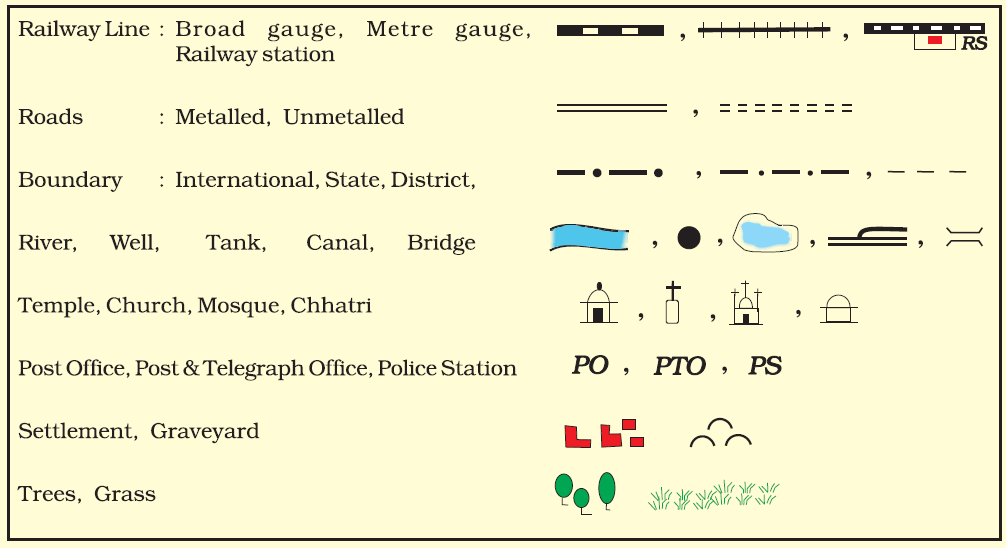
It is impossible to draw actual shape and size of different features like buildings, roads, trees, railway lines or a well on a map, so we use various symbols to show these features.
  1. Symbols give much information in a limited space.
  2. With the help of these symbols, we can draw maps and read them easily.
  3. Without knowing the language of a certain place, we can collect information from maps with the help of these symbols.
  4. Maps have a universal language - a language that can be read by all. An international agreement facilitates the use of these symbols.
  5. These symbols are called Conventional Symbols.
  6. Some of the conventional symbols are shown in the figure given below.
  7. Various colours in maps are also used for the same purpose.
View full question & answer
Question 135 Marks
What are the components of Maps? Describe them.
Answer
There are three components of Maps :
(i) Distance : Distance is an important component for those maps which are drawn to show the distance between the places. The actual distance between the places or objects can be measured by the map. To show the actual distance on the paper is a sensitive work and hence it is done very carefully. In this process, we choose a scale.

Suppose, we have to show distance between the Government School and Hospital of a village; distance between both is 500 metres. We will have to opt for a scale, that may be 200 metres = 1 cm. Therefore, the distance on map will be shown 2.5 cm. When there are large areas such as hundreds of km or thousands of km, we will have to choose a scale. Suppose, 100 km = 1 cm or 1mm etc. The scale is chosen in view of map’s size.

(ii) Direction : Direction is also an important component for the maps. The accurate directions make the maps useful which is made for the same purpose. On the upper right comer of the maps symbol of arrow marked with the letter ‘N’ is represented. There are four major directions-North, South, East and West. These are called cardinal points. Other four intermediate directions are – North- East(NE), South-East(SE), South-West (SW), and North-West (NW). These intermediate directions help us to locate any place more accurately.

(iii) Symbols : Third important component of maps is symbol. It is not possible to show each and every thing on the maps, hence many things or objects or places are shown with the help of symbols. We can show Railway Line, Roads, Boundary, Rivers, Temples, Post office, Police Station, Settlements, Graveyard, forest areas, trees, grass etc., with the help of symbols.

One of the important features of the maps is that the maps have universal language that can be understood by all. There is an international agreement regarding the use of these symbols. These are called conventional symbols.
View full question & answer
[5 marks Questions] - Social Science STD 6 Questions - Vidyadip