Questions

[5 marks Questions]

Take a timed test

14 questions · self-marked practice — reveal the answer and mark yourself.

Question 15 Marks
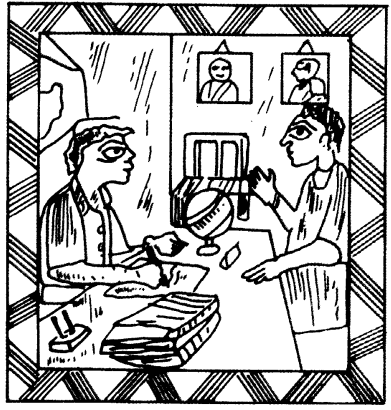
What are the duties of a Tehsildar?
Answer
Duties of a Tehsildar:
  1. He hears disputes.
  2. He supervises the work of Patwaris.
  3. He ensures that records are properly maintained by Patwaris and revenue is collected.
  4. He ensures that farmer gets copy of his records.
  5. He issues caste certificates to students.
  6. Land disputes are also heard by a Tehsildar.
View full question & answer
Question 25 Marks
What is the "Minimum Needs Programmes"?
Answer
The Minimum Needs Programme was introduced in the first year of the Fifth Five Year Plan. The objective of the Programme was to set up a network of basic services and facilities of social consumption in all the areas upto nationally-accepted norms, within a particular time-frame. The programme is intended to assist in raising living standards and in reducing the regional disparities in development. The basic needs of the people accredited for this programme are elementary education, adult education, rural health, rural roads, rural electrification, rural housing, environmental improvement of urban slums and nutrition.
View full question & answer
Question 35 Marks
What are the functions of a Patwari?
Answer
  1. Visiting agricultural lands and preparing land maps.
  2. Maintaining records of land owner, that is, the number of people who own that land.
  3. Maintaining records of the crop grown at every harvest and
  4. Collecting land revenue, irrigation dues, etc. from the farmers.
View full question & answer
Question 45 Marks
What are the important needs of villages?
Answer
Important needs:
  1. Water.
  2. Electricity.
  3. Road connections.
  4. Sanitation.
  5. Maintenance of land records.
  6. Resolution of conflicts.
View full question & answer
Question 55 Marks
Describe the duties of a Patwari.
Answer
Duties of a Patwari:
  1. Responsible for a group of villages.
  2. Maintains and updates the records of the village.
  3. Measures land with a long chain.
  4. Organises collection of land revenue.
  5. Provides information to government about crops grown in the area.
  6. Updating of records is required because of the following:
  7. Change in crops.
  8. Digging of wells.
View full question & answer
Question 65 Marks
Examine the Hindu Succession Amendment Act, 2005.
Answer
  1. In this new law, sons, daughters and their mothers can get an equal share in the property and land.
  2. The same law will apply to all states and union territories of the country.
  3. This law will benefit a large number of women.
  4. It makes them independent and gives their confident to feel important and gives them a feeling of security.
View full question & answer
Question 75 Marks
Describe the wish of a daughter.
Answer
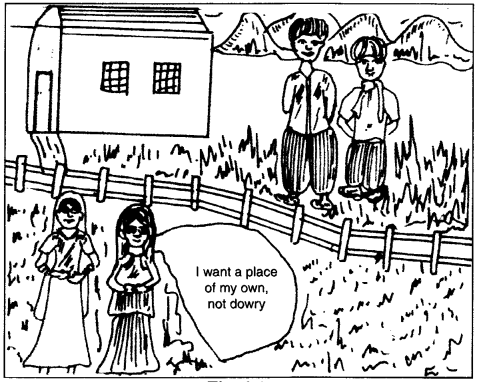
A Daughter’s Wish. Father inherited our house from his. Father. And everyone says he’ll leave it to. Brother. But what about me and my mother? To expect a share in my father’s home, Is not very womanly, I am told. But I really want a place of my own, Not dowry of silk and gold.
View full question & answer
Question 85 Marks
How does the Hindu Succession Amendment Act, 2005 helped women in India to get equal share in the family property?
Answer
The Hindu Succession (Amendment) Act, 2005 is a landmark in the way to women empowerment. It came into force on 9thSeptember 2005. The Act removes gender discriminatory provisions in the Hindu Succession Act, 1956 and gives equal rights in inheritance to daughters. This means daughter has the same right over the property as a son. The act states that daughters will have the same rights as sons to reside in or seek partition of the family house. Economically, it can improve women's security by giving them birth right in property. All this shows that daughters and sons are equally important members of the family.
View full question & answer
Question 95 Marks
How does rural administration work efficiently?
Answer
India is divided into small states which are in turn divided into districts. In order to run the administration, the district comprises of adjacent villages and towns. The revenue department manages all work relating to land. The sub-division of the district are called tehsil, taluka, etc. The district collector is the head of the revenue department. Under him come small officers like tehsildar, naib tehsildar who assist him in his work. Below them are the Patwaris who give information about the ownership, area, location, cultivated area and the facilities available. The copy of records can be made available easily to the farmer or landowners, whenever they need them.
View full question & answer
Question 105 Marks
Describe the provisions of Hindu Succession Amendment Act, 2005.
Answer
Provisions of Hindu Succession Amendment Act, 2005.
  1. Till the amendment women did not have the right to share family’s agricultural land.
  2. After the death of father his land was distributed among his sons only.
According to New Law:
  1. Sons, daughters and their mother get equal share in the land.
  2. The law applies to all the states and union territories.
  3. Patwari will transfer the land to all sons, daughters and their mother and record their names in the revenue records.
View full question & answer
Question 115 Marks
Describe functions of police.
Answer
The functions of the police Eire :
(a) To maintain law and order;
(b) To uphold and enforce the law impartially, and to protect life, liberty, property, human rights, and dignity of the members of the public;
(c) To protect internal security, to prevent and control terrorist activities, militant activities and other situations affecting internal security;
(d) To protect public properties including roads, railways, bridges, vital installations and establishments etc.
(e) To prevent crimes,
(f) To investigate and register all complaints and cognizable offences;
(h) To create and maintain a feeling of security in the community and as far as possible prevent conflicts and promote peace;
(i) To provide, as first responders, all possible help to people in situations arising out of natural or man-made disasters, and to provide active assistance to other agencies in relief and rehabilitation measures;
(j) To facilitate orderly movement of people and vehicles, and to control and regulate traffic on roads and highways.
(k) To collect intelligence relating matters affecting public peace, and all kind of crimes including social offences, communalism, extremism, terrorism.
(l) To take charge, as a police officer on duty, of all unclaimed property and take action for their safe custody and disposal in accordance with the procedure prescribed.
(m) To train, motivate and ensure welfare of police personnel.
View full question & answer
Question 125 Marks
You saw that Mohan and Raghu were arguing heatedly whether the common boundary of their fields had been shifted. Isn’t there a way by which they could have settled this dispute in a peaceful manner? Are there records that show who owns what land in the village? Let’s find out how this is done.
Answer
→ Yes, there is a way by which they could have settled this dispute in a peaceful manner :
• Mohan should have gone to Patwari first and got the fields measured.
• Mohan should have gone to the village panchayat.
· The Panchayat would have discussed the matter with Mohan and Raghu.
· The village members would have dissuaded Raghu and he would have retraced his step.
· He would have given back the occupied portion of land to Mohan.
→ Yes, there are records that show who owns what land in the village. They are called land revenue records. They remain with the village Patwari.
→ How land records are kept is given below :
• Patwari is an officer who measures the land and keeps the land records.
• Patwari is called by different names in different states :
· Patwari
· Lekhpal
· Kanungo
· Karmachari
· Village Officer
• Patwari maintains and updates the land records :
· he uses a long chain for measuring land.
· he also collects revenue (Lagaan or rent).
· he also informs the government about crops grown in his area.
View full question & answer
Question 135 Marks
When they reached the police station Mohan went to the person-in-charge (Station House Officer or S.H.O.) and told him what had happened. He also said that he wanted to give the complaint in writing. The S.H.O. rudely brushed him aside saying that he couldn’t be bothered to waste his time writing down minor complaints and then investigating them. Mohan showed him his injuries but the S.H.O. did not believe him.
Mohan was puzzled and did not know what to do. He was not sure why his complaint was not being recorded. He went and called his neighbours into the office.
Image
They argued strongly that Mohan had been beaten up in front of them and had they not rescued him he would have been injured very seriously. They insisted that the case be registered. Finally, the officer agreed. He asked Mohan to write down his complaint and also told the people that he would send a constable the next day to investigate the incident.

Question Box :
(i) Show the above situation in the police station through a skit.
(ii) Then talk about how you felt playing Mohan’s role or that of the S.H.O. or the neighbours.
(iii) Could the S.H.O. have handled the situation differently ?
Answer
(i) Please see the skit in the story.
(ii) I felt very Sorry for playing Mohan’s role, as no one in the police station helped me initially.
The S.H.O.’s role, in the beginning, was very disappointing. He should have behaved in a gentleman’s tone. He should have tackled the situation in a very judicious manner.
The neighbours instead of going to the police station should have gone to Raghu or the Village Panchayat to dissuade Raghu from giving back the portion of land to Mohan.
(iii) The S.H.O. could have handled the situation differently.
• He could have listened to Mohan patiently.
• He could have sent Raghu to the Police station.
• He could have dissuaded Raghu to retrace his decision.
• He could have scolded Raghu without any fear or pressure.
View full question & answer
Question 145 Marks
A Quarrel in the Village :
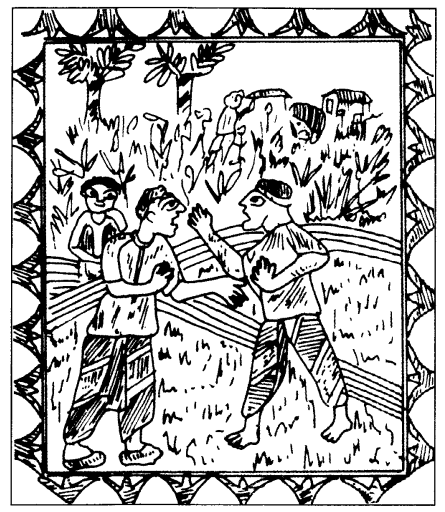
Mohan is a farmer. His family owns a small agricultural field, which they have been farming for many years. Next to his field is Raghu’s land which is separated from his by a small boundary called a bund.
One morning Mohan noticed that Raghu had shifted the bund by a few feet. By doing so, he had managed to take over some of Mohan’s land and increased the size of his own field. Mohan was angry but also a little frightened. Raghu’s family-owned many fields and besides, his uncle was also the Sarpanch of the village. But even so, he plucked up courage and went ” to Raghu’s house.
A heated argument followed. Raghu refused to accept that he had moved the bund. He called one of his helpers and they began shouting at Mohan and beating him up. The neighbours heard the commotion and rushed to the spot where Mohan was being beaten up. They took him away.
He was badly hurt on his head r and hand. He was given first aid by one of his neighbors. His friend, who also ran the village post-office, suggested that they go to the local police station and file a report. Others were doubtful if this was a good idea because they felt they would waste a lot of money and nothing would come out of it. Some people said that Raghu’s family would have already contacted the police station.
After much discussion, it was decided that Mohan would go to the police station along with some of the neighbours who had seen the incident.
Image

Area of the Police Station :
On the way to the police station, one of the neighbours asked, “Why don’t we spend some more money and go to the main police station in the town?”
“It is not a question of money. We can register the case only in this police station because our village comes in its area of work,” explained Mohan.
Every police station has an area that comes under its control. All persons in that area can report cases or inform the police about any theft, accident, injury, fight, etc. It is the responsibility of the police of that station to enquire, investigate and take action on the cases within its area.

Question Box :
1. If there is a theft in your house which police station would you go to to register your complaint?
2. What was the dispute between Mohan and Raghu?
3. Why was Mohan worried about picking a quarrel with Raghu?
4. Some people said Mohan should report the matter to the police and others said he should not. What were the arguments they gave?
Answer
1. If there is a theft in our house we would go to the police station in our area to register our complaint.
2. The dispute between Mohan and Raghu was that Raghu had shifted the bund of his agricultural field by a few feet into the fields of Mohan.
3. Mohan was worried about picking a quarrel with Raghu because of the following reasons :
• Raghu was a big landlord, as his family-owned many agricultural fields.
• He had resources at his disposal.
• His uncle was the sarpanch of the village.
4. The arguments are given by the people :
• He should report to the police
· The police would help him to force Raghu to retrace the bund.
· It would scold him.
· It would also send him to jail if he resists.
• He should not report to the police :
· He would waste a lot of money.
· Nothing would come out of it.
· Raghu would have already contacted the police and it would scold Mohan.
View full question & answer