Questions

5 Marks Questions

🎯

Test yourself on this topic

5 questions · timed · auto-graded

Question 15 Marks
Astronomy The table shows the mass of the planets, the sun and the moon in our solar system.
Celestial Body
Mass $(kg)$
Mass $(kg)$ Standard Notation
Sun
$1,990,000,000,000,000,000,000,000,000,000$
$1.99 \times 10^{30}$
Mercury
$330,000,000,000,000,000,000,000$
 
Venus
$4,870,000,000,000,000,000,000,000$
 
Earth
$5,970,000,000,000,000,000,000,000$
 
Mars
$642,000,000,000,000,000,000,000,000,000$
 
Jupiter
$1,900,000,000,000,000,000,000,000,000$
 
Saturn
$568,000,000,000,000,000,000,000,000$
 
Uranus
$86,800,000,000,000,000,000,000,000$
 
Neptune
$102,000,000,000,000,000,000,000,000$
 
Pluto
$12,700,000,000,000,000,000,000$
 
Moon
$73,500,000,000,000,000,000,000$
 
$a.$ Write the mass of each planet and the Moon in scientific notation.
$b.$ Order the planets and the moon by mass, from least to greatest.
$c.$ Which planet has about the same mass as earth?
Answer
$a.$ Mass of each planet and Moon in sceintific notation is given below:
Using law of exponents, $a^m \times a^n=a^{m+n}$
$ \text { Sun }=199 \times 10^{28}=1.99 \times 10^{28} \times 10^2=1.99 \times 10^{30} $
$\text { Mercury }=33 \times 10^{22}=3.3 \times 10^{22} \times 10=3.3 \times 10^{23} $
$\text { Venus }=487 \times 10^{22}=4.87 \times 10^{22} \times 10^2=4.87 \times 10^{24} $
$\text { Earth }=597 \times 10^{22}=5.97 \times 10^{22} \times 10^2=5.97 \times 10^{24}$
$\text { Mars }=642 \times 10^{27}=6.42 \times 10^{27} \times 10^2=6.42 \times 10^{29}$
$\text { Jupiter }=19 \times 10^{26}=1.9 \times 10^{26} \times 10=1.9 \times 10^{27} $
$\text { Saturn }=568 \times 10^{24}=5.68 \times 10^{24} \times 10^2=5.68 \times 10^{26} $
$\text { Uranus }=868 \times 10^{23}=8.68 \times 10^{23} \times 10^2=8.68 \times 10^{25} $
$\text { Naptune }=102 \times 10^{24}=1.02 \times 10^{24} \times 10^2=1.02 \times 10^{26} $
$\text { Pluto }=127 \times 10^{20}=1.27 \times 10^{20} \times 10^2=1.27 \times 10^{22} $
$\text { Moon }=735 \times 10^{20} \times 10^2=7.35 \times 10^{22}$
$b.$ Order of mass of all planets and Moon from least of greatest:
Pluto $ < $ Moon $ < $ Mercury $ < $ Venus $ < $ Earth $ < $ Uranus $ < $ Naptune $ < $ Saturn $ < $ Jupiter < Mars
$c.$ Venus has about the same mass as earth.
View full question & answer
Question 25 Marks
Investigating Solar System: The table shows the average distance from each planet in our solar system to the sun.
Planet
Distance from sun $(km)$
Distance from sun $(km)$ Standard Notation
Earth
$149,600,000$
$1.496 \times 10^8$
Jupiter
$778,300,000$
 
Mars
$227,900,000$
 
Mercury
$57,900,000$
 
Neptune
$4,497,000,000$
 
Pluto
$5,900,000,000$
 
Saturn
$1,427,000,000$
 
Uranus
$2,870,000,000$
 
Venus
$108,200,000$
 
$a.$ Complete the table by expressing the distance from each planet to the Sun in scientific notation.
$b.$ Order the planets from closest to the sun to farthest from the sun.
Answer
$a.$ Sceintific notation from Sun to:
$ \text { Earth }=149600000=1496 \times 10^5=1.496 \times 10^8 $
$ \text { Jupiter }=778300000=7783 \times 10^5=7.783 \times 10^8 $
$ \text { Mars }=227900000=2279 \times 10^5=2.297 \times 10^8 $
$ \text { Mercury }=57900000=579 \times 10^5=5.97 \times 10^7 $
$ \text { Neptune }=4497000000=4497 \times 10^6=4.497 \times 10^9 $
$ \text { Pluto }=5900000000=59 \times 10^8=5.9 \times 10^9 $
$ \text { Saturn }=1427000000=1427 \times 10^6=1.427 \times 10^9 $
$ \text { Uranus }=28700000000=287 \times 10^7=2.87 \times 10^9 $
$ \text { Venus }=108200000=1082 \times 10^5=1.082 \times 10^8 $
$b.$ Order of planet from closest to the Sun to farthest from the sun is given by:
Mercury $ < $ Venus $ < $ Earth $ < $ Mars $ < $ Jupiter $ < $ Saturn $ < $ Uranus $ < $ Naptune $ < $ Pluto
View full question & answer
Question 35 Marks
Predicting the ones digit, copy and complete this table and answer the questions that follow.
$x$
$1^x$
$2^x$
$3^x$
$4^x$
$5^x$
$6^x$
$7^x$
$8^x$
$9^x$
$10^x$
$1$
$1$
$2$


$2$
$1$
$4$


$3$
$1$
$8$


$4$
$1$
$16$


$5$
$1$
$32$


$6$
$1$
$64$


$7$
$1$
$128$


$8$
$1$
$256$


Ones Digit of the Powers
$1$
$2, 4, 8, 6$


$a.$ Describe patterns you see in the ones digits of the powers.
$b.$ Predict the ones digit in the following:
$i. 4^{12}$
$ii. 9^{20}$
$iii. 3^{17}$
$iv. 5^{100}$
$v. 10^{500}$
$c.$ Predict the ones digit in the following:
$i. 31^{10}$
$ii. 12^{10}$
$iii.17^{21}$
$iv. 29^{10}$
Answer
$a.$ On the basis of given pattern in $1^x$ and $2^x$ , we can make more patterns for $3^x, 4^x, 5^x, 6^x, 7^x, 8^x, 9^x, 10^x$.
Thus, we have following table which shows all details about the patterns.
$x$
$1^x$
$2^x$
$3^x$
$4^x$
$5^x$
$6^x$
$7^x$
$8^x$
$9^x$
$10^x$
$1$
$1$
$2$
$3$
$4$
$5$
$6$
$7$
$8$
$9$
$10$
$2$
$1$
$4$
$9$
$16$
$25$
$36$
$49$
$64$
$81$
$100$
$3$
$1$
$8$
$27$
$64$
$125$
$216$
$343$
$512$
$729$
$1000$
$4$
$1$
$16$
$81$
$256$
$625$
$1296$
$2401$
$4096$
$6561$
$10000$
$5$
$1$
$32$
$243$
$1024$
$3125$
$7776$
$16807$
$32768$
$59049$
$100000$
$6$
$1$
$64$
$729$
$4096$
$15625$
$46656$
$117649$
$262144$
$531441$
$1000000$
$7$
$1$
$128$
$2187$
$16384$
$78125$
$279936$
$823543$
$2097152$
$4782969$
$10000000$
$8$
$1$
$256$
$6561$
$65536$
$390625$
$1679616$
$5764801$
$16777216$
$43046721$
$100000000$
Ones Digit of the Powers
$1$
$2, 4, 8, 6$
$3, 9, 7, 1$
$4, 6$
$5$
$6$
$7, 9, 3, 1$
$8, 4, 2, 6$
$9, 1$
$0$
$b.$ Predict the ones digit:
$i.$ Ones digit in $4^{12}$ is $6$.
$ii.$ Ones digit in $9^{20}$ is $1$.
$iii.$ Ones digit in $3^{17}$ is $3$.
$iv.$ Ones digit in $5^{100}$ is $5$.
$v.$ Ones digit in $10^{500}$ is $0$.
$c.$ Predict the ones digit:
$i.$ Ones digit in $31^{10}$ is $1$.
$ii.$ Ones digit in $12^{10}$ is $4$.
$iii.$ Ones digit in $17^{21}$ is $7$.
$iv.$ Ones digit in $29^{10}$ is $1$.
View full question & answer
Question 45 Marks
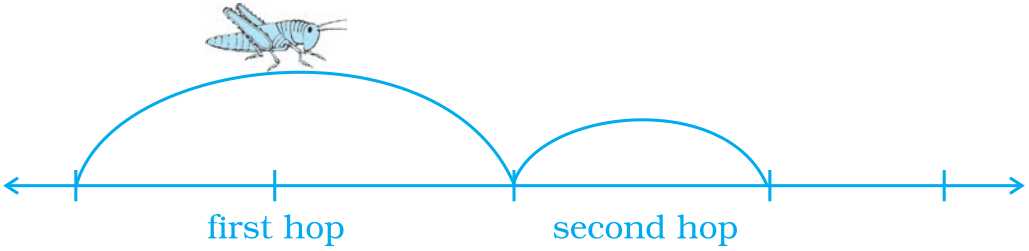
An insect is on the $0$ point of a number line, hopping towards $1$. She covers half the distance from her current location to $1$ with each hop. So, she will be at $\frac{1}{2}$ after one hop, $\frac{3}{4}$ after two hops, and so on.
$a.$ Make a table showing the insect’s location for the first $10$ hops.
$b.$ Where will the insect be after $n$ hops?
$c.$ Will the insect ever get to $1$? Explain.
Answer
$a.$ On the basis of given information in the question, we can arrange the following table which shows the insect’s location for the first $10$ hops.
Number of hops Distance covered Distance left Distance covered
$1.$ $\frac{1}{2}$ $\frac{1}{2}$ $1-\frac{1}{2}$
$2.$ $\frac{1}{2}\Big(​​\frac{1}{2}\Big)+\frac{1}{2}$ $\frac{1}{4}$ $1-\frac{1}{4}$
$3.$ $\frac{1}{2}\Big(​​\frac{1}{4}\Big)+\frac{3}{4}$ $\frac{1}{8}$ $1-\frac{1}{8}$
$4.$ $\frac{1}{2}\Big(​​\frac{1}{8}\Big)+\frac{7}{8}$ $\frac{1}{16}$ $1-\frac{1}{16}$
$5.$ $\frac{1}{2}\Big(​​\frac{1}{16}\Big)+\frac{15}{16}$ $\frac{1}{32}$ $1-\frac{1}{32}$
$6.$ $\frac{1}{2}\Big(​​\frac{1}{32}\Big)+\frac{31}{32}$ $\frac{1}{64}$ $1-\frac{1}{64}$
$7.$ $\frac{1}{2}\Big(​​\frac{1}{64}\Big)+\frac{63}{64}$ $\frac{1}{128}$ $1-\frac{1}{128}$
$8.$ $\frac{1}{2}\Big(​​\frac{1}{128}\Big)+\frac{127}{128}$ $\frac{1}{256}$ $1-\frac{1}{256}$
$9.$ $\frac{1}{2}\Big(​​\frac{1}{256}\Big)+\frac{255}{256}$ $\frac{1}{512}$ $1-\frac{1}{512}$
$10.$ $\frac{1}{2}\Big(​​\frac{1}{512}\Big)+\frac{511}{512}$ $\frac{1}{1024}$ $1-\frac{1}{1024}$
$b.$ If we see the distance covered in each hops
Distance covered in $1^{st}$ hop $=1-\frac{1}{2}$
Distance covered in $2^{nd}$ hops $=1-\frac{1}{4}$
Distance covered in $3^{rd}$ hops $=1-\frac{1}{8}$
Distance covered in $3^{rd}$ hops $=1-\Big(\frac{1}{2}\Big)^\text{n}$
$c.$ No, because for reaching $1$, $\Big(\frac{1}{2}\Big)^\text{n}$ has to be zero for some finite $n$ which is not possible.
View full question & answer
Question 55 Marks
This table shows the mass of one atom for five chemical elements. Use it to answer the question given.
Elements
Mass of atom $(kg)$
Titanium
$7.95 \times 10^{-26}$
Lead
$3.44 \times 10^{-25}$
Silver
$1.79 \times 10^{-25}$
Lithium
$1.15 \times 10^{-26}$
Hydrogen
$1.674 \times 10^{-27}$
$a.$ Which is the heaviest element?
$b.$ Which element is lighter, Silver or Titanium?
$c.$ List all five elements in order from lightest to heaviest.
Answer
Arrangement of masses of atoms in same power of $10$ is given by : Titanium $= 7.95 \times 10^{-26}$
Lead $= 34.4 \times 10^{-26}$
Silver $= 17.9 \times 10^{-26}$
Hydrogen $= 0.1674 \times 10^{-26}$
Thus, we have
$34.4 > 17.9 > 7.95 > 1.15 > 0.1674$
$a.$ Lead heaviest is the heaviest element.
$b.$ Silver $= 17.9 \times 10^{-26}$ and Titanium $= 7.95 \times 10^{-26}$, So titanium is lighter.
$c.$ Arrangement of elements in order from lightest to haviest is given by:
Hydrogen $ < $ Lithium $ < $ Titanium $ < $ Silver $ < $ Lead.
 
View full question & answer