Questions

5 Marks Questions

Take a timed test

9 questions · self-marked practice — reveal the answer and mark yourself.

Question 15 Marks
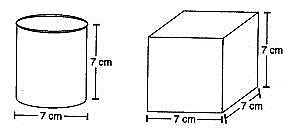
Describe how the two figures at the right are alike and how they are different. Which box has larger lateral surface area?
Answer
Similarity $\rightarrow$ Both have same height.
Difference $\rightarrow$ One is a cylinder, the other is a cube.
For the first figure
$r = \frac{7}{2}\ cm$
$h = 7\ cm$
$\therefore$ Lateral surface area $ = 2\pi rh$
$ = 2 \times \frac{{22}}{7} \times \frac{7}{2} \times 7$
$= 154\ cm^2$
For second figure
$l = 7 \ cm$
$b = 7 \ cm$
$h = 7 \ cm$
$\therefore$ Lateral surface area $= 4l^2$
= 4 $\times$ $(7)^2$
$= 196\ cm^2$
Hence, the second box has the larger lateral surface area.
View full question & answer
Question 25 Marks
Daniel is painting the walls and ceiling of a cuboidal hall with length, breadth and height of $15\ m, 10\ m$ and $7\ m$ respectively. From each can of paint $100$ $m^2$ of area is painted. How many cans of paint will she need to paint the room?
Answer
$l = 15\ m$
$b = 10\ m$
$h = 7\ m$
Surface area to be painted
$= 2$ $(l$ $\times$ $b + b$ $\times$ $h + h$ $\times$ $l) – l$ $\times$ $b$
$= 2 (15$ $\times$ $10 + 10$ $\times$ $7 + 7$ $\times$ $15)$$m^2$$– (15$ $\times$ $10)$ $m^2$
$= 2(150 + 70 + 105) m^2 – 150\ m^2$
$= 2 (325)\ m^2– 150\  m^2$
$= 650\  m^2– 150\  m^2$
$= 500\ m^2$
$\therefore$ Number of cans needed
$ = \frac{{Surface\;area\;to\;be\;pa\operatorname{int} ed}}{{Area\;pa\operatorname{int} ed\;by\;1\;can}}$
$ = \frac{{500}}{{100}}$
$= 5$
Hence, she will need $5$ cans to paint the room.
View full question & answer
Question 35 Marks
A suitcase with measures $80\ cm \times 48\ cm \times 24\ cm$ is to be covered with a trapaulin cloth. How many metres of trapaulin of width $96\ cm$ is required to cover $100$ such suitcases ?
Answer
Total surface area of the suitcase
$= 2 (80 \times 48 + 48 \times 24 + 24 \times 80)$
$= 2 (3840 + 1152 + 1920)$
$= 2 (6912)$
$= 13824\ cm^2$
$\therefore $ Length of trapaulin required to cover $1$ suitcase
$ = \frac{{Total\;Surface\;area\;of\;the\;suitcase}}{{width\;of\;trapaulin}}$
$ = \frac{{13824}}{{96}}$
$= 144\ cm$
∴ Length of trapaulin required to cover $100$ such suitcase
$= 144 \times 100\ cm$
$= 14400\ cm$
$= 144\ m$
Hence, $144\ m$ of trapaulin is required.
View full question & answer
Question 45 Marks
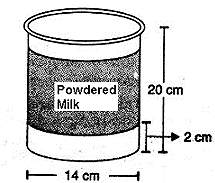
A company packages its milk powder in cylindrical container whose base has a diameter of $14\ cm$ and height $20\ cm$. Company places a label around the surface of the container (as shown in the figure). If the label is placed $2\ cm$ from top and bottom, what is the area of the label.
Answer
For a cylindrical container
Diameter of the base $= 14\ cm$
$\therefore$ Radius of the base $(r)$ =$\frac{{14}}{2}cm$
$= 7\ cm$
Height $(h) = 20\ cm$
$\therefore$ Curved surface area of the container $ = 2\pi rh$
$ = 2 \times \frac{{22}}{7} \times 7 \times 20$
$= 880\  cm^2$
$\therefore$ The surface area of the label
$ = 880\ cm2 - 2\left( {2 \times \frac{{22}}{7} \times 7 \times 2} \right)c{m2}$
$= 880\  cm^2– 176\  cm^2$
$= 704\  cm^2$
Hence, the surface area of the label is $704\ cm^2$.
Or
Diameter of the base $= 14\ cm$
$\therefore$ Radius of the base $(r)$ $ = \frac{{14}}{2}cm$
$= 7\ cm$
Height $(h) = (20$ $– 2$$\times$$2) = 16\ cm$
surface area of the label $ = 2\pi rh$
$ = 2 \times \frac{{22}}{7} \times 7 \times 16$
$= 704\  cm^2$
View full question & answer
Question 55 Marks
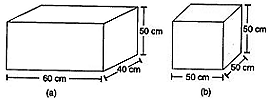
There are two cuboidal boxes as shown in the adjoining figure. Which box requires the least amount of material to make?
Answer
$i.$ First Cuboidal Box
$l = 60\ cm$
$b = 40\ cm$
$h = 50\ cm$
$\therefore $ Total surface area
$= 2 (lb + bh + hl)$
$= 2 (60$ $\times$ $40 + 40$ $\times$ $50 + 50$ $\times$ $60)$
$= 2 (2400 + 2000 + 3000)$
$= 2 (7400)$
$= 14800\  cm^2$
$ii.$Second Cuboidal Box
$l = 50\ cm$
$b = 50\ cm$
$h = 50\ cm$
$\therefore $ Total surface area
$= 2 (lb + bh + hl)$
$= 2 (50$ $\times$ $50 + 50$ $\times$ $50 + 50$ $\times$ $50)$
$= 2 (2500 + 2500 + 2500)$
$= 2 (7500)$
$= 15000\  cm^2$
Hence, the box $(a)$ requires the least amount of material to make.
View full question & answer
Question 65 Marks
The floor of a building consists of $3000$ tiles which are rhombus shaped and each of its diagonals are $45\ cm$ and $30\ cm$ in length. Find the total cost of polishing the floor, if the cost per $m^2$ is $₹ 4$.
Answer
Area of a tile = area of rhombus$\frac{1}{2} \text{d1d2}$
$\frac{1}{2}\text{45 \times 30}$ ​​​​
$= 675\ cm^2$
$\therefore$ Area of the floor $= 675$ $\times$ $3000\ cm^2$
$= 2025000\  cm^2$
$ = \frac{{2025000}}{{100 \times 100}}{m^2}$
$= 202.50\  m^2$
The cost of polishing per $m^2= Rs. 4$
$\therefore$ Total cost of polishing the floor
$= 202.50$ $\times$ $4$
$= Rs. 810$
View full question & answer
Question 75 Marks
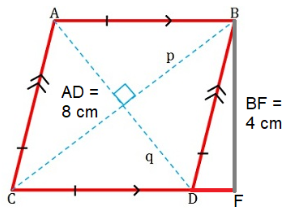
Find the area of a rhombus whose side is $5\ cm$ and whose altitude is $4.8\ cm$. If one of its diagonals is $8\ cm$ long, then find the length of the other diagonal.
Answer
The diagram of a rhombus can be given below:

$AB = BD = DC = CA = 6\ cm$
Now, Area of rhombus = Base $\times$ Altitude
$= CD$ $\times$ $BF$
$= 5\ cm \times$ $4.8\ cm$
$= 24.0\  cm^2$
Also, Area of rhombus = $ \frac{1}{2}\times AD\times BC$
$\Rightarrow$ $24 =  \frac{1}{2}\times$ $8\times BC$
$\Rightarrow$ $BC = 6\ cm$
Hence, the length of other diagonal is $6\ cm$
View full question & answer
Question 85 Marks
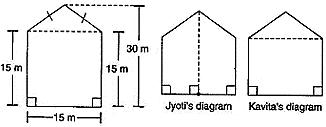
There is a pentagonal shaped park as shown in the figure. For finding its area Jyoti and Kavita divided it in two different ways.

Find the area of this park using both ways. Can you suggest some other way of finding area?
Answer
Jyoti's diagram
Area of the park $ = 2 \times \left[ {\frac{{(15 + 30)}}{2} \times \frac{{15}}{2}} \right]$
$ = \frac{{675}}{2}$
$= 337.5\  m^2$
Kavita's diagram
Area of the park = 15 $\times$15 $m^2+$ $\frac{{15 \times (30 - 15)}}{2}$ $m^2$
$= 225\  m^2+$ $\frac{{225}}{2}$ $m^2$
$= 225\  m^2 + 112.5\  m^2$
$= 337.5\  m^2$
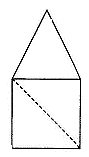
Another way of finding the area

Area of the park $ = \frac{{15 \times (30 - 15)}}{2}{m^2} +2 \times \left[ {\frac{{15 \times 15}}{2}} \right]{m^2}$
$ = 112.5\  m^2 + 225\  m^2$
$= 337.5\  m^2$
View full question & answer
Question 95 Marks
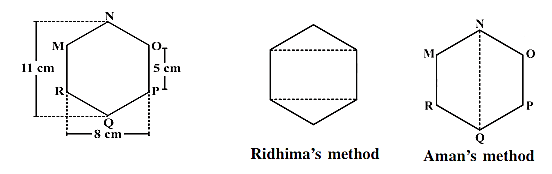
There is a hexagon $MNOPQR$ of side $5\ cm$ (Fig.). Aman and Ridhima divided it in two different ways (Fig). Find the area of this hexagon using both ways.
Answer
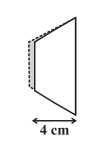
Aman’s method: Since it is a hexagon so, $NQ$ divides the hexagon into two congruent trapeziums. We can verify it by paper folding (Fig.)

Now area of trapezium $MNQR$ = $4 \times \frac{(11+5)}{2}$
$=32 \mathrm{cm}^{2}$
So, the area of hexagon $MNOPQR$ $= 2$ $\times$ $32$
$= 64\  cm^2$.
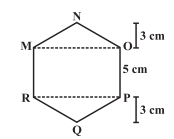
Ridhima’s method: $\triangle$ $MNO$ and $\triangle$ $RPQ$ are congruent triangles with altitude $3\ cm$ (Fig.)

We can verify this by cutting off these two triangles and placing them on one another.
Area of $\triangle$ $MNO$ = $\frac{1}{2}$ $\times$ $8$ $\times$ $3$
$= 12\ cm^2$
So, Area of $\triangle$ $RPQ =$ $= 12\  cm^2$
Area of rectangle $MOPR = 8$ $\times$ $5$
$= 40\  cm^2$
Now, area of hexagon $MNOPQR = 40 + 12 + 12$
$= 64\  cm^2$
View full question & answer