MCQ 1511 Mark
Find the area of a triangle whose base is $4cm$ and altitude is $6cm.$
- A
$10cm^2$
- B
$14cm^2$
- C
$16cm^2$
- ✓
$12cm^2$
AnswerCorrect option: D. $12cm^2$
D. $12cm^2$
View full question & answer→MCQ 1521 Mark
$1\ cm$ is equal to how many millimeters$?$
- A
$\frac{1}{10}$
- B
$\frac{1}{100}$
- ✓
$10$
- D
$100$
View full question & answer→MCQ 1531 Mark
A metal sheet $27cm$ long, 8cm broad and $1cm$ thick is melted into a cube. The side of the cube is:
- ✓
$6cm$
- B
$8cm$
- C
$12cm$
- D
$24cm$
AnswerA. $6cm$
Solution:
Given, a metal sheet $27cm$ long, $8cm$ bread and $1cm$ thick.
Then, volume of the sheet (cubiodal) $= 1 \times b \times h$
$= 27 \times 8 \times 1 = 216cm^3$
Now, since this sheet is melted to form a cube of edge length a (say).
Then, volume of the cube = Volume of the metal sheet
$\Rightarrow a^3 = 216cm^2$
$\Rightarrow a = 6cm$
Hence, the side of the cube is $6cm.$
View full question & answer→MCQ 1541 Mark
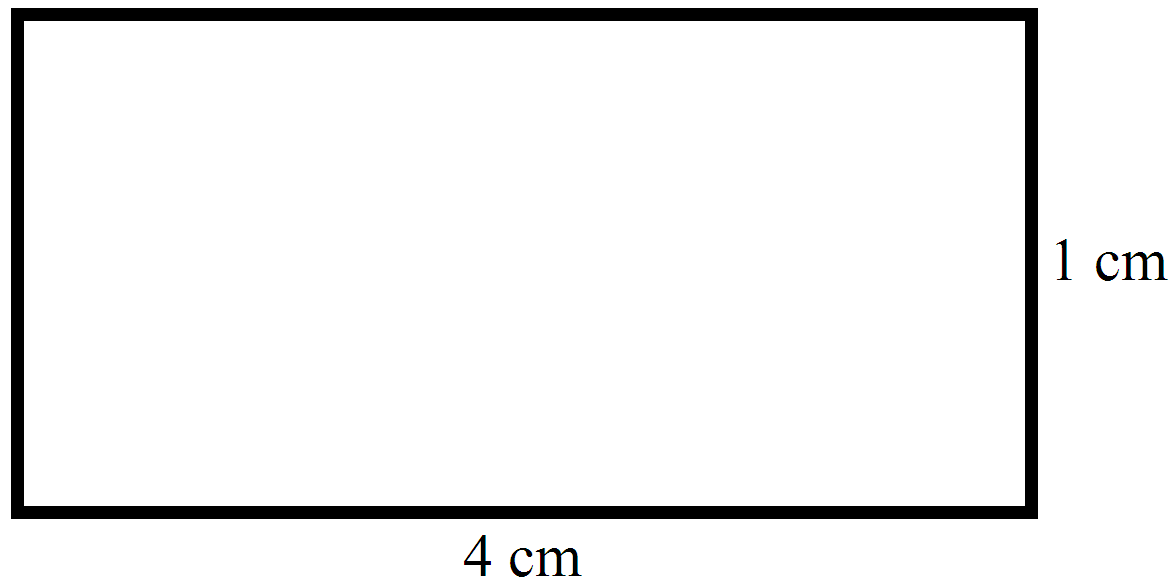
The perimeter of the figure is:
- A
$5\ cm$
- ✓
$10\ cm$
- C
$4\ cm$
- D
$8\ cm$
AnswerCorrect option: B. $10\ cm$
Perimeter $= 2(4 + 1) = 10\ cm.$
View full question & answer→MCQ 1551 Mark
Two identical cubes each of total surface area of $6cm^2$ are joined end to end. Which of the following is the total surface area of the cuboid so formed?
- A
$12cm^2$
- B
$18cm^2$
- ✓
$10cm^2$
- D
$8cm^2$
AnswerCorrect option: C. $10cm^2$
C. $10cm^2$
Solution:
(IMAGE)
Total area surface of cube $ = 6cm^2$
Let a be the side of cube then,
$6a^2 = 6$
$a = +1cm$
Both are unit cube,
Total area surface of cuboid,
$= 2(lb+bh+hl)$
$= 2(1 \times 1 + 1 \times 2 + 2 \times 1)$
$= 2(1 + 2 + 2)$
$= 2(5) = 10cm^2$
View full question & answer→MCQ 1561 Mark
The side of a triangle are $16cm, 30cm$ and $34cm.$ Its area is:
- ✓
- B
$120cm^2$
- C
$260cm^2$
- D
$272cm^2$
View full question & answer→MCQ 1571 Mark
The volume of a cube of edge a is:
- A
$a^2$
- ✓
$a^3$
- C
$a^4$
- D
$6a^2$
View full question & answer→MCQ 1581 Mark
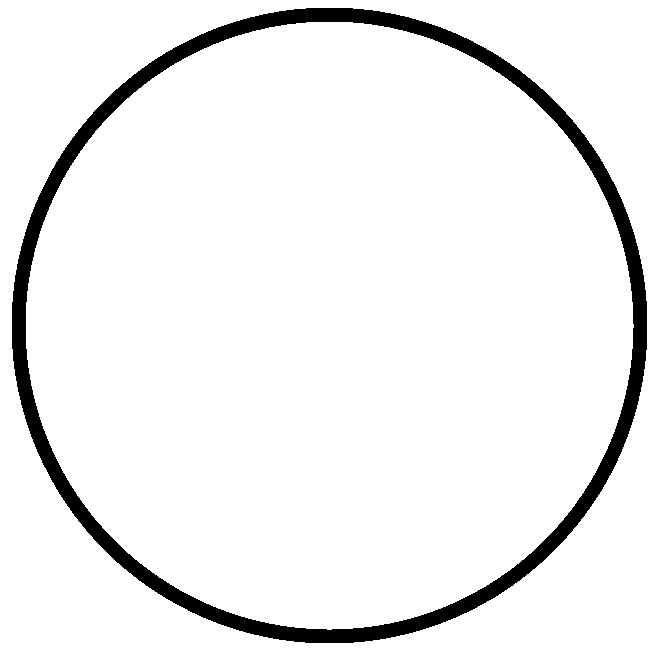
The diagram has the shape of a:
MCQ 1591 Mark
If the edge of a cube is $1cm$ then which of the following is its volume?
AnswerCorrect option: C. $1m^3$
C. $1m^3$
Solution:
We know that the volume of a cube is the numerical cube of it's one side.
So,
Cube's volume = (side)$^3$
Here, side $= 1m$
So,
Volume $= (1m)^3$
$= 1m \times 1m \times 1m$
$= 1m^3$
View full question & answer→MCQ 1601 Mark
What will be the length of the side of a cube if its total surface area is $2166cm^2?$
- ✓
$19cm$
- B
$18cm$
- C
$13cm$
- D
$16cm$
AnswerCorrect option: A. $19cm$
A. $19cm$
Solution:
Let the length of the side be $\times$ cm.
We know that, Total surface area of a cube is given by $6(side)^2$
$\therefore$ Total surface area $= 2166 = 6 \times x^2$
$\text{x}^2=\frac{2166}{66}=361$
$\text{x}=\sqrt{361} = 19\text{cm}$
View full question & answer→MCQ 1611 Mark
Find the area of a rhombus whose diagonals are of lengths $20cm$ and $16cm.$
- A
$140cm^2$
- B
$120cm^2$
- C
$150cm^2$
- ✓
$160cm^2$
AnswerCorrect option: D. $160cm^2$
D. $160cm^2$
View full question & answer→MCQ 1621 Mark
The area of a rectangle of length a and breadth b is:
- A
$a + b$
- ✓
$ab$
- C
$a^2 + b^2$
- D
$2ab$
View full question & answer→MCQ 1631 Mark
If the length and breadth of a rectangle are $15cm$ and $10cm,$ respectively, then its area is:
- A
$100 sq.cm$
- B
$200 sq.cm$
- ✓
$150 sq.cm$
- D
$115 sq.cm$
AnswerCorrect option: C. $150 sq.cm$
C. $150 sq.cm$
Solution:
Length $= 15cm$
And breadth $= 10cm$
Area of rectangle $= Length \times breadth$
$= 15 \times 10$
$= 150cm^2$
View full question & answer→MCQ 1641 Mark
Find the area of a quadrilateral having a diagonal of $48\ cm$ and the perpendiculars dropped on it from the remaining opposite vertices are $16\ cm$ and $26\ cm.$
- A
$1,808\ cm^2$
- B
$1,800 \ cm^2$
- C
$1,080\ cm^2$
- ✓
$1,008\ cm^2$
AnswerCorrect option: D. $1,008\ cm^2$
D. $1,008\ cm^2$
Solution:
We know that the area of a general quadrilateral is given by the formula,
$=\frac{1}{2} d\left( h _1+ h _2\right)$
Here, $d=48 cm$
$h _1=16 cm $
$h _2=26 cm$
Putting the values in the formula, we'll get
$=\frac{1}{2} \times 48(16+26) $
$=24 \times 42 $
$=1,008 cm^2$
View full question & answer→MCQ 1651 Mark
The area of a trapezium is $384cm^2.$ Its parallel sides are in the ratio $5 : 3$ and the distance between them is $12cm.$ The longer of the parallel sides is:
- A
$24cm$
- ✓
$40cm$
- C
$32cm$
- D
$36cm$
AnswerCorrect option: B. $40cm$
B. $40cm$
Solution:
Area of the trapezium $=\Big\{\frac{1}{2}\times(5\text{x}+3\text{x})\times12\Big\}\text{cm}^2$
$=\Big(\frac{1}{2}\times8\text{x}\times12\Big)\text{cm}^2=48\text{x}\ \text{cm}^2$
But, the area of the trapezium is $384cm^2.$
$48\text{x}=384$
$\Rightarrow\text{x}=\frac{384}{48}=8$
Longer side $= 5x = 5 \times 8 = 40cm.$
View full question & answer→MCQ 1661 Mark
AnswerCorrect option: D. $\frac{1}{2} \text{d}_1\times \text{d}_2$
D. $\frac{1}{2} \text{d}_1\times \text{d}_2$
View full question & answer→MCQ 1671 Mark
Tick the correct answer in the following: The parallel sides of a trapezium are in the ratio $3 : 4$ and the perpendicular distance between them is $12cm.$ If the area of the trapezium is $630cm^2,$ then its shorter of the parallel sides is:
- ✓
$45cm$
- B
$42cm$
- C
$60cm$
- D
$36cm$
AnswerCorrect option: A. $45cm$
A. $45cm$
Solution:
Ratio in parallel sides $= 3 : 4$
Perpendicular distance $(h) = 12cm$
Area of trapezium $= 630cm^2$
$\therefore$ Sum of parallel sides $\frac{\text{Area}\times2}{\text{Altitude}}$
$=\frac{630\times2}{12}=105\text{cm}$
Now shorter side $=\frac{105\times3}{3+4}$
$=\frac{105\times3}{7}=45\text{cm}$
View full question & answer→MCQ 1681 Mark
If the dimensions of a room are $2m, 3m$ and $4m$ then which of the following is the number of cubes of size $\frac{1}{2}\text{m}\times\frac{1}{3}\text{m}\times\frac{1}{4}\text{m}$ which can he placed is the room?
Answer Given,
Dimension of the room are $2m, 3m, 4m$
Dimension of the cubes are $\frac{1}{2}\text{m}, \frac{1}{3}\text{m}, \frac{1}{4}\text{m}$
Number of cubes placed in the room,
$=\frac{\text{Capacity of the room}}{\text{Volume of a cube} }$
$=\frac{2\times3\times4}{\frac{1}{2}\times\frac{1}{3}\times\frac{1}{4}}$
$2 × 3 × 4 × 2 × 3 × 4 = X$
$X = 576$
View full question & answer→MCQ 1691 Mark
The height of a cylinder whose radius is $7cm$ and the total surface area is $968cm^2$ is:
- ✓
$15cm$
- B
$17cm$
- C
$19cm$
- D
$21cm$
AnswerCorrect option: A. $15cm$
A. $15cm$
Solution:
Total surface area $= 2\pi\text{r}(\text{h + r)}$
$968 = 2\times\frac{22}{7}\times 7(7 + \text{h})$
$\text{h} = 15\text{cm}$
View full question & answer→MCQ 1701 Mark
Ruhi painted a TV cabinet of dimensions $2.3m \times 1.2m \times 1.5m.$ Find the surface area she painted if she painted if she painted all except bottom and the front of the cabinet.
- A
$5.80m^2$
- B
$9.22m^2$
- C
$6.73m^2$
- ✓
$9.81m^2$
AnswerCorrect option: D. $9.81m^2$
D. $9.81m^2$
Solution:
Here,
$I = 2.3cm$
$b = 1.2cm$
$h = 1.5cm$
Area of $2$ side faces $= 2(b \times h) = 2 \times (1.2 \times 1.5)$
$= 3.6m^2$
Area of the back side $= I \times h = 2.3 \times 1.5$
$= 3.45m^2$
Area of the top side $= I \times b$
$= 2.3 \times 1.2$
$= 2.76m^2$
Total surface area she painted is,
$= 3.6m^2 + 3.45m^2 + 2.76m^2$
$= 9.81m^2$
View full question & answer→MCQ 1711 Mark
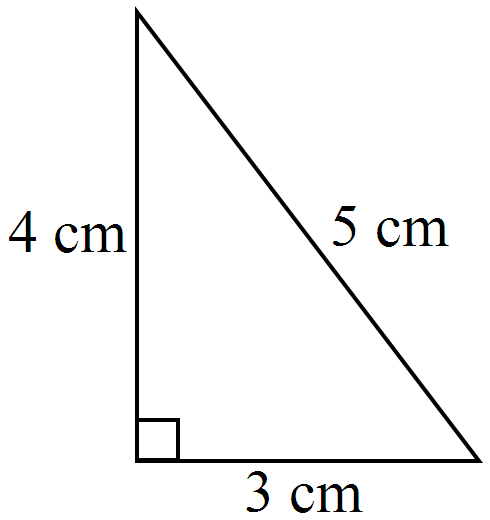
The perimeter of the figure is:
- ✓
$12\ cm$
- B
$24\ cm$
- C
$6\ cm$
- D
$60\ cm$
AnswerCorrect option: A. $12\ cm$
Perimeter $= 4 + 3 + 5 = 12\ cm$
View full question & answer→MCQ 1721 Mark
The volume of a cube is $64cm^3.$ Its surface area is:
- A
$16cm^2$
- B
$64cm^2$
- ✓
$96cm^2$
- D
$128cm^2$
AnswerCorrect option: C. $96cm^2$
C. $96cm^2$
Solution:
Let the side of the cube be a. Then,
Volume of cube $= a^3 - 64$ [given]
$\Rightarrow a = 4$
Now, surface area of the cube $= a^2 = 6 × 4^2 = 96cm^2.$
View full question & answer→MCQ 1731 Mark
Surface area of a cuboid = __________.
- A
$2h(l + b)$
- B
$2lbh$
- ✓
$2(lb + bh + hl)$
- D
AnswerCorrect option: C. $2(lb + bh + hl)$
$2(lb + bh + hl)$
View full question & answer→MCQ 1741 Mark
Find the total surface area of a cube whose volume is $343cm^3.$
- A
$350cm^2$
- ✓
$294cm^2$
- C
$494cm^2$
- D
$200cm^2$
AnswerCorrect option: B. $294cm^2$
B. $294cm^2$
View full question & answer→MCQ 1751 Mark
A trapezium is having an area of $576cm^2,$ The length of one of the parallel side is $24cm$ and the height of the trapezium is $18cm.$ Find the length of the other parallel side.
- ✓
$40cm$
- B
$48cm$
- C
$88cm$
- D
$36cm$
AnswerCorrect option: A. $40cm$
A. $40cm$
Solution:
We know that, Area of trapezium $=\frac{1}{2}\text{h}(\text{a+b)}$
Here, $h = 18cm$
$a = 24cm$
Area $= 576cm^2$
Putting the values,
$\Rightarrow\frac{1}{2}\text{h}(\text{a+b)}$
$\Rightarrow\frac{1}{2}\times{18}\times(\text{24 + b)}=576$
$\Rightarrow24+\text{b}=64$
$\text{b}=40\text{cm}$
View full question & answer→MCQ 1761 Mark
Find the area of a trapezium $PQRS,$ having $PQ || RS,$ $\angle\text{S}= 90^\circ$. Also, $RS = 96cm, PS = 30cm$ and $PQ = 80cm.$
- ✓
$2640cm^2$
- B
$6240cm^2$
- C
$2040cm^2$
- D
$2600cm^2$
AnswerCorrect option: A. $2640cm^2$
A. $2640cm^2$
Solution:
Here, $\angle\text{R} = 90^\circ$
$RS = 96cm$
$PS = 30cm$
$PQ = 80cm$
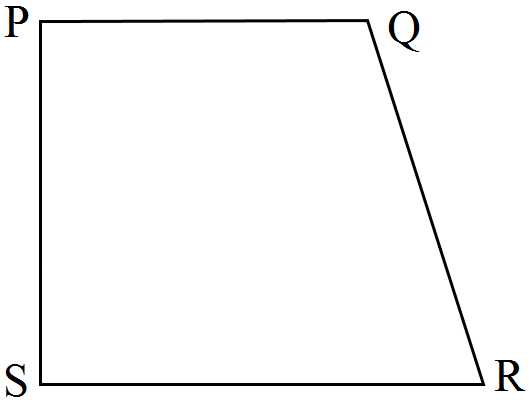
We know that, Area of trapezium $(\text{A}) =\frac{1}{2}\text{h}(\text{a+b})$
Here,$ h = PS = 30cm$
$a = PQ = 80cm$
$b = RS = 96cm$
$\text{A}=\frac{1}{2}\times30\times(80\times96)$
$A = 15 \times l76$
$A = 2640cm^2$
View full question & answer→MCQ 1771 Mark
The side of a triangle are $16cm, 30cm$ and $34cm.$ Its area is:
- A
$120cm^2$
- ✓
$240cm^2$
- C
$260cm^2$
- D
$272cm^2$
AnswerCorrect option: B. $240cm^2$
B. $240cm^2$
View full question & answer→MCQ 1781 Mark
The perimeter of a rectangle with length $(l)$ and width $(w)$ is:
- A
$l + w$
- B
$(l + w)^2$
- C
$lw$
- ✓
$2(l + w)$
AnswerCorrect option: D. $2(l + w)$
D. $2(l + w)$
View full question & answer→MCQ 1791 Mark
The area of circle of redius $r$ is:
AnswerCorrect option: B. $\text{r}^2$
$\text{r}^2$
View full question & answer→MCQ 1801 Mark
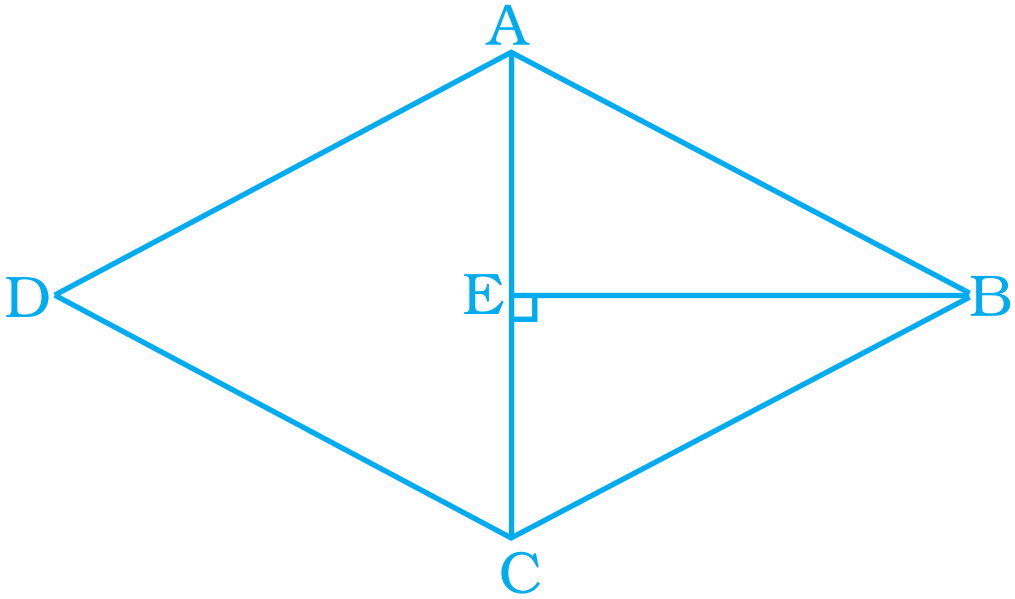
What is the area of the rhombus $ABCD$ below if $AC = 6cm,$ and $BE = 4cm?$
- A
$36cm^2$
- B
$16cm^2$
- ✓
$24cm^2$
- D
$13cm^2$
AnswerCorrect option: C. $24cm^2$
The diagonal $AC$ of the rhombus $ABCD$ divides it into two triangles of equal areas.
Now, area of $\triangle\text{ABC}=\frac{1}{2}$ $\times Base \times Height$ $=\frac{1}{2}$ $\times 4 \times 6 = 12cm^2$
$\therefore$ Area of the rhombus $ABCD = 2 \times Area$ of $\triangle\text{ABC}$
$= 2 \times 12 = 24cm^2$
View full question & answer→MCQ 1811 Mark
Opposite angles of a rhombus are:
MCQ 1821 Mark
cube of side $4\ cm$ is cut into $1\ cm$ cubes. What is the ratio of the surface areas of the original cubes and cut-out cubes?
- A
$1 : 2$
- B
$1 : 3$
- ✓
$1 : 4$
- D
$1 : 6$
AnswerCorrect option: C. $1 : 4$
C. $1 : 4$
Solution:
Volume of the original cube having side of length $4 cm=(4)^3-64 cm^3\left[\because\right.$ volume of cube with side $\left.a=a^3\right]$
Volume of the cut-out cubes with side of length $1 cm=1 cm^3$
$\therefore$ Number of cut-out cubes $=\frac{\text { Volume of the original cube }}{\text { Volume of a smaller cube }}$
$=\frac{64}{1}=64$
Now, surface area of cut-out cubes $=64 \times 6 \times(1)^2 cm^2\left[\because\right.$ surface area of cube with side $\left.a=6 a^2\right]$
and surface area of the original cute $=6 \times 4^2 cm^2$
$\therefore$ The required ratio of surface areas of the original cube and cut-out cubes $=\frac{6 \times 4^2}{64 \times 6}=1: 4$
View full question & answer→MCQ 1831 Mark
The adjacent sides of a parallelogram are $8\ cm$ and $9\ cm.$ The diagonal joining the ends of these side is $13\ cm$. Its area is:
- A
$72\text{cm}^2$
- B
$150\text{cm}^2$
- C
$24\sqrt{35}\text{cm}^2$
- ✓
$12\sqrt{35}\text{cm}^2$
AnswerCorrect option: D. $12\sqrt{35}\text{cm}^2$
$12\sqrt{35}\text{cm}^2$
View full question & answer→MCQ 1841 Mark
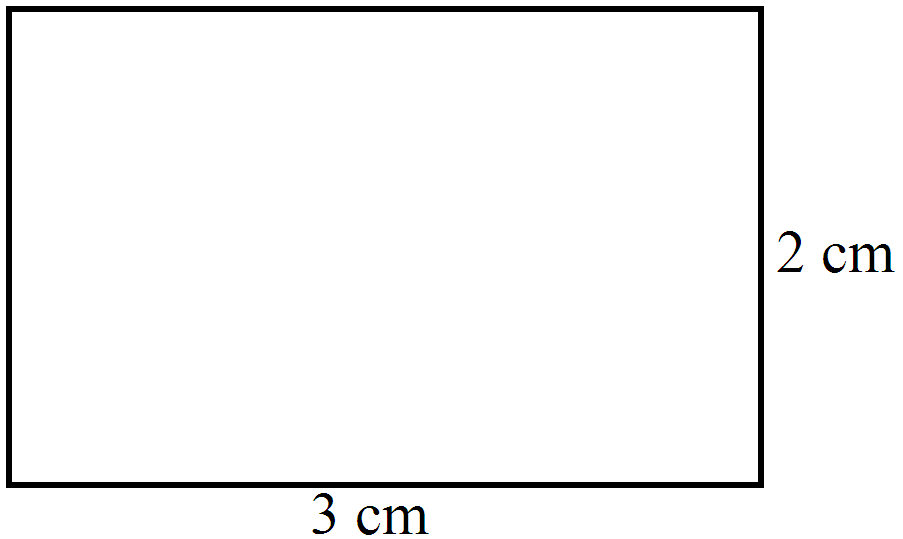
The area of the figure is:
- ✓
$6cm^2$
- B
$12cm^2$
- C
$5cm^2$
- D
$10cm^2$
AnswerCorrect option: A. $6cm^2$
A. $6cm^2$
Solution:
$Area = 3 \times 2 = 6cm^2.$
View full question & answer→MCQ 1851 Mark
How many cuboidal boxes of volume $0.9\ m^3$ can be stored in the warehouse of dimension $57\ m \times 50\ m \times 30\ m\ ?$
- A
$89,700$
- B
$92,500$
- ✓
$95,000$
- D
$98,000$
AnswerCorrect option: C. $95,000$
C. $95,000$
Solution:
Volume of the warehouse $=$ Length $\times$ breath $\times$ Height $= 57 \times 50 \times 30$
$= 85500\ m^3$
Number of boxes that can be stored $=\frac{\text{Volume of the warehouse}}{\text{Volume of one box}}$
$=\frac{85500}{0.9}$
$= 95,000$
View full question & answer→MCQ 1861 Mark
If the side faces, the back face and the base of a cuboidal aquarium are to be covered with a colored paper. Find the area of the paper needed given that the external measures are $70\ cm \times 40\ cm \times 50\ cm\ ?$
- ✓
$10,300\ cm^2$
- B
$10,500\ cm^2$
- C
$11,000\ cm^2$
- D
$9,900\ cm^2$
AnswerCorrect option: A. $10,300\ cm^2$
A. $10,300\ cm^2$
Solution:
Here, length $( I )=70\ cm$
Breath $(b)=40\ cm$
And, height $(h)=50 \ cm$
We need to find the area of each face individually,
Area of side face, will be given by,
$b \times h=40 \times 50=2000\ cm^2$
As there will be two side faces, the total area will be,
$2 \times 2000=4000\ cm^2$
Area of the back face will be given by,
$I \times h =70 \times 50=3500\ cm^2$
Area of the base will be given by,
$I \times b =70 \times 40=2800\ cm^2$
The total surface area will be,
Total area $=4000\ cm^2+3500\ cm^2+2800\ cm^2$
$=10,300\ cm^2$
View full question & answer→MCQ 1871 Mark
The area of a rhombus is $60cm^2.$ One diagonal is $10cm.$ The other diagonal is:
- A
$6cm$
- ✓
$12cm$
- C
$3cm$
- D
$24cm$
AnswerCorrect option: B. $12cm$
B. $12cm$
Solution:
$\frac{1}{2} \times 10 \times \text{d}_2 = 60$
$\Rightarrow \text{d}_2 = 12\text{cm}.$
View full question & answer→MCQ 1881 Mark
Find the perimeter of the a square with side $4\ cm.$
- ✓
$16\ cm$
- B
$12\ cm$
- C
$10\ cm$
- D
$8\ cm$
AnswerCorrect option: A. $16\ cm$
$16\ cm$
View full question & answer→MCQ 1891 Mark
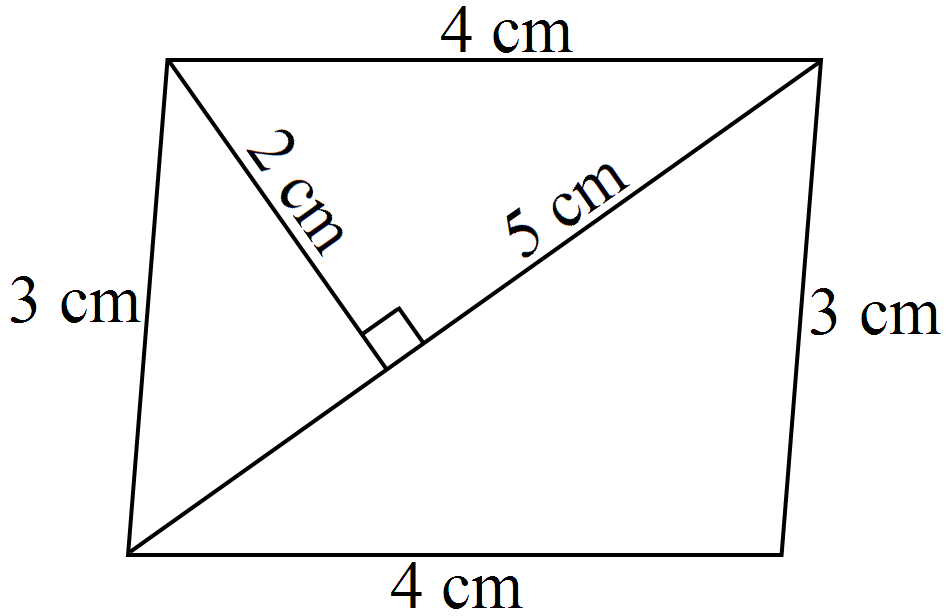
The area of the quadrilateral is:
- ✓
$10cm^2$
- B
$5cm^2$
- C
$20cm^2$
- D
$15cm^2$
AnswerCorrect option: A. $10cm^2$
A. $10cm^2$
Solution:
$\text{Area} = 2\big(\frac{5\times2}{2}\big) = 10\text{cm}^2$
View full question & answer→MCQ 1901 Mark
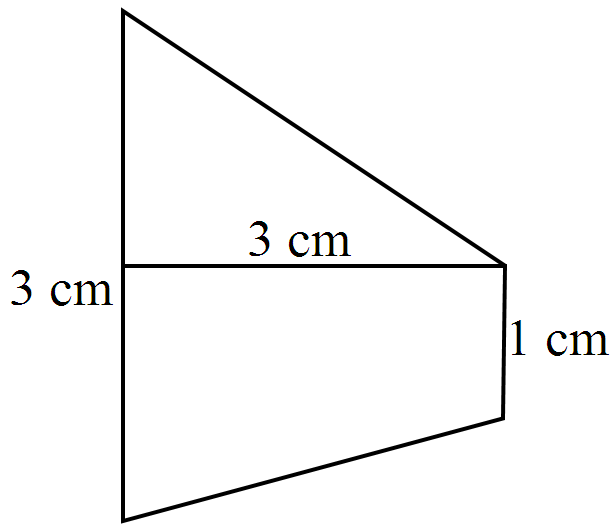
The area of the trapezium is:
- ✓
$6cm^2$
- B
$4cm^2$
- C
$3cm^2$
- D
$9cm^2$
AnswerCorrect option: A. $6cm^2$
A. $6cm^2$
Solution:
$\text{Area}= \frac{(3+2)^3}{2} = 6\text{cm}^2$
View full question & answer→MCQ 1911 Mark
How many small cubes with edge of $20cm$ each can be just accommodated in a cubical box of $2m$ edge?
- A
$10$
- B
$100$
- ✓
$1000$
- D
$10000$
AnswerCorrect option: C. $1000$
C. $1000$
Solution:
Volume of cube = (Side)$^3$
Volume of each small cube $= 20^3 = 8000cm^3$
$= 0.008m^3$
Now, volume of the cubical box $= 2^3 = 8m^3$
$\therefore$ Number of small cubes, that can just be accommodated in the cubical box $=\frac{\text{Volume of cubical box}}{\text{Volume of small cube}}$
$=\frac{8}{0.008}$
$=1000$
View full question & answer→MCQ 1921 Mark
In a right circular cylinder, the line segments joining the centre of circular faces is $.............$ to the base.
View full question & answer→MCQ 1931 Mark
If the height of a cuboid becomes zero, it will take the shape of a:
MCQ 1941 Mark
All six faces of a cube are:
AnswerAll six faces are squares and identical.
View full question & answer→MCQ 1951 Mark
The area of a rhombus is $120cm^2$ and its altitude is $10cm.$ The length of the rhombus is:
- A
$4cm$
- ✓
$12cm$
- C
$24cm$
- D
$8cm$
AnswerCorrect option: B. $12cm$
B. $12cm$
View full question & answer→MCQ 1961 Mark
Which of the following has its area and perimeter numerically equal$?$
AnswerCorrect option: C. A square of side $1\ cm$
Square formula $= 4\ ×$ side
$4 × 1 = 4$
Whereas perimeter of square $= 1 + 1 + 1 + 1 = 4$
View full question & answer→MCQ 1971 Mark
The area of a rhombus is $240cm^2.$ If one of its diagonals is $16cm,$ what the length of its other diagonal is?
- ✓
$30cm$
- B
$32cm$
- C
$45cm$
- D
$48cm$
AnswerCorrect option: A. $30cm$
A. $30cm$
View full question & answer→MCQ 1981 Mark
Tick the correct answer in the following: The parallel sides of a trapezium measure $14cm$ and $18cm$ and the distance between them is $9cm.$ The area of the trapezium is:
- A
$96cm^2$
- ✓
$144cm^2$
- C
$189cm^2$
- D
$207cm^2$
AnswerCorrect option: B. $144cm^2$
B. $144cm^2$
Solution:
Parallel sides $14cm$ and $18cm,$
Distance between parallel sides $(h) = 9cm,$
$\therefore$ Area of trap $=\frac{1}{2}$ (sum of parallel sides) $\times$ height
$=\frac{1}{2}(14+18)\times9=\frac{1}{2}\times32\times9\text{cm}^2$
$=144\text{cm}^2$
View full question & answer→MCQ 1991 Mark
An aluminum sheet is rolled into a cylinder about its width. Hence the width of the paper becomes height. If the width of the sheet is $28cm$ and volume of the cylinder formed is $8800cm^3.$ Find the radius of the cylinder formed.
- A
$8cm$
- ✓
$10cm$
- C
$18cm$
- D
$14cm$
AnswerCorrect option: B. $10cm$
B. $10cm$
Solution:
We know that, Volume of a cylinder $=\pi\text{r}^2\text{h}$
Here, $h = 28cm$
Putting the values,
$\text{V}=\frac{22}{7}\times\text{r}^2\times28=8800$
$22\times\text{r}^2\times4=8800$
$\Rightarrow 88\times\text{r}^2=8800$
$\text{r}^2=\frac{8800}{88}$
$\text{r}^2=100$
$\text{r}=\sqrt{100}$
$=10\text{cm}$
View full question & answer→MCQ 2001 Mark
The height of a cuboid whose volume is $275 \mathrm{cm}^{3}$ and base area is $25 \mathrm{cm}^{2}$ is:
- A
$10 \mathrm{cm}$
- ✓
$11 \mathrm{cm}$
- C
$12 \mathrm{cm}$
- D
$13 \mathrm{cm}$
AnswerCorrect option: B. $11 \mathrm{cm}$
Volume of a cuboid $=$ Base area $×$ Height
Height $=$ Volume / Base area
$H = 275/25 = 11 \ cm$
View full question & answer→