Questions

questions in short. [2 marks ]

🎯

Test yourself on this topic

44 questions · timed · auto-graded

Question 12 Marks
‘Cells are the basic structural units of living organisms’. Explain.
Answer
A cell is the smallest unit of life and is capable of all living functions. All basic functions for the organism survival take place inside cells. They are the building blocks of life. This is the reason why ‘Cells are the basic structural units of living organisms’.
View full question & answer
Question 22 Marks
Why does a red blood cell not reproduce?
Answer
Red blood cell do not reproduce because they do not contain nucleus, thus they do not have $DNA$ which is the genetic material needed for reproduction.
View full question & answer
Question 32 Marks
What is the function of cell wall in a plant cell?
Answer
Cell wall provides shape and rigidity to the plant cell. It also provides protection the cell.
View full question & answer
Question 42 Marks
What is meant by ‘division of labour’ in multicellular organisms?
Answer
In unicellular organisms, the only cell present will have to complete all tasks necessary for survival. Whereas in multicellular organisms, certain cells specialise in their function and divide the labour between multiple different cell groups.
View full question & answer
Question 52 Marks
Robert Hooke observed cell by viewing which structure?
Answer
Robert Hooke observed cell by viewing thin slices of cork. He observed that the cork was made up of tiny hollow compartments separated from each other by wall or partition. He gave these compartment the name "cell". Robert Hooke was actually observing dead plant's cell wall and empty spaces.
View full question & answer
Question 72 Marks
An organelle provides energy to the cell. Give its name and location.
Answer
Mitochondria is the organelle that provides energy to the cell. It is a tiny oval shaped organelle found in the cytoplasm of eukaryotic cells and is not found in prokaryotic cells. Aerobic respiration occurs in mitochondria that generates energy for the cell. Energy is generated in the form of ATP.
View full question & answer
Question 82 Marks
Is there any relation between size of organism and number of cells?
Answer
In multicellular organisms, there is no relation between size of organism and number of cells. In unicellular organisms, since there is a single cell, the size of the organism will be equally big as the size of the single cell.
View full question & answer
Question 92 Marks
Where are chromosomes found in a cell?
Answer
Chromosomes are found in the nucleus of eukaryotic cell. These are rod like structures made up of condensed chromatin. The genes and DNA which carry the genetic information are found on these chromosomes.
View full question & answer
Question 102 Marks
In a cell, where are the genes located?
Answer
Genes are located on thread-like structures called chromosomes. These are present inside the nucleus. These are units of inheritance in living organisms, that control transfer of hereditary characteristics from parents to offsprings.
View full question & answer
Question 112 Marks
Write the importance of lagella.
Answer
Flagella is a whip like structure that allows a cell to move. Flagella is important because it helps in locomotion by allowing microtubules to slide against one another and thereby producing a bending motion. A cell is able to move or swim across the cell surface due to the organization of lagella.
View full question & answer
Question 122 Marks
The fundamental unit of life is cell. Comment.
Answer
All living beings are made up of cell which is the basic unit of life. Cell carries out all the functions necessary for living beings, like nutrition, excretion, respiration, reproduction and transportation. A Cell also exists independently in unicellular organism and supports life. Thus, cell is called the fundamental unit of life.
View full question & answer
Question 132 Marks
Name an additional feature of a plant cell.
Answer
Few additional features of plant cell are that they possess cell wall and have chloroplast, which are not found in animal cells. Both, animal and plant cells have nucleus, cytoplasm, plasma membrane, Golgi apparatus, mitochondria, endoplasmic reticulum and ribosomes.
View full question & answer
Question 142 Marks
Chloroplasts are found only in plant cell. Explain.
Answer
Chloroplast are double membrane structures found only in plants. They are found only in plants because they contain chlorophyll which is required for photosynthesis by plants. Chloroplast is a plastid which is found in plants only and not in animal cells.
View full question & answer
Question 152 Marks
$A, B, C$ and $D$ are the basic part of all the cells. The part $A$ contains threadlike structures called E which transfer the characteristic from parents to their off springs. The part $B$ uses glucose and oxygen to produce energy whereas part $C$ controls the movement of substance into the cell. The part $D$ is a transparent, jelly-like material. What could $A, B, C, D$ and $E$ be?
Answer
$A$ is nucleus; $B$ is mitochondria; $C$ is cell membrane; $D$ is cytoplasm; and $E$ is chromosomes.
View full question & answer
Question 162 Marks
What are multicellular organisms? Name two multicellular organisms.
Answer
The organisms made up of many cells are called multicellular organisms.
Examples: Animal and plant.
View full question & answer
Question 172 Marks
Why a cell is called the structural and functional unit of living organisms?
Answer
Cell is called structural unit because it provides a shape to the body and all the life processes occurs inside the cell, so it is called functional unit of living organisms.
View full question & answer
Question 182 Marks
Are cells living or non-living?
Answer
Cells are living. All living beings are made up of cell. It is a membrane covered structure containing all the material needed for life. Cells are the basic unit of life.
View full question & answer
Question 192 Marks
$X$ and $Y$ are the two types of cells. The cells $X$ have a well$-$organized nucleus which is separated from the cytoplasm by the nuclear membrane on the other hand, cells $Y$ do not have a real nucleus, their nuclear material is in direct contact with the cytoplasm.
$a.$ What type of cells are $(i) X,$ and $(ii) Y?$
$b.$ Give one example each of cells like $(i) X,$ and $(ii) Y?$
Answer
$a. (i)$ Eukaryotic cell $(ii)$ Prokaryotic cell.
$b. (i)$ Amoeba cell $(ii)$ Bacterium cell.
View full question & answer
Question 202 Marks
Amoeba can attain the shape of Paramecium. Can Paramecium attain the shape of Amoeba?
Answer
No, paramecium cannot attain the shape of Amoeba. Amoeba has no deinite shape, so it can obtain the shape of paramecium since its shape changes as it moves. Paramecium already has a slipper like shape.
View full question & answer
Question 212 Marks
What is protoplasm? Name the elements which make up major part of protoplasm.
Answer
Cell without its cell membrane is called Protoplasm. The Cytoplasm and Nucleus taken together make up the protoplasm.
View full question & answer
Question 222 Marks
Out of Amoeba cell and white blood cell, which one is:
$a.$ Eukaryotic cell, and
$b.$ Prokaryotic cell?
Answer
Amoeba cell and White Blood Cell both are eukarytic cell because they have well defined nucleus with a nuclear membrane.
View full question & answer
Question 232 Marks
Name two cells which are found in animals and two which are found in plants.
Answer
The cells which are found in animals are – Red blood cells $(RBCs)$ and Muscle cells The cells which are found in plants are – Xylem cells and phloem cells.
View full question & answer
Question 242 Marks
Classify the following terms into cells, tissues and organs and write in the tabular column given below. $RBC, WBC,$ Nerve cell, blood, muscle, blood vessels, brain, heart, hand
Cell Tissue Organ
.............. .............. ..............
.............. .............. ..............
.............. .............. ..............
Answer
Cell Tissue Organ
$RBC$ Blood Blood vessels
$WBC$ Muscle Heart
Nerve ......... Hand
......... ......... Brain
View full question & answer
Question 252 Marks
The largest loating body is generally in the centre of a cell. Give its name.
Answer
Nucleus is the largest loating body generally in the centre of a cell. It is the control centre of the cell and is a membrane bound organelle found in eukaryotic cell. The nucleus contains $DNA$ with histones that form the chromosome.
View full question & answer
Question 262 Marks
In leaves name the cell organelle and pigment that is responsible for green colour.
Answer
The cell organelle is chloroplast and chlorophyll is the pigment responsible for green colour of leaves. It is because of this pigment that sunlight (energy) is captured by plant and photosynthesis takes place.
View full question & answer
Question 272 Marks
Name one prokaryotic cell and one eukaryotic cell.
Answer
$a.$ Prokaryotic cell – Blue green algae.
$b.$ Eukaryotic cell – Onion peel cell.
View full question & answer
Question 282 Marks
Cell theory was reined in $1855.$ Name the scientist who is credited for it.
Answer
Rudolf Virchow in $1855$ reined the cell theory. He added the $3^{rd}$ part to cell theory which stated that all cells come from existing cells. This statement is presently known as the "Biogenic Law".
View full question & answer
Question 292 Marks
Which is the largest cell in human body$?$
Answer
The largest cell in human body is the female ovum or egg with a diameter of $1000$ micrometres. Ovum is the female reproductive cell and is found in the ovaries.
View full question & answer
Question 302 Marks
Give an example of an organisms with well defined nucleus.
Answer
Eukaryotic cells have a well-defined nucleus. The nucleus contains chromosomes and is surrounded by nuclear membrane. Plant and animal cells are eukaryotic cell. Yeast, paramecia, amoeba are also examples of eukaryotes.
View full question & answer
Question 312 Marks
Name the green coloured plastid, essential for plants.
Answer
The green coloured plastid essential for plants is chloroplast. These plastids are double membrane structures found only in plants. Chloroplast is essential for plant since it contains chlorophyll which is required for photosynthesis by plants.
View full question & answer
Question 322 Marks
In which part of cell, most of the chemical reactions take place?
Answer
Most of the chemical reactions in a cell take place in the cytoplasm. It is a jelly-like substance enclosed by the cell membrane. It consists of all the organelles that carry out speciic functions and all the chemical reactions take place here in cytoplasm.
View full question & answer
Question 332 Marks
Why are plant and animal specimens usually stained with dyes before observing them through a microscope? Name one stain (or dye) used for this purpose.
Answer
The various parts of the cell are colorless and hence, difficult to distinguish. So, various stains are used to colour the parts of the cell to study the detailed structure through a microscope. The dyes (stains) which are used in the study of cell structure are methylene blue, dilute iodine solution, etc.
View full question & answer
Question 342 Marks
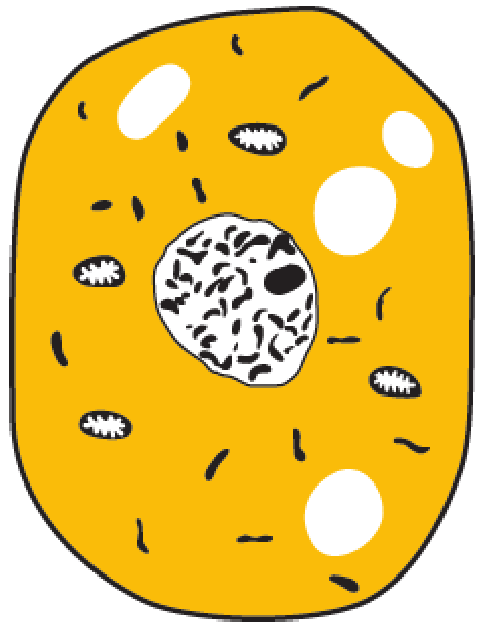
Observe the following diagram given as Fig.

Answer the following questions.
$a.$ Does it represent a plant cell or an animal cell?
$b.$ Does it represent a prokaryotic cell or an eukaryotic cell?
Answer
$a.$ The above diagram represents an animal ceil because cell is bounded by cell membrane. Cell wall is absent.
$b.$ The above diagram represents an eukaryotic cell as it has a well organised nucleus and also other cell organelles in it.
View full question & answer
Question 352 Marks
One cell performs all life activities in unicellular organisms. State yes or no.
Answer
Yes, one cell performs all life activities in unicellular organisms. Unicellular organisms (prokaryotes and eukaryote) are made up of just one cell and all the things needed for the survival of the organism takes place in that one cell. Thus, one cell carries out all the functions in unicellular organisms.
View full question & answer
Question 362 Marks
Write the name of control centre of cell.
Answer
Nucleus is the control centre of the cell. It is the largest loating body found in the cell. Nucleus controls and regulates all the cell activities. The $DNA$ of the cell is found here in nucleus.
View full question & answer
Question 372 Marks
What is the shape of red blood cells in human blood? What function do red blood cells perform$?$
Answer
Red blood cells $(RBCs)$ are usually spherical in shape. The main function of red blood cells is to carry oxygen from the lungs to the tissues around the body.
View full question & answer
Question 382 Marks
State the difference between prokaryotes and eukaryotes.
Answer
Prokaryotes have nuclear material without nuclear membrane whereas eukaryotes have well organized nucleus with a nuclear membrane.
View full question & answer
Question 392 Marks
What are unicellular organisms? Name two unicellular organisms.
Answer
The organisms made up of single cell are called unicellular organisms. Examples- Amoeba, Paramecium.
View full question & answer
Question 402 Marks
What are genes? Where are genes located?
Answer
Gene is a unit of inheritance in living organisms. It controls the transfer of a hereditary characteristic from parents to offspring. Genes are located on chromosomes.
View full question & answer
Question 412 Marks
Name two prokaryotes and two eukaryotes.
Answer
$a.$ Prokaryotes $-$ Blue green algae and bacteria.
$b.$ Eukaryotes $-$ Onion cells and cheek cells.
View full question & answer
Question 422 Marks
What is the size of an ostrich egg$?$ Is it a single cell or a group of cells$?$
Answer
The size of an ostrich egg is $170\ mm \times 130\ mm.$ It is the largest cell. It is a single cell called “fertilized egg cell” or “zygote”.
View full question & answer
Question 432 Marks
Why are nerve cells long and have branches?
Answer
Nerve cells (neurons) are long, branched and have thread-like projections so that they can connect other nerves cells and transmit messages over long distance.
View full question & answer
Question 442 Marks
Amoeba and Paramecium belong to which category of organisms?
Answer
Amoeba and Paramecium are unicellular prokaryotic organisms, i.e. they are made up of a single cell and their nucleus is not well defined. No cell organelle is present.
View full question & answer