Questions · Page 5 of 6

M.C.Q. [I MARKS]

MCQ 2011 Mark
Convergence of concave mirror can be decreased by dipping in.
  • A
    Water
  • B
    Oil
  • C
    Both oil $\ \&\ $ water
  • Neither oil nor water
Answer
Correct option: D.
Neither oil nor water
View full question & answer
MCQ 2021 Mark
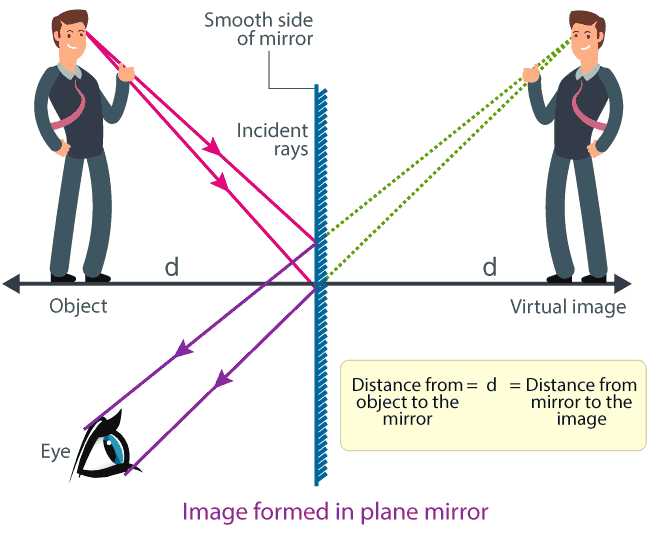
The image of an object formed by a plane mirror is:
  • Virtual.
  • B
    Real.
  • C
    Diminished.
  • D
    Upside$-$down.
Answer
Correct option: A.
Virtual.
The image of an object formed by a plane mirror is virtual always suggesting that the light rays do not actually come from the image.
View full question & answer
MCQ 2031 Mark
Which of the following statements is correct regarding rods and cones in the human eye?
  • A
    Cones are sensitive to dim light.
  • Cones are sensitive to bright light.
  • C
    Rods are sensitive to bright light.
  • D
    Rods can sense colour.
Answer
Correct option: B.
Cones are sensitive to bright light.
Cones are sensitive to bright light and they sense colour. However, rods are sensitive dim light.
View full question & answer
MCQ 2041 Mark
If the angle of incidence is $80^\circ$, what will be the angle of reflection?
  • $80^\circ$
  • B
    $100^\circ$
  • C
    $160^\circ$
  • D
    $20^\circ$
Answer
Correct option: A.
$80^\circ$
The angle of incidence $=$ the angle of reflection. So, the angle of reflection is $80^\circ$.
View full question & answer
MCQ 2051 Mark
The impression or sensation remains on the retina for about how many seconds even after removal of the object.
  • A
    $1$ second.
  • $\frac{1}{16}\text{th}$ of a second.
  • C
    $16$ seconds.
  • D
    $1$ minute.
Answer
Correct option: B.
$\frac{1}{16}\text{th}$ of a second.

 The impression or sensation remains on the retina for about $1/16th$ of a second even after removal of the object.
View full question & answer
MCQ 2061 Mark
United Football Club are playing an evening match. The team's jersey has blue and white stripes. What colour would the stripes appear under floodlights which produce a yellow light?
  • Black and yellow.
  • B
    Blue and white.
  • C
    Blue and yellow.
  • D
    Black and white.
Answer
Correct option: A.
Black and yellow.
An object appears blue when it reflects blue colour and absorbs rest of colours when light falls on it. But when yellow light falls on blue colour, it absorbs yellow and reflects nothing thus appears black. The white stripe reflects the yellow colour which falls on it, thus appears yellow.
View full question & answer
MCQ 2071 Mark
The property of plane mirror to make 'right appear as left' and vice versa, is called:
  • A
    Vertical inversion
  • Lateral inversion
  • C
    Reflection
  • D
    Refraction
Answer
Correct option: B.
Lateral inversion
View full question & answer
MCQ 2081 Mark
An object $5\ cm$ high is placed at a distance of $15\ cm$ from a concave mirror of radius of curvature $20\ cm.$ The height of the image in $cm$ is:
  • A
    $5\ cm$
  • B
    $20\ cm$
  • C
    $15\ cm$
  • $10\ cm$
Answer
Correct option: D.
$10\ cm$
View full question & answer
MCQ 2091 Mark
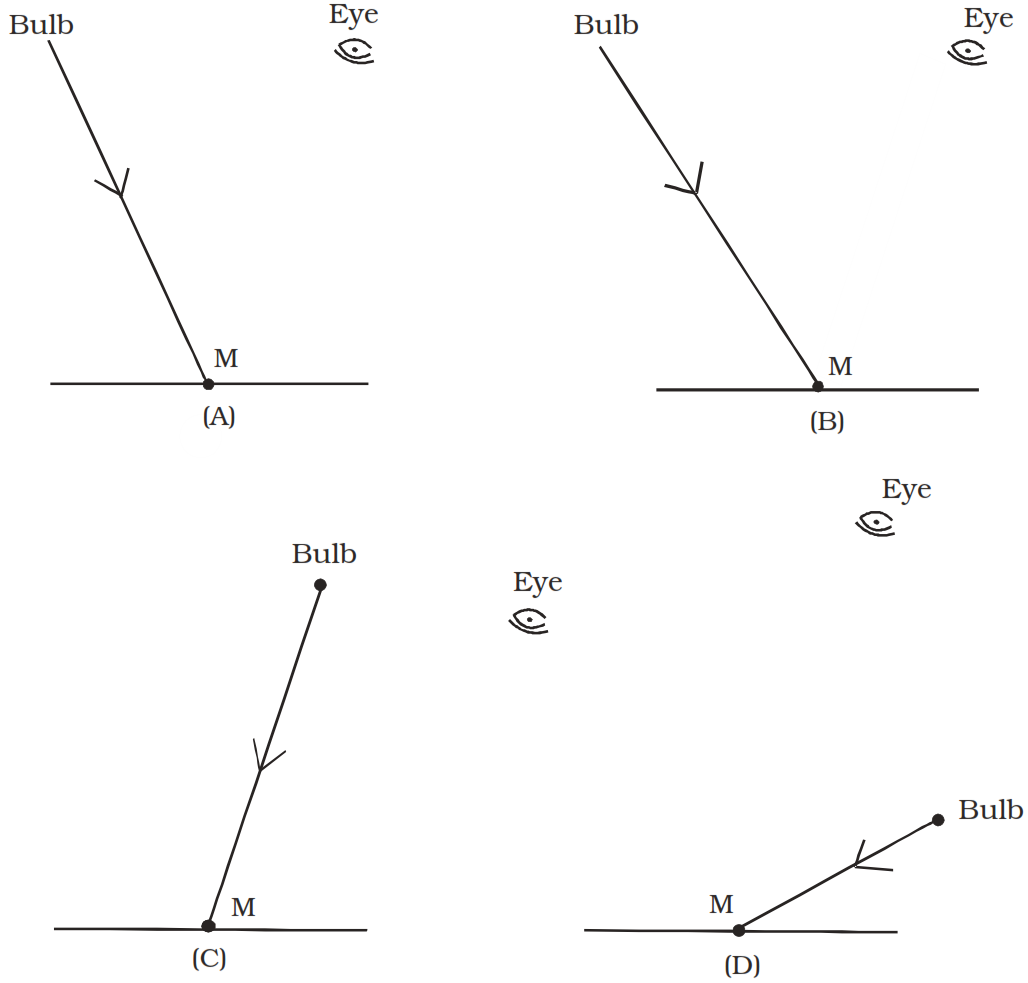
A tiny mirror $M$ is fixed on a piece of cardboard placed on a table. The cardboard is illuminated by light from a bulb. The position of eye with respect to position of bulb is shown in Figure as $A, B, C$ and $D.$ In which position mirror will be visible$?$
  • $A$
  • B
    $B$
  • C
    $C$
  • D
    $D$
Answer
Correct option: A.
$A$

 Following the laws of reflection of light, in case $A,$ when a ray of light from the bulb strikes the mirror $M,$ it will get reflected back such that the angle of incidence is equal to the angle of reflection.

View full question & answer
MCQ 2101 Mark
A series of fast moving still pictures can create an illusion of movement. Why?
  • A
    The eye can focus on very rapidly changing pictures.
  • B
    The eye is quicker than the brain.
  • The eye can separate two images only when the interval of separation between them is one-sixteenth of a second.
  • D
    The optical cortex can see through the rapidly moving images.
Answer
Correct option: C.
The eye can separate two images only when the interval of separation between them is one-sixteenth of a second.
A series of fast moving still pictures can create an illusion of movement as the eye can separate two images only when the interval of separation between them is one-sixteenth of a second. This happens due to a phenomenon called persistence of vision.
View full question & answer
MCQ 2111 Mark
The number of images of an object placed between two plane mirrors at $45^\circ $ to each other is:
  • A
    $2$
  • $7$
  • C
    $8$
  • D
    $10$
Answer
Correct option: B.
$7$
View full question & answer
MCQ 2121 Mark
You are standing in front of a plane mirror, which is approaching you with a speed of $10\ cm/ sec.$ Then the speed of the image approaching you will be.
  • A
    $20\ cm/ s$
  • B
    $10\ cm/ s$
  • $15\ cm/ s$
  • D
    $25\ cm/ s$
Answer
Correct option: C.
$15\ cm/ s$

 For a plane mirror, the image distance = object distance. Therefore, the image is formed at a distance of $10\ cm$ from the mirror on the other side.

View full question & answer
MCQ 2131 Mark
An incident ray makes an angle of $65$ degree with the surface of a plane mirror. The angle of reflection in this case will be:
  • A
    $65^\circ$
  • B
    $45^\circ$
  • $25^\circ$
  • D
    $35^\circ$
Answer
Correct option: C.
$25^\circ$

 According to the law of reflection, the angle of incidence is equal to the angle of reflection. If the incident ray makes an angle of $65$ degree with the surface of plane mirror, than the angle of incidence can be calculated as: angle of incidence $= 90 –$ angle made with the plane mirror $= 90 – 65 = 25$ degree. Since, the angle of incidence is equal to the angle of reflection, therefore the required angle of reflection $= 25$ degree.
View full question & answer
MCQ 2141 Mark
What makes objects visible?
  • A
    The absorption of light by objects.
  • The reflected light from the object.
  • C
    The total internal reflection taking place in an object.
  • D
    The refracted light from the object
Answer
Correct option: B.
The reflected light from the object.
An object is visible only when reflected light from the object reaches the retina of our eyes.
View full question & answer
MCQ 2151 Mark
The size of the pupil of the eye is adjusted by:
  • A
    Cornea
  • B
    Ciliary muscles
  • C
    Optic nerve
  • Iris
Answer
Correct option: D.
Iris
The size of the pupil of the eye is adjusted by “iris”. The pupil of our eye is an entrance for the light rays to enter our eyes and give us the sensation of sight. If too much light enters our eyes, it can be dangerous for eyes. Whenever the light is strong, the pupil shrinks in order to reduce the entrance of light and protect our eyes. If too less light enters our eyes, we don’t get a clear vision. Whenever the light is weak, the pupil expands in order to increase the entrance of light and improve the vision. This is how pupil of the eye changes its size to adjust for different amount of light.
View full question & answer
MCQ 2161 Mark
Match the following: Position of object Position of image.
$i.$ Between pole and focus At $F.$
$ii.$ Between $F$ and $C$ At $C.$
$iii.$ At $C$ Behind the mirror.
$iv.$ At infinity Beyond $C.$
  • A
    $\text{1-A, 2-B, 3-D, 4-C.}$
  • $\text{1-C, 2-D, 3-B, 4-A.}$
  • C
    $\text{1-C, 2-A, 3-D, 4-B.}$
  • D
    $\text{1-B, 2-C, 3-D, 4-A.}$
Answer
Correct option: B.
$\text{1-C, 2-D, 3-B, 4-A.}$
View full question & answer
MCQ 2171 Mark
Which of the following eye parts is not in contact with the eye lens?
  • A
    Vitreous humour
  • B
    Ciliary fibres
  • Cornea
  • D
    Iris
Answer
Correct option: C.
Cornea
Cornea is the outer envelope of the eye. It provides focusing power to the eye. The aqueous humour separates the lens from the cornea.

It can be observed that the cornea is not in contact with the eye lens.
View full question & answer
MCQ 2181 Mark
Motion and still pictures projected in a cinema hall are $............$ images.
  • Real
  • B
    Virtual
  • C
    Erect
  • D
    All of these
Answer
Correct option: A.
Real
View full question & answer
MCQ 2191 Mark
A plane mirror reflecting a ray of incident light is rotated through an angle $\theta$, about an axis through the point of incidence, in the plane of the mirror perpendicular to the plane of incidence. Then,
$i.$ The reflected ray does not rotate.
$ii.$ The reflected ray rotates through an angle $\theta$.
$iii.$ The reflected ray rotates through an angle 2$\theta$.
$iv. $The incident ray is fixed.
  • A
    Only $(i)$ is correct.
  • B
    $(i)$ and $(iii)$ are correct.
  • $(iii)$ and $(iv)$ are correct.
  • D
    $(ii)$ and $(iv)$ are correct.
Answer
Correct option: C.
$(iii)$ and $(iv)$ are correct.
View full question & answer
MCQ 2201 Mark
A lady dressed in a new sari stands in front of a plane mirror fixed on a vertical wall, height of the lady is $160\ cm$ and that of her eyes from the ground is $150\ cm,$ then The length of the mirror required to see her fall view in the mirror is.
  • A
    $160\ cm$
  • B
    $100 \ cm$
  • $80 \ cm$
  • D
    $320\ cm$
Answer
Correct option: C.
$80 \ cm$

 Length of the plane mirror required is $H/ 2,$
$H =$ height of object.

View full question & answer
MCQ 2211 Mark
Periscope works on the principle of multiple reflections. It consists of two or more mirror, used for the reflection. If the two mirrors are placed at an angle of $90?$ how many images of the object are formed between them?
  • A
    One
  • B
    Two
  • Three
  • D
    Four
Answer
Correct option: C.
Three
View full question & answer
MCQ 2221 Mark
When we stand in front of our dressing table, our left hand seems to be right and right seems to be left. This is called.
  • A
    Left$-$right confusion.
  • Lateral inversion.
  • C
    Up$-$side down phenomenon.
  • D
    mirage.
Answer
Correct option: B.
Lateral inversion.
View full question & answer
MCQ 2231 Mark
Visually impaired people can read and write using:
  • A
    Electronic writer
  • Braille system
  • C
    Digital pens
  • D
    Hearing aids
Answer
Correct option: B.
Braille system
View full question & answer
MCQ 2241 Mark
A plane mirror is approaching you at $10\ cm$ per second. You can see your image in it. At what speed will your image approaches you.
  • A
    $5\ cm/ s$
  • B
    $25\ cm/ s$
  • $20\ cm/ s$
  • D
    $15\ cm/ s$
Answer
Correct option: C.
$20\ cm/ s$
View full question & answer
MCQ 2251 Mark
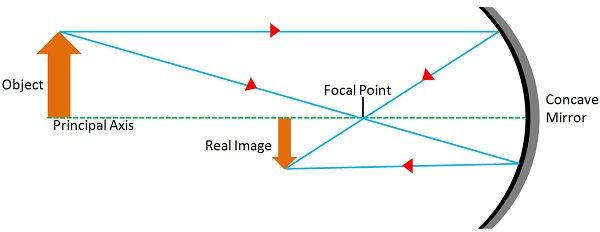
When the rays of light, diverging from a point, after reflection or refraction actually converge at some other point then that point is ___ image of the object.
  • A
    Virtual
  • Real
  • C
    Both $(a)$ and $(b)$
  • D
    Neither $(a)$ nor $(b)$
Answer
Correct option: B.
Real

 When the rays of light, diverging from a point, after reflection or refraction actually converge at some other point then that point is real image of the object.
View full question & answer
MCQ 2261 Mark
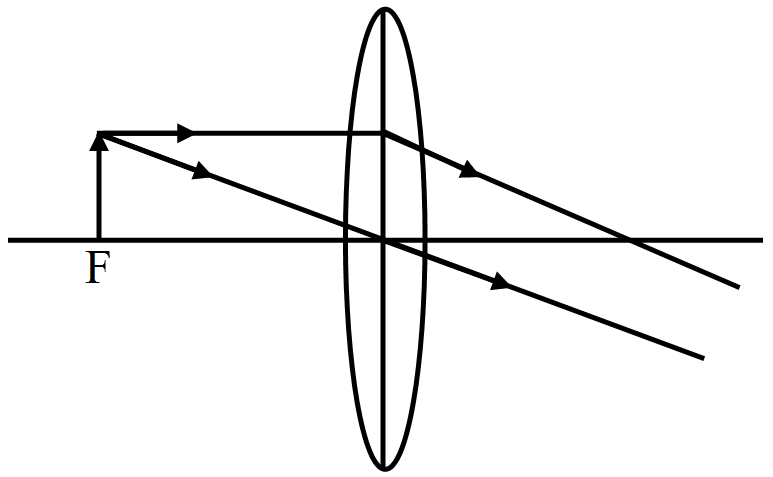
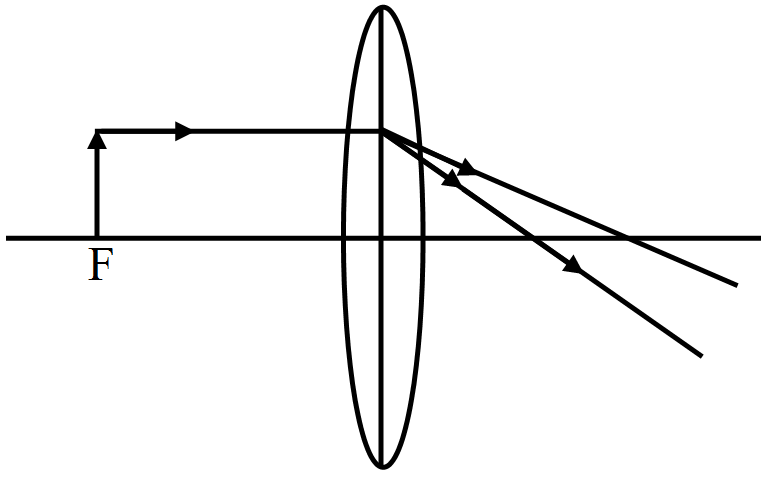
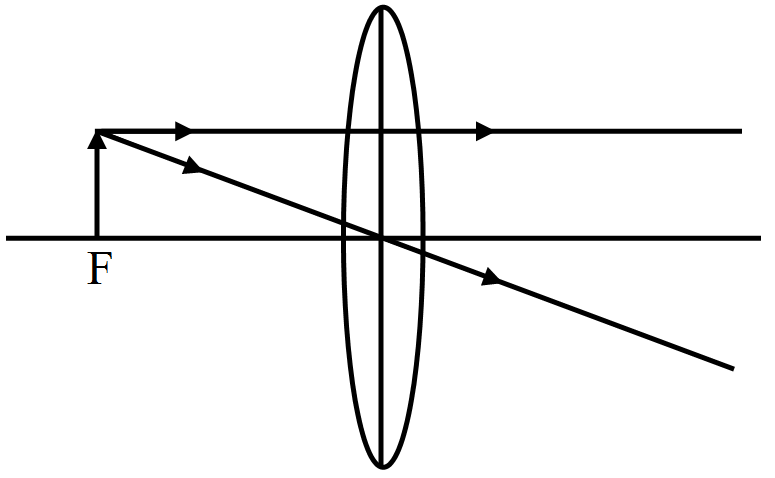
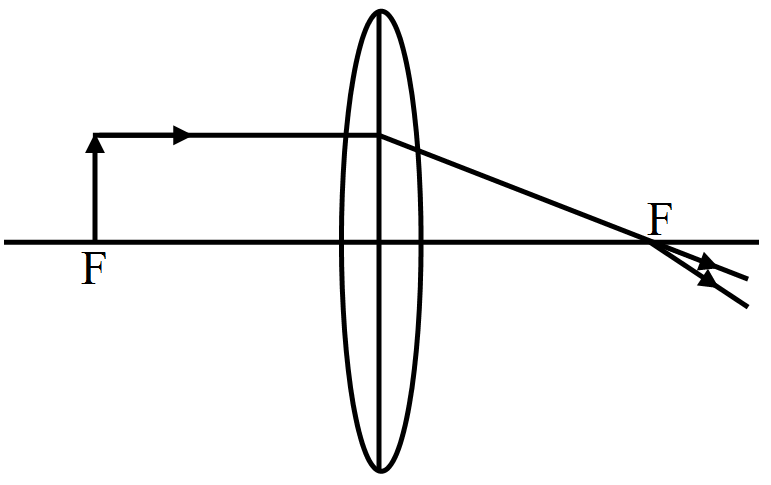
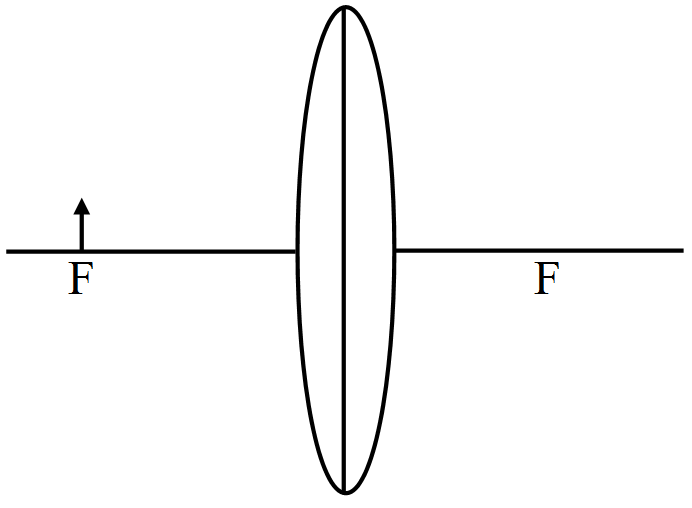
An object $AB$ is placed in front of a convex lens at its principal focus as shown in the Figure.
Which of the ray diagram given below correctly depicts the refraction through the lens $L?$
  • B
  • C
  • D

      
Answer
Correct option: A.
View full question & answer
MCQ 2271 Mark
To make a kaleidoscope we require.
  • Three plane mirrors.
  • B
    Four plane mirrors.
  • C
    Three glass sheets.
  • D
    Four glass sheets.
Answer
Correct option: A.
Three plane mirrors.
View full question & answer
MCQ 2281 Mark
Statement $I:$ A concave mirror has a real focus.
Statement $II:$ A convex mirror has a virtual focus.
  • A
    Both Statements are true. Statement$-II$ is the correct explanation of Statement$-I.$
  • Both Statements are true. Statement$-II$ is not correct explanation of Statement$-I$.
  • C
    Statement$-I$ is true. Statement$-II$ is false.
  • D
    Statement$-I$ is false. Statement$-II$ is true.
Answer
Correct option: B.
Both Statements are true. Statement$-II$ is not correct explanation of Statement$-I$.
View full question & answer
MCQ 2291 Mark
The perpendicular drawn to the reflecting surface is called:
  • Normal
  • B
    Incident ray
  • C
    Reflected ray
  • D
    None of these
Answer
Correct option: A.
Normal
View full question & answer
MCQ 2301 Mark
Which of the following can make beautiful patterns due to the formation of multiple images:
  • Kaleidoscope
  • B
    Periscope
  • C
    Microscope
  • D
    telescope
Answer
Correct option: A.
Kaleidoscope
View full question & answer
MCQ 2311 Mark
A device which works on the reflection of light from two plane mirrors arranged parallel to one another is:
  • A
    Electroscope.
  • B
    Kaleiodoscope.
  • Periscope.
  • D
    Stethoscope.
Answer
Correct option: C.
Periscope.
Periscopes are used to see objects that are not in direct line of sight.
View full question & answer
MCQ 2321 Mark
The reflection of light from a smooth surface is called:
  • A
    Diffused reflection
  • Regular reflection
  • C
    Dispersion
  • D
    Spectrum
Answer
Correct option: B.
Regular reflection
View full question & answer
MCQ 2331 Mark
In a science quiz competition, payel is asked a question where she had to choose the statement which was/were correct?
  • A
    An optical instrument in which reflected light is reflected again is a periscope.
  • B
    A periscope is a long, tubular device through which a person can see object that are out of the direct line of sight.
  • C
    A periscope works on the reflection of light from two plane mirrors arranged parallel to one another.
  • All the above.
Answer
Correct option: D.
All the above.
Here, all the statements are correct.
View full question & answer
MCQ 2341 Mark
A straight stick partially immersed under water obliquely appears to be bent due to.
  • A
    Reflection.
  • Refraction.
  • C
    Total internal reflection.
  • D
    Parallax error.
Answer
Correct option: B.
Refraction.
View full question & answer
MCQ 2351 Mark
The back side of a plane mirror contains:
  • A
    Gold coating
  • Silver coating
  • C
    Aluminium coating
  • D
    Copper coating
Answer
Correct option: B.
Silver coating
View full question & answer
MCQ 2361 Mark
The ciliary muscles of the human eye contract and relax in order to.
  • A
    Adjust the size of the eyeball.
  • Adjust the focal length of the lens.
  • C
    Control the amount of light entering the eye.
  • D
    Prevent foreign elements from entering the eye.
Answer
Correct option: B.
Adjust the focal length of the lens.
View full question & answer
MCQ 2371 Mark
With what is glass coated in order to convert it into a mirror?
  • Silver
  • B
    Copper
  • C
    Aluminium
  • D
    Platinum
Answer
Correct option: A.
Silver
Glass is coated with silver.
View full question & answer
MCQ 2381 Mark
Light starting from a medium of refractive index $\mu$ undergoes refraction into a medium $\mu_1$ If $i$ and $r$ stand for angles of incidence and refraction respectively, then,
  • A
    $\frac{\sin\text{i}}{\sin\text{r}}=\frac{\mu}{\mu_1}$
  • $\frac{\sin\text{i}}{\sin\text{r}}=\frac{\mu_1}{\mu}$
  • C
    $\frac{\cos\text{i}}{\cos\text{r}}=\frac{\mu_1}{\mu}$
  • D
    $\frac{\sin\text{i}}{\sin\text{r}}=\frac{1}{\mu\mu^1}$
Answer
Correct option: B.
$\frac{\sin\text{i}}{\sin\text{r}}=\frac{\mu_1}{\mu}$

$\mu_1 \sin\text{i} = \mu_2 \sin\text{r};$
$\mu \sin\text{i} = \mu \sin\text{r};$
View full question & answer
MCQ 2391 Mark
The ciliary muscles of the human eye contract and relax in order to.
  • A
    Adjust the size of the eyeball.
  • Adjust the focal length of the lens.
  • C
    Control the amount of light entering the eye.
  • D
    Prevent foreign elements from entering the eye.
Answer
Correct option: B.
Adjust the focal length of the lens.
View full question & answer
MCQ 2401 Mark
Which of the following statements is true?
  • A
    The angle of incidence is twice the angle of reflection.
  • The incident ray, the reflected ray and the normal drawn at the point of incidence lie in the same plane.
  • C
    Some virtual images can be caught on the screen.
  • D
    A convex mirror forms a real image.
Answer
Correct option: B.
The incident ray, the reflected ray and the normal drawn at the point of incidence lie in the same plane.
When a light ray is reflected from the reflecting surface, the incident ray, the reflected ray and the normal lie in the same plane.
The angle of incidence $=$ The angle of reflection.
View full question & answer
MCQ 2411 Mark
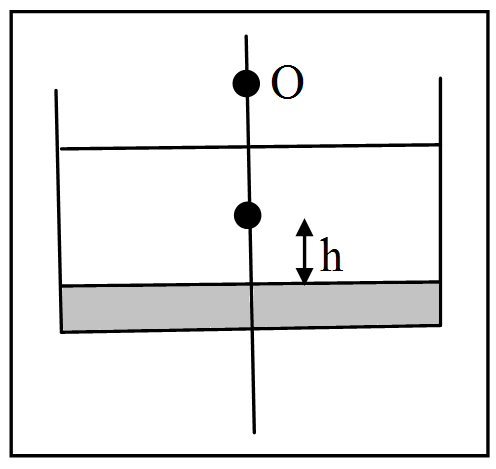
In the figure,

A point source $P$ is placed at a height $4\ m$ above the plane mirror in a medium of refractive index $1.2$ an observer $0$ vertically above $P,$ outside the liquid sees $P$ and its image in the mirror. The apparent distance between these two is $.........cm.$
  • A
    $3.3\ cm$
  • B
    $6.6\ cm$
  • $9.9\ cm$
  • D
    $13.2\ cm$
Answer
Correct option: C.
$9.9\ cm$
View full question & answer
MCQ 2421 Mark
The graph drawn with object distance along $x-$ coordinate and image $($real$)$ distance as $y-$ coordinate for a convex is a.
  • A
    Straight line
  • B
    Circle
  • C
    Parabola
  • Rectangular hyperbola
Answer
Correct option: D.
Rectangular hyperbola
View full question & answer
MCQ 2431 Mark
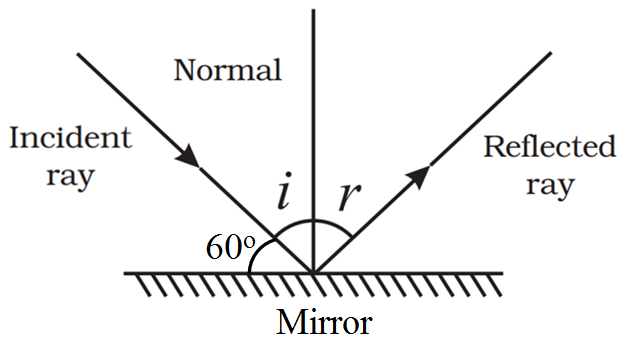
The diagram shows a ray of light reflected at a plane mirror.
Which pair of the angle of incidence and angle of reflection is correct?
  • Angle of Incidence
    Angle of reflection
    $30^\circ $
    $30^\circ $
  • B
    Angle of Incidence
    Angle of reflection
    $30^\circ $
    $60^\circ $
  • C
    Angle of Incidence
    Angle of reflection
    $60^\circ $
    $30^\circ $
  • D
    Angle of Incidence
    Angle of reflection
    $60^\circ $
    $60^\circ $
Answer
Correct option: A.
Angle of Incidence
Angle of reflection
$30^\circ $
$30^\circ $
 By the geometry of figure angle of incidence $= 30^\circ .$ According to first law of reflection, the angle of incidence is equal to the angle of reflection.
View full question & answer
MCQ 2441 Mark
In our houses, which of the following is used for looking at ourselves?
  • A
    Convex mirror
  • B
    Concave mirror
  • C
    Convex lens
  • Plane mirror
Answer
Correct option: D.
Plane mirror
We use plane mirrors to see ourselves, because the image formed by a plane mirror is virtual, erect and of the same size.
View full question & answer
MCQ 2451 Mark
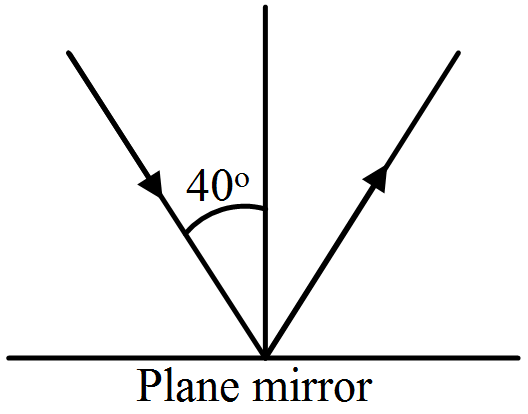
Look at the given figure.

Find the angle between the incident ray and the reflected ray.
  • A
    $60^\circ$
  • B
    $90^\circ$
  • $80^\circ$
  • D
    $40^\circ$
Answer
Correct option: C.
$80^\circ$
$\angle\text{i}=40^\circ ($given$)$
$\angle\text{i}=\angle\text{r}=40^\circ$
The angle between the incident ray and the reflected ray $=\angle\text{i}=\angle\text{r}=40^\circ+40^\circ = 80^\circ$
View full question & answer
MCQ 2461 Mark
An object situated at a distance of $10\ cm$ infront of a plane mirror. The distance of image from the mirror is.
  • $10\ cm$
  • B
    $20\ cm$
  • C
    $5\ cm$
  • D
    other value
Answer
Correct option: A.
$10\ cm$
View full question & answer
MCQ 2471 Mark
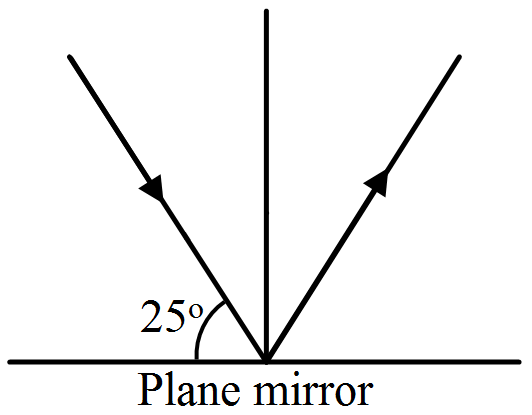
Observe the figure given below.

Find the angle between the incident and the reflected ray.
  • A
    $65^\circ$
  • B
    $90^\circ$
  • $130^\circ$
  • D
    $25^\circ$
Answer
Correct option: C.
$130^\circ$
View full question & answer
MCQ 2481 Mark
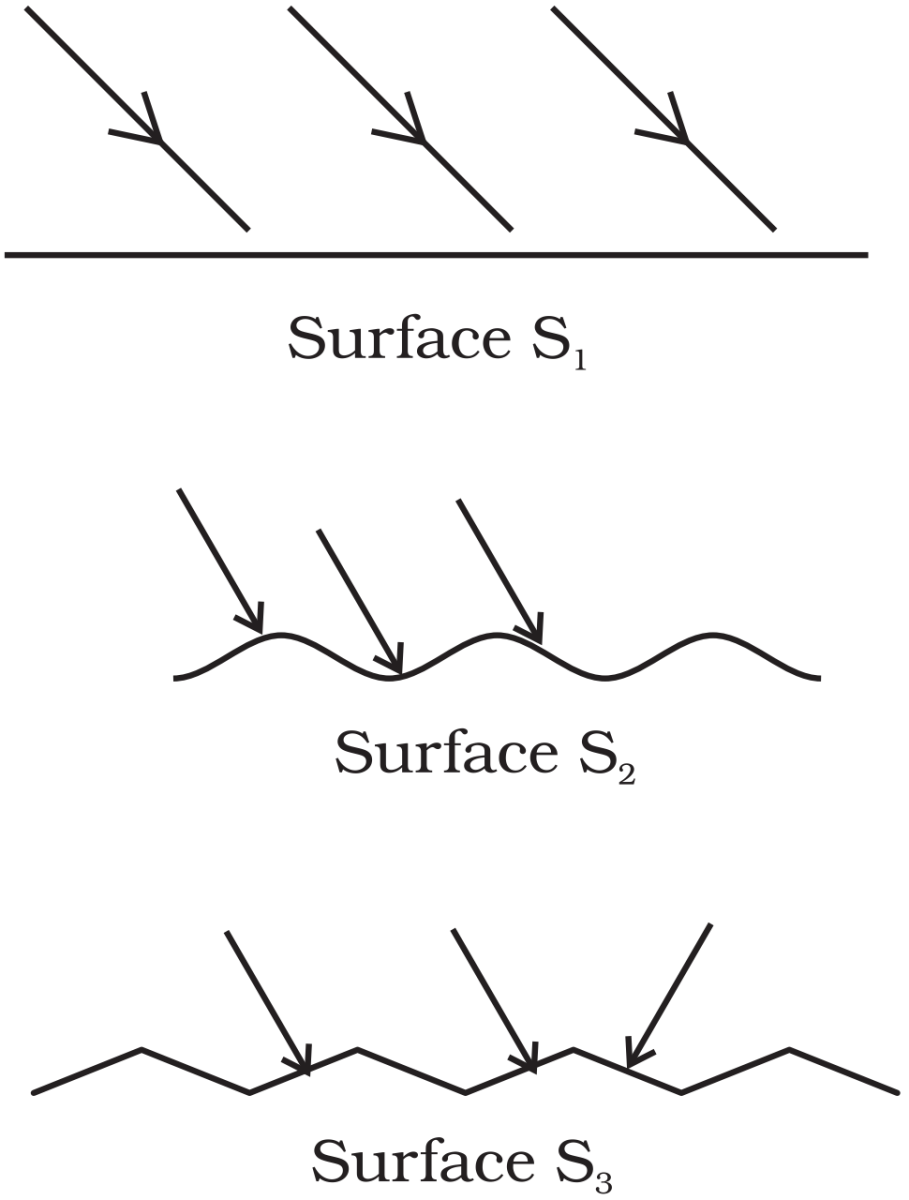
Light is falling on surfaces $S_1 , S_2$ and $S_3$ as shown in the figure.

Surfaces on which the angle of incidence is equal to the angle of reflection is/are:
  • A
    $S_1$ only.
  • B
    $S_1$ and $S_2$ only.
  • C
    $S_2$ and $S_3.$
  • All the three surfaces.
Answer
Correct option: D.
All the three surfaces.
Laws of reflection are always followed whatever be the surface of the object. Therefore, the angle of incidence is equal to the angle of reflection on ail the three surfaces $(S_1, S_2$ and $S_3).$
View full question & answer
MCQ 2491 Mark
When the rays of light, diverging from a point, after reflection or refraction, appear to diverge from another point, then the image so formed is called.
  • A
    Virtual image
  • Real image
  • C
    Both $(a)$ and $(b)$
  • D
    Neither $(a)$ nor $(b)$
Answer
Correct option: B.
Real image

When the rays of light, diverging from a point, after reflection or refraction, appear to diverge from another point, then the image so formed is called virtual image.
View full question & answer
MCQ 2501 Mark
A parallel beam of light is incident on a converging lens parallel to its principal axis. As one moves the source of light away from the lens on its principal axis, the intensity of light.
  • A
    Remains constant.
  • B
    Continuously increases.
  • Continuously decreases.
  • D
    First increases than decreases.
Answer
Correct option: C.
Continuously decreases.
In the given situation, the intensity of light decreases continuously with increase in distance.
View full question & answer
M.C.Q. [I MARKS] - Page 5 - Science STD 8 Questions - Vidyadip