Question types

Stars and the Solar System question types

414 questions across 11 question groups — pick any mix to generate a Science paper with step-by-step answer keys.

414
Questions
11
Question groups
5
Question types
Sample Questions

Stars and the Solar System questions

One sample from each question group in this chapter. Select any group above to see the full set with answer keys.

Phases of the Moon occur because:
  • A
    We can see only that part of the Moon which reflects light towards us.
  • B
    Our distance from the Moon keeps changing.
  • C
    The shadow of the Earth covers only a part of the Moon's surface.
  • The thickness of the Moon's atmosphere is not constant.

Answer: D.

View full solution
Match the Column $I$ with Column $II$ and select the correct option from the codes given below.
 
Column $I$
 
Column $II$
$(a)$
Made of ice and rocky material
$(i)$
Orion
$(b)$
Chunks of rocks that have never managed to come together as planet
$(ii)$
Meteors
$(c)$
Shooting stars in the sky
$(iii)$
Asteroids
$(d)$
The hunter
$(iv)$
Comets
  • A
    $(a)-(i), (b)-(ii), (c)-(iii), (d)-(iv)$
  • $(a)-(iv), (b)-(iii), (c)-(ii), (d)-(i)$
  • C
    $(a)-(iii), (b)-(ii), (c)-(i), (d)-(iv)$
  • D
    $(a)-(ii), (b)-(i), (c)-(iv), (d)-(iii)$

Answer: B.

View full solution
If plastic strips are placed in an electroscope at the place of aluminum strips then:
  • A
    Divergence of strips will take place.
  • No divergence of strips will take place.
  • C
    Partial divergence of strips will take place.
  • D
    Either $[a]$ or $[b].$

Answer: B.

View full solution
Match items in column $A$ with one or more items in column $B$.
$A$ $B$
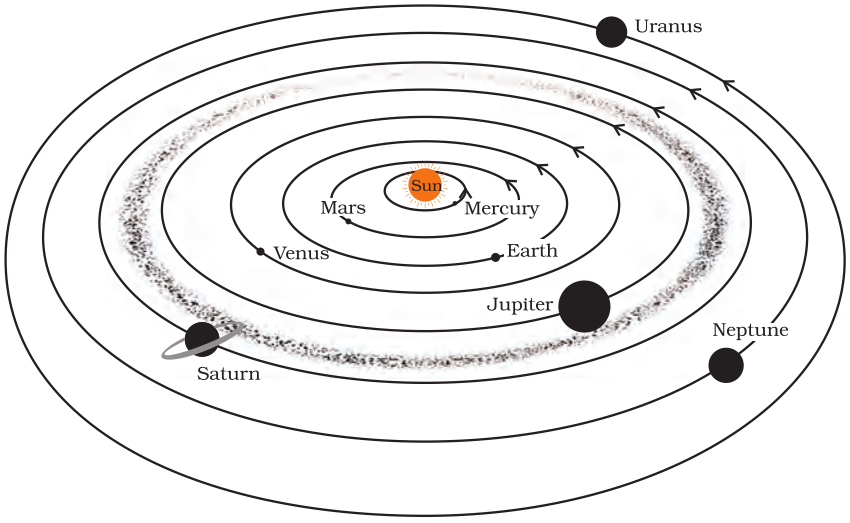
$i. $ Inner planets $a. $ Saturn
$ii. $ Outer planets $b. $ Pole star
$iii.$ Constellation $c. $ Great Bear
$iv.$ Satellite of the Earth $d. $ Moon
  $e. $ Earth
$f. $ Orion
$g. $ Mars
View full solution
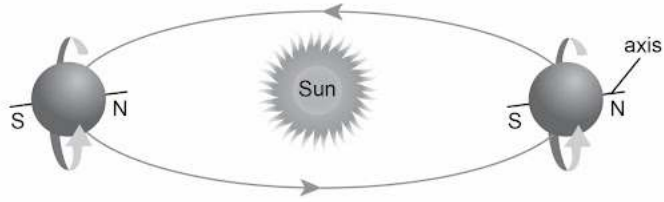
The diagram shows how a planet rotates on its axis as it revolves around the Sun.Image
$9.$ What can be concluded about the planet from the diagram?
Can this be concluded from the diagram? Yes or No
The planet rotates from east to west. Yes/No
The planet does not experience change of seasons. Yes/No
The planet rolls on its orbit as it revolves around the Sun. Yes/No
$10.$ What is the word used for a celestial object that has a bright head and a long tail?
$A.$ Comet
$B.$ Meteor
$C. $ Asteroid
$D.$  Meteorite
View full solution
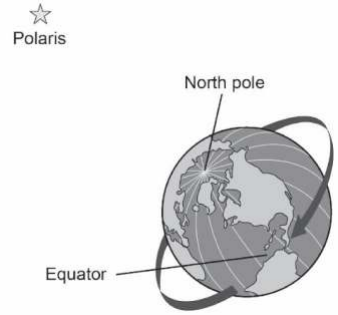
Polaris is a star that always appear at the same point in the night sky.
Image

$7.$ Why does Polaris appear at the same location over time$?$
$A.$ It is a part of our solar system
$B.$ It is too far away from the Earth
$C.$ It is situated along the Earth’s axis
$D.$ It is held in its position by the Earth’s gravity
$8.$ What is Polaris commonly known as$?$
View full solution
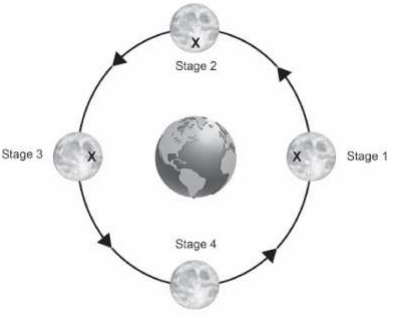
The picture shows how a part of the Moon $(X)$ is seen as it rotates around the Earth.

Image
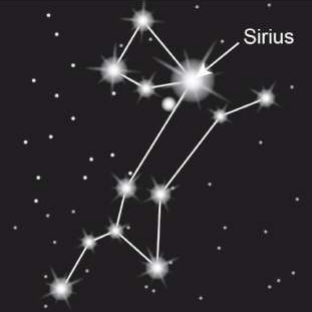
$5.$ What is the word used for this type of imaginary igures$?$
$A.$ Galaxy
$B.$ Supernova
$C.$ Constellation
$D.$ Solar System
$6.$ Sirius is twice as large as the Sun.
Why does it appear so small from the Earth$?$
View full solution
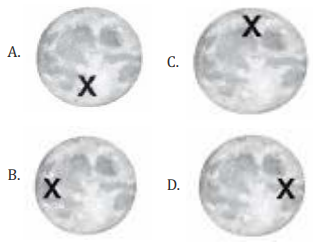
The picture shows how a part of the Moon $(X)$ is seen as it rotates around the Earth.Image
$3.$ What will be the position of $X$ at Stage $4?$
Image
$4.$ Why can’t living things survive on the Moon$?$
Circle ‘Yes’ or ‘No’ for the correct response.
Is the statement true$?$ Yes or No
There is no water on the Moon. Yes/No
There is no oxygen on the Moon. Yes/No
There are many high mountains on the Moon. Yes/No
View full solution
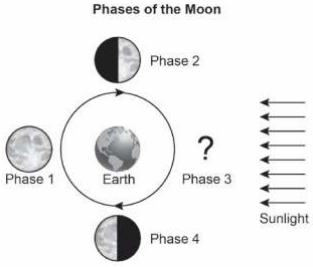
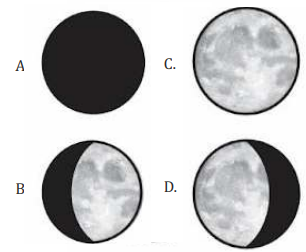
The diagram shows how the Moon appears to the Earth at four different phases.Image
$1.$ Which of these pictures represents Phase $3?$
Image
$2.$ What is the rough number of days in between Phase $2$ and Phase $4$ of the Moon$?$
$A.$ Half a day
$B.$ One day
$C$. Fifteen days
$D.$ Thirty days
View full solution

Generate a Stars and the Solar System paper free

Pick question groups from the list above, set marks and difficulty, and export a branded PDF with step-by-step answer keys. First 3 chapters free — no signup.

Download App