What refers to a goal or a principle in its most excellent or perfect form?
Question types
The Indian Constitution question types
139 questions across 5 question groups — pick any mix to generate a Social Science paper with step-by-step answer keys.
139
Questions
5
Question groups
5
Question types
01
MCQ (1 Mark)
62 Q→02Question(1 Marks)
24 Q→03VERY SHORT ANSWER QUESTIONS
21 Q→04Answer The Following Questions In Short.[3 Marks Each]
15 Q→05Answer The Following Questions In Brief.[5 Marks Each]
17 Q→Sample Questions
The Indian Constitution questions
One sample from each question group in this chapter. Select any group above to see the full set with answer keys.
View full solution →
In 1934, _____ demanded for a Constituent Assembly for the first time.
Shri Jagjivan Ram was the first _____ minister of India.
Which statement from the following is in the Preamble of Indian Constitution?
The existence of more than one level of government in any country is called ____.
Define right to equality.
Define fundamental rights.
What is universal adult franchise?
What is democracy?
Who is known as the Father of the Indian Constitution?
Discuss with your teacher what you understand by the term ‘constitutive’. Provide one example of ‘constitutive rules’ from your everyday life.
What do you mean by tyranny of majority?
What do you mean by Directive Principles of State Policy?
If any of our right is exploited, what can we do?
Discuss the difference between State and Government with your teacher.
What would happen if there were no restrictions on the power of elected representatives?
List the different types of religious practice that you find in your neighbourhood. This could be different forms of prayer, worship of different gods, sacred sites, different kinds of religious music and singing, etc. Does this indicate freedom of religious practice?
Explain how the constitution of India gets made?
Read the following storyboard and answer the following questions: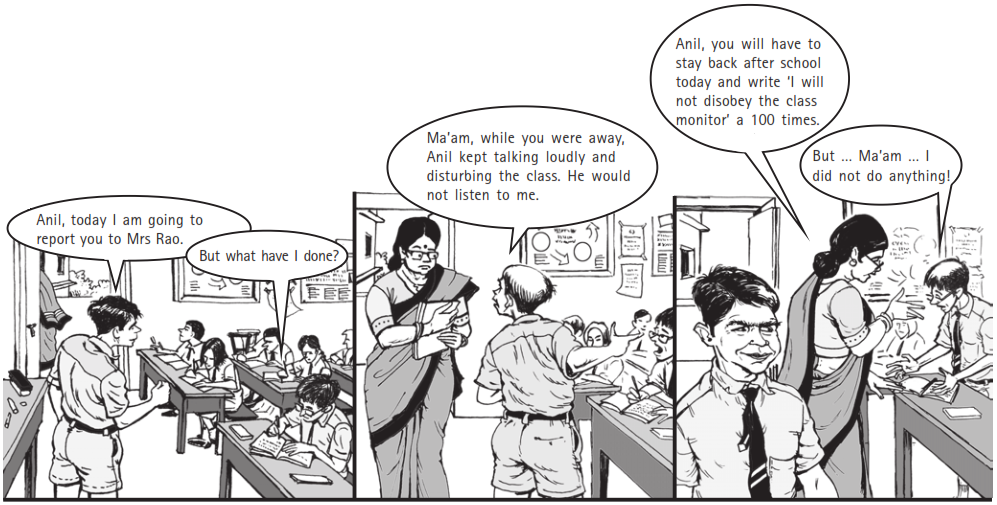
In what way is the class monitor misusing his power?
In what way is the class monitor misusing his power?
In which of the following situations is a minister misusing his power:
- Refuses to sanction a project of his ministry for sound technical reasons.
- Threatens to send his security staff to rough up his neighbour.
- Calls up the police station asking them not to register a complaint that is likely to be filed against his relative.
The column on the left lists some of the key features of the Indian Constitution. In the other column write two sentences, in your own words, on why you think this feature is important:
|
Key Feature
|
Significance
|
|
Federalism
|
|
|
Separation of Powers
|
|
|
Fundamental Rights
|
|
|
Parliamentary Form of Government
|
|
In each of the following situations, identify the minority. Write one reason why you think it is important to respect the views of the minority in each of these situations.
- In a school with 30 teachers, 20 of them are male.
- In a city, 5 per cent of the population are Buddhists.
- In a factory mess for all employees, 80 percent are vegetarians.
- In a class of 50 students, 40 belong to more well-off families.
Look at the wordings of the two documents given below. The first column is from the 1990 Nepal Constitution. The second column is from the more recent Constitution of Nepal.
What is the difference in who exercises ‘Executive Power’ in the above two Constitutions of Nepal?
|
1990 Constitution of Nepal
Part 7: Executive
|
2015 Constitution of Nepal
Part 7: Federal Executive
|
|
Article 35: Executive Power: The executive power of the Kingdom of Nepal shall be vested in His Majesty and the Council of Ministers.
|
Article 75: Executive Power: The executive power of Nepal shall, pursuant to this Constitution and law be vested in the Council of Ministers.
|
Why does a democratic country need a Constitution?
Elaborate the rights to equality.
Generate a The Indian Constitution paper free
Pick question groups from the list above, set marks and difficulty, and export a branded PDF with step-by-step answer keys. First 3 chapters free — no signup.