Questions

3 Marks Question

🎯

Test yourself on this topic

7 questions · timed · auto-graded

Question 13 Marks
Construct a triangle ABC in which BC = 5cm, $\angle\text{B}=60^\circ$ and AC + AB = 7.5cm.
Answer
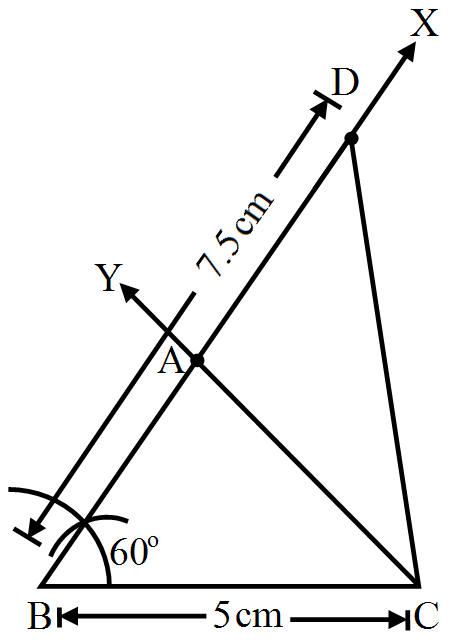
  1. Draw the base BC = 5cm.
  2. At the point B make an $\angle\text{XBC}=60^\circ$
  3. Cut a line segment BD equal to AB + AC = 7.5cm from the ray BX.
  1. Join DC.
  2. Make an $\angle\text{DCY}=\angle\text{BDC}$
  3. Let CY intersect BX at A.
Then, $\triangle\text{ABC}$ is the required triangle.
View full question & answer
Question 23 Marks
Construct the following and give justification:
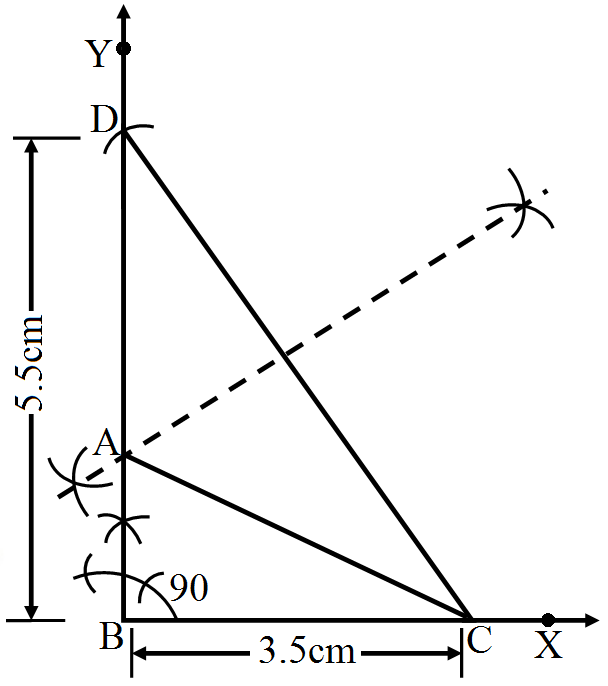
A right triangle when one side is 3.5cm and sum of other sides and the hypotenuse is 5.5cm.
Answer
In $\triangle\text{ABC},$ base BC = 3.5cm, the sum of other side and hypotenuse i.e., AB + AC = 5.5cm and $\angle\text{ABC}=90^\circ$ To construct, An $\triangle\text{ABC}.$ Steps of construction,
  1. Draw a ray BX and cut off a line segment BC = 3.5cm from it.
  2. Construct $\angle\text{XBY}=90^\circ$ with the help of a ruler and compass.
  3. From by cut off a line segment BD = 5.5cm.
  1. Join CD.
  2. Draw the perpendicular bisector of CD intersecting BD at A.
  3. Join AC. Then, ABC is the required triangle.
View full question & answer
Question 33 Marks
Construct the following and give justification:
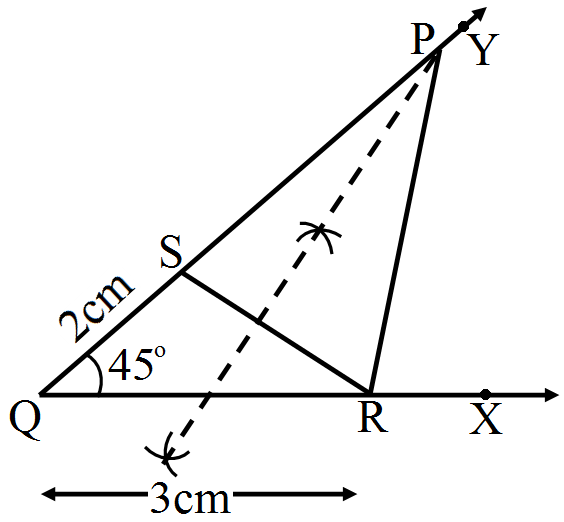
A triangle PQR given that QR = 3cm, $\angle\text{PQR}=45^\circ$ and QP - PR = 2cm.
Answer
Steps of construction,
  1. Draw a ray OX and cut off a line segment QR = 3cm.
  2. AT Q, construction $\angle\text{YQR}=45^\circ$ with help of protractor.
  3. On QY, cut off QS = 2cm.
  1. Join RS.
  2. Draw perpendicular bisector of RS to meet QY at P.
  3. Join PR. Then PQR is the required triangle.
View full question & answer
Question 43 Marks
Construct the following and give justification:
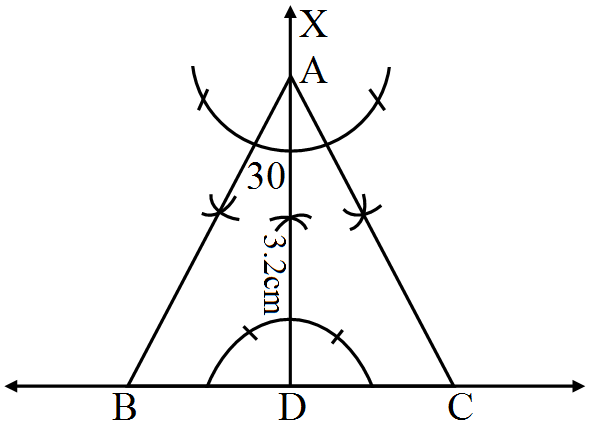
An equilateral triangle if its altitude is 3.2cm.
Answer
Steps of Construction,
  1. Draw a line l.
  2. Mark any point D on the line l.
  1. At point D, draw $\overline{\text{DX}}\perp\text{l}$ with the help of ruler and compass and cut DA = 3.2cm on $\overline{\text{DX}}.$
  2. At the point A, construct AB and AC which meets the l as points B and C respectively such that $\angle\text{DAB}=30^\circ$ and $\angle\text{DAC}=30^\circ$
Then $\triangle\text{ABC}=30^\circ$ is the required equilateral triangle because,
$\angle\text{ABC}=180^\circ-(90^\circ+30^\circ)=60^\circ$
$\angle\text{ACB}=180^\circ-(90^\circ+30^\circ)=60^\circ$
And $\angle\text{BAC}=30^\circ+30^\circ=60^\circ$
View full question & answer
Question 53 Marks
Construct the following and give justification:
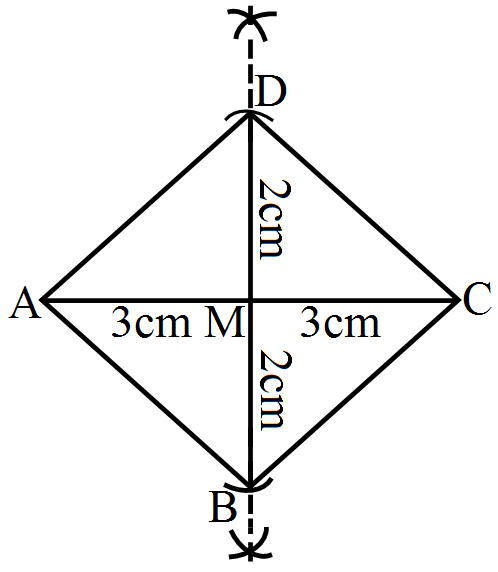
A rhombus whose diagonals are 4cm and 6cm in lengths.
Answer
To construct, A rhombus ABCD. Step of constuction,
  1. Take AC = 6cm.
  2. Draw BD the right bisectors of AC.
  1. Cut off MB = 2cm.
  2. Join AB, BC, Cd and DA.
Hence, ABCD is the required rhombus.
View full question & answer
Question 63 Marks
Construct the following and give justification:
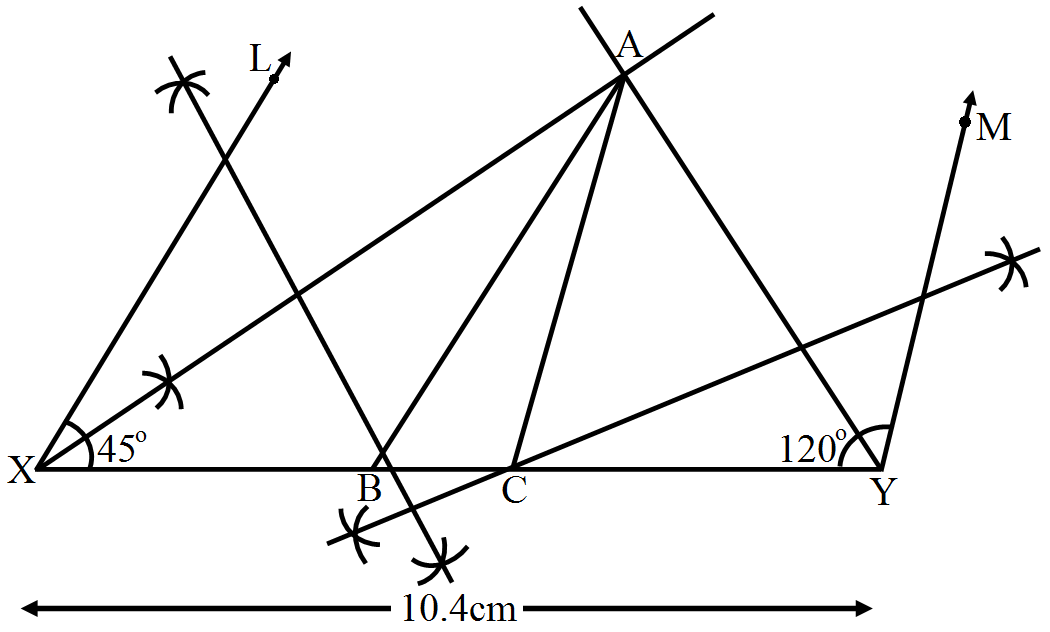
A triangle if its perimeter is 10.4cm and two angles are 45° and 120°
Answer
Steps of construction,
  1. Draw XY = 10.4cm
  2. Draw $\angle\text{LXY}=45^\circ$ and $\angle\text{MYX}=120^\circ$ with the help of protractor.
  3. Draw angle bisector $\angle\text{LXY}.$
  4. Draw angles bisector of $\angle\text{MYX}$ such that it meets the angle bisector of $\angle\text{LXY}$ at point A.
  5. Draw the perpendicular bisector of AX such that it meets XY at B.
  6. Draw the perpendicular bisector of AY such that it meets XY at C.
  7. Join AB and AC. Thus ABC is the required triangle.
View full question & answer
Question 73 Marks
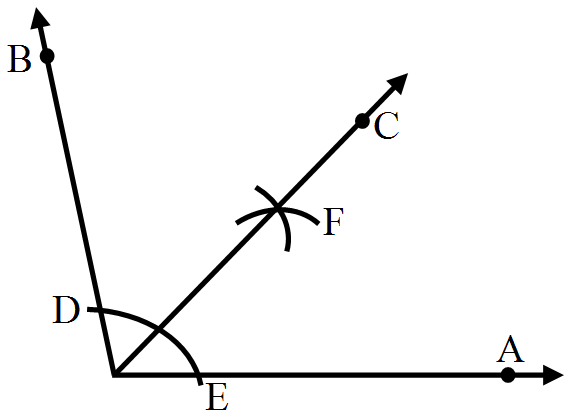
Draw an angle of 110° with the help of a protractor and bisect it. Measure each angle.
Answer
Draw $\angle\text{BXA}=110^\circ$ with the help of a protractor. Now, we use the following steps for required construction.

Taking X as centre and any radius daw an arc to Intersect the rays XA and XB, say at E and D, respectively.
Taking D and E as centres and with the radius more than $\frac{1}{2}\text{DE},$ draw arcs to intersect each other, say at F.
Draw the ray XF. Thus, ray XF is the required bisector of the angle BXA. On measuring each angle.
we get,
$\angle\text{BXC}=\angle\text{AXC}=55^\circ$
$\Big[\therefore\ \angle\text{BXC}=\angle\text{AXC}=\frac{1}{2}\ \angle\text{BXA}=\frac{1}{2}\times110^\circ=55^\circ\Big]$
View full question & answer
3 Marks Question - MATHS STD 9 Questions - Vidyadip