Questions

4 Marks Questions

🎯

Test yourself on this topic

6 questions · timed · auto-graded

Question 14 Marks
Draw a line segment AB of 4cm in length. Draw a line perpendicular to AB through A and B, respectively. Are these lines parallel?
Answer
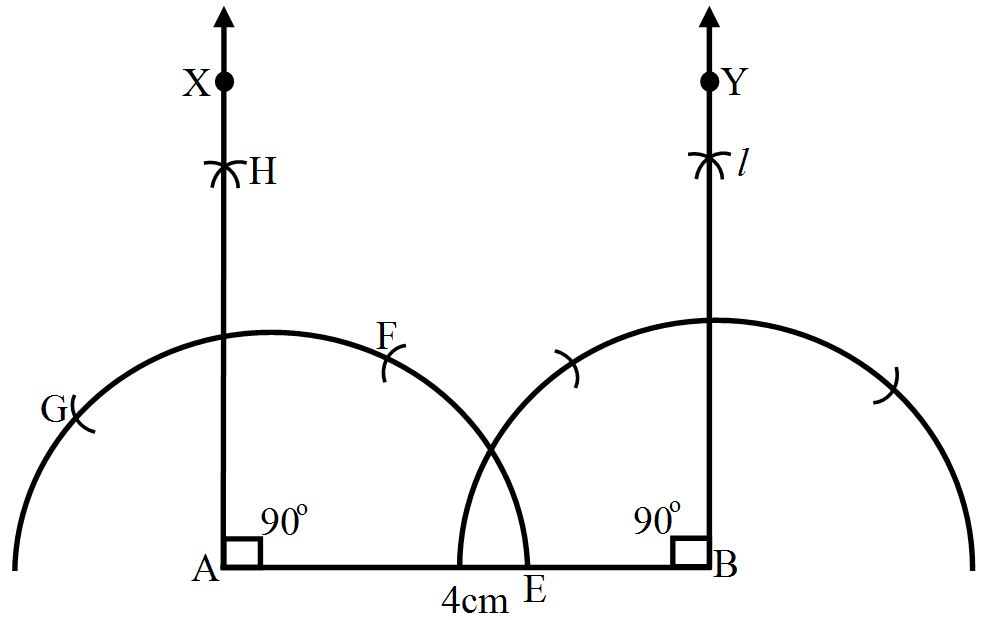
  1. Draw a line segment AB = 4cm.
  2. Taking 4 as centre and radius more than $\frac{1}{2}\text{AB}$ (i.e., 2cm) draw an arc say it intersect AB at E.
  3. Taking E as centre and with same radius as above draw an arc which intersect previous arc at F.
  4. Again, taking F as centre and with same radius as above draw an arc which intersect previous arc (obtained in step ii) at G.
  1. Taking G and F are centres, draw arcs which intersect each other at H.
  2. Join AH . Thus, AX is perpendicular to AB at A. Similarly, draw $\text{BY}\perp\text{AB}$ at B.
Now, we know that if two lines are parallel, then the angle between them will be 0° or 180°
Here, $\angle\text{XAB}=90^\circ\ \big[\therefore\ \text{XA}\perp\text{AB}\big]$
and $\angle\text{YBA}=90^\circ\ \big[\therefore\ \text{YB}\perp\text{AB}\big]$
$\angle\text{XAB}+\angle\text{YBA}=90^\circ+90^\circ=180^\circ$
So, the lines XA and YS are parallel. [since, it sum of interior angle on same side of transversal is 180°, then the two lines are parallel]
View full question & answer
Question 24 Marks
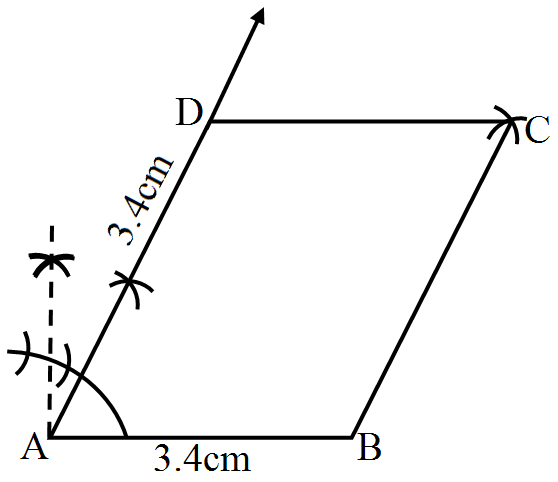
Construct a rhombus whose side is of length 3.4cm and one of its angles is 45°
Answer
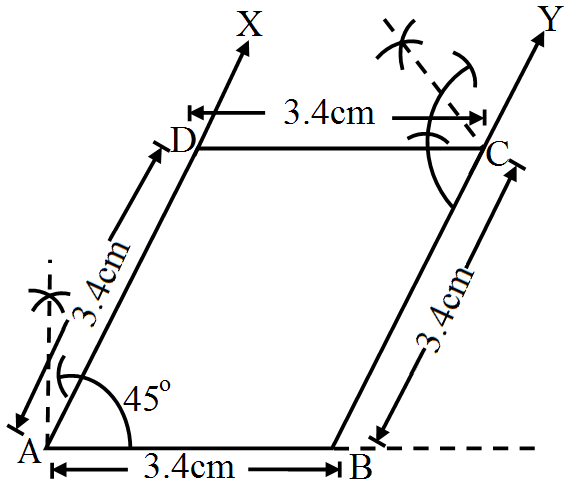
  1. Draw a line segment AS of length 3.4cm.
  1. Now, generate an angle 45° at both ends A and B of line segment AB and plot the parallel lines AX and BY.
  2. Cut AD and SC of length 3.4cm from AX and BY, respectively.
  3. Draw an angle of 45° at one of the point D or C and join both points by a line segment DC of length 3.4cm and parallel to AB. Thus, ABCD is the required rhombus whose side is of length 3.4cm and one of its angle is 45°
View full question & answer
Question 34 Marks
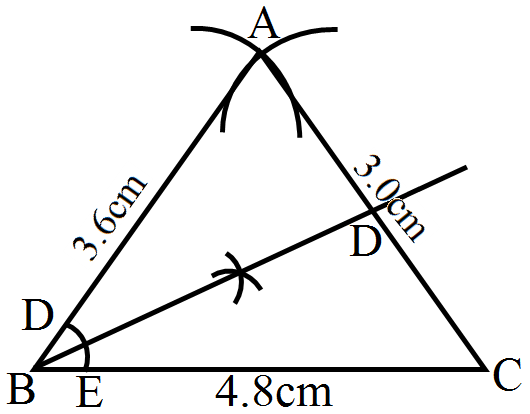
Construct a triangle whose sides are 3.6cm, 3.0cm and 4.8cm. Bisect the smallest angle and measure each part.
Answer
To construct a triangle ABC in which AB = 3.6cm, AC = 3.0cm and BC = 4. 8cm, use the following steps.
  1. Draw a line segment BC of length 4.8cm.
  2. From B, point A is at a distance of 3.6cm. So, having B as centre, draw an arc of radius 3.6cm.
  1. From C, point A is at a distance of 3cm. So, having C as centre, draw an arc of radius 3cm which intersect previous arc at A.
  2. Join AB and AC. Thus, $\triangle\text{ABC}$ is the required triangle.
Here, angle B is smallest, as AC is the smallest side. To direct angle B, we use the following steps.
  1. Taking B as centre, we draw an are intersecting AB and BC at D and E, respectively.
  2. Taking D and E as centres we draw arcs intersecting at P.
  3. Joining BP, we obtain angle bisector of $\angle\text{B}$
  4. Here, $\angle\text{ABC}=39 ^\circ$
Thus, $\angle\text{ABD}=\angle=\text{DBC}=\frac{1}{2}\times139^\circ=19.5^\circ$
View full question & answer
Question 44 Marks
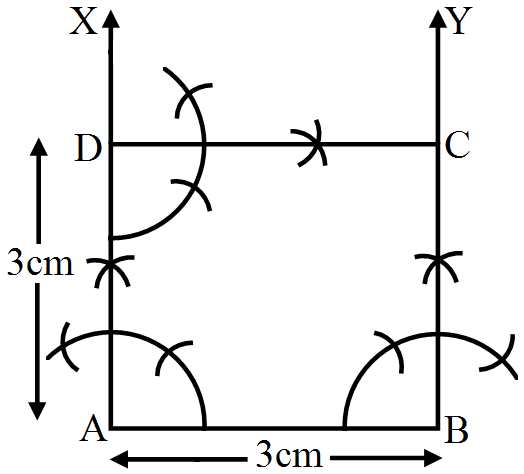
Construct a square of side 3cm.
Answer
We know that, each angle of a square is right angle (i.e., 90°). To construct a square of side 3 cm, use the following steps.
  1. Draw a line segment AS of length 3 cm.
  2. Now, generate an angle of 90º at points A and B of the line segment and plot the parallel lines AX and BY at these points.
  3. Cut AD and SC of length 3 cm from AX and BY, respectively.
  4. Draw an angle of 90º at any one of the point C or D and join both points by a line segment CD of length 3 cm.
    Thus, ABCD is the required square of side, 3cm.
View full question & answer
Question 54 Marks
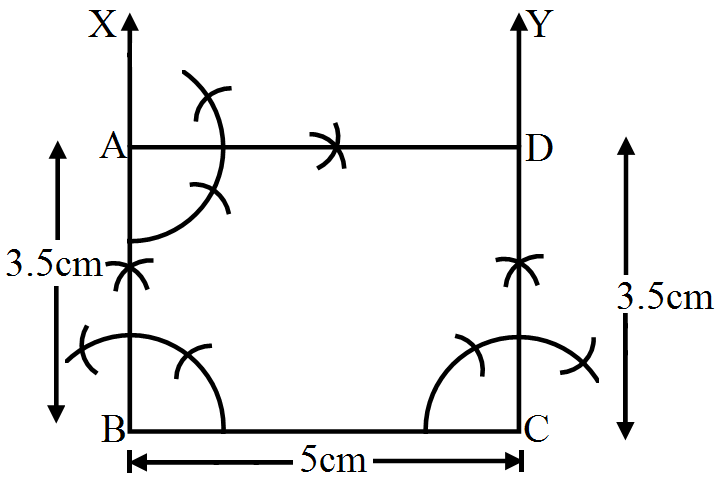
Construct a rectangle whose adjacent sides are of lengths 5cm and 3.5cm.
Answer
We know that, each angle of a rectangle is right angle (i.e., 90°) and its opposite sides are equal and parallel. To construct a rectangle whose adjacent sides are of lengths 5cm and 3.5cm, use the 1 following steps.
  1. Draw a line segment BC of length 5cm.
  2. Now, generate an angle of 90° at points B and C of the line segment BC and plot the parallel lines BX and CY at these points.
  1. Cut AB and CD of length 3.5cm from BX and CY, respectively.
  2. Draw an angle 90° at one of the point A or D and join both points by a line segment AD of length 5cm. Thus, ABCD is the required rectangle with adjacent sides of length 5cm and 3.5cm.
View full question & answer
Question 64 Marks
Draw an angle of 80° with the help of a protractor. Then construct angles of :
  1. 40°
  2. 160°
  3. 120°
Answer
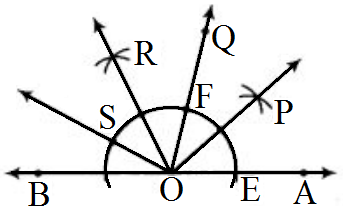
First, draw an angle of 80° say $\angle\text{QOA}=180°$ with the help of protractor. Now, use the the following steps to construct angles of,

Taking O as centre and any radius draw an arc which intersect OA at E and OQ at F.
Taking E and F as centres and radius more than $\frac{1}{2}\text{EF}$ draw arcs which intersect each other at P.
Join OP Thus, $\angle\text{POA}=40^\circ$ $\big[\therefore\ 40^\circ=\frac{1}{2}\text{x }80^\circ\big]$
Now, taking F as centre and radius equal to EF draw an arc which intersect previous arc obtained in step ii at S.
Join OS. Thus, $\angle\text{SOA}=160^\circ$ $\big[\therefore\ 160^\circ=2\times80^\circ\big] $
Taking S and F as centre and radius more than $\frac{1}{2}\text{SF}$ draw arcs which intersect each other at R.
Join OR. Thus, $\angle\text{ROA}=\angle=\text{ROQ}=40^\circ+80^\circ=120^\circ$
View full question & answer
4 Marks Questions - MATHS STD 9 Questions - Vidyadip