Questions · Page 1 of 4

M.C.Q

🎯

Test yourself on this topic

50 questions · timed · auto-graded

Question 11 Mark
Write the correct answer in the following:
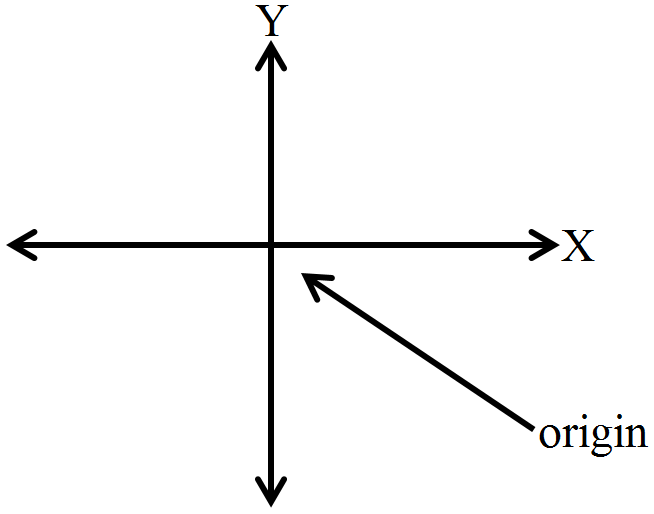
The point at which the two coordinate axes meet is called the:
Answer
  1. Origin.
    Solution:
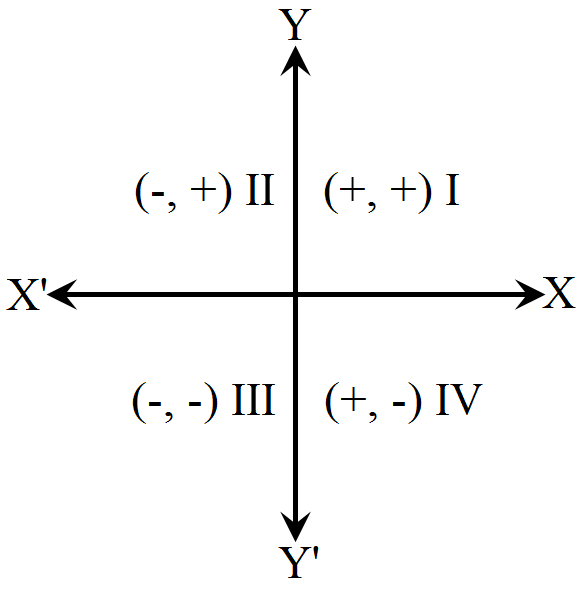
    The points at which the two coordinate axes meet is called the origin.
View full question & answer
Question 31 Mark
The point which lies on the y-axis at a distance of 5 units in the negative direction of the y-axis is:
Answer
  1. (0, -5)
    Solution:
    The point which lies on the y-axis at a distance of 5 units in the negative direction of the y-axis is (0, -5).
View full question & answer
Question 41 Mark
Abscissa of a point is positive in:
Answer
  1. Quadrant I and IV
    Solution:
    Abscissa means x-corrdinate.
    In quadrant I and IV, the value of x is positive.
    Thus, the abscissa of a point is positive in quadrant I and IV.
View full question & answer
Question 51 Mark
A symbol having a fixed value is called a ______.
Answer
  1. Constant.
    Solution:
    A symbol having a fixed value is called a constant.
    Any natural number, whole number, integers, rational number. A symbol having the variable values is called variable.
View full question & answer
Question 61 Mark
A point whose abscissa is -3 and ordinate 2 lies in:
Answer
  1. Second quadrant.
    Solution:
    As we know that abscissa is negative in second and third coordinate and ordinate is positive in first and second coordinate. Therefore the given point (-3, 2) lies in second coordinate.
View full question & answer
Question 81 Mark
The ordinate of any point on x-axis is:
Answer
  1. 0
    Solution:
    On X-axis, all points have their Y-intercept = 0
    So their ordinate = 0
View full question & answer
Question 101 Mark
The points (-5, 2) and (2, -5) lie in the:
Answer
  1. II and IV quadrants, respectively.
    Solution:
    In point (-5, 2), x-coordinate is negative and y-coordinate is positive, so it lies in II quadrant and in point (2, -5),
    x- coordinate is positive and y-coordinate is negative, so it lies in IV quadrant.
View full question & answer
Question 111 Mark
The signs of abscissa and ordinate of a point in quadrant IV are:
Answer
  1. (+, -)
    Solution:
    In the Cartesian plane, if co-ordinate of any point P is P(x, y), then x-coordinate is called the abscissa of the point and, y-coordinate is called ordinate of the point.
    The signs of abscissa and ordinate of a point in quadrant IV is (+, -)
View full question & answer
Question 121 Mark
If A (-2, 3) and B(-3, 5) are two given points then (abscissa of A) - (abscissa of B) = ?
Answer
  1. 1
    Solution:
    Abscissa of A - Abscissa of B
    = -2 - (-3)
    = -2 + 3
    = 1
View full question & answer
Question 131 Mark
The abscissa of a point is positive in the:
Answer
  1. Fourth and first quadrant.
    Solution:
    We know that abscissa is always positive in first and fourth coordinate and ordinate is always positive in first and second coordinate:
View full question & answer
Question 141 Mark
The point whose ordinate is 3 and which lies on the y-axis is:
Answer
  1. (0, 3)
    Solution:
    Since the point lies on y-axis, so, x = 0.
    Hence, the required point is: (0, 3)
View full question & answer
Question 151 Mark
The abscissa of any point on y-axis is:
Answer
  1. 0
    Solution:
    The abscissa of any point on y-axis is always zero. This means that this point hasn't covered any distance on x-axis.
View full question & answer
Question 171 Mark
Points (1, -1), (2, -2), (-3, -4), (4, -5)
Answer
  1. Do not lie in the same quadrant.
    Solution:
    Points (1, -1), (2, -2) and (4, -5) lie in Quadrant IV, but point (-3, -4) lies in Quadrant III.
    Hence, all the given points do not lie in the same quadrant.
View full question & answer
Question 181 Mark
Write the correct answer in the following:
If P(5, 1), Q(8, 0), R(0, 4), S(0, 5) and O(0, 0) are plotted on the graph paper, then the point(s) on the x-axis are:
Answer
  1. Q and O
    Solution:
    We now that, a point lies on X-axis, if its y-coordinate is zero.
    So, the points on the axis are Q(8, 0) and O(0, 0).
View full question & answer
Question 191 Mark
The point (0, -4) lies:
Answer
  1. On the negative direction of y-axis
    Solution:
    Since x = 0 so point lies on y-axis, but value of y is -ve.
    So, point lies on -ve direction of y-axis.
View full question & answer
Question 201 Mark
The equation of y-axis is:
Answer
  1. x = 0
    Solution:
    The value of abscissa or x-corrdinate is always zero at any point on y-axis.
    So, x = 0 is the equation of y-axis.
View full question & answer
Question 211 Mark
The abscissa and ordinate of the origin are:
Answer
  1. (0, 0)
    Solution:
    Absciss = intercept pon X - axis = 0
    Ordinate = intercept on Y - axis = 0
    ⇒ (0, 0) is the answer.
View full question & answer
Question 221 Mark
The perpendicular distance of the point P (4, 3) from x-axis is:
Answer
  1. 3
    Solution:
    The perpendicular distance of any point from x-axis is always equal to the value of ordinate.
View full question & answer
Question 231 Mark
Write the correct answer in the following:
Point (0, -7) lies:
Answer
  1. In the fourth quadrant.
    Solution:
    In Point (0, -7) co-ordinate of x axis is zero so it lies on y axis.
View full question & answer
Question 241 Mark
Points (2, -3), (4, -5), (5, -9) and (-2, -5).
Answer
  1. Does not lie in same quadrant.
    Solution:
    Point (2, -3), (4, -5), (5, -9) lies in 4th quadrant, because sign of abscissa and ordinate in 4th quadrant is (+, -).
    But point (-2, -5) lies in 3rd quadrant since, sign of abscissa and ordinate in 3rd quadrant is (-, -).
View full question & answer
Question 251 Mark
Which of the following points lie on the line y = 3x – 4?
Answer
  1. (2, 2)
    Solution:
    When we put x = 2 in the given equation,
    Then, y = (3 × 2)–4
    y = 6 - 4 = 2, so point is (2, 2)satisfied the given equation,
    Hence point (2, 2) will lie on the line y = 3x - 4
View full question & answer
Question 271 Mark
The perpendicular distance of the point P(-2, -3) from the y-axis is:
Answer
  1. 2 units
    Solution:
    Perpendicular distance of any point from y-axis is the given x-coordinate of point,
    So distance = 2 units
View full question & answer
Question 281 Mark
Which of the following are the signs of abscissa and ordinate of a point in quadrant?
Answer
  1. (+, +)
    Solution:
    The signs of abscissa and ordinate of a point in quadrant I are both +ve i.e. (+, +)
View full question & answer
Question 291 Mark
The co-ordinates of two points A and B are (4, 3) and (-5, 3) respectively. The co-ordinates of the point at which the line segment AB meets the y-axis are:
Answer
  1. (0, 3)
    Solution:
    Since it meets at y-axis, so, abscissa will be zero and we have ordinate = 3 in common so,point will be (0, 3)
View full question & answer
Question 301 Mark
If A(2, 3) and B(-3, 4), then (abscissa of A) - (abscissa of B) is:
Answer
  1. 5
    Solution:
    Here we have, the abscissa of A = 2 and abscissa of B = -3.
    So, according to question,
    (abscissa of A) - (abscissa of B)
    = 2 - (-3)
    = 5
View full question & answer
Question 311 Mark
If P(3, 9) and Q(-3, -4), then (abscissa of P) - (ordinate of Q) is:
Answer
  1. 7
    Solution:
    From the given data we have,
    The abscissa of P = 3 and ordinate of Q = -4,
    So, according to question,
    (abscissa of P) - (ordinate of Q)
    = 3 - (-4)
    = 7
View full question & answer
Question 321 Mark
The co-ordinate of origin is:
Answer
  1. (0, 0)
    Solution:
    The center of the coordinate system (where the lines intersect) is called the origin.
    The axes intersect when both x and y are zero.
    The coordinates of the origin are (0, 0).
View full question & answer
Question 331 Mark
Write the correct answer in the following:
Point (-3, 5) lies in the:
Answer
  1. Second quadrant.
    Solution:
    In the point (-3, 5) abscissa is negative and ordinate is positive. So, it lies in the second quadrant.
View full question & answer
Question 341 Mark
A point whose abscissa and ordinate are 2 and -5 respectively, lies in:
Answer
  1. Fourth quadrant.
    Solution:
    As we know in the fourth coordinate abscissa is positive and ordinate is negative.
View full question & answer
Question 351 Mark
The point at which the two coordinate axes meet is called the:
Answer
  1. Origin.
    Solution:
    The point at which the two coordinate axes meet is called the origin.
View full question & answer
Question 361 Mark
The name of the horizontal line drawn to determine the position of any point in the Cartesian plane is:
Answer
  1. x-axis
    Solution:
    In co-ordinate, we have two axis, one is a horizontal line called x-axis and the other is vertical line called y-axis.
    Used to determine the position of any point in Cartesian plane.
View full question & answer
Question 371 Mark
Two points having same abscissa but different ordinates lie on:
Answer
  1. A line parallel to y-axis
    Solution:
    Two points having same abscissa but different ordinate always make a line which is parallel to the y-axis as abscissa is fixed and the only ordinate keeps changing.
View full question & answer
Question 381 Mark
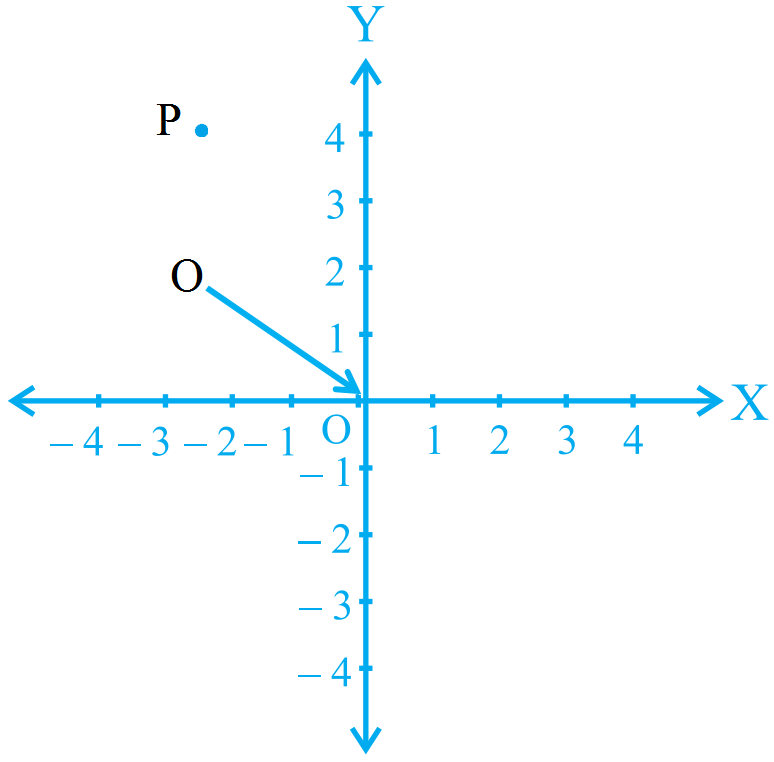
Answer
  1. (-2, 4)
    Solution:
    Here, given point P lies in II quadrant, so its abscissa will be negative and ordinate wilt be positive. Also, its perpendicular distance from X-axis is 4, so y-coordinate of P is 4 and its perpendicular distance from Y-axis is 2, so x-coordinate is -2. Hence, coordinates of P are (-2, 4).
View full question & answer
Question 391 Mark
The points (-5,3) and (3, -5) lie in the.
Answer
  1. II and IV quadrants respectively.
    Solution:
    II and IV quadrants respectively, as in II quadrant abscissa is negative and ordinate in positive, on the other hand in IV quadrant abscissa is positive and ordinate is negative.
View full question & answer
Question 401 Mark
The distance of the point (-3, -2) from x-axis is:
Answer
  1. 2 units
    Solution:
    Distance from x-axis is they, co-ordinate of other point So ,here distance = 2,
View full question & answer
Question 411 Mark
The point (-2, 5) lies in:
Answer
  1. 2nd quadrant
    Solution:
    For any point to lie in the second quadrant, Abscissa and ordinate must be (-, +). So the given point (-2, 5) lies in 2nd quadrant.
View full question & answer
Question 421 Mark
The point at which the two co-ordinate axes meet is called the:
Answer
  1. Origin.
    Solution:
    In co-ordinate system, there are two axes; x-axis and y-axis, point of intersection of x-axis and y-axis is called the origin.
View full question & answer
Question 431 Mark
If a > 0 and b > 0 then the point (a, b) lies in quadrant.
Answer
  1. II
    Solution:
    Since, x co-ordinate is negative and y co-ordinate is positive, the given point lies in Quadrant II.
View full question & answer
Question 441 Mark
The zero of the polynomial $(x - 2)^2 - (x + 2)^2$ is:
Answer
$(x - 2)^2 - (x + 2)^2$
$= (x - 2 + x + 2) (x - 2 - x - 2) [$Using identity$]$
$a^2 - b^2 = (a + b) (a - b)$
$= (2x) (-4)$
$= -8x$
Then the zero is,
$-8x = 0$
$\Rightarrow x = 0$
View full question & answer
Question 461 Mark
Signs of the abscissa and ordinate of a point in the second quadrant are respectively.
Answer
  1. (-, +)
    Solution:
    Abscissa means just the horizontal axis i.e. x axis. Ordinate means just the vertical axis i.e. y axis.
    x-corrdinate and y-corrdinate make a point.
    The signs of abscissa and ordinate of a point in quadrant II are (-, +).
View full question & answer
Question 471 Mark
Two point having same abscissae but different ordinates lie on:
Answer
  1. A line parallel to y-axis
    Solution:
    Let two points be (a, b) and (a, c).
    If abscissa is same = a
    and ordinate is different then all such points will lie on a line parallel to Y
    axis because value of X-intercept
    i.e. abscissa is fixed.
View full question & answer
Question 481 Mark
The equation of y-axis is:
Answer
  1. (4, 12)
    Solution:
    y = 3x + 4
    for x = 4, we have
    = 3 × 4 + 4
    = 12 + 4
    = 16 ≠ 12
    Hence, (4, 12) doesn't lie on the given line.
View full question & answer
Question 491 Mark
The distance of the point (3, 5) from x- axis is:
Answer
  1. 5 units
    Solution:
    Distance of any point from x-axis is y-coordinate of that given point:
View full question & answer
Question 501 Mark
The distance of the point (2, 3) from the y-axis:
Answer
  1. 2 units
    Solution:
    The distance from y-axis is equal to the x-coordinate, so distance = 2 units
View full question & answer
M.C.Q - MATHS STD 9 Questions - Vidyadip