Questions

4 Marks Questions

🎯

Test yourself on this topic

11 questions · timed · auto-graded

Question 14 Marks
From a point in the interior of an equilateral triangle, perpendiculars are drawn on the three sides. The lengths of the perpendiculars are 14cm, 10cm and 6cm. Find the area of the triangle.
Answer
Let sides of an equilateral triangle be a m.
$\text{Area of }\triangle\text{OAB}=\frac{1}{2}\times\text{AB}\times\text{OP}$
$=\frac{1}{2}\times\text{a}\times14=7\text{a cm}^2$
$\text{Area of }\triangle\text{OBC}=\frac{1}{2}\times\text{BC}\times\text{OQ}$
$=\frac{1}{2}\times\text{a}\times10=5\text{a cm}^2$
$\text{Area of }\triangle\text{OAC}=\frac{1}{2}\times\text{AC}\times\text{OR}$
$=\frac{1}{2}\times\text{a}\times6=3\text{a cm}^2$
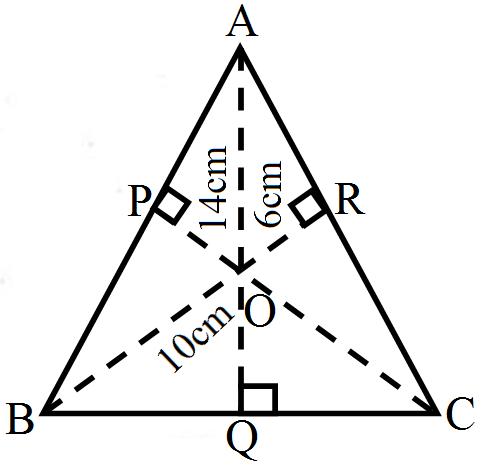
$\therefore$ Area of an equilateral $\triangle\text{ABC}=\text{Area of}(\triangle\text{OAB}+\triangle\text{OBA}+\triangle\text{OAC})$
$=(7\text{a}+5\text{a}+3\text{a})=15\text{a cm}^2$
We have, semi-permeter,
$\text{s}=\frac{\text{a}+\text{a}+\text{a}}{2}$
$\text{s}=\frac{3\text{a}}{2}\text{cm}$
$\therefore$ Area of an equilateral $\triangle\text{ABC}=\sqrt{\text{s}(\text{s}-\text{a})(\text{s}-\text{b})(\text{s}-\text{c})}$ [by Heron's formula]
$=\sqrt{\frac{3\text{a}}{2}\Big(\frac{3\text{a}}{2}-\text{a}\Big)\Big(\frac{3\text{a}}{2}-\text{a}\Big)\Big(\frac{3\text{a}}{2}-\text{a}\Big)}$
$=\sqrt{\frac{3\text{a}}{2}\times\frac{\text{a}}{2}\times\frac{\text{a}}{2}\times\frac{\text{a}}{2}}=\frac{\sqrt{3}}{4}\text{a}^2$
From eqs. (iv) and (v)
$\frac{\sqrt{3}}{4}\text{a}^2=15\text{a}$
$\Rightarrow\ \text{a}=\frac{15\times4}{\sqrt{3}}\times\frac{\sqrt{3}}{\sqrt{3}}=\frac{60\sqrt{3}}{3}=20\sqrt{3}\text{cm}$
On putting $\text{a}=20\sqrt{3}$ in eq. (v), we get
$\text{Area of }\triangle\text{ABC}=\frac{\sqrt{3}}{4}\big(20\sqrt{3}\big)^2$
$=\frac{\sqrt{3}}{4}\times400\times3$
$=300\sqrt{3}\text{cm}^2$
Hence, the area of an equilateral triangle is $300\sqrt{3}\text{cm}^2$
View full question & answer
Question 24 Marks
A rhombus shaped sheet with perimeter $40\ cm$ and one diagonal $12\ cm,$ is painted on both sides at the rate of $Rs. 5$ per $m^2.$ Find the cost of painting.
Answer

Let $\text{ABCD}$ be a rhombus having each side equal to $x \ cm.$
$i.e., AB = BC = CD = DA = x \ cm$ Given, perimeter of a rhombus $= 40$
$\therefore\text{ AB}+\text{BC}+\text{CD}+\text{DA}=40$
$\Rightarrow\ \text{x}+\text{x}+\text{x}+\text{x}=40$
$\Rightarrow4\text{x}=40$
$\Rightarrow\text{x}=\frac{40}{4}$
$\therefore\ \text{x}=10\text{cm}$ In $\triangle\text{ABC},$
let $\text{a}=\text{AB}=10\text{ cm},\text{ b}=\text{BC}$
$=10\text{ cm}$ and $\text{c}$
$=\text{AC}=12\text{ cm}$ Now,
semi$-$perimeter of a $\triangle\text{ABC},\text{ s}=\frac{\text{a}+\text{b}+\text{c}}{2}$
$=\frac{10+10+12}{2}$
$=\frac{32}{2}$
$=16\text{ cm}$
$\therefore$  Area of  $\triangle\text{ABC}=\sqrt{\text{s}(\text{s}-\text{a})(\text{s}-\text{b})(\text{s}-\text{c})}$ [by Heron's formula$]$
$=\sqrt{16(16-10)(16-10)(16-12)}$
$=\sqrt{16\times6\times6\times4}$
$=4\times6\times2$
$=48\text{ cm}^2$
$\because$ Cost of painting of the sheet of $1\ cm^2 = Rs. 5\ cm$
 $\therefore$ Cost of painting of the sheet of $96\ cm^2 = 96 \times 5 = Rs. 480$
 Hence, the cost of the painting of the sheet for both sides $= 2 \times 480 = Rs. 960$
View full question & answer
Question 34 Marks
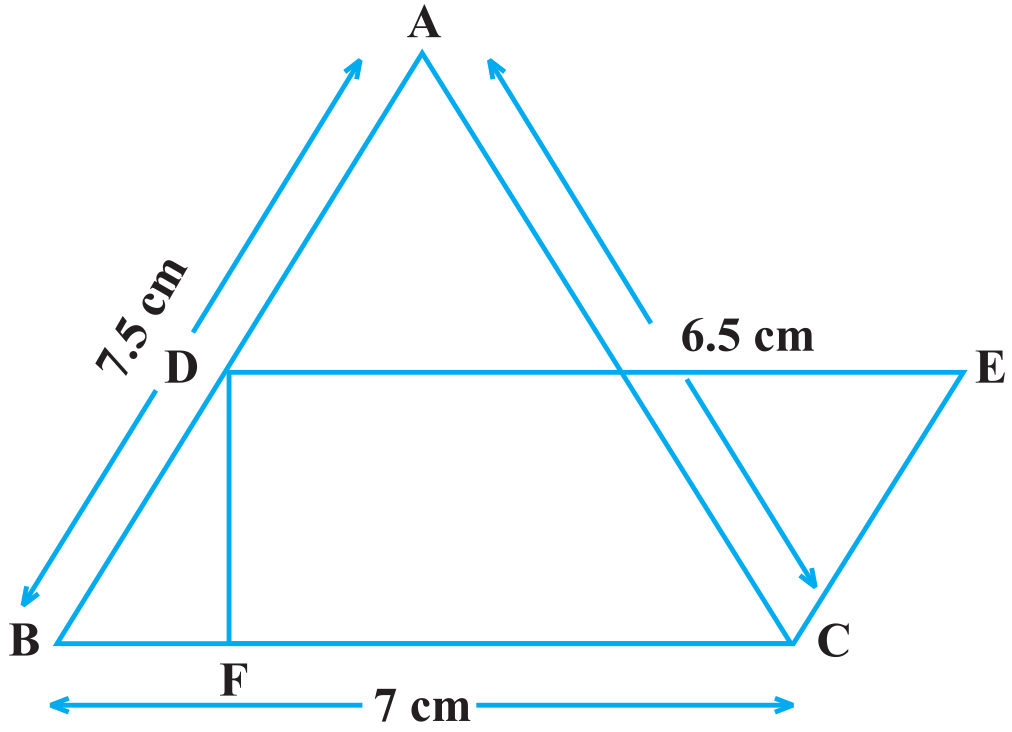
In $\triangle\text{ABC}$ has sides AB = 7.5cm, AC = 6.5cm and BC = 7cm. On base BC a parallelogram DBCE of same area as that of $\triangle\text{ABC}$ is constructed. Find the height DF of the parallelogram.
Answer
Now, first determine the area of $\triangle\text{ABC}$
The sides of a traingle are
$\text{AB} = \text{a} = 7.5\text{cm,} \text{ BC} = \text{b} = 7\text{cm} \text{ and}\text{ CA} = 6.5\text{cm}$
Now, semi-perimeter of a traingle,
$\text{S} = \frac{\text{a+b+c}}{2} = \frac{\text{7.5+7+6.5}}{2}=\frac{21}{2}=10.5\text{cm}$
$\therefore\ \text{Area of }\triangle\text{ABC}=\sqrt{\text{s}(\text{s}-\text{a})(\text{s}-\text{b})(\text{s}-\text{c})}$ [by Heron's formula]
$=\sqrt{10.5(10.5-7.5)(10.5-7)(10.5-6.5)}$
$=\sqrt{10.5\times3\times3.5\times4}$
$=\sqrt{441}=21\text{cm}^2$
Now, area of parallelogram BCED = Base × Height
$=\text{BC}\times\text{DF}=7\times\text{DF}$
According to the question,
Area of $\triangle\text{ABC}$ = Area of parallelogram BCED
$\Rightarrow\ 21=7\times\text{DF}$ [from eqs. (i) and (ii)]
$\Rightarrow\text{DF}=\frac{21}{4}=3\text{cm}$
Hence, the height of parallelogrom is 3cm.
View full question & answer
Question 44 Marks
The perimeter of a triangular field is 420m and its sides are in the ratio 6 : 7 : 8. Find the area of the triangular field.
Answer
Given, perimeter of a triangular field is 420m and its sides are in the ratio 6 : 7 : 8.
Let sides of a triangular field be a = 6x, b = 7x and c = 8x
Perimeter of a triangular field, 2s = a + b + c
⇒ 420 = 6x + 7x + 8x
⇒ 420 = 21x
$\Rightarrow\text{x}=\frac{420}{21}=20\text{m}$
$\therefore$ Sides of a triangular filed are,
$\text{a}=6\times20=120\text{m}$
$\text{b}=7\times20=140\text{m}$
and $\text{c}=8\times20=160\text{m}$
Now, semi-perimeter,
$\text{s}=\frac{\text{a}+\text{b}+\text{c}}{2}$
$=\frac{120+140+160}{2}$
$=\frac{420}{2}=210\text{m}$
$\therefore$ Area of a triangular field $=\sqrt{\text{s}(\text{s}-\text{a})(\text{s}-\text{b})(\text{s}-\text{c})}$ [by Heron's formula]
$=\sqrt{210(210-120)(210-140)(210-160)}$
$=\sqrt{210\times90\times70\times50}$
$=100\sqrt{21\times9\times7\times5}$
$=100\sqrt{7\times3\times3^2\times7\times5}$
$=100\times7\times3\times\sqrt{15}$
$=2100\sqrt{15}\text{m}^2$
Hence, the area of triangle field is $2100\sqrt{15}\text{m}^2$
View full question & answer
Question 54 Marks
The perimeter of a triangle is 50cm. One side of a triangle is 4cm longer than the smaller side and the third side is 6cm less than twice the smaller side. Find the area of the triangle.
Answer
Let the smaller side of the triangle be x cm. therefore, the second side will be (x + 4)cm, and third side is (2x - 6)cm.
Now, perimeter of triangle = x + (x + 4) + (2x - 6) = (4x - 2)cm
Also, perimeter of triangle = 50cm.
$4\text{x}=52, \text{x}=52\div4=13$
Therefore, the three sides are 13cm, 17cm, 20cm
Semiperimeter of triangle $=\text{s}=\frac{13 +17+20}{2}=\frac{50}{2}=25\text{cm}$
$\therefore\text{area of }\Delta=\sqrt{25(25-13)(25-17)(25-20)}$
$=\sqrt{25\times12\times8\times5}=\sqrt{5\times5\times4\times3\times4\times2\times5}$
$=5\times4\sqrt{3\times2\times5}=20\sqrt{30}\text{cm}^2$
View full question & answer
Question 64 Marks
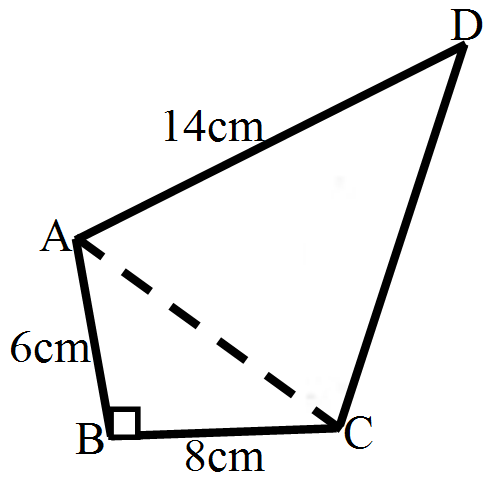
The sides of a quadrilateral $\text{ABCD}$ are $6\ cm, 8\ cm, 12\ cm$ and $14\ cm ($taken in order$)$ respectively, and the angle between the first two sides is a right angle. Find its area.
Answer

Given $\text{ABCD}$ is a quadrilateral having sides $AB = 6\ cm, BC = 8\ cm, CD = 12\ cm$ and $DA = 14\ cm.$ Now, join$ AC$.
We have,$\text{ABC}$ is a right angled triangle at $B.$ Now, $AC^2 $
$= AB^2 + BC^2 $
$= 6^2 + 8^2 $
$= 36 + 64 $$= 100$
$ \Rightarrow AC = 10\ cm$
$\therefore$ Area of quadrillateral $\text{ABCD}$ Area of $\triangle\text{ABC}+$Area of $\triangle\text{ACD}$ Now,area of $\triangle\text{ABC}=\frac{1}{2}\times\text{AB}\times\text{BC}$ $\Big[\because\ \text{area of triangle}=\frac{1}{2}(\text{base}\times\text{height})\Big]$
$=\frac{1}{2}\times6\times8$
$=24\text{ cm}^2$
In $\triangle\text{ACD},\ \text{AC}=\text{a}=10\text{ cm},\text{ CD}=\text{b}=12\text{ cm}$ and, $\text{DA}=\text{c}=14\text{ cm}$ Now, semi$-$perimeter of, $\triangle\text{ACD},\text{s}=\frac{\text{a}+\text{b}+\text{c}}{2}$
$=\frac{10+12+14}{2}$
$=\frac{36}{2}$
$=18\text{ cm}$
Area of $\triangle\text{ACD}=\sqrt{\text{s}(\text{s}-\text{a})(\text{s}-\text{b})(\text{s}-\text{c})} [$by Heron's formula$]$
$=\sqrt{18(18-10)(18-12)(18-14)}$
$=\sqrt{18\times8\times6\times4}$
$=\sqrt{(3)^2\times2\times4\times2\times3\times2\times4}$
$=3\times4\times2\sqrt{3\times2}$
$=24\sqrt{6}\text{ cm}^2$
View full question & answer
Question 74 Marks
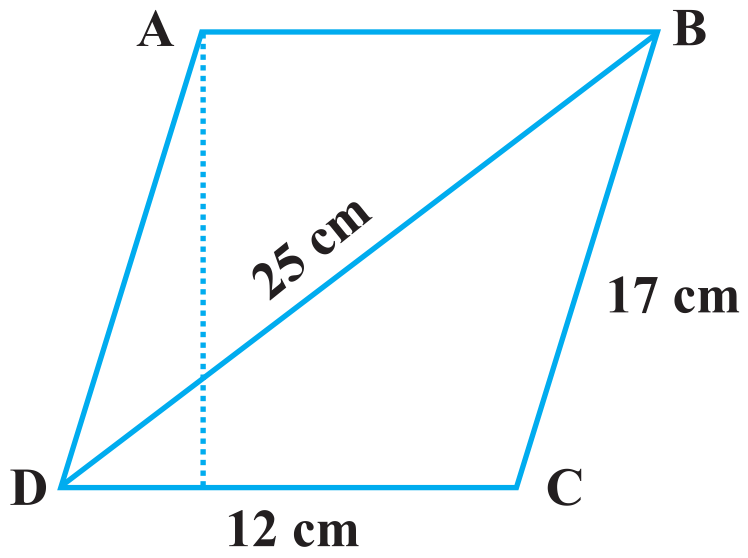
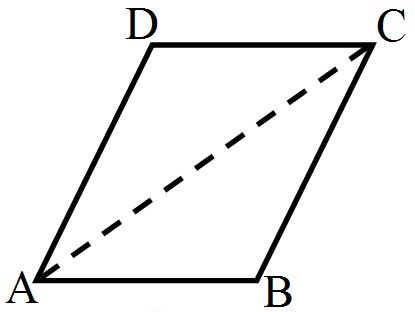
Find the area of a parallelogram given in also find the length of the altitude from vertex $A$ on the side $DC.$​​​​​​​
Answer
Area of parallelogram, $\text{ABCD}=2($ Area of $\triangle\text{BCD})$
Now, the sides of a $\triangle\text{BCD}\text{ are a}=12\text{ cm},\text{ b}=17\text{ cm and c}=25\text{ cm}$
$\therefore$ Semi$-$permimeter of $\triangle\text{BCD},\ \text{s}=\frac{\text{a}+\text{b}+\text{c}}{2}$
$=\frac{12+17+25}{2}$
$=\frac{54}{2}$
$=27\text{ cm}$
$\therefore$ Area of $\triangle\text{BCD}=\sqrt{\text{s}(\text{s}-\text{a})(\text{s}-\text{b})(\text{s}-\text{c})} [$by Heron's formula$]$
$=\sqrt{27(27-12)(27-17)(27-25)}$
$=\sqrt{27\times15\times10\times2}$
$=\sqrt{9\times3\times3\times5\times5\times2\times2}$
$=3\times3\times5\times2\text{ cm}^2$
Area of parallelogram $\text{ABCD} = 2 \times 90$
$= 180\ cm^2 ....(ii)$
Let altitude of a parallelogram be $h.$
Also, area of parallelogram $\text{ABCD} =$ Base $\times$ Altitude
$\Rightarrow180=\text{DC}\times\text{h} [$from $Eq. (ii)]$
$\Rightarrow180=12\times\text{h}$
$\therefore\ \text{h}=\frac{180}{12}$
$=15\text{ cm}$
Hence$,$ the area of parallelogram is $180\ cm^2$ and the length of altitude is $15\ cm.$
View full question & answer
Question 84 Marks
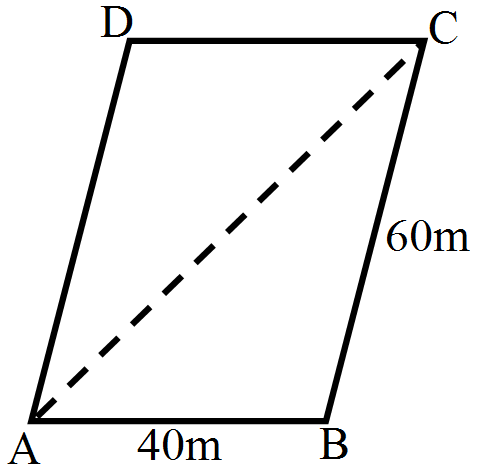
A field in the form of a parallelogram has sides $60\ m$ and $40\ m$ and one of its diagonals is $80\ m$ long. Find the area of the parallelogram.
Answer

Let the field be $\text{ABCD}$. Since diagonal of a parallelogram bisect into two triangle of equal areas. Therefore, Area of the parallelogram $\text{ABCD}=2($ area of $\triangle\text{ABC})\ ...(\text{i})$
Now, the sides of $\triangle\text{ABC}$ are $\text{a}=40\text{ m},\text{ b}=60\ m$  and  $c =80\text{ m}$
$\therefore$ Semi$-$perimeter of $\triangle\text{ABC},$
$\text{s}=\frac{\text{a}+\text{b}+\text{c}}{2}$
$=\frac{40+60+80}{2}$
$=\frac{180}{2}$
$=90\text{ m}$
$\therefore$ Area of $\triangle\text{ABC}=\sqrt{\text{s}(\text{s}-\text{a})(\text{s}-\text{b})(\text{s}-\text{c})} [$By Heron's formula$]$
$=\sqrt{90(90-40)(90-60)(90-80)}$
$=\sqrt{90\times50\times30\times10}$
$=\sqrt{3\times30\times5\times10\times30\times10}$
$=300\sqrt{15}\text{ cm}^2$
$=1161.895\text{ m}^2$ Form equation $(i),$ we get Area of parallelogrom
$\text{ABCD} = 2 \times 1161.895$
$ = 2323.79\ m^2$
View full question & answer
Question 94 Marks
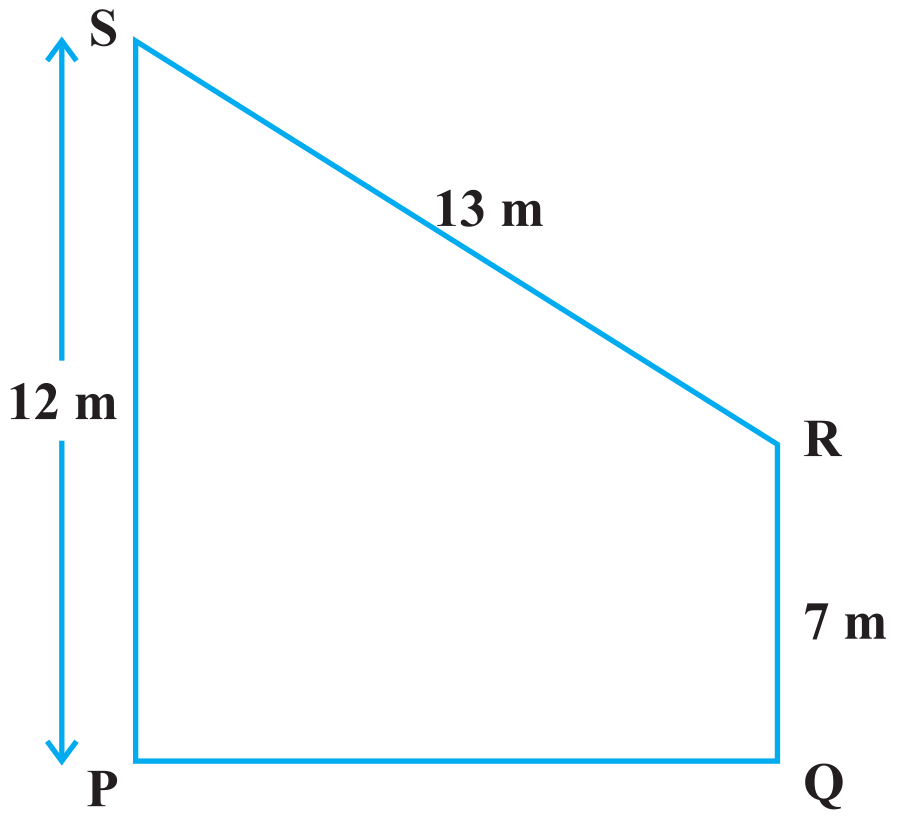
Find the area of the trapezium $\text{PQRS}$ with height $PQ$ given in:
Answer
Draw $\text{RT}\perp\text{PS}$ from the it is clear that,
$ST = PS - PT$
$= 12\ m - 7\ m$
$= 5\ m$
Now, from right triangle $\text{RTS},$ we have
$RS^2 = RT^2 + ST^2$
$\Rightarrow RT^2 = RS^2 - ST^2$
$\Rightarrow RT^2 = (13)^2 - 5^2$
$\therefore RT^2= 169 - 25 = 144$
$\Rightarrow \text{RT}=+\sqrt{144}$
$=12\text{ m}$
Now area of trapezium $\text{PQRS}$
$=\frac{1}{2}(\text{PS}+\text{QR})\times\text{RT}$
$=\frac{1}{2}(12+7)\times12$
$=\frac{1}{2}\times19\times12$
$=14\text{ m}^2$
View full question & answer
Question 104 Marks
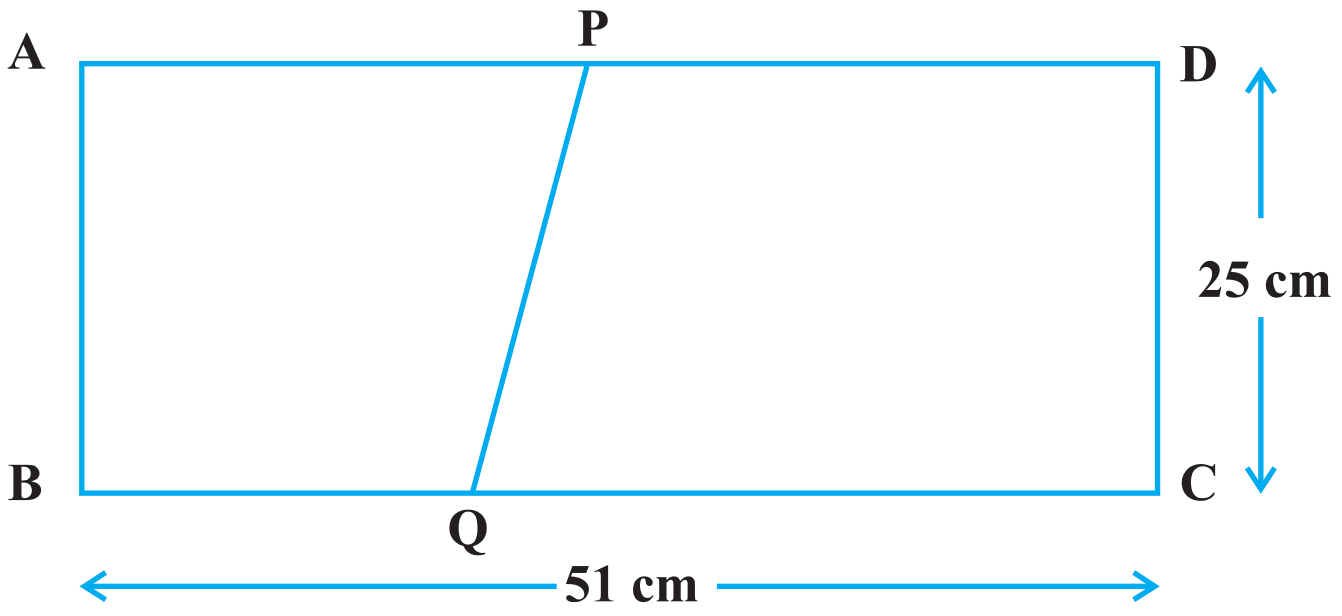
The dimensions of a rectangle ABCD are 51cm × 25cm. A trapezium PQCD with its parallel sides QC and PD in the ratio 9 : 8, is cut off from the rectangle as shown in the if the area of the trapezium PQCD is $\frac{5}{6}{\text{th}}$ part of the area of the rectangle, find the lengths QC and PD.
Answer
ABCD is a rectangle in which CD = 25cm and BC = 51cm
Since parallel sides QC and PD are in the ratio 9 : 8, so let QC = 9x and PD = 8x
Now, are of trapezium $\text{PQCD}=\frac{1}{2}\times(9\text{x}+8\text{x})\times25\text{cm}^2$
$=\frac{1}{2}\times17\text{x}\times25$
Area of rectangle ABCD = BC × CD = 51 × 25
It is given that area of trapezium $\text{PQCD}=\frac{5}{6}\times\text{Area of rectangle ABCD}$
$\therefore\ \frac{1}{2}\times17\text{x}\times25=\frac{5}{6}\times51\times25$
$\Rightarrow\text{x}=\frac{5}{6}\times51\times25\times2\times\frac{1}{17\times25}=5$
Hence, the length QC = 9x = 9 × 5 = 45cm
And the lengthb PD = 8x = 8 × 5 = 40cm
View full question & answer
Question 114 Marks
The perimeter of an isosceles triangle is 32cm. The ratio of the equal side to its base is 3 : 2. Find the area of the triangle.
Answer
As the sides of the equal to the base of an isosceles triangle is 3 : 2, so let the sides of an isosceles triangle be 3x, 3x and 2x
Now, perimeter of triangle = 3x + 3x + 2x = 8x
Given perimeter of triangle = 32m
$\therefore\ 8\text{x}=32, \text{x}=32\div8=4\text{cm}$
So, the sides of the isosecles triangle are (3 × 4)cm, (3 × 4)cm, (2 × 4)cm i.e, 12cm, 12cm and 8cm
$\therefore\ \text{s}=\frac{12+12+8}{2}=\frac{32}{2}=16\text{cm}$
Area of triangular flyover $=\sqrt{\text{s}(\text{s}-\text{a})(\text{s}-\text{b})(\text{s}-\text{c})}$
$=\sqrt{16(16-12)(16-12)(16-8)}$
$=\sqrt{16\times4\times4\times8}$
$=\sqrt{4\times4\times4\times4\times4\times2}$
$=4\times4\times2\sqrt{2}$
$=32\sqrt{2}\text{cm}^2$
View full question & answer
4 Marks Questions - MATHS STD 9 Questions - Vidyadip