Questions

5 Marks Questions

🎯

Test yourself on this topic

3 questions · timed · auto-graded

Question 15 Marks
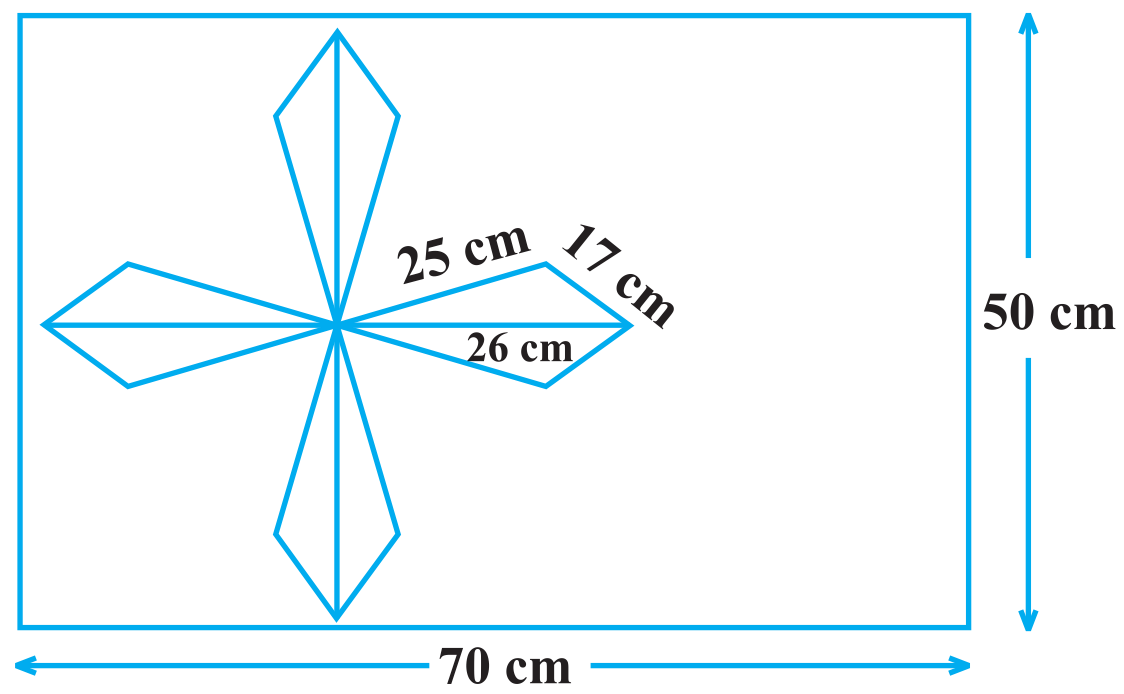
A design is made on a rectangular tile of dimensions $50\ cm \times 70\ cm$ as shown in the design shows $8$ triangles, each of sides $26\ cm, 17\ cm$ and $25\ cm$. Find the total area of the design and the remaining area of the tile.
Answer
Given, tha dimension of rectangular lile is $50\ cm \times 70\ cm$
Area of rectangular tile $= 50 \times 70 $
$= 3500\ cm^2$
The sides of a design of one triangle be,
$a = 25\ cm, b = 17\ cm$ and $c = 26\ cm$
Now, semi$-$perimeter, $\text{s}=\frac{\text{a}+\text{b}+\text{c}}{2}$
$=\frac{25+17+26}{2}$
$=\frac{68}{2}$
$=34$
$\therefore$ Area of one triangle $=\sqrt{\text{s}(\text{s}-\text{a})(\text{s}-\text{b})(\text{s}-\text{c})} [$by Heron's formula$]$
$=\sqrt{34\times9\times17\times8}$
$=\sqrt{17\times2\times3\times3\times17\times2\times2\times2}$
$=17\times3\times2\times2$
$=204\text{ cm}^2$
$\therefore$ Total area of eight triangles
$= 204 \times 8 $
$= 1632\ cm$
Now, area of the desion $=$ Total area of eight triangles
$= 1632\ cm^2$
Also, remaining area of the tile $=$ Area of the rectangle $-$ Area of the design
$= 3500 - 1632$
$= 1868\ cm$
Hence, the total area of the design is $1632\ cm^2$ and the remaining area of the tile is $1868\ cm^2$
View full question & answer
Question 25 Marks
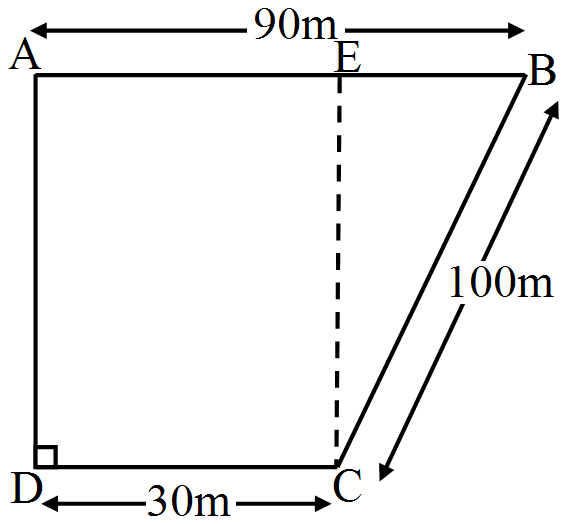
A field is in the shape of a trapezium having parallel sides $90\ m$ and $30\ m$. These sides meet the third side at right angles. The length of the fourth side is $100\ m$. If it costs $Rs. 4$ to plough $1\ m^2$ of the field, find the total cost of ploughing the field.
Answer

In trapezium $\text{ABCD}$, we draw a perpendicular line $CE$ to the line $AB.$
We have$, DC = AE = 30\ m$ 
Now, $BE = AB - AE $
$= 90 - 30 $
​​​​​​​$= 60\ m$ In right angled
$\triangle\text{BEC}, (BC)^2 = (BE)^2 + (EC)^2 [$Using pythagoras theorem$]$
$\Rightarrow (100)^2 = (60)^2 + (EC)^2$
$\Rightarrow (EC)^2 = 10000 - 3600$
$\Rightarrow (EC)^2 = 6400$
$\therefore\ \text{EC}=\sqrt{6400}=80\text{ m} [$taking positive square root because length is always positive$]$
 $\therefore$ Area of trapezium $\text{ABCD} =\frac{1}{2} ($Sum of parallel sides$) \times$ Distance between parallel sides $=\frac{1}{2}(\text{AB}\times\text{CD})\times\text{EC}$
$=\frac{1}{2}(90+30)\times80$
$=\frac{1}{2}\times(120)\times80$
$=4800\text{ m}^2$
$\because$ Cost of ploughing the field of $1m^2 = Rs. 4$
$\therefore$ Cost of ploughing the field of $4800\ m^2 $
$= 4800 \times 4 $
$= Rs. 19200$
Hence, the total cost of ploughing the field is $Rs. 19200$
View full question & answer
Question 35 Marks
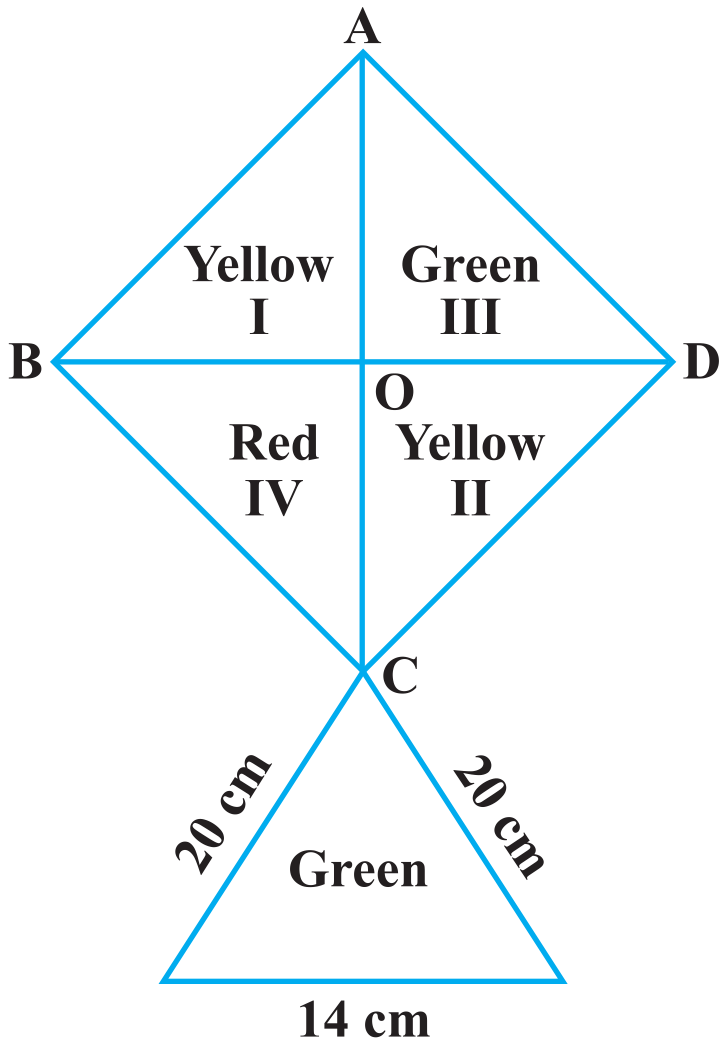
How much paper of each shade is needed to make a kite given in which $\text{ABCD}$ is a square withdiagonal $44\ cm$
.
Answer
We know that, all the sides of a square are always equal.
i.e., $\text{AB}=\text{BC}=\text{CD}=\text{DA}$
In $\triangle\text{ABCD},\text{ AC}=44\text{ cm},\angle\text{D}=90^\circ$
Using pythagoras theorem in $\triangle\text{ACD},$
$\text{AC}^2=\text{AD}^2+\text{DC}^2$
$\Rightarrow44^2=\text{AD}^2+\text{AD}^2$
$\Rightarrow2\text{AD}^2=44\times44$
$\Rightarrow\text{AD}^2=22\times44$
$\Rightarrow\text{AD}=\sqrt{22\times44}\  [$taking positive square because length is always positive$]$
$\Rightarrow\text{AD}=\sqrt{2\times11\times4\times11}$
$\Rightarrow\text{AD}=22\sqrt{2}\text{ cm}$
So, $\text{AB}=\text{BC}=\text{CD}=\text{DA}=22\sqrt{2}\text{ cm}$
$\therefore$ Area od squre $\text{ABCD}=$ Side $\times$ Side 
$=22\sqrt{2}\times22\sqrt{2}$
$=968\text{ cm}^2$
$\therefore$ Area of the red portion $=\frac{968}{4}=242\text{ cm}^2\  [$Since, area of square is divided into four parts$]$
area of the yellow portion $=\frac{968}{2}$
$=484\text{ cm}^2$
In $\triangle\text{PCQ},$ Side $PC = a = 20\ cm, CQ = b = 20\ cm$ and $PQ = c = 14\ cm$
$\text{s}=\frac{\text{a}+\text{b}+\text{c}}{2}$
$=\frac{20+20+4}{2}$
$=\frac{54}{2}$
$=27\text{ cm}$
$\therefore$ Area of $\triangle\text{PCQ}=\sqrt{\text{s}(\text{s}-\text{a})(\text{s}-\text{b})(\text{s}-\text{c})} [$by Heron's formula$]$
$=\sqrt{27(27-20)(27-20)(27-14)}$
$=\sqrt{27\times7\times7\times13}$
$=\sqrt{3\times3\times3\times7\times7\times13}$
$=21\sqrt{39}$
$=21\times6.24$
$=131.04\text{ cm}^2$
$\therefore$ Total area of the green portion $= 242 + 131.04 $
$= 373.04\ cm^2$
Hence, the paper required for each shade to make a kite is red paper $242\ cm^2,$ yellow paper $484\ cm^2$ and green paper $373.04\ cm^2$
View full question & answer
5 Marks Questions - MATHS STD 9 Questions - Vidyadip