Question 14 Marks
Find the area of a triangle two sides of which are 18cm and 10cm and the perimeter is 42cm.
AnswerWhenever we are given the measurements of all sides of a triangle, we basically look for Heron's formula to find out the area of the triangle.
If we denote area of the triangle by A, then the area of a triangle having sides a, b, c and s as semi-perimeter is given by:
$\text{A}=\sqrt{\text{s}\times(\text{s}-\text{a})\times(\text{s}-\text{b})\times(\text{s}-\text{c})}$
Where, $\text{s}=\frac{\text{a}+\text{b}+\text{c}}{2}$
We are given:
a = 18cm
b = 10cm, and perimeter = 42cm
We know that perimeter = 2s,
So, 2s = 42
Therefore, s = 21cm
We know that, $\text{s}=\frac{\text{a}+\text{b}+\text{c}}{2}$
$21=\frac{18+10+\text{c}}{2}$
42 = 28 + c
c = 14cm
So the area of the triangle is:
$\text{A}=\sqrt{21\times(21-18)\times(21-10)\times(21-14)}$
$\text{A}=\sqrt{21\times(3)\times(11)\times(7)}$
$\text{A}=21\sqrt{11}\text{cm}^2$
View full question & answer→Question 24 Marks
Find the area of a triangle whose sides are respectively 9cm, 12cm and 15cm.
AnswerLet the sides of the given triangle be a, b, c respectively.
So given,
a = 9cm
b = 12cm
c = 15cm
By using Heron's Formula
The area of the triangle $=\sqrt{\text{s}\times(\text{s}-\text{a})\times(\text{s}-\text{b})\times(\text{s}-\text{c})}$
Semi perimeter of a triangle = s
2s = a + b + c
$\text{s}=\frac{\text{a}+\text{b}+\text{c}}{2}$
$\text{s}=\frac{(9+12+15)}{2}$
$\text{s} = 18\text{cm}$
$\therefore$ Area of the triangle $=\sqrt{\text{s}\times(\text{s}-\text{a})\times(\text{s}-\text{b})\times(\text{s}-\text{c})}$
$=\sqrt{18\times(18-9)\times(18-12)\times(18-15)}$
$= 54\text{cm}^2$
View full question & answer→Question 34 Marks
Find the area of the of the blades of the magnetic compass shown in Fig. below
$\big($ Take $\sqrt{11}=3.32\big).$
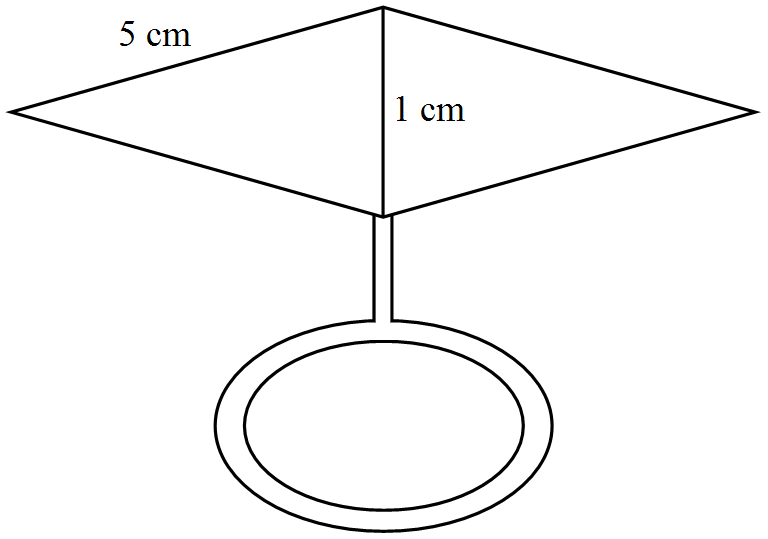
AnswerArea of the blades of magnetic compass $=$ Area of $\triangle\text{ADB} +$ Area of $\triangle\text{CDB}$
Now, for the area of $\triangle\text{ADB}$
Perimeter $= 2s = AD + DB + BA$
$2s = 5\ cm + 1\ cm + 5\ cm$
$s = 5.5\ cm$
By using Heron's Formula,
Area of the $\triangle\text{DEF}=\sqrt{\text{s}(\text{s}-\text{a})\times(\text{s}-\text{b})\times(\text{s}-\text{c})}$
$=\sqrt{5.5\times(5.5)\times(4.5)\times(0.5)}$
$= 2.49\ cm^2$
Also, area of $\triangle\text{ADB}$ = Area of $\triangle\text{CDB}$
Therefore area of the blades of the magnetic compass $= 2 \times$ area of $\triangle\text{ADB}$
Area of the blades of the magnetic compass $= 2 \times 2.49$
Area of the blades of the magnetic compass $= 4.98\ cm^2$
View full question & answer→Question 44 Marks
The perimeter of a triangullar field is 144m and the ratio of the sides is 3 : 4 : 5. Find the area of the field.
AnswerThe area of a triangle having sides a, b, c and s as semi-perimeter is given by,
$\text{A}=\sqrt{\text{s}(\text{s}-\text{a})(\text{s}-\text{b})(\text{s}-\text{c})},$ where,
$\text{s}=\frac{\text{a}+\text{b}+\text{c}}{2}$
It is given the sides of a triangular field are in the ratio 3 : 4 : 5 and perimeter = 144m
Therefore, a : b : c = 3 : 4 : 5
We will assume the sides of triangular field as
a = 3x; b = 4x; c = 5x
$2\text{s} = 144$
$\text{s}=\frac{144}{2}$
$\text{s} = 72$
$72=\frac{3\text{x}+4\text{x}+5\text{x}}{2}$
$72 \times 2 = 12\text{x}$
$\text{x}=\frac{144}{12}$
$\text{x} = 12$
Substituting the value of x in, we get sides of the triangle as
a = 3x = 3 × 12
a = 36m
b = 4x = 4 × 12
b = 48m
c = 5x = 5 × 12
c = 60m
Area of a triangular field, say A having sides a, b, c and s as semi-perimeter is given by:
a = 36m; b = 48m; c = 60m
$\text{s} = 72\text{m}$
$\text{A}=\sqrt{72(72-36)(72-48)(72-60)}$
$\text{A}=\sqrt{72(36)(24)(12)}$
$\text{A}=\sqrt{746496}$
$\text{A} = 864\text{m}^2.$
View full question & answer→Question 54 Marks
The lengths of the sides of a triangle are in a ratio of $3 : 4 : 5$ and its perimeter is $144\ cm.$ Find the area of the triangle and the height corresponding to the longest side.
AnswerGiven the perimeter of a triangle is $160m$ and the sides are in a ratio of $3 : 4 : 5$
Let the sides $a, b, c$ of a triangle be $3x, 4x, 5x$ respectively
So, the perimeter $= 2s = a + b + c$
$144 = a + b + c$
$144 = 3x + 4x + 5x$
Therefore, $x = 12\ cm$
So, the respective sides are:
$a = 36\ cm$
$b = 48\ cm$
$c = 60\ cm$
Now, semi perimeter
$\text{s}=\frac{\text{a}+\text{b}+\text{c}}{2}$
$=\frac{36+45+60}{2}$
$= 72 \ cm$
By using Heron's Formula,
The area of a triangle $=\sqrt{\text{s}\times(\text{s}-\text{a})\times(\text{s}-\text{b})\times(\text{s}-\text{c})}$
$=\sqrt{72\times(72-36)\times(72-48)\times(72-60)}$
$= 864 \ cm^2$
Thus, the area of a triangle is $864\ cm^2$
The longest side $= 60\ cm$
Area of the triangle $=\frac12\times\text{h}\times60$
$\frac12\times\text{h}\times60=864 \ cm^2$
$\text{h} = 28.8 \ cm$
Hence the length of the smallest altitude is $28.8\ cm.$
View full question & answer→Question 64 Marks
A park in the shape of a quadrilateral $\text{ABCD,}$ has angle $\angle\text{C}=90^\circ, AB = 9m, BC = 12m, CD = 5m, AD = 8m.$ How much area does it occupy.
AnswerGiven that the sides of the quadrilateral are
$AB = 9m, BC = 12m, CD = 5m, DA = 8m$
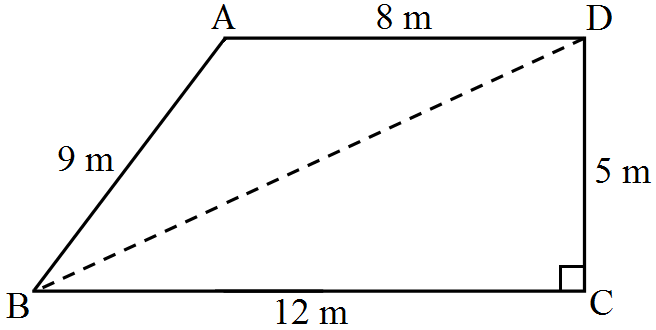
In $\triangle\text{BCD},$ apply Pythagoras theorem
$BD^2 = BC^2 + CD^2$
$BD^2 = 12^2 + 5^2$
$BD = 13m$
Area of $\triangle\text{BCD}=\frac12\times\text{BC}\times\text{CD}$
$=\frac12\times12\times5$
$= 30m^2$
Now, in $\triangle\text{ABD},$
Perimeter $= 2s = 9 m + 8m + 13m$
$s = 15m$
By using Heron's Formula
The area of a triangle $\text{PSR} =\sqrt{\text{s}\times(\text{s}-\text{a})\times(\text{s}-\text{b})\times(\text{s}-\text{c})}$
$=\sqrt{15\times(15-9)\times(15-8)\times(15-13)}$
$= 35.49m^2$
Area of quadrilateral $\text{ABCD}=$ Area of triangle $\text{ABD} +$ Area of triangle $\text{BCD}$
$= (35.496 + 30)m^2$
$= 65.5m^2$ View full question & answer→Question 74 Marks
A rhombus sheet, whose perimeter is $32m$ and whose diagonal is $10m$ long, is painted on both the sides at the rate of $₹ 5$ per meter square. Find the cost of painting.
AnswerGiven that,
Perimeter of a rhombus $= 32m$
We know that,
Perimeter of a rhombus $= 4 \times$ side
$4 \times$ side $= 32m$
$4 \times a = 32m$
$a = 8m$
Let $AC = 10m$
$OA = 12 \times AC$
$OA = 12 \times 10$
$OA = 5m$
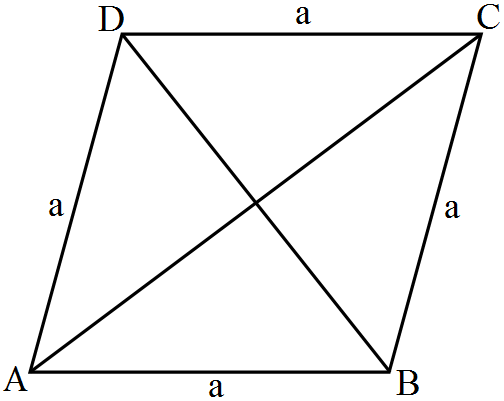
By using Pythagoras theorem
$OB^2 = AB^2 − OA^2$
$OB^2 = 8^2 − 5^2$
$\text{OB}=\sqrt{39}\text{m}$
$BD = 2 \times OB$
$\text{BD}=2\sqrt{39}\text{m}$
Area of the sheet $=\frac{1}{2}\times\text{BD}\times\text{AC}$
Area of the sheet $=\frac12\times2\sqrt{39}\times10$
Therefore, cost of printing on both sides at the rate of $₹ 5$ per $m^2$
$=₹2\times10\sqrt{39}\times5$
$= ₹ 625.$ View full question & answer→Question 84 Marks
If each side of a triangle is doubled, the find percentage increase in its area.
AnswerThe area of a triangle having sides $a, b, c$ and s as semi$-$perimeter is given by,
$\text{A}=\sqrt{\text{s}(\text{s}-\text{a})(\text{s}-\text{b})(\text{s}-\text{c})}$
where,
$\text{s}=\frac{\text{a}+\text{b}+\text{c}}{2}$
$2s = a + b + c$
We take the sides of a new triangle as $2a, 2b, 2c$ that is twice the sides of previous one
Now, the area of a triangle having sides $2a, 2b,$ and $2c$ and $s_1$ as semi$-$perimeter is given by,
$\text{A}_1=\sqrt{\text{s}_1(\text{s}_1-2\text{a})(\text{s}_1-2\text{c})(\text{s}_1-2\text{c})},$
Where,
$\text{s}_1=\frac{2\text{a}+2\text{b}+2\text{c}}{2}$
$\text{s}_1=\frac{2(\text{a}+\text{b}+\text{c})}{2}$
$\text{s}_1 = \text{a} + \text{b} + \text{c}$
$\text{s}_1 = 2\text{s}$
Now,
$\text{A}_1=\sqrt{2\text{s}(2\text{s}-2\text{a})(2\text{s}-2\text{b})(2\text{s}-2\text{c})}$
$\text{A}_1=\sqrt{2\text{s}\times2(\text{s}-\text{a})\times2(\text{s}-\text{b})\times2(\text{s}-\text{c})}$
$\text{A}_1=4\sqrt{\text{s}(\text{s}-\text{a})(\text{s}-\text{b})(\text{s}-\text{c})}$
$\text{A}_1=4\triangle$
Therefore, increase in the area of the triangle
$= A_1- A$
$= 4A - A$
$= 3A$
Percentage increase in area
$=\frac{3\text{A}}{\text{A}}\times100$
$= 300\%.$
View full question & answer→Question 94 Marks
The perimeter of an isosceles triangle is $42\ cm$ and its base is $\Big(\frac32\Big)$ times each of the equal side. Find the length of each of the triangle, area of the triangle and the height of the triangle.
AnswerLet $'x\ '$ be the length of two equal sides,
Therefore the base $=\frac12\times\ x$
Let the sides $a, b, c$ of a triangle be $\frac12\times\text{x}, x$ and $x$ respectively
So, the perimeter $= 2s = a + b + c$
$42 = a + b + c$
$42=\frac32\times\text{x}+\text{x}+\text{x}$
Therefore, $x = 12\ cm$
So, the respective sides are:
$a = 12\ cm$
$b = 12\ cm$
$c = 18\ cm$
Now, semi perimeter
$\text{s}=\frac{\text{a}+\text{b}+\text{c}}{2}$
$=\frac{12+12+18}{2}$
$= 21\ cm$
By using Heron's Formula,
The area of a triangle $=\sqrt{\text{s}\times(\text{s}-\text{a})\times(\text{s}-\text{b})\times(\text{s}-\text{c})}$
$=\sqrt{21\times(21-12)\times(21-12)\times(21-18)}$
$= 71.42\ cm^2$
Thus, the area of a triangle is $70.42\ cm^2$
The altitude will be smallest provided the side corresponding to this altitude is longest.
The longest side $= 18\ cm$
Area of the triangle $=\frac12\times\text{h}\times18$
$\frac12\times\text{h}\times18=71.42\ cm^2$
$\text{h} = 7.94\ cm$
Hence the length of the smallest altitude is $7.93\ cm.$
View full question & answer→Question 104 Marks
The sides of a quadrilateral field, taken in order are $26m, 27m, 7m, 24m$ respectively. The angle contained by the last two sides is a right angle. Find its area.
AnswerHere the length of the sides of the quadrilateral is given as:
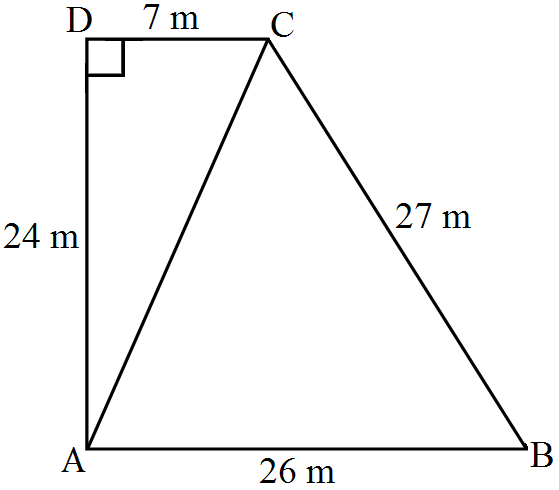
$AB = 26m, BC = 27m, CD = 7m, DA = 24m$
Diagonal $AC$ is joined.
Now, in $\triangle\text{ADC}$
By applying Pythagoras theorem
$AC^2 = AD^2 + CD^2$
$AC^2 = 14^2+ 7^2$
$AC = 25m$
Now area of $\triangle\text{ABC}$
Perimeter $= 2s = AB + BC + CA$
$2s = 26m + 27m + 25m$
$s = 39m$
By using Heron's Formula
The area of a triangle $=\sqrt{\text{s}\times(\text{s}-\text{a})\times(\text{s}-\text{b})\times(\text{s}-\text{c})}$
$=\sqrt{39\times(39-26)\times(39-27)\times(39-25)}$
$= 291.84m^2$
Thus, the area of a triangle is $291.84m^2$
Now for area of $\triangle\text{ADC}$
Perimeter $= 2S = AD + CD + AC$
$= 25m + 24m + 7m$
$S = 28m$
By using Heron's Formula
The area of triangle $=\sqrt{\text{s}\times(\text{s}-\text{a})\times(\text{s}-\text{b})\times(\text{s}-\text{c})}$
$=\sqrt{28\times(28-24)\times(28-7)\times(28-25)}$
$= 84m^2$
Thus, the area of a triangle is $84m^2$
Therefore, Area of rectangular field $\text{ABCD}$
= Area of triangle $\text{ABC +}$ Area of triangle $\text{ADC}$
$= 291.84 + 84$
$= 375.8m^2$ View full question & answer→Question 114 Marks
Find the area of a rhombus whose perimeter is $80m$ and one of whose diagonal is $24m.$
AnswerPerimeter of a rhombus $= 80m$
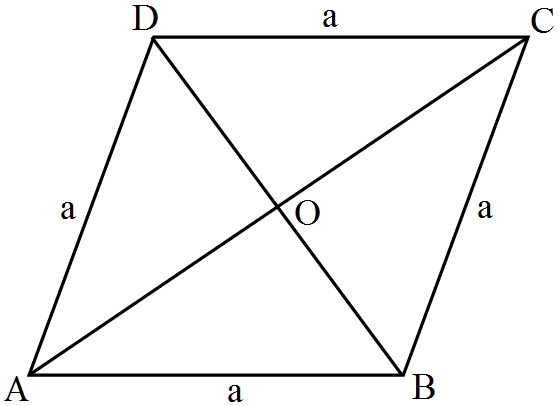
As we know,
Perimeter of a rhombus $= 4 \times$ side $= 4 \times a$
$4 \times a = 80m$
$a = 20m$
Let $AC = 24m$
Therefore, $\text{OA}=\frac12\times\text{AC}$
$OA = 12m$
In $\triangle\text{AOB}$
$OB^{2 }= AB^2 − OA^2$
$OB^2 = 20^{2 }− 12^2$
$OB = 16m$
Also, $OB = OD$ because diagonal of rhombus bisect each other at $90^\circ$
Therefore, $BD = 2 OB = 2 \times 16 = 32m$
Area of rhombus $=\frac12\times\text{BD}\times\text{AC}$
Area of rhombus $=\frac12\times32\times24$
Area of rhombus $= 384\ m^2$ View full question & answer→Question 124 Marks
Find the perimeter and area of the quadrilateral $\text{ABCD}$ in which $AB = 17\ cm, AD = 9\ cm, CD = 12\ cm, \angle\text{ACB}=90^\circ$ and $AC = 15\ cm.$
AnswerWe assume $\text{ABCD}$ be the quadrilateral having sides $AB, BC, CD, DA$ and $\angle\text{ACB}=90^\circ.$
We take a diagonal $AC,$ where $AC$ divides $\text{ABCD}$ into two triangle $\triangle\text{ACB}$ and $\triangle\text{ADC}$
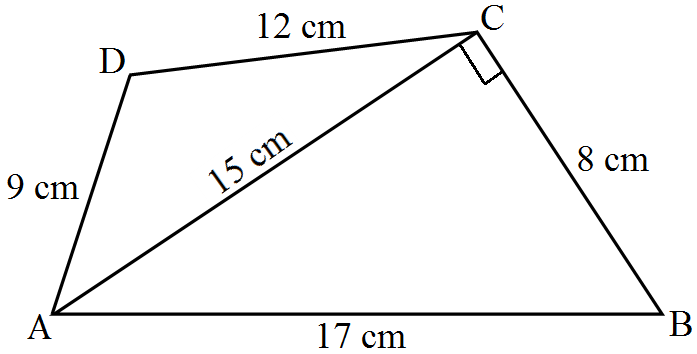
Since $\triangle\text{ACB}$ is right angled at $C,$ we have
$AC = 15\ cm; AB = 17\ cm$
$AB2 = AC2 + BC2$
$(17)^2 = (15)^2 + BC^2$
$289 = 225 + BC^2$
$BC^2 = 289 - 225$
$\text{BC}^2=\sqrt{64}$
$BC = 8\ cm$
Area of right angled $\triangle\text{ABC},$ say $A_1$ is given by
$A_1=\frac12($Base $\times$ Height$)$
where,
Base $= BC = 8\ cm;$ Height $= AC = 15\ cm$
$P = 9 + 12 + 8 + 17$
$= 46\ cm$
$P = 46\ cm.$ View full question & answer→Question 134 Marks
The perimeter of a triangle is 300m. If its sides are in the ratio of 3 : 5 : 7. Find the area of the triangle.
AnswerGiven the perimeter of a triangle is 300 m and the sides are in a ratio of 3 : 5 : 7
Let the sides a, b, c of a triangle be 3x, 5x, 7x respectively
So, the perimeter = 2s = a + b + c
200 = a + b + c
300 = 3x + 5x + 7x
300 = 15x
Therefore, x = 20m
So, the respective sides are
a = 60m
b = 100m
c = 140m
Now, semi perimeter
$\text{s}=\frac{(\text{a}+\text{b}+\text{c})}{2}$
$\text{s}=\frac{(60+100+140)}{2}$
$= 150\text{m}$
By using Heron's Formula
The area of the triangle $=\sqrt{\text{s}\times(\text{s}-\text{a})\times(\text{s}-\text{b})\times(\text{s}-\text{c})}$
$=\sqrt{150\times(150-60)\times(150-100)\times(150-140)}$
$=1500\sqrt{3}\text{m}^2$
Thus, the area of a triangle is $1500\sqrt{3}\text{m}^2$
View full question & answer→Question 144 Marks
Find the area of the shaded region in fig. below
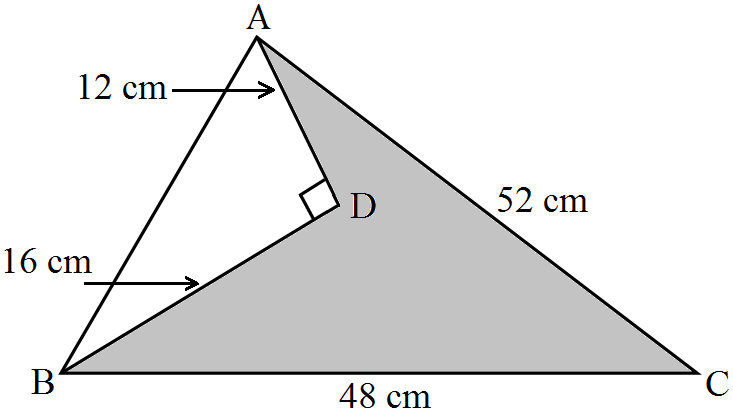
AnswerArea of the shaded region = Area of $\triangle\text{ABC}-$ Area of $\triangle\text{ADB}$
Now in triangle $\text{ADB}$
$AB^2 = AD^2 + BD^2....(i)$
Given, $AD = 12\ cm, BD =16\ cm$
Substituting the value of $AD$ and $BD$ in eq $(i),$ we get
$AB^2 = 12^{2 }+ 16^2$
$= 400\ cm^2$
$AB = 20\ cm$
Now, area of a triangle $=\frac12\times\text{AD}\times\text{BD}$
$= 96\ cm^2$
Now in triangle $\text{ABC,}$
$\text{s}=\frac12\times(\text{AB}+\text{BC}+\text{CA})$
$=\frac12\times(52+48+20)$
$= 60 \ cm$
By using Heron's Formula
The area of a triangle $=\sqrt{\text{s}\times(\text{s}-\text{a})\times(\text{s}-\text{b})\times(\text{s}-\text{c})}$
$=\sqrt{60\times(60-20)\times(60-48)\times(60-52)}$
$= 480\ cm^2$
Thus, the area of a triangle is 4$80\ cm^2$
Area of shaded region $=$ Area of $\triangle\text{ABC}-$ Area of $\triangle\text{ADB}$
$= (480 - 96)cm^2$
$= 384\ cm^2$
Area of shaded region $= 384\ cm^2$
View full question & answer→Question 154 Marks
Find the area of an isosceles triangle having the base x cm and one side y cm.
AnswerLet us assume triangle ABC be the given isosceles triangle having sides AB = AC and base BC. The area of a triangle ABC, say A having given sides AB and AC equals to y cm and given base BC equals to x cm is given by:
$\text{A}=\frac12(\text{Base}\times\text{Height})$
Where,
Base = BC = x cm; Height $=\sqrt{\text{y}^2-\frac{\text{x}^2}{4}}$
$\text{A}=\frac12(\text{Base}\times\text{Height})$
$=\frac12\times\text{x}\Big(\sqrt{\text{y}^2-\frac{\text{x}^2}{4}}\Big)$
$=\frac{\text{x}}{2}\Big(\sqrt{\text{y}^2-\frac{\text{x}^2}{4}}\Big)$
View full question & answer→Question 164 Marks
Two parallel sides of a trapezium are $60m$ and $77m$ and the other sides are $25m$ and $26m.$ Find the area of the trapezium.
AnswerGiven,
Two parallel sides of trapezium are $AB = 77m$ and $CD = 60m$
The other two parallel sides of trapezium are $BC = 26m, AD = 25m$
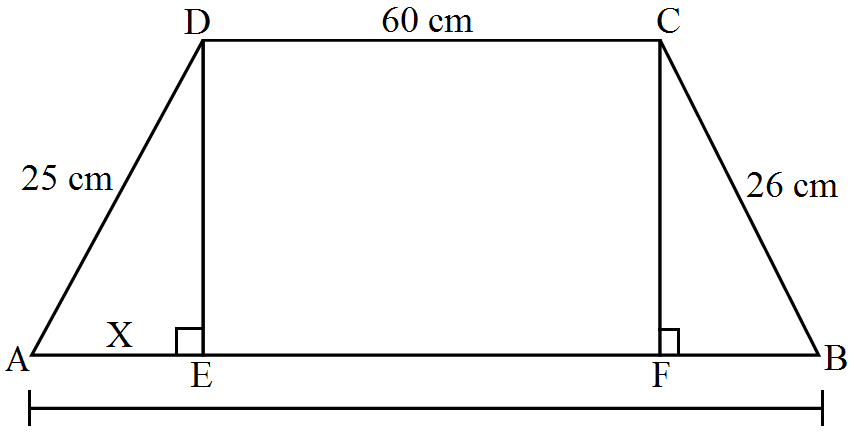
Join $AE$ and $CF$
$DE$ is perpendicular to $AB$ and also, $CF$ is perpendicular to $AB$
Therefore, $DC = EF = 60m$
Let $AE = x$
So, $BF = 77 - 60 - x$
$BF = 17 - x$
In $\triangle\text{ADE},$
By using Pythagoras theorem,
$DE^2 = AD^2 - AE^2$
$DE^2 = 25^2 - x^2$
In $\triangle\text{BCF},$
By using Pythagoras theorem,
$CF^2 = BC^2 - BF^2$
$CF^2 = 26^2 - (17 − x)^2$
Here, $DE = CF$
So, $DE^2 = CF^2$
$25^2 - x^2 = 26^2 - (17 - x)^2$
$25^2 - x^2 = 26^2 - (17^2 - 34x + x^2)$
$25^2 - x^2 = 26^2 - 17^2 + 34x + x^2$
$25^2 = 26^2 - 17^2 + 34x$
$x = 7$
$DE^2 = 25^2 - x^2$
$\text{DE}=\sqrt{625-49}$
$DE = 24m$
Area of trapezium $=\frac12\times(60+77)\times24$
Area of trapezium $= 1644m^2.$ View full question & answer→Question 174 Marks
Find the area of the quadrilateral $\text{ABCD}$ in which$ AD = 24\ cm, \angle\text{BAD}=90^\circ$ and $\text{BCD}$ forms an equilateral triangle whose each side is equal to $26\ cm.$ $\big($ Take $\sqrt{3}=1.73\big)$
AnswerGiven that, in a quadrilateral $\text{ABCD}$ in which $AD = 24\ cm,$
$\angle\text{BAD}=90^\circ$
$\text{BCD}$ is an equilateral triangle and the sides $BC = CD = BD = 26\ cm$
In $\triangle\text{BAD},$ by applying Pythagoras theorem,
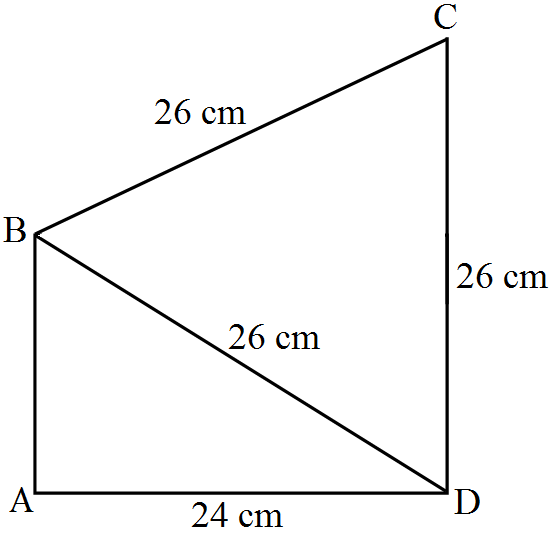
$BA^2 = BD^2 − AD^2$
$BA^2 = 26^2 + 24^2$
$\text{BA}=\sqrt{100}$
$BA = 10\ cm$
Area of the $\triangle\text{BAD}=\frac12\times\text{BA}\times\text{AD}$
Area of the $\triangle\text{BAD}=\frac12\times10\times24$
Area of the triangle $\text{BAD} = 120\ cm^2$
Area of the equilateral triangle $=\sqrt{\frac34}\times\text{side}$
Area of the equilateral $\triangle\text{QRS}=\sqrt{\frac34}\times36$
Area of the equilateral triangle $\text{BCD} = 292.37\ cm^2$
Therefore, the area of quadrilateral $\text{ABCD} =$ Area of $\triangle\text{BAD} +$ Area of the $\triangle\text{BCD}$
The area of quadrilateral $\text{ABCD} = 120 + 292.37$
$= 412.37\ cm^2$ View full question & answer→Question 184 Marks
The sides of a quadrilateral, taken in order as $5m, 12m, 14m, 15m$ respectively. The angle contained by first two sides is a right angle. Find its area. 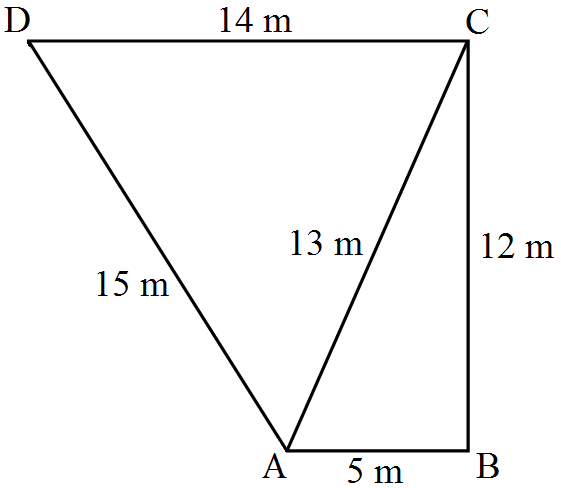
AnswerGiven that the sides of the quadrilateral are
$AB = 5m, BC = 12m, CD = 14m, DA = 15m$
Join $AC$
Now, in $\triangle\text{ABC}=\frac12\times AB \times BC$
$=\frac{1}{2}\times5\times12$
$= 30m^2$
In $\triangle\text{ABC},$ By applying Pythagoras theorem
$AC^2 = AB^2 + BC^2$
$\text{AC}=\sqrt{5^2+12^2}$
$AC = 13m$
Now area of $\triangle\text{ADC},$
Perimeter $= 2s = AD + DC + AC$
$2s = 15m + 14m + 13m$
$s = 21m$
By using Heron's Formula
The area of a triangle $\text{PSR} =\sqrt{\text{s}\times(\text{s}-\text{a})\times(\text{s}-\text{b})\times(\text{s}-\text{c})}$
$=\sqrt{21\times(21-15)\times(21-14)\times(21-13)}$
$= 84m^2$
Area of quadrilateral $\text{ABCD}=$ Area of triangle $\text{ABC} +$ Area of triangle $\text{ADC}$
$= (30 + 84) m^2$
$= 114m^2$
View full question & answer→Question 194 Marks
Find the area of quadrilateral $\text{ABCD}$ in which $AB = 42\ cm, BC = 21\ cm, CD = 29\ cm, DA = 34\ cm$ and the diagonal $BD = 20\ cm.$
AnswerGiven:
$AB = 42\ cm, BC = 21\ cm, CD = 29\ cm, DA = 34\ cm,$ and the diagonal
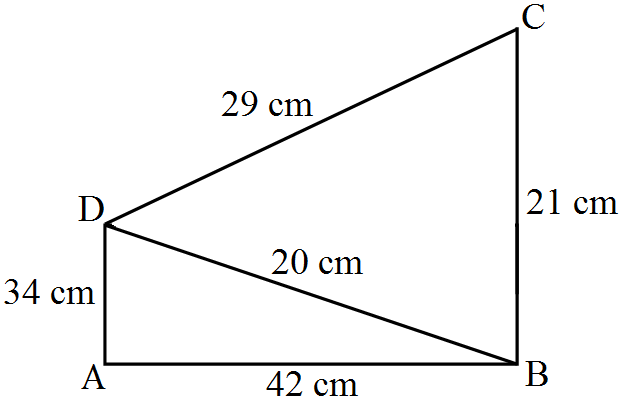
$BD = 20\ cm.$
Now, for the area of triangle $\text{ABD}$
Perimeter of triangle $\text{ABD} 2s = AB + BD + DA$
$2s = 34\ cm + 42\ cm + 20\ cm$
$s = 48\ cm$
By using Heron’s Formula,
Area of the $\triangle\text{ABD}=\sqrt{\text{s}\times(\text{s}-\text{a})\times(\text{s}-\text{b})\times(\text{s}-\text{c})}$
$=\sqrt{48\times(48-42)\times(48-20\times(48-34)}$
$= 336\ cm^2$
Now, for the area of triangle $\text{BCD}$
Perimeter of triangle $\text{BCD} 2s = BC + CD + BD$
$2s = 29\ cm + 21\ cm + 20\ cm$
$s = 35\ cm$
By using Heron's Formula,
Area of the $\triangle\text{BCD}=\sqrt{\text{s}\times(\text{s}-\text{a})\times(\text{s}-\text{b})\times(\text{s}-\text{c})}$
$=\sqrt{35\times(14)\times(6)\times(15)}$
$= 210\ cm^2$
Therefore, Area of quadrilateral $\text{ABCD} =$ Area of $\triangle\text{ABC} +$ Area of $\triangle\text{BCD}$
Area of quadrilateral $\text{ABCD} = 336 + 210$
Area of quadrilateral $\text{ABCD} = 546\ cm^2$ View full question & answer→Question 204 Marks
In a triangle $\triangle\text{ABC}, AB = 15\ cm, BC = 13\ cm$ and $AC = 14\ cm.$ Find the area of triangle $\text{ABC}$ and hence its altitude on $AC.$
AnswerLet the sides of the given triangle be $AB = a, BC = b, AC = c$ respectively.
So given,
$a = 15\ cm$
$b = 13\ cm$
$c = 14\ cm$
By using Heron's Formula
The Area of the triangle $=\sqrt{\text{s}\times(\text{s}-\text{a})\times(\text{s}-\text{b})\times(\text{s}-\text{c})}$
Semi perimeter of a triangle $= 2s$
$2s = a + b + c$
$\text{s}=\frac{(\text{a}+\text{b}+\text{c})}{2}$
$\text{s}=\frac{(15+13+14)}{2}$
$\text{s} = 21\ cm$
$\therefore$ Area of the triangle $=\sqrt{\text{s}\times(\text{s}-\text{a})\times(\text{s}-\text{b})\times(\text{s}-\text{c})}$
$=\sqrt{21\times(21-15)\times(21-13)\times(21-14)}$
$= 84\ cm^2$
$BE$ is a perpendicular on $AC$
Now, area of triangle $= 84\ cm^2$
$\frac12\times BE \times AC=84\ cm^2$
$BE = 12\ cm$
The length of $BE$ is $12\ cm.$
View full question & answer→Question 214 Marks
Find the area of a triangle whose sides are 3cm, 4cm and 5cm respectively.
AnswerThe area of a triangle having sides a, b, c and s as semi-perimeter is given by,
$\text{A}=\sqrt{\text{s}(\text{s}-\text{a})(\text{s}-\text{b})(\text{s}-\text{c})},$ where
$\text{s}=\frac{\text{a}+\text{b}+\text{c}}{2}$
Therefore the area of a triangle, say having sides 3cm, 4cm and 5cm is given by:
a = 3cm; b = 4cm; c = 5cm
$\text{s}=\frac{\text{a}+\text{b}+\text{c}}{2}$
$\text{s}=\frac{2+4+5}{2}$
$\text{s}=\frac{12}{2}$
$\text{s} = 6\text{cm}$
Now, area $\text{A}=\sqrt{\text{s}(\text{s}-\text{a})(\text{s}-\text{b})(\text{s}-\text{c})}$
$=\sqrt{6(6-3)(6-4)(6-5)}$
$=\sqrt{6\times3\times2\times1}$
$=\sqrt{36}$
$= 6\text{cm}^2.$
View full question & answer→Question 224 Marks
Let $\triangle$ be the area of a triangle. Find the area of a triangle whose each side is twice the side of the given triangle.
AnswerWe are given assumed value $\triangle$ is the area of a given $\triangle\text{ABC}$
We assume the sides of the given triangle $\text{ABC}$ be $a, b, c$
The area of a triangle having sides $a, b, c$ and $s$ as semi$-$perimeter is given by,
$\text{A}=\sqrt{\text{s}(\text{s}-\text{a})(\text{s}-\text{b})(\text{s}-\text{c})}$
$\triangle=\sqrt{\text{s}(\text{s}-\text{a})(\text{s}-\text{b})(\text{s}-\text{c})}$
Where,
$\text{s}=\frac{\text{a}+\text{b}+\text{c}}{2}$
$2\text{s} = \text{a} + \text{b} + \text{c}$
We take the sides of a new triangle as $2a, 2b, 2c$ that is twice the sides of previous one
Now, the area of a triangle having sides $2a, 2b$, and $2c$ and $s_1$ as semi$-$perimeter is given by,
$\text{A}_1=\sqrt{\text{s}_1(\text{s}_1-2\text{a})(\text{s}_1-2\text{c})(\text{s}_1-2\text{c})},$ where
$\text{s}_1=\frac{2\text{a}+2\text{b}+2\text{c}}{2}$
$\text{s}_1=\frac{2(\text{a}+\text{b}+\text{c})}{2}$
$\text{s}_1 = \text{a} + \text{b} + \text{c}$
$\text{s}_1 = 2\text{s}$
Now,
$\text{A}_1=\sqrt{2\text{s}(2\text{s}-2\text{a})(2\text{s}-2\text{b})(2\text{s}-2\text{c})}$
$\text{A}_1=\sqrt{2\text{s}\times2(\text{s}-\text{a})\times2(\text{s}-\text{b})\times2(\text{s}-\text{c})}$
$\text{A}_1=4\sqrt{\text{s}(\text{s}-\text{a})(\text{s}-\text{b})(\text{s}-\text{c})}$
$\text{A}_1=4\triangle$
View full question & answer→Question 234 Marks
A hand fan is made by sticking $10$ equal size triangular strips of two different types of paper as shown in the figure. The dimensions of equal strips are $25\ cm, 25\ cm$ and $14\ cm.$ Find the area of each type of paper needed to make the hand fan.
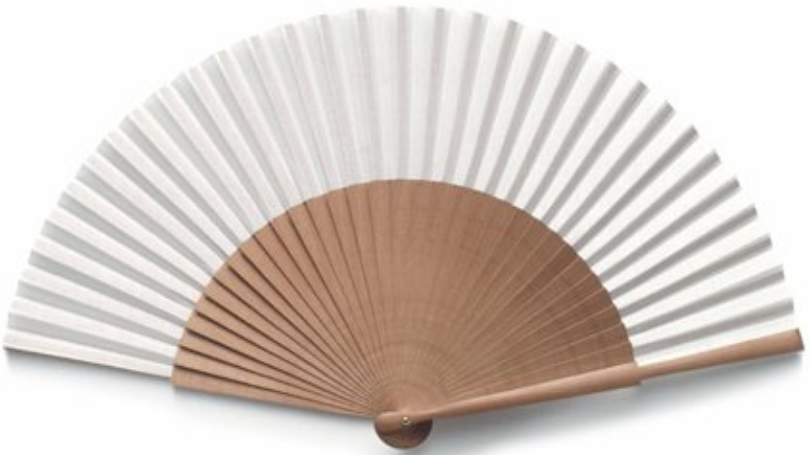
AnswerGiven that,
$AO = 25\ cm$
$OB = 25\ cm$
$BA = 14\ cm$
Area of each strip $=$ Area of $\triangle\text{AOB}$
Now, for the area of $\triangle\text{AOB}$
Perimeter $= AO + OB + BA$
$2s = 25\ cm +25\ cm + 14\ cm$
$s = 32\ cm$
By using Heron's Formula,
Area of the $\triangle\text{AOB}=\sqrt{\text{s}\times(\text{s}-\text{a})\times(\text{s}-\text{b})\times(\text{s}-\text{c})}$
$=\sqrt{32\times(7)\times(4)\times(18)}$
$= 168\ cm^2$
Also, area of each type of paper needed to make a fan $= 5 \times$ Area of $\triangle\text{AOB}$
Area of each type of paper needed to make a fan $= 5 \times 168\ cm^2$
Area of each type of paper needed to make a fan $= 840\ cm^2.$
View full question & answer→Question 244 Marks
Find the area of the quadrilateral $\text{ABCD}$ in which $AB = 3\ cm, BC = 4\ cm, CD = 4\ cm, DA = 5\ cm$ and $AC = 5\ cm.$
AnswerFor $\triangle\text{ABC}$
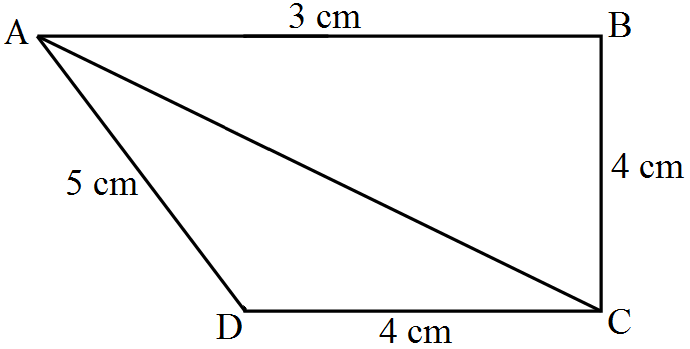
$AC^2 = BC^2 + AB^2$
$25 = 9 + 16$
So, $\triangle\text{ABC}$ is a right angle triangle right angled at point $R$
Area of triangle $\text{ABC} = 12 \times AB \times BC$
$=\frac12\times3\times4$
$= 6\ cm^2$
From $\triangle\text{CAD}$
Perimeter $= 2s = AC + CD + DA$
$2s = 5\ cm + 4\ cm + 5\ cm$
$2s = 14\ cm$
$s = 7\ cm$
By using Heron's Formula
Area of the triangle $\text{CAD} =\sqrt{\text{s}\times(\text{s}-\text{a})\times(\text{s}-\text{b})\times(\text{s}-\text{c})}$
$=\sqrt{7\times(7\times5)\times(7-4)\times(7-5)}$
$= 9.16\ cm^2$
Area of $\text{ABCD} =$ Area of $\text{ABC} +$ Area of $\text{CAD}$
$= (6 + 9.16)cm^2$
$= 15.16 \ cm^2$ View full question & answer→Question 254 Marks
The adjacent sides of a parallelogram $\text{ABCD}$ measure $34\ cm$ and $20\ cm,$ and the diagonal $AC$ measures $42\ cm.$ Find the area of parallelogram.
AnswerThe adjacent sides of a parallelogram $\text{ABCD}$ measures $34\ cm$ and $20\ cm,$ and the diagonal $AC$ measures $42\ cm.$ Area of the parallelogram $=$ Area of $\triangle\text{ADC} +$ Area of $\triangle\text{ABC}$
Note: Diagonal of a parallelogram divides into two congruent triangles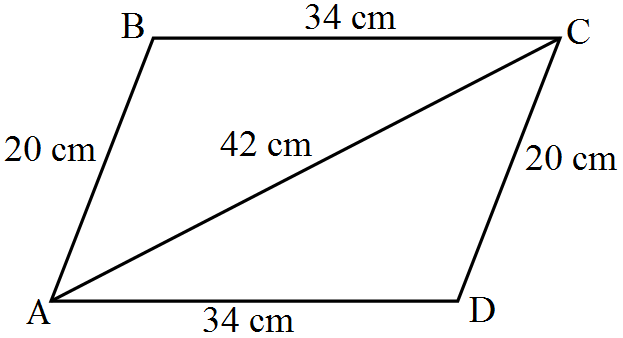
Therefore, Area of the parallelogram $= 2 \times \big($Area of $\triangle\text{ABC}\big)$ Now, for area of $\triangle\text{ABC}$ Perimeter $= 2s = AB + BC + CA 2s = 34\ cm + 20\ cm + 42\ cm s = 48\ cm$ By using Heron's Formula, Area of the $\triangle\text{ABC}=\sqrt{\text{s}\times(\text{s}-\text{a})\times(\text{s}-\text{b})\times(\text{s}-\text{c})}$
$=\sqrt{48\times(14)\times(28)\times(6)} = 336\ cm^2$ Therefore, area of parallelogram $ABCD = 2 \times \big($Area of $\triangle\text{ABC}\big)$ Area of parallelogram $= 2 \times 336\ cm^2$ Area of parallelogram $\text{ABCD} = 672\ cm^2$ View full question & answer→Question 264 Marks
A triangle and a parallelogram have the same base and the same area. If the sides of the triangle are $13\ cm, 14\ cm$ and $15\ cm$ and the parallelogram stands on the base $14\ cm,$ find the height of a parallelogram.
AnswerThe sides of the triangle $\text{DCE}$ are:
$DC = 15\ cm,$
$CE = 13\ cm,$
Let the h be the height of parallelogram $\text{ABCD}$
Now, for the area of $\triangle\text{DCE}$
Perimeter $= DC + CE + ED$
$2s = 15\ cm + 13\ cm + 14\ cm$
$s = 21\ cm$
By using Heron's Formula,
Area of the $\triangle\text{AOB}=\sqrt{\text{s}(\text{s}-\text{a})\times(\text{s}-\text{b})\times(\text{s}-\text{c})}$
$=\sqrt{21\times(7)\times(8)\times(6)}$
$= 84\ cm^2$
Also, area of $\triangle\text{DCE}$ = Area of parallelogram $\text{ABCD} \Rightarrow 84\ cm^2$
$24 \times h = 84\ cm^2$
$h = 6\ cm.$
View full question & answer→Question 274 Marks
If each side of a equilateral triangle is tripled then what is the percentage increase in the area of the triangle?
AnswerArea of an equilateral triangle having each side a $cm$ is given by:
$\text{A}=\frac{\sqrt{3}\text{a}^2}{4}$
Now, Area of an equilateral triangle, say $A_1$ if each side is tripled is given by;
$a = 3a$
$\text{A}_1=\frac{\sqrt{3}}{4}\text{a}^2$
$\text{A}_1=\frac{\sqrt{3}}{4}(3\text{a})^2$
$\text{A}_1=\frac{9\sqrt{3}\text{a}^2}{4}\ cm^2$
Therefore, increase in area of triangle
$= A_1 - A$
$=\frac{9\sqrt{3}\text{a}^2}{4}-\frac{\sqrt{3}\text{a}^2}{4}$
$=\frac{8\sqrt{3}\text{a}^2}{4}$
Percentage increase in area
$=\frac{\frac{8\sqrt{3}\text{a}^2}{4}}{\frac{\sqrt{3}\text{a}^2}{4}}\times100$
$= 800\%.$
View full question & answer→Question 284 Marks
The perimeter of a triangular field is 240dm. If two of its sides are 78dm and 50dm, find the length of the perpendicular on the side of length 50dm from the opposite vertex.
AnswerGiven,
In a triangle ABC, a = 78dm = AB, b = 50dm = BC
Now, Perimeter = 240dm
Then, AB + BC + AC = 240dm
78 + 50 + AC = 240
AC = 240 - (78 + 50)
AC = 112dm = c
Now, 2s = a + b + c
2s = 78 + 50 + 112
s = 120dm
Area of the triangle ABC $=\sqrt{\text{s}\times(\text{s}-\text{a})\times(\text{s}-\text{b})\times(\text{s}-\text{c})}$
$=\sqrt{120\times(120-78)\times(120-50)\times(120-112)}$
$= 1680\text{dm}^2$
Let AD be a perpendicular on BC
Area of the triangle ABC $=\frac12\times\text{AD}\times\text{BC}$
$\frac{1}{2}\times\text{AD}\times\text{BC}=1680\text{dm}^2$
$\text{AD} = 67.2\text{dm}.$
View full question & answer→Question 294 Marks
A triangle has sides 35cm, 54cm, 61cm long. Find its area. Also, find the smallest of its altitudes.
AnswerGiven,
The sides of the triangle are
a = 35cm
b = 54cm
c = 61cm
Perimeter 2s = a + b + c
2s = 35 + 54 + 61cm
Semi perimeter s = 75cm
By using Heron's Formula,
$=\sqrt{\text{s}\times(\text{s}-\text{a})\times(\text{s}-\text{b})\times(\text{s}-\text{c})}$
$=\sqrt{75\times(75-35)\times(75-54)\times(75-61)}$
$= 939.14\text{cm}^2$
The altitude will be smallest provided the side corresponding to this altitude is longest.
The longest side = 61cm
Area of the triangle $=\frac12\times\text{h}\times61$
$\frac12\times\text{h}\times61=939.14\text{cm}^2$
$\text{h} = 30.79\text{cm}$
Hence the length of the smallest altitude is 30.79cm.
View full question & answer→Question 304 Marks
Find the area of a triangle whose sides are respectively $150\ cm, 120\ cm$ and $200\ cm.$
AnswerLet the sides of the given triangle be $a, b, c$ respectively.
So given,
$a = 150\ cm$
$b = 120\ cm$
$c = 200\ cm$
By using Heron's Formula
The Area of the triangle $=\sqrt{\text{s}\times(\text{s}-\text{a})\times(\text{s}-\text{b})\times(\text{s}-\text{c})}$
Semi perimeter of a triangle $= s$
$2s = a + b + c$
$\text{s}=\frac{(\text{a}+\text{b}+\text{c})}{2}$
$\text{s}=\frac{(150+200+120)}{2}$
$s = 235\ cm$
Therefore,
Area of the triangle $=\sqrt{\text{s}\times(\text{s}-\text{a})\times(\text{s}-\text{b})\times(\text{s}-\text{c})}$
$=\sqrt{235\times(235-150)\times(235-200)\times(235-120)}$
$= 8966.56\ cm^2$
View full question & answer→Question 314 Marks
The perimeter of a triangular field is $540m$ and its sides are in the ratio $25 : 17 : 12.$ Find the area of triangle.
AnswerLet the sides of the given triangle be $a = 25x, b = 17x, c = 12x$ respectively,
So,
$a = 25x \ cm$
$b = 17x \ cm$
$c = 12x \ cm$
Given Perimeter $= 540\ cm$
$2s = a + b + c$
$a + b + c = 540\ cm$
$25x + 17x + 12x = 540\ cm$
$a = 250\ cm$
$b = 170\ cm$
$c = 120\ cm$
Now, Semi perimeter $\text{s}=\frac{(\text{a}+\text{b}+\text{c})}{2}$
$=\frac{540}{2}$
$= 270\ cm$
By using Heron's Formula
The area of the triangle $=\sqrt{\text{s}\times(\text{s}-\text{a})\times(\text{s}-\text{b})\times(\text{s}-\text{c})}$
$=\sqrt{270\times(270-250)\times(270-170)\times(270-120)}$
$= 9000\ cm^2$
Therefore, the area of the triangle is $9000\ cm^2$
View full question & answer→