Questions

M.C.Q

🎯

Test yourself on this topic

27 questions · timed · auto-graded

Question 11 Mark
The side faces of a pyramid are:
  1. Triangles.
  2. Squares.
  3. Trapeziums.
  4. Polygons.
Answer
  1. Triangles.
Solution:
The side faces of a pyramid are triangles.
View full question & answer
Question 21 Mark
A pyramid is a solid figure, whose base is:
  1. Only a triangle.
  2. Only a square.
  3. Only a rectangle.
  4. Any polygon.
Answer
  1. Any polygon.
Solution:
A pyramid is a solid figure, whose base is any polygon.
View full question & answer
Question 31 Mark
Which of the following is a true statement?
  1. Only a unique line can be drawn through a given point.
  2. Infinitely many lines can be drawn through two given points.
  3. If two circles are equal, then their radii are equal.
  4. A line has a definite length.
Answer
  1. If two circles are equal, then their radii are equal.
Solution:
In option (a), infinite number of line can be drawn to pass through a given point. So, it is not a true statement.
In option (b), only one line can be drawn to pass through two given points. So, it is not a true statement.
In option (c),
'If two circles are equal, then their radii are equal' is the true statement.
In option (d), A line has no end points. A line has an indefinite length. So, it is not a true statement.
View full question & answer
Question 41 Mark
In ancient India, the shapes of altars used for household rituals were:
  1. Squares and rectangles.
  2. Squares and circles.
  3. Triangles and rectangles.
  4. Trapeziums and pyramids.
Answer
  1. Squares and circles.
Solution:
Squares and circular altars were used for household rituals.
Whereas altars having shapes as combinatiotanglens of recs, triangles and trapeziums were used for public worship.
View full question & answer
Question 51 Mark
Which of the following needs a proof?
  1. Axiom.
  2. Postulate.
  3. Definition.
  4. Theorem.
Answer
  1. Theorem.
Solution:
A statement that requires a proof is called a theorem.
View full question & answer
Question 61 Mark
Which of the following is a true statement?
  1. The floor and a wall of a room are parallel planes.
  2. The ceiling and a wall of a room are parallel planes.
  3. The floor and the ceiling of a room are parallel planes.
  4. Two adjacent walls of a room are parallel planes.
Answer
  1. The floor and the ceiling of a room are parallel planes.
Solution:
Two lines are said to be parallel, if they have no point in common.
Options (a), (b) and (d) have a common point, hence they are not parallel.
In option (c), the floor and the ceiling of a room are parallel to each other is a true statement.
View full question & answer
Question 71 Mark
Euclid stated that 'all right angles are equal to each other', in the form of:
  1. A definition.
  2. An axiom.
  3. A postulate.
  4. A proof.
Answer
  1. An axiom.
Solution:
Euclid stated that 'All right angles are equal to each other' in the form of a postulate.
This is Euclid's Postulate 4.
Note: The answer in the book is option (a). But if you have a look at the Euclid's postulate, the answer is a postulate.
View full question & answer
Question 81 Mark
A point C is said to lie between the points A and B if.
  1. AC = CB.
  2. AC + CB = AB.
  3. Point A, C and B are collinear.
  4. None of these.
Answer
  1. Point A, C and B are collinear.
Solution:
If direction ratios of three vectors a, b, c are proportional then they are collinear.
View full question & answer
Question 91 Mark
Which of the following is a false statement?
  1. An infinity number of lines can be drawn to pass through a given point.
  2. A unique line can be drawn to pass through two given points.
  3. $\text{Ray }\overrightarrow{\text{AB}}=\text{ray}\ \overrightarrow{\text{BA}}.$
  4. A ray has one end point.
Answer
  1. $\text{Ray }\overrightarrow{\text{AB}}=\text{ray}\ \overrightarrow{\text{BA}}.$
Solution:
Option (a) is true, since we can pass an infinite number of lines through a given point.
Option (b) is true, since a unique line can be drawn to pass through two given points.
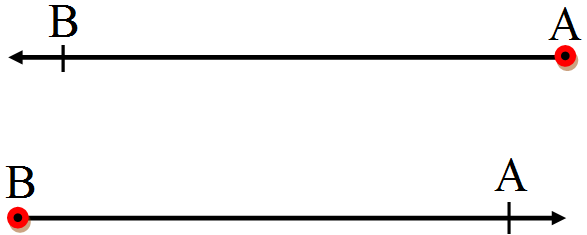
Consider option (c).
A ray is a line segment that extends indefinitely in one direction as shown below.
$\text{Ray }\overrightarrow{\text{AB}}=\text{ray}\ \overrightarrow{\text{BA}}$ is a false statement since clearly the lines extend indefinitely.

As shown in the above diagram, a ray has only one end-point. So, option (d) is true.
Hence, the only false statement is option (c).
View full question & answer
Question 101 Mark
Boundaries of solids are:
  1. Lines.
  2. Curves.
  3. Surfaces.
  4. None of these.
Answer
  1. Surfaces.
Solution:
Boundaries of solids are surfaces.
View full question & answer
Question 111 Mark
The number of planes passing through 3 non-collinear points is:
  1. 4
  2. 3
  3. 2
  4. 1
Answer
  1. 1
Solution:
The number of planes passing through three non-collinear points is 1.
View full question & answer
Question 121 Mark
A point C is called the mid-point of a line segment $\overrightarrow{\text{AB}}$ if.
  1. C is an interior point of AB.
  2. AC = CB.
  3. C is an interior point of AB such that $\overrightarrow{\text{AC}}=\overrightarrow{\text{CB}}.$
  4. AC + CB = AB. 
Answer
  1. C is an interior point of AB such that $\overrightarrow{\text{AC}}=\overrightarrow{\text{CB}}.$
Solution:
A point C is called the midpoint of a line segment $\overline{\text{AB}},$ if C is an interior point of AB such that  $\overline{\text{AC}}=\overline{\text{CB}}.$
View full question & answer
Question 131 Mark
Axioms are assumed:
  1. Definitions.
  2. Theorems.
  3. Universal truths specific to geometry.
  4. Universal truths in all branches of mathematics.
Answer
  1. Universal truths in all branches of mathematics.
Solution:
Axioms are assumed as universal truths in all branches of mathematics because they are taken for granted, without proof.
View full question & answer
Question 141 Mark
In Indus Valley Civilisation (about BC 3000), the bricks used for construction work were having dimensions in the ratio of:
  1. 5 : 3 : 2
  2. 4 : 2 : 1
  3. 4 : 3 : 2
  4. 6 : 4 : 2
Answer
  1. 4 : 2 : 1
Solution:
In Indus Valley Civilization (about 300 BC) the bricks used for construction work were having dimensions in the ratio is 4 : 2 : 1.
View full question & answer
Question 151 Mark
Into how many chapters was the famous treatise, 'The Elements' divided by Euclid?
  1. 13
  2. 12
  3. 11
  4. 9
Answer
  1. 13
Solution:
The famous treatise 'The Elements' was divided into 13 chapters by Euclid.
View full question & answer
Question 161 Mark
Boundaries of surfaces are:
  1. Lines.
  2. Curves.
  3. Polygons.
  4. None of these.
Answer
  1. Curves.
Solution:
Boundaries of surfaces are curves.
View full question & answer
Question 171 Mark
A is of the same age as B and C is of the same age as B. Euclid's which axiom illustrates the relative ages of A and C?
  1. Frist axiom.
  2. Second exiom.
  3. Third axiom.
  4. Fourth axiom.
Answer
  1. Frist axiom.
Solution:
Euclid's first axiom states that 'Things which are equal to the same thing are equal to one another'.
That is,
A's age = B's age and C's age = B' age
⇒ A's age = C's age 
View full question & answer
Question 191 Mark
Euclid belongs to the country:
  1. India.
  2. Greece.
  3. Japan.
  4. Egypt.
Answer
  1. Greece.
Solution:
Euclid belongs to the country, Greece.
View full question & answer
Question 211 Mark
Pythagoras was a student of:
  1. Euclid.
  2. Thales.
  3. Archimedes.
  4. Bhaskara.
Answer
  1. Thales.
Solution:
Pythagoras was a student of Thales.
View full question & answer
Question 221 Mark
How many dimensions does a point have:
  1. 0
  2. 1
  3. 2
  4. 3
Answer
  1. 0
Solution:
A point is an exact location. A fine dot represents a point. So, a point has 0 dimensions.
View full question & answer
Question 231 Mark
Thales belongs to the country:
  1. India.
  2. Egypt.
  3. Greece.
  4. Babylonia.
Answer
  1. Greece.
Solution:
Thales belongs to the country, Greece.
View full question & answer
Question 241 Mark
The number of interwoven isosceles triangles in a Sriyantra is:
  1. Five.
  2. Seven.
  3. Nine.
  4. Eleven.
Answer
  1. Nine.
Solution:
The Sriyantra consists of nine interwoven isosceles triangles.
View full question & answer
Question 251 Mark
In ancient India, altars with combination of shapes like rectangles, triangles and trapeziums were used for:
  1. Household rituals.
  2. Public rituals.
  3. Both (a) and (b).
  4. None of (a), (b) and (c).
Answer
  1. Public rituals.
Solution:
In ancient India, altars with combination of shapes like rectangles, triangles and trapeziums were used for public rituals.
View full question & answer
Question 261 Mark
Euclid's which axiom illustrates the statement that when x + y = 15 then x + y + 2 = 15 + z?
  1. Frist.
  2. Second.
  3. Third.
  4. Fourth.
Answer
  1. Second.
Solution:
Euclid's second axiom states that 'If equals are added to equals, the wholes are equal'.
Hence, when x + y = 15, then x + y + z = 15 + z.
View full question & answer
Question 271 Mark
The statement that 'the lines are parallel if they do not intersect' is in the form of:
  1. A definition.
  2. An axiom.
  3. A postulate.
  4. A theorem.
Answer
  1. A definition.
Solution:
Lines are parallel if they do not intersect' is started in the form of a definition.
View full question & answer
M.C.Q - MATHS STD 9 Questions - Vidyadip
