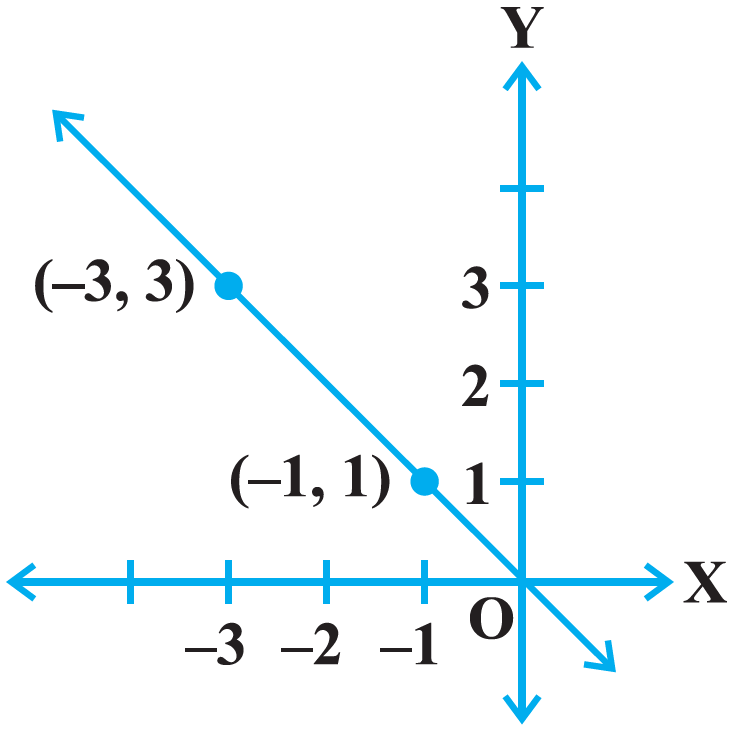
The graph of x = 3 is a line:
Question types
Linear Equations in Two Variables question types
309 questions across 7 question groups — pick any mix to generate a MATHS paper with step-by-step answer keys.
309
Questions
7
Question groups
5
Question types
01
M.C.Q
189 Q→02Assertion (A) & Reason (B) MCQ
69 Q→03True False[1 Marks ]
7 Q→041 Marks Question
26 Q→052 Marks Questions
11 Q→063 Marks Question
2 Q→07Case study (4 Marks)
5 Q→Sample Questions
Linear Equations in Two Variables questions
One sample from each question group in this chapter. Select any group above to see the full set with answer keys.
View full solution →
The graph of the linear equation 2x + 5y = 10 meets the x-axis at the point.
The graph of the linear equation 2x + 3y = 6 is a line which meets the x-axis at the point.
The equation 2x + 5y = 7 has a unique solution, if x and y are:
Any point on the x-axis is of the form:
Directions: In the following questions, the Assertions (A) and Reason(s) (R) have been put forward. Read both the statements carefully and choose the correct alternative from the following:
Assertion: The graph of y = 4x is line passing through the origin.
Reason: The pair of equations x = 0 and x = 5 has two solutions.
Assertion: The graph of y = 4x is line passing through the origin.
Reason: The pair of equations x = 0 and x = 5 has two solutions.
- Both Assertion and Reason are correct and Reason is the correct explanation for Assertion.
- Both Assertion and Reason are correct and Reason is not the correct explanation for Assertion.
- Assertion is true but the reason is false.
- Both assertion and reason are false.
Directions: In the following questions, the Assertions (A) and Reason(s) (R) have been put forward. Read both the statements carefully and choose the correct alternative from the following:
Assertion: Just as numbers, variables can, also, be transposed from one side of the equation to the other.
Reason: 3(t - 3) = 5(2t + 1) is + 1.
Assertion: Just as numbers, variables can, also, be transposed from one side of the equation to the other.
Reason: 3(t - 3) = 5(2t + 1) is + 1.
- Both Assertion and Reason are correct and Reason is the correct explanation for Assertion.
- Both Assertion and Reason are correct and Reason is not the correct explanation for Assertion.
- Assertion is true but the reason is false.
- Both assertion and reason are false.
Directions: In the following questions, the Assertions (A) and Reason(s) (R) have been put forward. Read both the statements carefully and choose the correct alternative from the following:
Assertion: x = 3 and y = -2 is a solution of the equation 4px – 3y = 12, then the value of p is $\frac{1}{2}$.
Reason: Graph of linear equation ax + by + c = 0, a × 0, 6 × 0 cuts x - axis and y - axis respectively at the points (x, 0), (y, 0)
View full solution →Assertion: x = 3 and y = -2 is a solution of the equation 4px – 3y = 12, then the value of p is $\frac{1}{2}$.
Reason: Graph of linear equation ax + by + c = 0, a × 0, 6 × 0 cuts x - axis and y - axis respectively at the points (x, 0), (y, 0)
- Both Assertion and Reason are correct and Reason is the correct explanation for Assertion.
- Both Assertion and Reason are correct and Reason is not the correct explanation for Assertion.
- Assertion is true but the reason is false.
- Both assertion and reason are false.
Directions: In the following questions, the Assertions (A) and Reason(s) (R) have been put forward. Read both the statements carefully and choose the correct alternative from the following:
Assertion: Any point on the x - axis is of the form (x, 0).
Reason: Any point on the x - axis is of the form (x, 0). On the x - axis, x can take any values, whereas y should be equal to 0.
Assertion: Any point on the x - axis is of the form (x, 0).
Reason: Any point on the x - axis is of the form (x, 0). On the x - axis, x can take any values, whereas y should be equal to 0.
- Both Assertion and Reason are correct and Reason is the correct explanation for Assertion.
- Both Assertion and Reason are correct and Reason is not the correct explanation for Assertion.
- Assertion is true but the reason is false.
- Both assertion and reason are false.
Directions: In the following questions, the Assertions (A) and Reason(s) (R) have been put forward. Read both the statements carefully and choose the correct alternative from the following:
Assertion: The graph of the linear equations 3x + 2y = 12 and 5x - 2y = 4 gives a pair of intersecting lines.
Reason: The graph of linear equations a1x + b1y + c1 = 0 and a2x + b2y + c2 = 0 gives a pair of intersecting lines if $\frac{\text{a}1}{\text{a}2}\neq\frac{\text{b}1}{\text{b}2}$
View full solution →Assertion: The graph of the linear equations 3x + 2y = 12 and 5x - 2y = 4 gives a pair of intersecting lines.
Reason: The graph of linear equations a1x + b1y + c1 = 0 and a2x + b2y + c2 = 0 gives a pair of intersecting lines if $\frac{\text{a}1}{\text{a}2}\neq\frac{\text{b}1}{\text{b}2}$
- Both Assertion and Reason are correct and Reason is the correct explanation for Assertion.
- Both Assertion and Reason are correct and Reason is not the correct explanation for Assertion.
- Assertion is true but the reason is false.
- Both assertion and reason are false.
The graph of the linear equation x + 2y = 7 passes through the point (0, 7).
The graph of every linear equation in two variables need not be a line.
The point (0, 3) lies on the graph of the linear equation 3x + 4y = 12.
The boundaries of the solids are curves.
Find the value of k, if x = 2, y = 1 is a solution of the equation 2x + 3y =k.
Find whether (1, 1) is the solution of the equation x – 2y = 4 or not.
Find whether(4, 0) is the solution of the equation x – 2y = 4 or not?
Find whether (2, 0) is the solution of the equation x – 2y = 4 or not?
Which one of the options is true, and why? y = 3x + 5 has
Find whether $(\sqrt{2},4\sqrt{2})$ is the solution of the equation x – 2y = 4 or not?
View full solution →Find whether (0, 2)is the solution of the equation x – 2y = 4 or not?
Write four solutions of the equation: x = 4y.
Write four solutions of the equation: $\pi$x + y = 9
View full solution →Write four solutions of the equation: 2x + y = 7
You know that the force applied on a body is directly proportional to the acceleration produced in the body. Write an equation to express this situation and plot the graph of the equation.
Draw the graph of x + y = 7
1. A soap manufacturer makes fragrant and non-fragrant liquid soaps. The liquid soaps are illed in plastic bottles and packed in equal size cartons for transportation. Each carton contains 50 bottles. The mass of a full bottle of soap is 220 gm and that of a half-illed bottle is 120 gm. What will be the mass (gm) of the empty bottle?
A. 10
B. 20
C. 100
D. 110
A. 10
B. 20
C. 100
D. 110
4. The soap bottles are available in small and large sizes.
A carton with 10 small and 40 large bottles weighs 10.8 kg. What is the mass of the carton with 50 large bottles?
A carton with 10 small and 40 large bottles weighs 10.8 kg. What is the mass of the carton with 50 large bottles?
3. A carton is checked randomly. Which of the following cannot be the number of fragrant and nonfragrant liquid bottles in the carton?
A. (5, 45)
B. (15, 35)
C. (20, 30)
D. (30, 40)
A. (5, 45)
B. (15, 35)
C. (20, 30)
D. (30, 40)
2. A carton contains both fragrant and non-fragrant liquid soap bottles.
Write an equation representing the number of fragrant and non-fragrant bottles in the carton.
Write an equation representing the number of fragrant and non-fragrant bottles in the carton.
Sodium silicate is one of the constituents in liquid soap. The graph shows the amount of sodium
silicate in liquid soap.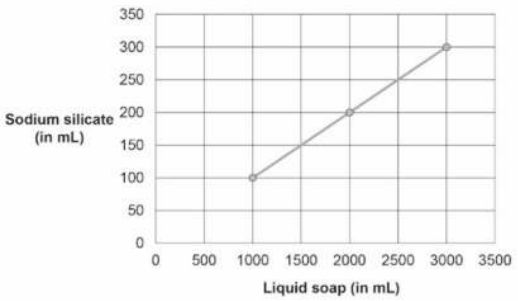
$5$. How much sodium silicate $(ml)$ is used for making $10\ L$ of soap?
$6$. Write an equation to show the relation between quantities of sodium silicate and liquid soap.
silicate in liquid soap.
$5$. How much sodium silicate $(ml)$ is used for making $10\ L$ of soap?
$6$. Write an equation to show the relation between quantities of sodium silicate and liquid soap.
- A$100$
- B$110$
- ✓$1000$
- D$10000$
Answer: C.
View full solution →Generate a Linear Equations in Two Variables paper free
Pick question groups from the list above, set marks and difficulty, and export a branded PDF with step-by-step answer keys. First 3 chapters free — no signup.