Questions

M.C.Q

🎯

Test yourself on this topic

24 questions · timed · auto-graded

Question 11 Mark
The equation 2x + 5y = 7 has a unique solution, if x and y are:
  1. Natural numbers.
  2. Rational numbers.
  3. Positive real numbers.
  4. Real numbers.
Answer
  1. Natural numbers.
Solution:
The equation 2x + 5y = 7 has a unique solution, if x and y are natural numbers.
If we take x = 1 and y = 1, the given equation is satisfied. 
View full question & answer
Question 21 Mark
The linear equation 3x - 5y = 15 has:
  1. A unique solution.
  2. Two solutions.
  3. Infinitely many solutions.
  4. No solution.
Answer
  1. Infinitely many solutions.
Solution:
The linear equation 3x - 5y = 15 has infinitely many solutions since any every point on this line will be a solution of this equation.
For different values of x, we will get get the corresponding different values of y.
Since x can take infinitely many values, y will also have infinite values.
Hence, the line will have infinitely many solutions.
View full question & answer
Question 31 Mark
Any point on the x-axis is of the form:
  1. (x, y)
  2. (0, y)
  3. (x, 0)
  4. (x, x)
Answer
  1. (x, 0)
Solution:
Any point on x-axis is of the form (x, 0), where $\text{x}\neq0,$
Since its y-coordinate will be 0 always.
View full question & answer
Question 41 Mark
The point of the form $(\text{a},-\text{a}),\ \text{a}\neq0$ lies on:
  1. The x-axis
  2. The y-axis
  3. The line y = x
  4. The line x + y = 0
Answer
  1. The line x + y = 0
Solution:
A point which lies on the x-axis has its y-coordinate = 0
While a point which lies on the y-axis has its x-coordinate = 0.
So, the points of the form (a, -a) will not lie on either axes.
Also, it does not satisfy the equation on of the line y = x.
The point of the form (a, -a) lies on the line x + y = 0 since it satisifes the equation of the given line.
View full question & answer
Question 51 Mark
The graph of the linear equation 2x + 3y = 6 meets the y-axis at the point:
  1. (2, 0)
  2. (3, 0)
  3. (0, 2)
  4. (0, 3)
Answer
  1. (0, 2)
Solution:
When a graph meets the y-axis, the x coordinate is zero.
Thus, substituting x = 0 in the given equation,
We get:
2(0) + 3y = 6
⇒ 3y = 6
⇒ y = 2
Hence, the required point is (0, 2).
View full question & answer
Question 61 Mark
The graph of y + 2 = 0 is a line:
  1. Making an intercept -2 on the x-axis.
  2. Making an intercept -2 on the y-axis.
  3. Parallel to the x-axis at a distance of 2 units below the x-axis.
  4. Parallel to the y-axis at a distance of 2 units to the left of y-axis.
Answer
  1. Parallel to the x-axis at a distance of 2 units below the x-axis.
Solution:
The graph of y + 2 = 0 is a line parallel to the x-axis at a distance of 2 units below the x-axis.
View full question & answer
Question 71 Mark
The equation of the x-axis is:
  1. x = 0
  2. y = 0
  3. x = y
  4. x + y = 0
Answer
  1. y = 0
Solution:
The equation of the x-axis is y = 0.
View full question & answer
Question 81 Mark
The graph of the linear equation 2x + 5y = 10 meets the x-axis at the point:
  1. (0, 2)
  2. (2, 0)
  3. (5, 0)
  4. (0, 5)
Answer
  1. (5, 0)
Solution:
When a graph meets the x-axis, the y coordinate is zero.
Thus, substituting y = 0 in the given equation,
We get:
2x + 5(0) = 10
⇒ 2x = 10
⇒ x = 5
Hence, the required point is (5, 0).
View full question & answer
Question 91 Mark
The graph of x = 4 is a line:
  1. Making an intercept 4 on the x-axis.
  2. Making an intercept 4 on the y-axis.
  3. Parallel to the x-axis at a distance of 4 units from the origin.
  4. Parallel to the y-axis at a distance of 4 units from the origin.
Answer
  1. Parallel to the y-axis at a distance of 4 units from the origin.
Solution:
The graph of x = 4 is a line parallel to the y-axis at a distance of 4 units from the origin.
View full question & answer
Question 101 Mark
If (2, 0) is a solution of the linear equation 2x + 3y = k then the value of k is:
  1. 6
  2. 5
  3. 2
  4. 4
Answer
  1. 4
Solution:
Since, (2, 0) is a solution of the linear equation 2x + 3y = k, substituting x = 2 and y = 0 in the given equation,
We have:
2(2) + 3(0) = k
⇒ 4 + 0 = k
⇒ k = 4
View full question & answer
Question 111 Mark
The equation of the y-axis is:
  1. x = 0
  2. y = 0
  3. x = y
  4. x + y = 0
Answer
  1. y = 0
Solution:
The equation of the y-axis is x = 0.
View full question & answer
Question 121 Mark
The graph of y = 5 is a line:
  1. Making an intercept 5 on the x-axis.
  2. Making an intercept 5 on the y-axis.
  3. Parallel to the x-axis at a distance of 5 units from the origin.
  4. Parallel to the y-axis at a distance of 5 units from the origin.
Answer
  1. Parallel to the x-axis at a distance of 5 units from the origin.
Solution:
The graph of y = 5 is a line parallel to the x-axis at a distance of 5 units from the origin.
View full question & answer
Question 131 Mark
x = 5, y = 2 is a solution of the linear equation:
  1. x + 2y = 7
  2. 5x + 2y = 7
  3. x + y = 7
  4. 5x + y = 7
Answer
  1. x + y = 7
Solution:
Substituting x = 5 and y = 2 in L.H.S. of equation x + y = 7,
We get:
LHS
= 5 + 2
7 = RHS
Hence, x = 5 and y = 2 is a solution of the linear equation x + y = 7.
View full question & answer
Question 141 Mark
The graph of x + 3 = 0 is a line:
  1. Making an intercept -3 on the x-axis.
  2. Making an intercept -3 on the y-axis.
  3. Parallel to the y-axis at a distance of 3 units to the left of y-axis.
  4. Parallel to the x-axis at a distance of 3 units below the x-axis.
Answer
  1. Parallel to the y-axis at a distance of 3 units to the left of y-axis.
Solution:
The graph of x + 3 = 0 is a line parallel to the y-axis at a distance of 3 units to the left of y-axis.
View full question & answer
Question 151 Mark
The graph of the line y = 3 passes through the point:
  1. (3, 0)
  2. (3, 2)
  3. (2, 3)
  4. None of these.
Answer
  1. (2, 3)
Solution:
Since, the y coordinate is 3, the graph of the line y = 3 passes through the point (2, 3).
View full question & answer
Question 161 Mark
How many linear equation can be satisfied by x = 2 and y = 3?
  1. Only one.
  2. Only two.
  3. Only three.
  4. Infinitely many.
Answer
  1. Infinitely many.
Solution:
Infinitely many linear equations can be satisfied by x = 2 and y = 3.
View full question & answer
Question 171 Mark
Any point on the y-axis is of the form:
  1. (x, y)
  2. (0, y)
  3. (x, 0)
  4. (y, y)
Answer
  1. (0, y)
Solution:
Any point on y-axis is of the form (0, y), where $\text{y}\neq0,$
Since its x-coordinate will always be 0.
View full question & answer
Question 181 Mark
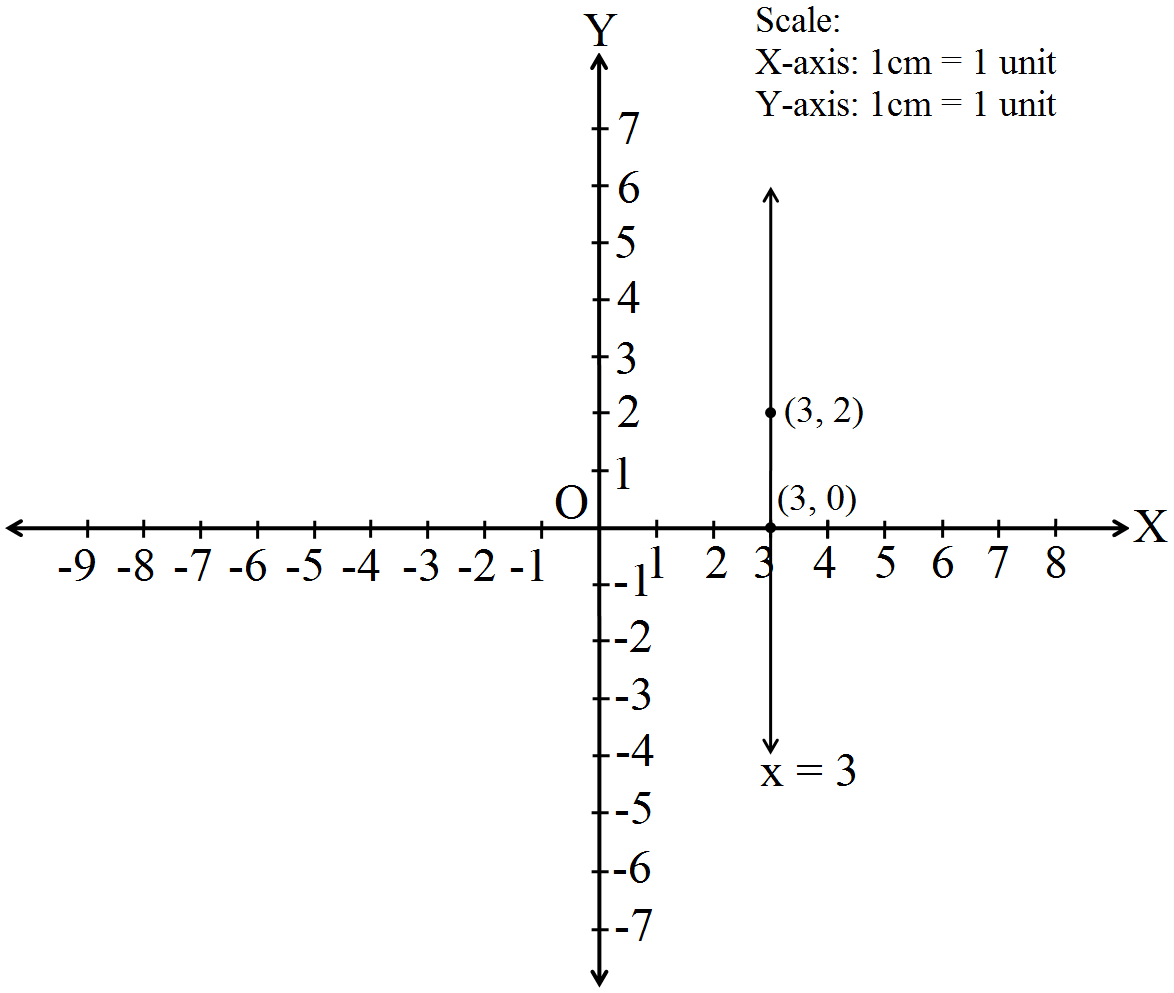
The graph of the line x = 3 passes through the point:
  1. (0, 3)
  2. (2, 3)
  3. (3, 2)
  4. None of these
Answer
  1. (3, 2)
Solution:
The line x = 3 passes through the point (3, 2).
View full question & answer
Question 191 Mark
A linear equation in two variables x and y is of the form ax = by + c = 0, where:
  1. $\text{a}\neq0,\ \text{b}\neq0$
  2. $\text{a}\neq0,\ \text{b}=0$
  3. $\text{a}=0,\ \text{b}\neq0$
  4. $\text{a}=0,\ \text{c}=0$
Answer
  1. $\text{a}\neq0,\ \text{b}\neq0$
Solution:
A linear equation in tow variables x and y is of the form ax + by + c = 0, where $\text{a}\neq0$ and $\text{b}\neq0,$ since if either a or be is 0, the degree of the equation would be but it would not be a linear equation in tow variables.
If both a and b are 0, then the equation is not linear.
View full question & answer
Question 201 Mark
If the point (3, 4) lies on the graph of 3y = ax + 7 then the value of a is:
  1. $\frac{2}{5}$
  2. $\frac{5}{3}$
  3. $\frac{3}{5}$
  4. $\frac{2}{7}$
Answer
  1. $\frac{5}{3}$
Solution:
Since the point (3, 4) lies on the graph of 3y = ax + 7,
substituting x = 3 and y = 4 in the given equation,
We get:
3(4) = a(3) + 7
⇒ 12 = 3a + 7
⇒ 3a = 5
$\Rightarrow\text{a}=\frac{5}{3}$
View full question & answer
Question 211 Mark
The point of the form $(\text{a},\ \text{a}),\ \text{a}\neq0$ lies on:
  1. The x-axis
  2. The y-axis
  3. The line y = x
  4. The line x + y = 0
Answer
  1. The line y = x
Solution:
Given, a point of the form (a, a), where $\text{a}\neq0$
When a = 1, the point is (1, 1)
When a = 2, the point is (2, 2) ... and so on.
Plot the points (1, 1) and (2, 2) ... and so on.
Join the points and extend them in both the direction.
You will get equation of the line y = x.
View full question & answer
Question 221 Mark
The graph of the line x - y = 0 passes through the point:
  1. $\Big(\frac{-1}{2},\frac{1}{2}\Big)$
  2. $\Big(\frac{3}{2},\frac{-3}{2}\Big)$
  3. $(0,-1)$
  4. $(1, 1)$
Answer
  1. $(1, 1)$
Solution:
The given linear equation is x = y = 0.
We have to check which of the point satisfy the given equation.
consider option (a):
Substituting $\text{x}=-\frac{1}{2}$ and $\text{y}=\frac{1}{2}$ in the LHS if the given linear equation
$\therefore\ \text{x}-\text{y}=-\frac{1}{2}-\frac{1}{2}=-1\neq\text{RHS}$
$\therefore\ \text{x}=-\frac{1}{2}$ and $\text{y}=\frac{1}{2}$ does not satisfy the given linear equation.
Consider option (b):
Substituting $\text{a}=\frac{3}{2}$ and $\text{y}=-\frac{3}{2}$ in the LHS if the given linear equation on
$\therefore\ \text{x}-\text{y}=\frac{3}{2}+\frac{3}{2}=3\neq\text{RHS}$
$\therefore\ \text{x}=-\frac{3}{2}$ and $\text{y}=-\frac{3}{2}$ does not satisfy the given linear eqation on.
Consider option (d):
Substitution x = 1 and y = 1 in the LHS if the given linear equation
$\therefore\ $x - y = 1 - 1 = 0 = RHS
$\therefore\ $x = 1 and y = 1 satisfies the given linear equation.
View full question & answer
Question 231 Mark
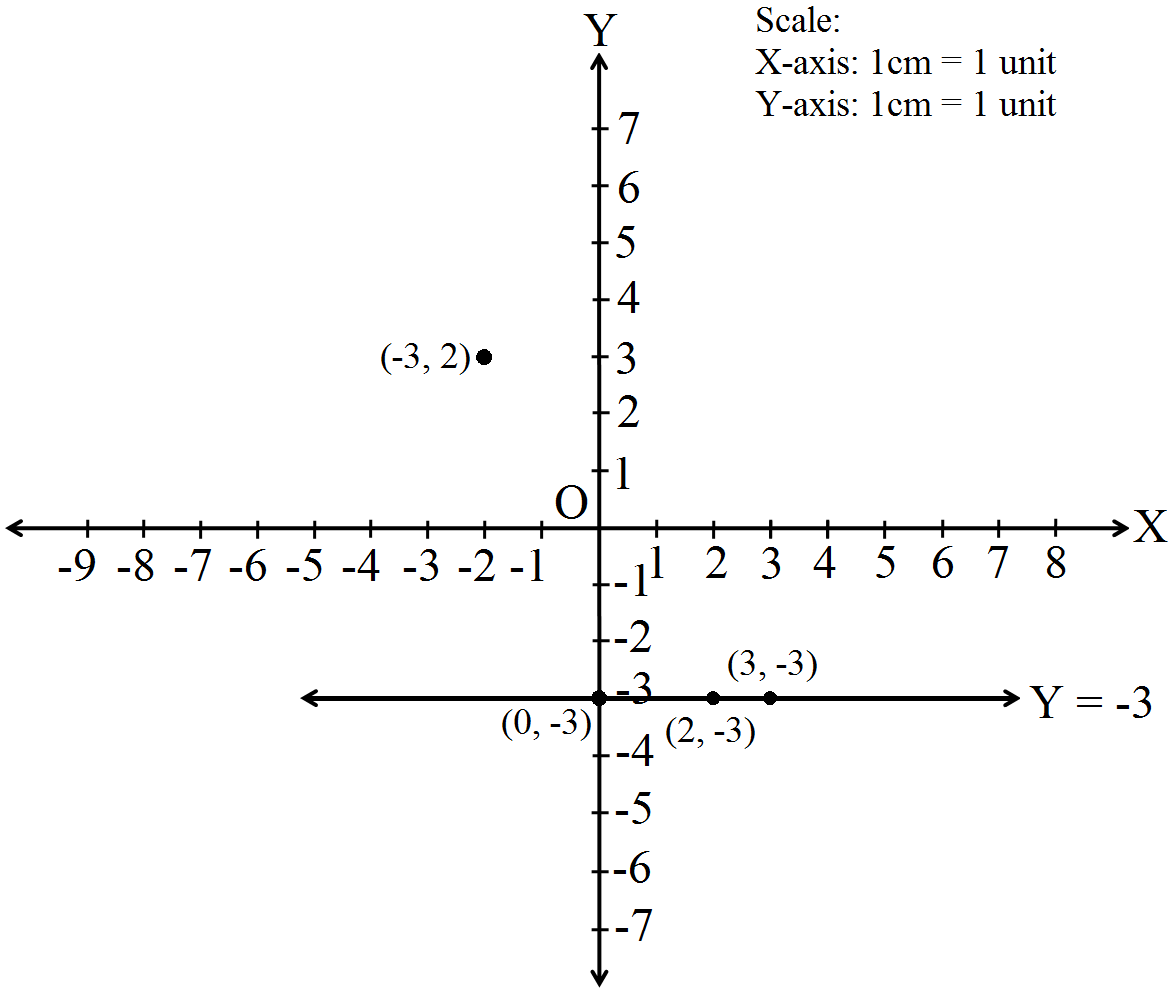
The graph of the line y = -3 does not pass through the point:
  1. (2, -3)
  2. (3, -3)
  3. (0, -3)
  4. (-3, 2)
Answer
  1. (-3, 2)
Solution:
The line y = -3 does not pass through the point (-3, 2) since $\text{y}\neq2.$
View full question & answer
Question 241 Mark
Each of the points (-2, 2), (0, 0), (2, 2) satisfies the linear equation:
  1. x - y = 0
  2. x + y = 0
  3. -x + 2y = 0
  4. x - 2y = 0
Answer
  1. x + y = 0
Solution:
Since given that each of the three points is a solution of the linear equation, all three points have to satisfy the linear equation.
We need to check for each of the four given equations.
Substituting x = -2 and y = 2 in option (b),
We get:
LHS
= x + y
= -2 + 2
0 = RHS
$\therefore\ $x = -2 and y = 2
Satisfy the given linear equation.
Substituting x = 0 and y = 0 in option (b),
We get:
LHS
= x + y
= 0 + 0
0 = RHS
$\therefore\ $x = 0 and y = 0
Satisfy the given linear equation.
Substituting x = -2 and y = 2 in option (b),
We get:
LHS
= x + y
= 2 - 2
0 = RHS
$\therefore\ $x = 2 and y = -2
Satisfy the given linear equation.
So, clearly all the three points satisfy the equation
x + y = 0.
View full question & answer
M.C.Q - MATHS STD 9 Questions - Vidyadip