Questions

3 Marks Question

🎯

Test yourself on this topic

5 questions · timed · auto-graded

Question 13 Marks
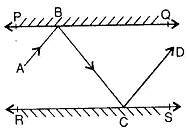
In figure, PQ and RS are two mirrors placed parallel to each other. An incident ray AB strikes the mirror PQ at B. The reflected ray moves along the path BC and strikes the mirror RS at C and again reflects back along CD. Prove that AB || CD.
Answer
Draw ray BL $\perp$ PQ and ray CM $\perp$ RS.
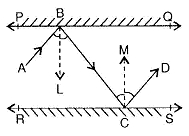
BL $\perp$ PQ, CM $\perp$ RS and PQ $\parallel$ RS
BL || CM
$\angle$LBC = $\angle$MCB . . . (1)
$\angle$ABL = $\angle$LBC . . . [Angle of incident = Angle of reflection] . . . .(2)
$\angle$MCB = $\angle$MCD . . . [Angle of incident = Angle of reflection] . . . . (3)
$\angle$ABL = $\angle$MCD . . . [From (1), (2) and (3)]
$\angle$LBC + $\angle$ABL = $\angle$MCB + $\angle$MCD . . . [Adding (1) and (4)]
$\angle$ABC = $\angle$BCD are alternate interior angles and are equal.
$\therefore$ AB || CD
View full question & answer
Question 23 Marks
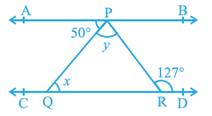
In the given figure, if AB || CD, ​​​​​​$\angle$ APQ = 50° and $\angle$PRD = 127°, find x and y.

Answer
We are given that $AB\parallel CD,\angle APQ = {50^\circ }$ and $\angle$PRD = 127°
We need to find the value of x and y in the figure.
$\angle$APQ = x = 50° (Alternate interior angles)
$\angle$PRD = $\angle$APR = 127° (Alternate interior angles)
$\angle$APR = $\angle$QPR + $\angle$APQ.
127° = y + 50°
$\Rightarrow$ y = 77°.
Therefore, we can conclude that x = 55° and y = 77°
Alternatively, 127° = y + x (because exterior angle is equal to the sum of interior opposite angles).
so, ​​​​​​127° = y + 50°
which gives, x = 50° and y = 77°
View full question & answer
Question 33 Marks
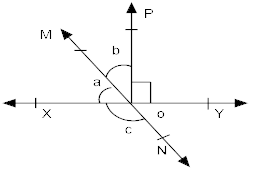
In fig lines XY and MN intersect at O If $\angle $POY = 90° and a:b = 2:3 find $\angle $c.

Answer
Lines XY and MN intersect at O.
$\therefore \angle C = \angle XON = \angle MOY$ [vertically opposite angle]
$= \angle b + \angle POY$
But, $\angle$POY = 90°
$\therefore $ $\angle$C = $\angle$b + 90° ...(i)
Also,
$\angle$POX = 180° - $\angle$POY
= 180° - 90°
= 90°
$\therefore$ a + b = 90°
But,
a:b = 2:3 [Given]
$a = \frac{2}{5} \times {90^0}$
= 36° ...(ii)
Thus, From (i) and (ii) we get
b = 90° - 36° = 54°
$\angle$C = 54° + 90° ( From (1) )
= 144°
View full question & answer
Question 43 Marks
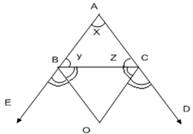
In fig the side AB and AC of $\vartriangle $ ABC are produced to point E And D respectively. If bisector BO and CO of $\angle $CBE And $\angle $BCD respectively meet at point O, then prove that $\angle $ BOC =${90^ \circ } - \frac{1}{2}\angle $ BAC

Answer
Ray BO bisects $\angle$CBE
${\text{ }}\therefore {\text{ }}\angle {\text{CBO = }}\frac{1}{2}{\text{ }}\angle {\text{CBE}}$
${\text{ = }}\frac{1}{2}\left( {{{180}^ \circ } - y} \right)$ ${\text{ }}\left( {\because {\text{ }}\angle {\text{CBE + y = 18}}{{\text{0}}^ \circ }}\therefore \angle CBE = 180^\circ - y \right)$
${\text{ = }}{90^ \circ } - {\text{ }}\frac{y}{2}{\text{ }}$...(i)
Similarly, ray CO bisects $\angle BCD$
$\angle {\text{BCO = }}\frac{1}{2}\angle BCD$
${\text{ = }}\frac{1}{2}\left( {{{180}^ \circ } - z} \right)$
${\text{ = }}{90^ \circ } - \frac{Z}{2}$...(ii)
$In{\text{ }}\vartriangle {\text{ BOC }}$In $\triangle$BOC
$\angle {\text{BOC + }}\angle {\text{BCO + }}\angle {\text{CBO = 18}}{{\text{0}}^ \circ }$
$\angle {\text{BOC = }}\frac{1}{2}\left( {y + z} \right)$
But x + y + z = 180°
y + z = 180°-x
$\angle {\text{BOC = }}\frac{1}{2}\left( {{{180}^ \circ } - x} \right) = {90^ \circ } - \frac{x}{2}$
$\angle {\text{BOC = }}{90^ \circ } - \frac{1}{2}{\text{ }}\angle {\text{BAC}}$
View full question & answer
Question 53 Marks
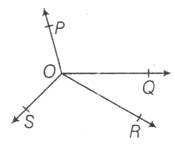
In the given figure, $OP, OQ, OR$ and $OS$ are four rays. Prove that
$\angle POQ + \angle ROQ + \angle SOR + \angle POS = 360^\circ .$
Answer
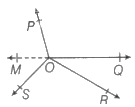
Let us produce a ray $OQ$ backwards to a point $M,$ then $MOQ$ is a straight line.
Now, $OP$ is a ray on the line $MOQ.$ Then, by linear pair axiom, we have
$\angle MOP +  \angle POQ = 180^o ......(i)$

Similarly, $OS$ is a ray on the line $MOQ.$ Then, by linear pair axiom, we have
$\angle MOS +  \angle SOQ = 180^\circ ....(ii)$
Also, $\angle SOR$ and $\angle ROQ$ are adjacent angles.
$\therefore \angle SOQ = \angle SOR + \angle ROQ ...(iii)$
On putting the value of $\angle SOQ$ from Eq.$(iii)$ in Eq.$(ii)$, we get
$\angle MOS + \angle SOR + \angle ROQ = 180^o ....(iv)$
Now, on adding Eqs.$(i)$ and $(iv)$, we get
$\angle MOP + \angle POQ + \angle MOS + \angle SOR + \angle ROQ = 180^o + 180^o$
$\Rightarrow \angle MOP + \angle MOS + \angle POQ + \angle SOR + \angle ROQ = 360^o ....(iv)$
But $\angle MOP + \angle MOS = \angle POS$
Then, from Eq.$(v),$ we get
$\angle POS + \angle POQ + \angle SOR + \angle ROQ = 360^o$
Hence proved.
View full question & answer
3 Marks Question - MATHS STD 9 Questions - Vidyadip