Questions

M.C.Q

🎯

Test yourself on this topic

26 questions · timed · auto-graded

Question 11 Mark
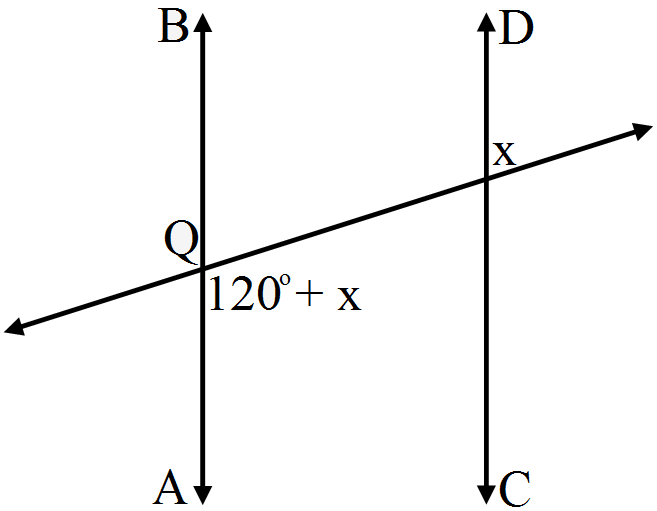
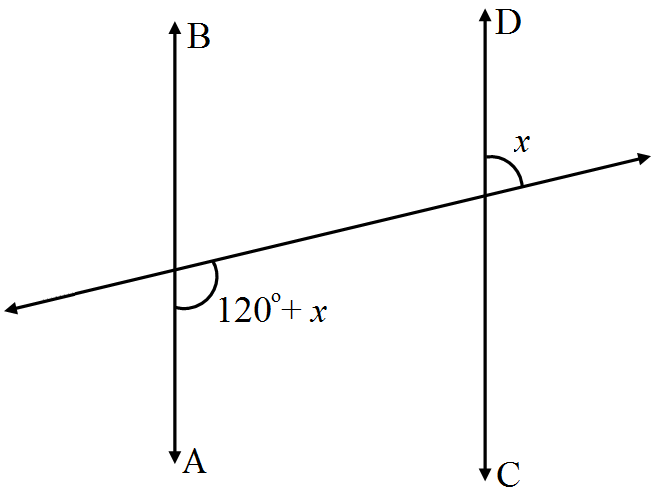
In figure, if AB || CD, then the value of x is:
  1. 20°
  2. 30°
  3. 45°
  4. 60°
Answer
  1. 30°
Solution:

From figure,
$\angle\text{DPQ}+\angle\text{x}^\circ=180^\circ\dots(1)$ [linear pair]
Also,
$\angle\text{DPQ}=\angle\text{AQP}$ [Interior opposite angles] 
$\Rightarrow\ \angle\text{DPQ}=120^\circ+\text{x}$
From (1),
$120^\circ+\text{x}+\text{x}=180^\circ$
$\Rightarrow\ 2\text{x}=60^\circ$
$\Rightarrow\text{x}=30^\circ$
View full question & answer
Question 21 Mark
In figure, which of the following statement must be true? (i) a + b = d + c (ii) a + c + e = 180° (iii) b + f = c + e
  1. (i) only
  2. (ii) only
  3. (iii) only
  4. (ii) and (iii) only
Answer
  1. (ii) and (iii) only
Solution:

From figure, we can see that
$\angle\text{a}^\circ+\angle\text{b}^\circ+\angle\text{c}^\circ=\angle\text{FOC}=180^\circ$
Also,
$\angle\text{b}^\circ=\angle\text{e}^\circ$ [Opposite angles]
So,
$\angle\text{a}^\circ+\angle\text{e}^\circ+\angle\text{c}^\circ=180^\circ$
⇒ (ii) is correct
Now,
$\angle\text{FOB}\neq\angle\text{DOB}$
$\Rightarrow\ \angle\text{a}^\circ+\angle\text{b}^\circ\neq\angle\text{d}^\circ+\angle\text{c}^\circ$
⇒ (i) is correct
Now,
$\angle\text{b}^\circ=\angle\text{e}^\circ$ and $\angle\text{f}^\circ=\angle\text{c}^\circ$ [Opposite angles are equal]
Thus,
$\angle\text{b}^\circ=\angle\text{f}^\circ=\angle\text{e}^\circ+\angle\text{c}^\circ$
⇒ (iii) is correct.
View full question & answer
Question 31 Mark
Two straight lines AB and CD cut each other at O. If $\angle\text{BOD}=63^\circ,$ then $\angle\text{BOC}=$
  1. 63°
  2. 117°
  3. 17°
  4. 153°
Answer
  1. 117°
Solution:

$\angle\text{BOD}$ and $\angle\text{BOC}$ from a linear pair.
$\therefore\ \angle\text{BOD}+\angle\text{BOC}=180^\circ$
$\Rightarrow\ 63^\circ+\angle\text{BOC}=180^\circ$
$\Rightarrow\ \angle\text{BOC}=117^\circ$
View full question & answer
Question 41 Mark
In figure, if line segment AB is parallel to the line segment CD, what is the value of y?
  1. 12
  2. 15
  3. 18
  4. 20
Answer
  1. 20
Solution:

From figure,
$\angle\text{ABD}+\angle\text{EBD}=180^\circ$
$\Rightarrow\ \angle\text{EBD}=180^\circ-\angle\text{ABD}\dots(1)$
Now,
$\angle\text{ABD}=\text{y}^\circ+2\text{y}^\circ+\text{y}^\circ$
$\Rightarrow\ \angle\text{ABD}=4\text{y}^\circ\dots(2)$
Substituting (2) in (1), we have 
$\angle\text{EBD}=180^\circ-4\text{y}^\circ$
Now,
$\angle\text{EBD}=\angle\text{BDC}$ [Alternate angles]
$\Rightarrow\ 180^\circ-4\text{y}^\circ=5\text{y}^\circ$
$\Rightarrow\ 180^\circ=9\text{y}^\circ$
$\Rightarrow\ \text{y}^\circ=20^\circ$
View full question & answer
Question 51 Mark
Given $\angle\text{POR}=3\text{x}$ and $\angle\text{QOR}=2\text{x}+10^\circ.$If POQ is a straight line, then the value of x is:
  1. 30°
  2. 34°
  3. 36°
  4. None of these
     
Answer
  1. 34°
Solution:

$\angle\text{POR}=3\text{x}$ and $\angle\text{QOR}=2\text{x}+10^\circ$
From figure, we can see that $\angle\text{POR}$ and $\angle\text{QOR}$ are two adjacent angles and are supplement.
$\Rightarrow\ \angle\text{POR}+\angle\text{QOR}=180^\circ$
$\Rightarrow\ 3\text{x}+2\text{x}+10^\circ=180^\circ$
$\Rightarrow\ 5\text{x}=170^\circ$
$\Rightarrow\ \text{x}=34^\circ$
View full question & answer
Question 61 Mark
In figure, PQ || RS, $\angle\text{AEF}=95^\circ,\angle\text{BHS}=110^\circ$ and $\angle\text{ABC}=\text{x}^\circ.$ Then the value of x is:
  1. 15°
  2. 25°
  3. 70°
  4. 35°
Answer
  1. 25°
Solution:

From figure,
$\angle\text{AEF}=\angle\text{EGH}$ [Corresponding angles]
$\Rightarrow\ \angle\text{EGH}=\angle\text{AEF}=95^\circ$
Also,
$\angle\text{BGH}+\angle\text{EGH}=180^\circ$
$\Rightarrow\ \angle\text{BGH}=180^\circ-\angle\text{EGH}=180^\circ-95^\circ$
$=85^\circ$
$\angle\text{BHS}=110^\circ$
Now,
$\angle\text{BHG}+\angle\text{BHS}=180^\circ$
$\Rightarrow\ \angle\text{BHG}=180^\circ-\angle\text{BHS}=180^\circ-110^\circ$
$=70^\circ$
Now, in $\triangle\text{BHG}$
$\angle\text{BGH}+\angle\text{BGH}+\text{x}=180^\circ$ [Sum of all angles of a $\triangle$ is 180°]
$\Rightarrow\ 85^\circ+70^\circ+\text{x}^\circ=180^\circ$
$\Rightarrow\ \text{x}^\circ=180^\circ-155^\circ=25^\circ$
View full question & answer
Question 71 Mark
In figure, if $\frac{\text{y}}{\text{x}}=5$ and $\frac{\text{z}}{\text{x}}=4,$ then the value of x is:
  1. 18°
  2. 12°
  3. 15°
Answer
  1. 18°
Solution:

From figure, we can see that
$\angle\text{x}^\circ+\angle\text{y}^\circ+\angle\text{z}^\circ=180^\circ\dots(1)$
Now,
$\frac{\text{y}}{\text{x}}=5\Rightarrow\ \text{y}=5\text{x}$
And,
$\frac{\text{z}}{\text{x}}=4,\text{z}=4\text{x}$
Substituting these value in equation (1), we have
$\angle\text{x}^\circ+\angle5\text{x}^\circ+\angle4\text{x}=180^\circ$
$\Rightarrow\ \angle10\text{x}^\circ=180^\circ$
$\Rightarrow\ \angle\text{x}^\circ=18^\circ$
View full question & answer
Question 81 Mark
In figure, the value of x, is:
  1. 12
  2. 15
  3. 20
  4. 30
Answer
  1. 20
Solution:

From figure, we can see that
$\angle\text{BOD}+\angle\text{AOD}=180^\circ$
 $\angle\text{BOD}=90^\circ$ [Given]
$\Rightarrow\ \angle\text{AOD}=180^\circ-90^\circ=90^\circ$
Now,
$\text{x}^\circ=\angle\text{COE}=\angle\text{FOD}$ [Opposite angles are equal]
Now,
$\angle\text{AOF}+\angle\text{FOD}=90^\circ=\angle\text{AOD}$
$\Rightarrow\ 3\text{x}^\circ+10^\circ+\text{x}^\circ=90^\circ$
$\Rightarrow\ 4\text{x}^\circ=80^\circ$
$\Rightarrow\ \text{x}^\circ=20^\circ$
View full question & answer
Question 91 Mark
In figure, the value of y is:
  1. 20°
  2. 30°
  3. 45°
  4. 60°
Answer
  1. 30°
Solution:

From figure, we can see
$\angle\text{x}^\circ=\angle\text{y}^\circ$ [Vertically opposite angles]
Also,
$\angle\text{3}\text{x}^\circ+\angle\text{y}^\circ+\angle2\text{x}^\circ=180^\circ$
Now,
$\angle\text{x}^\circ=\angle\text{y}^\circ$
$\therefore\ \angle\text{3}\text{y}^\circ+\angle\text{y}^\circ+\angle2\text{y}^\circ=180^\circ$
$\Rightarrow\ \angle6\text{y}^\circ=180^\circ$
$\Rightarrow\ \angle\text{y}^\circ=180^\circ$
View full question & answer
Question 101 Mark
In figure, if lines l and m are parallel lines, then x =
  1. 70°
  2. 100°
  3. 40°
  4. 30°
Answer
  1. 40°
Solution:

From figure,
$\angle\text{ABC}=\angle\text{DCE}\dots(1)$ [Corresponding angles]
$\angle\text{ECF}=180^\circ-\angle\text{DCE}$ [Supplementary]
$=180^\circ-\angle\text{ABC}$ [From (1)]
$=180^\circ-70^\circ$
$\Rightarrow\ \angle\text{ECF}=110^\circ$
Now, in $\triangle\text{CEF}$
$\angle\text{ECF}+\angle\text{CFE}+\angle\text{FEC}=180^\circ$
$\Rightarrow\ 110^\circ+\text{x}+30^\circ=180^\circ$
$\Rightarrow\ \text{x}=40^\circ$
View full question & answer
Question 111 Mark
In figure, if CP || BQ, then the measure of x is:
  1. 130°
  2. 105°
  3. 175°
  4. 125°
Answer
  1. 130°
Solution:

From figure,
$\angle\text{QBA}=\angle\text{CEA}$ [Correspondence angles]
$\Rightarrow\ \angle\text{CEA}=105^\circ\dots(1)$
In $\triangle\text{ACE},$
$\angle\text{CEA}+\angle\text{EAC}+\angle\text{ACE}=180^\circ$
$\Rightarrow\ 105^\circ+25^\circ+\angle\text{ACE}=180^\circ$ [From (1)]
$\Rightarrow\ 130^\circ+\angle\text{ACE}=180^\circ$
$\Rightarrow\ \angle\text{ACE}=50^\circ$
Now,
$\text{x}=\angle\text{ACP}=180^\circ-\angle\text{ACE}$
$=180^\circ-50^\circ=130^\circ$
View full question & answer
Question 121 Mark
AB and CD are two parallel lines. PQ cuts AB and CD at E and F respectively. EL is the bisector of $\angle\text{FEB}.$ If $\angle\text{LEB}=35^\circ,$ then $\angle\text{CFQ}$ will be:
  1. 55°
  2. 70°
  3. 110°
  4. 130°
Answer
  1. 110°
Solution:

From figure,
$\angle\text{LEB}=\angle\text{FEL}$ [EL is bisector of $\angle\text{FEB}$]
Now,
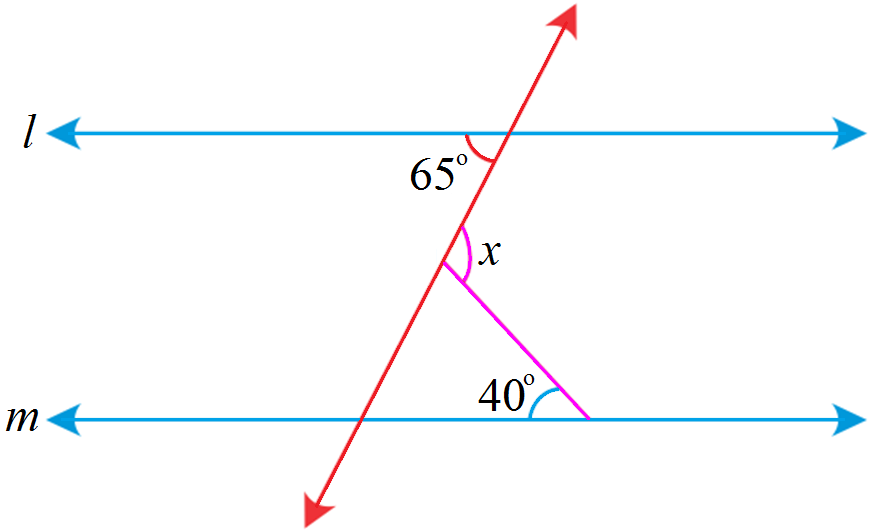
$\angle\text{FEB}=2\angle\text{LEB}=2\times35^\circ=70^\circ$
Also,
$\angle\text{FEB}=\angle\text{CFE}$ [Alternate interior angles]
$\Rightarrow\ \angle\text{CFE}=70^\circ$
Now,
$\angle\text{CFE}+\angle\text{CFQ}=180^\circ$
$\Rightarrow\ 70^\circ+\angle\text{CFQ}=180^\circ$
$\Rightarrow\ \angle\text{CFQ}=180^\circ-70^\circ=110^\circ$
View full question & answer
Question 131 Mark
In figure, if lines l and m are parallel, then x =
  1. 20°
  2. 45°
  3. 65°
  4. 85°
Answer
  1. 45°
Solution:

From figure,
$\angle\text{ABD}=\angle\text{CDF}$ [Correspondence angles]
$\Rightarrow\ \angle\text{CDF}=65^\circ$
Now,
$\angle\text{FDE}=180^\circ-\angle\text{CDF}=180^\circ-65^\circ$
$\Rightarrow\ \angle\text{FDE}=115^\circ$
In $\triangle\text{EDF},$
$\angle\text{FDE}+\angle\text{DEF}+\angle\text{EFD}=180^\circ$
$\Rightarrow\ 115^\circ+\text{x}+20^\circ=180^\circ$ [Sum of all interior angles of a $\triangle$ as 180°]
$\Rightarrow\ \text{x}=180^\circ-20^\circ-115^\circ=45^\circ$
View full question & answer
Question 141 Mark
If two interior angles on the same side of a transversal intersecting two parallel lines are in the ratio 2 : 3, then the measure of the larger angle is:
  1. 54°
  2. 120°
  3. 108°
  4. 136°
Answer
  1. 108°
Solution:

Let AB and CD are two parallel lines and PQ is transverce to it.
According to question,
$\frac{\angle\text{BRS}}{\angle\text{DSR}}=\frac{2}{3}$
$\Rightarrow\ \angle\text{BRS}=\frac{2}{3}\angle\text{DSR}\dots(1)$
Now,
$\angle\text{CSR}=\angle\text{BRS}$ [Alternate angles]
$\Rightarrow\ \angle\text{CSR}+\angle\text{DSR}=180^\circ$
$\Rightarrow\ \angle\text{BRS}+\angle\text{DSR}=180^\circ$
$\Rightarrow\ \frac{2}{3}\angle\text{DSR}+\angle\text{DSR}=180^\circ$
$\Rightarrow\ \angle\text{DSR}=\frac{180\times3}{5}=108^\circ$
$\Rightarrow\ \angle\text{BRS}=\frac{2}{3}\times108^\circ=72^\circ$
Thus,
$\angle\text{DSR}=108^\circ$ and $\angle\text{BRS}=72^\circ$
⇒ Larger angle is $\angle\text{DSR}.$
View full question & answer
Question 151 Mark
In figure, AOB is a straight line. If $\angle\text{AOC}+\angle\text{BOD}=85^\circ,$ then $\angle\text{COD}=$
  1. 85°
  2. 90°
  3. 95°
  4. 100°
Answer
  1. 95°
Solution:

From figure, we can see
$\angle\text{AOC}+\angle\text{COD}+\angle\text{BOD}=180^\circ$
But,
$\angle\text{AOC}+\angle\text{BOD}=85^\circ$ [Given]
$\Rightarrow\ 85^\circ+\angle\text{COD}=180^\circ$
$\Rightarrow\ \angle\text{COD}=95^\circ$
View full question & answer
Question 161 Mark
In figure, if lines l and m are parallel, then the value of x, is:
  1. 35°
  2. 55°
  3. 65°
  4. 75°
Answer
  1. 35°
Solution:

From figure,
$\angle\text{ACB}=180^\circ-\angle\text{ACD}=180^\circ-125^\circ=55^\circ$
Or
$\angle\text{BCA}=55^\circ$
In right $\triangle\text{ABC}$
$\angle\text{ABC}+\angle\text{BCA}+\angle\text{CAB}=180^\circ$
$\Rightarrow\ 90^\circ+55^\circ+\text{x}=180^\circ$
$\Rightarrow\ \text{x}=35^\circ$
View full question & answer
Question 171 Mark
In figure, AB || CD || EF and GH || KL. The measure of $\angle\text{HKL},$ is:
  1. 85°
  2. 135°
  3. 145°
  4. 215°
Answer
  1. 145°
Solution:

GH || KL
$\Rightarrow\ \angle\text{GHK}=\angle\text{HKL}$ [Interior opposite angles]
Now,
$\angle\text{GHK}=\angle\text{GHD}+\angle\text{DHR}$
$=(180^\circ-\angle\text{GHC})+\angle\text{DHK}$ 
[$\angle\text{GHC}$ and $\angle\text{GHD}$ are supplementary]
$=180^\circ-60^\circ+25^\circ$
$\Rightarrow\ \angle\text{GHK}=145^\circ$
$\Rightarrow\ \angle\text{HKL}=\angle\text{GHK}=145^\circ$
View full question & answer
Question 181 Mark
Two straight lines AB and CD intersect one another at the point O. If $\angle\text{AOC}+\angle\text{COB}+\angle\text{BOD}=274^\circ,$ then $\angle\text{AOD}=$
  1. 86°
  2. 90°
  3. 94°
  4. 137°
Answer
  1. 86°
Solution:

$\angle\text{AOC}+\angle\text{COB}+\angle\text{BOD}+\angle\text{AOD}=360^\circ\dots(1)$
Now,
$\angle\text{AOC}+\angle\text{COB}+\angle\text{BOD}=274^\circ\dots(2)$ [Given]
From (1) and (2).
$274^\circ+\angle\text{AOD}=360^\circ$
$\Rightarrow\ \angle\text{AOD}=360^\circ-274^\circ$
$\Rightarrow\ \angle\text{AOD}=86^\circ$
View full question & answer
Question 191 Mark
Two complementary angles are such that two times the measure of one is equal to three times the measure of the other. The measure of the smaller angle is:
  1. 45°
  2. 30°
  3. 36°
  4. None of these
Answer
  1. 36°
Solution:
Let one angle be $\theta$
Then, its complementary $=90-\theta$
According to question,
$2\theta=3(90-\theta)$
$=5\theta=270$
$\theta=54^\circ$
Then, $90-\theta^\circ=36^\circ$
Hence, the smaller angle is 36°.
View full question & answer
Question 201 Mark
In figure, if AB || CD, then x =
  1. 100
  2. 105
  3. 110
  4. 114
Answer
  1. 100
Solution:

Extending line BA and CP to meet at point E.
$\angle\text{APE}=180^\circ-148^\circ=32^\circ$
$\angle\text{EAP}=180^\circ-132^\circ=48^\circ$
$\angle\text{AEP}=\text{x}^\circ$ [(Correspondence angles) because AB || CD cut by transverse EC]
Now, in $\triangle\text{APE}$
$\angle\text{APE}+\angle\text{EAP}+\angle\text{AEP}=180^\circ$
$\Rightarrow\ 32^\circ+48^\circ+\text{x}^\circ=180^\circ$
$\Rightarrow\ \text{x}^\circ=100$
View full question & answer
Question 211 Mark
One angle is equal to three times its supplement. The measure of the angle is:
  1. 130°
  2. 135°
  3. 90°
  4. 120°
Answer
  1. 135°
Solution:
Let the required angle be ${\theta}.$
Then, measure of its supplement $180^\circ-\theta$
According to question, we have
$\theta=3(180-\theta)$
$\Rightarrow\ \theta=540^\circ-3\theta$
$\Rightarrow\ 4\theta=540^\circ $
$\Rightarrow\ \theta=135^\circ$
View full question & answer
Question 221 Mark
In figure, if AB || HF and DE || FG, then the measure of $\angle\text{FDE}$ is:
  1. 108°
  2. 80°
  3. 100°
  4. 90°
Answer
  1. 80°
Solution:

AB || HF and $\angle\text{CFH}=28^\circ$ [Given]
$\angle\text{CFH}=\angle\text{FDA}$ [Correspondence angels are equal]
$\angle\text{FDA}=28^\circ$
Now,
$\angle\text{FDA}+\angle\text{FDE}+\angle\text{EDB}=180^\circ$
$\Rightarrow\ 28^\circ+\angle\text{FDE}+72^\circ=180^\circ$
$\Rightarrow\ \angle\text{FDE}=80^\circ$
View full question & answer
Question 231 Mark
Consider the following statement:
When two straight lines intersect:
  1. Adjacent angles are complementary
  2. Adjacent angles are supplementary
  3. Opposite angles are equal
  4. Opposite angles are supplementary
Of these statements
  1. (i) and (ii) are correct
  2. (ii) and (iii) are correct
  3. (i) and (iv) are correct
  4. (ii) and (iv) are correct
Answer
  1. (ii) and (iii) are correct
Solution:

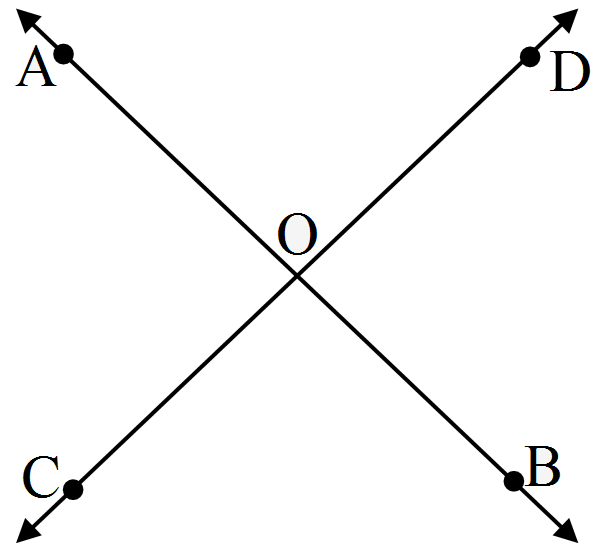
Let two lines AB and CD intersect each other at O.
Now,
We can see from fogure any two adjacent angles
$\angle\text{AOD}$ and $\angle\text{DOB},\angle\text{DOB}$ and $\angle\text{BOC}$ etc are supplementary because their sum is 180°.
$\angle\text{AOD}+\angle\text{DOB}=180^\circ$
$\angle\text{DOB}+\angle\text{BOC}=180^\circ$
So two adjacent angles are always supplementary.
Now,
Two opposite angle like $\angle\text{AOC}$ and $\angle\text{DOB},\angle\text{AOD}$ and $\angle\text{COB}$ are always equal to each other as they are vertically opposite angles
$\angle\text{AOC}=\angle\text{DOB}$
$\angle\text{AOD}=\angle\text{COB}$
Hence statement (ii) and (iii) are correct.
View full question & answer
Question 241 Mark
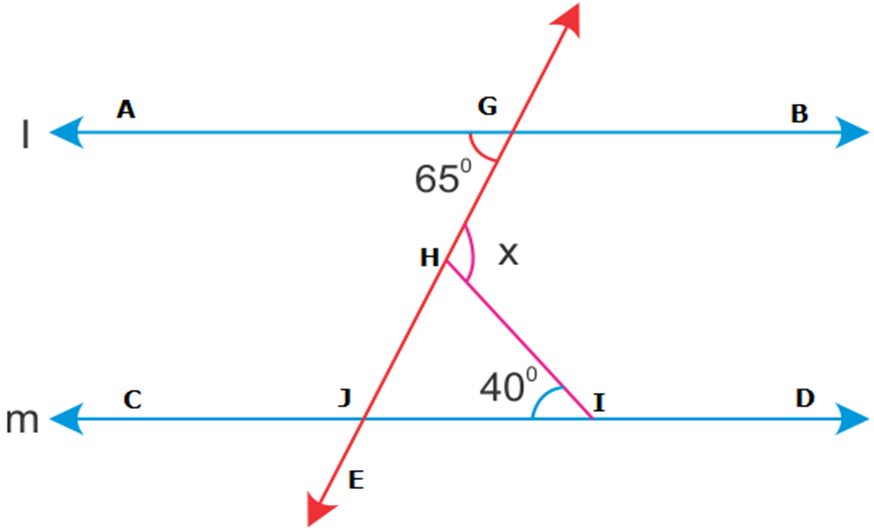
In figure, if l || m, then x =
  1. 105°
  2. 65°
  3. 40°
  4. 25°

 
Answer
  1. 105°
Solution:

From figure,
$\angle\text{AGE}=\angle\text{FGB}$ [Opposite angles]
$\Rightarrow\ \angle\text{FGB}=65^\circ$
Also,
$\angle\text{FGB}=\angle\text{HJI}$ [Corresponding angle]
$\Rightarrow\ \angle\text{HJI}=65^\circ$
Now, in $\angle\text{HJI},$
$\angle\text{HJI}+\angle\text{JIH}+\angle\text{IHJ}=180^\circ$
$\Rightarrow\ 65^\circ+40^\circ+\angle\text{IHJ}=180^\circ$
$\Rightarrow\ \angle\text{IHJ}=180^\circ-65^\circ-40^\circ=75^\circ$
Now,
$\text{x}=180^\circ-\angle\text{IHJ}=180^\circ-75^\circ$
$=105^\circ$
View full question & answer
Question 251 Mark
Two lines AB and CD intersect at O. If $\angle\text{AOC}+\angle\text{COB}+\angle\text{BOD}=270^\circ,$then $\angle\text{AOC}=$
  1. 70°
  2. 80°
  3. 90°
  4. 180°
Answer
  1. 90°
Solution:

$\angle\text{AOC}+\angle\text{COB}+\angle\text{BOD}=270^\circ$ [Given]
From figure,
$\angle\text{AOC}+\angle\text{COB}+\angle\text{BOD}+\angle\text{DOA}=360^\circ$
$\Rightarrow\ 270^\circ+\angle\text{DOA}=360^\circ$
$\Rightarrow\ \angle\text{DOA}=360^\circ-270^\circ=90^\circ$
Now,
$\angle\text{DOA}+\angle\text{AOC}=180^\circ$
$\Rightarrow\ \angle\text{AOC}=180^\circ-90^\circ=90^\circ$
View full question & answer
Question 261 Mark
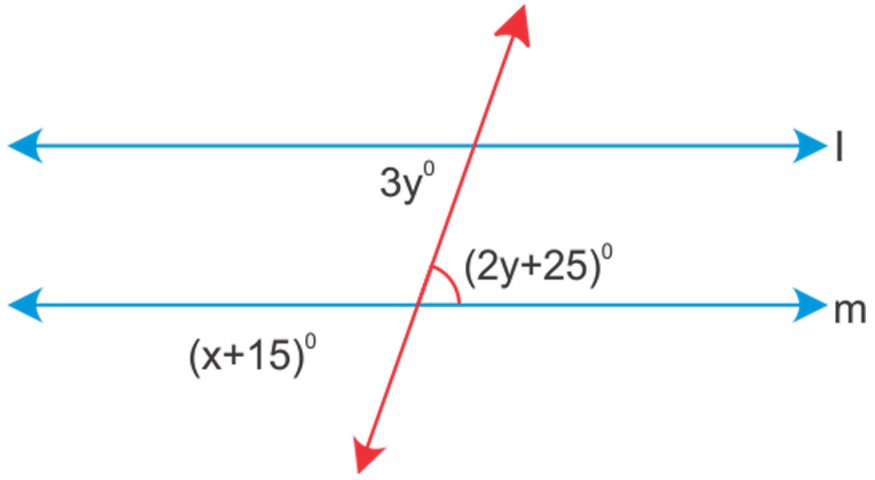
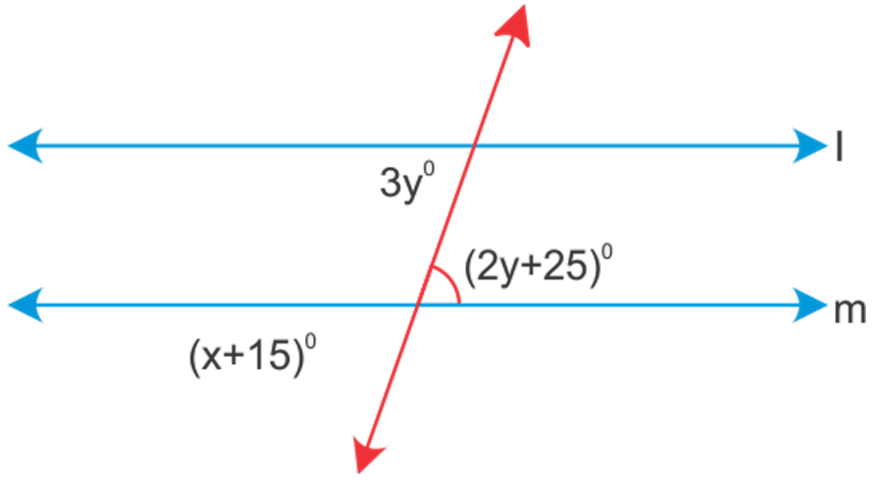
In figure, if l || m, what is the value of x?
  1. 60
  2. 50
  3. 45
  4. 30
Answer
  1. 60
Solution:

3y° = 2y° + 25° [Alternate angles]
⇒ y° = 25°
Now,
x° + 15° = 2y° + 25° [Opposite angles]
⇒ x = 2y° + 25° - 15°
⇒ x = 2y° + 10°
⇒ x = 2 × 25° + 10°
⇒ x = 60°
View full question & answer
M.C.Q - MATHS STD 9 Questions - Vidyadip