Questions · Page 2 of 2

1 Marks Question

Question 511 Mark
Classify the following number as rational or irrational. give reasons to support your answer.
$\sqrt{21}$
Answer
$\sqrt{21}=\sqrt{3}\times\sqrt{7}=4.58257...$
It is an irrational number.
View full question & answer
Question 521 Mark
Find an irrational number between 5 and 6.
Answer
An irrational number between 5 and 6 $=\sqrt{5\times6}=\sqrt{30}$
View full question & answer
Question 531 Mark
Simplify:
$3^\frac{1}{4}\times5^\frac{1}{4}$
Answer
$3^\frac{1}{4}\times5^\frac{1}{4}=(3\times5)^{\frac{1}{4}}=(15)^{\frac{1}{4}}$
View full question & answer
Question 541 Mark
Represent the following rational numbers on the number line:
$1.3$
Answer
$1.3=\frac{13}{10}=1\frac{3}{10}$
View full question & answer
Question 551 Mark
Classify the following number as rational or irrational. give reasons to support your answer.
$\sqrt{\frac{3}{81}}$
Answer
$\sqrt{\frac{3}{81}}$
$\sqrt{\frac{3}{81}}=\sqrt{\frac{1}{27}}=\frac{1}{3}\sqrt{\frac{1}{3}}$
It is an irrational number.
View full question & answer
Question 561 Mark
Simplify:
$\frac{5^{\frac{6}{7}}}{5^{\frac{2}{3}}}$
Answer
$\frac{5^{\frac{6}{7}}}{5^{\frac{2}{3}}}=5^{\big(\frac{6}{7}-\frac{2}{3}\big)}$
$=5^{\big(\frac{18-14}{21}\big)}=5^{\frac{4}{21}}$
View full question & answer
Question 571 Mark
Write the rationalising factor of the denominator in $\frac{1}{\sqrt{2}+\sqrt{3}}.$
Answer
The rationalising factor of the denominator in $\frac{1}{\sqrt{2}+\sqrt{3}}$ is $\big(\sqrt{2}-\sqrt{3}\big).$
View full question & answer
Question 581 Mark
Without actual division, find the following rational numbers are terminating decimals. $\frac{16}{125}$
Answer
$\frac{16}{125}$ Denominator of $\frac{16}{125}$ is $125.$
And,
$125 = 5^3$ Therefore, $125$ has no other factors than $2$ and $5.$
Thus, $\frac{16}{125}$ is a terminating decimal.
View full question & answer
Question 591 Mark
Represent the following rational numbers on the number line:
$-2.4$
Answer
$-2.4=\frac{-24}{10}=\frac{-12}{5}=-2\frac{2}{5}$
View full question & answer
Question 601 Mark
Find two irrational numbers between 0.16 and 0.17.
Answer
Two irrational numbers between 0.16 and 0.17 are as follows: 0.1611161111611111611111... and 0.169669666...
View full question & answer
Question 611 Mark
Classify the following number as rational or irrational. give reasons to support your answer.
2.356565656...
Answer
2.356565656... is a rational number because it is repeating.
View full question & answer
Question 621 Mark
Simplify:
$2^\frac{2}{3}\times2^\frac{1}{3}$
Answer
$2^{\frac{2}{3}}\times2^{\frac{1}{3}}$
$=2^{\frac{2}{3}+\frac{1}{3}}$
$=2^{\frac{3}{3}}$
$=2^1$
$=2$
View full question & answer
Question 631 Mark
Evaluate:
$\big(64\big)^{\frac{1}{6}}$
Answer
$\big(64\big)^{\frac{1}{6}}=(2^6)^{\frac{1}{6}}=2^{\big(6\times\frac{1}{6}\big)}=2^1=2$
View full question & answer
Question 641 Mark
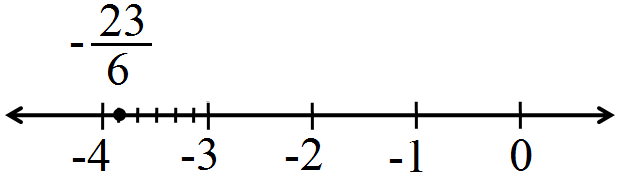
Represent the following rational numbers on the number line:
$-\frac{23}{6}$
Answer
$-\frac{23}{6}=-3\frac{5}{6}$
View full question & answer
Question 651 Mark
Give an example of two irrational numbers whose:
Quotient is a rational number.
Answer
2 irrational numbers with quotient a rational number will be $\sqrt{63}$ and $\sqrt{7}$
View full question & answer
Question 661 Mark
Simplify:
$7^\frac{5}{6}\times7^\frac{2}{3}$
Answer
$\Bigg(7^{\frac{5}{6}}\times7^{\frac{2}{3}}\Bigg)=7^{\big(\frac{5}{6}+\frac{2}{3}\big)}=7^{\big(\frac{5+4}{6}\big)}$
$=7^{\frac{9}{6}}=7^{\frac{3}{2}}$
View full question & answer
Question 671 Mark
Give an example of two irrational numbers whose:
Difference is an irrational number.
Answer
2 irrational numbers with difference an irrational number will be $3-\sqrt{5}$ and $3+\sqrt{5}.$
View full question & answer
Question 681 Mark
Evaluate:
$\big(81\big)^{\frac{3}{4}}$
Answer
$\big(81\big)^{\frac{3}{4}}=(3^4)^{\frac{3}{4}}=3^{\big(4\times\frac{3}{4}\big)}=3^3=27$
View full question & answer
Question 691 Mark
Simplify:
$\frac{6^{\frac{1}{4}}}{6^{\frac{1}{5}}}$
Answer
$\frac{6^{\frac{1}{4}}}{6^{\frac{1}{5}}}=6^{\big(\frac{1}{4}-\frac{1}{5}\big)}$
$=6^{\big(\frac{5-4}{20}\big)}=6^{\frac{1}{20}}$
View full question & answer
Question 701 Mark
Represent the following rational numbers on the number line:
$\frac{8}{3}$
Answer
$\frac{8}{3}=2\frac{2}{3}$
View full question & answer
Question 711 Mark
Evaluate:
$(1^3+2^3+3^3)^{\frac{1}{2}}$
Answer
$(1^3+2^3+3^3)^{\frac{1}{2}}$
$=(1+8+27)^{\frac{1}{2}}$
$=(36)^{\frac{1}{2}}$
$=(6^2)^{\frac{1}{2}}$
$=6$
View full question & answer
1 Marks Question - Page 2 - MATHS STD 9 Questions - Vidyadip